You don't need another pretty cookbook that sits in the kitchen and makes you feel vaguely cultured. You need the best French cook book for your actual life, the one that matches your skill, your dinners, and whether you want the pages to help your French or just decorate a shelf. Pick badly and you'll cook from it twice, then forget it. Pick well and you'll keep reaching for it whenever you want a reliable bistro dinner, a regional dish, or a recipe you can read in French without panic.
Table of Contents
- Why Choosing the Right French Cookbook Feels So Hard
- Define Your Skill Level and Cooking Goals First
- The Four Cookbook Categories Worth Knowing
- Buying Tips That Save You From a Dusty Shelf
- Turn Your Cookbook Into a French Lesson
- A Student Story From the Tutoring Kitchen
- Your Next Step With a Tutor and a Cookbook
Why Choosing the Right French Cookbook Feels So Hard
You're standing in a bookstore aisle, or scrolling late at night, and every spine looks convincing. One book promises the authority of a chef, another has glossy photography, and a third looks like it belongs in a museum rather than beside a saucepan. That's the trap. The book that looks smartest is often the one you'll use least.
The most common mistake is chasing a famous name because it feels safe. A chef can be brilliant and still write a book that's a poor fit for your kitchen. Another mistake is confusing a beautiful object with a working cookbook. A coffee-table title can be inspiring, but if it doesn't teach timing, substitutions, and sequence, it won't help on a Tuesday night.
The third mistake is expecting one French cookbook to do everything. A book that's great for sauce-based classics may be awkward for pastry, and a regional title may be useless if you want simple dinners. That's why the phrase best French cook book only makes sense when you attach it to a real purpose.
Practical rule: buy for the meals you'll actually cook, not for the French image you want on the shelf.
The long view supports that approach. Cuisinière bourgeoise became the most reprinted French cookbook for more than a century, and it's described as the only cookbook written before 1789 that was reprinted after 1800, which shows how strongly one title can shape domestic cooking across a huge historical shift. That kind of staying power matters because it came from usefulness, not just prestige. The right book earns a permanent place because it teaches something you can repeat.
Define Your Skill Level and Cooking Goals First
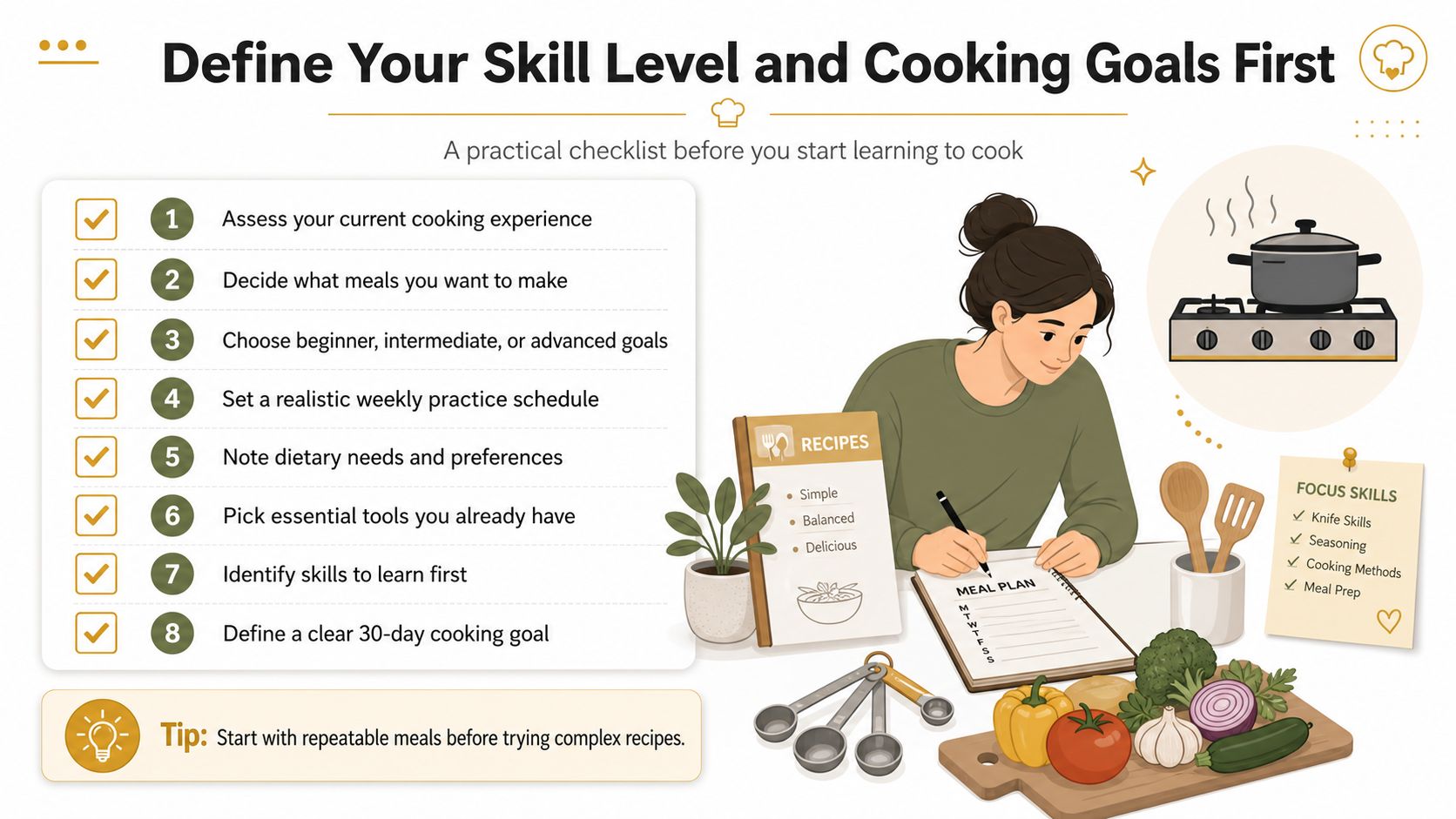
Before you buy anything, ask yourself three blunt questions. How comfortable are you with basic French technique, are you cooking for weeknights or showpiece dinners, and do you want the book to help your French reading as much as your cooking? If you answer clearly, the right shelf starts to sort itself out. If you answer romantically, you'll probably buy the wrong book.
An absolute beginner needs hand-holding, clear steps, and a tone that assumes nothing. That reader should prioritize books with explicit technique, simple ingredient lists, and photos that show each stage. If you're in that camp, a book that reads like a calm teacher is better than one that performs for the camera. If your French is also weak, start with support from a beginner-friendly path like French for beginners, then pair it with a book that uses familiar kitchen vocabulary.
Match the book to the way you cook
An intermediate cook chasing regional authenticity should look for recipes that explain local ingredients and old-school methods without turning every dish into a lecture. That person wants depth, not intimidation. A reference buyer wants repetition, technique, and a book that gets opened for sauces, dough, and timing. A language learner wants recipes that can be read aloud, translated, and reused as vocabulary drills.
Best fit matters more than prestige. A book can be excellent and still be wrong for your current level.
If you want a quick filter, use this: beginners should choose clarity, intermediates should choose range, reference buyers should choose method, and language learners should choose readability. That's how you avoid the classic regret of buying a book that's beautiful but impractical. A good French cookbook doesn't just look credible. It gives you a reason to cook from it again next week.
The Four Cookbook Categories Worth Knowing
French cookbooks split into four useful categories, and each one serves a different buyer. The mistake is treating them as interchangeable. They're not. A home-cooking classic, a chef-driven modern book, a technique reference, and a regional title all solve different problems, so the smartest purchase is the one that matches your kitchen goal.
| French Cookbook Categories at a Glance | Best For | Typical Strength | Skip If |
|---|---|---|---|
| Accessible home-cooking classics | Beginners and confident everyday cooks | Clear French home dishes and repeatable recipes | You want deep technical breakdowns |
| Chef-driven modern bibles | Readers who want a stylish, current shortlist | Prestige, polish, and a strong editorial point of view | You need a gentle teacher |
| Technique and reference works | Self-taught cooks and serious learners | Step-by-step method and reproducible execution | You want quick weeknight inspiration only |
| Regional or specialty cookbooks | Buyers chasing authenticity or specific local dishes | Local identity, seasonality, and regional detail | You want one book to cover all of France |
Accessible home-cooking classics
The iconic English-language example here is Mastering the Art of French Cooking, published in the early 1960s and still widely treated as the gateway French cookbook in the United States. It remains a classic because it teaches readers how to cook French food without making every recipe feel ceremonial. If you want a book that bridges confidence and tradition, this is the lane to watch. It works best for people who want to learn the rhythm of French home cooking, not just collect recipes.
Chef-driven modern bibles
This lane is where curated shortlists matter. Editions Colombe's “Les 7 (vrais) meilleurs livres de cuisine française en 2025” signals the kind of tight, credibility-focused curation buyers want when they're shopping with intent. These books usually look polished, feel current, and make good gifts. They're strong when you care about status and modern presentation, but they can be less forgiving for beginners who need more explanation than atmosphere.
Technique and reference works
For pure usability, the most actionable format is the step-by-step illustrated method. One reference title is described as presenting 300 techniques of French cooking step by step, with each technique illustrated by 2 to 10 realistic photos and a plain-language explanation under each image. That format is hard to beat because it breaks cooking into gestures you can repeat. If you want to understand sauces, knife work, emulsions, and timing, this is the category that teaches instead of merely impressing.
Regional or specialty cookbooks
Regional titles are where many mainstream roundups get lazy. France isn't one cuisine, it's a patchwork of local traditions, so the best book for Breton crêpes is not the best book for Provençal vegetables or Alsatian dishes. If that's your goal, buy regional on purpose. If you just want to cook French food broadly, skip the specialty lane and stay with a more general title.
Buying Tips That Save You From a Dusty Shelf

A cookbook should earn its space in your kitchen. Hardcover looks handsome and lasts well, but paperback is easier to keep by the stove and less irritating when your hands are covered in flour. Spiral-bound books, when publishers bother to make them, are the best choice for active cooking because they stay open without a fight. If a book is beautiful but awkward every time you use it, it will become shelf decoration fast.
Translation and edition year are not cosmetic details
If your French is shaky, translation quality matters. A sloppy translation blurs technique words and makes even a strong book feel vague. If you read in French, the original text is usually the better teacher because you see the vocabulary cooks use. Edition year matters too. A 2024 hardcover like Hachette Pratique's Cuisine française makes sense if you want something current, durable, and presentable rather than a tired classic.
My opinion: check the edition before you check the cover art.
Metric versus imperial feels minor until you are halfway through a recipe. French recipes are written for metric measurements, so a metric-friendly book is usually easier to use and closer to the author's intent. If your kitchen runs on cups and spoons, you need to choose between convenience and fidelity. I would buy the metric version and learn the system instead of converting every weekend.
Retail browsing matters too. Major booksellers keep dedicated French-cuisine shelves, like Cultura's Livres de cuisine francaise section, which is a smarter starting point than generic bestseller lists. A focused shelf lets you compare real differences, not just whatever happens to be trending. If you also want to expand into pairing and regional drink traditions, a French wine guide can help, and this guide to the best French wine books is worth a look alongside your cookbook search.
A quick pre-checkout checklist
- Can I see myself cooking three recipes from it within a month? If not, leave it.
- Does the format work in my kitchen? If it will not stay open, it is a problem.
- Do I need translation or original French? Buy for your real level.
- Does the edition feel current or intentionally classic? Choose on purpose.
- Will the measurement system slow me down? Do not pretend it will not.
If you cannot say yes to most of those, the book is probably a browsing pleasure, not a cooking tool. I would rather see you buy one book you use than five books you admire. That is the shelf test.
Turn Your Cookbook Into a French Lesson
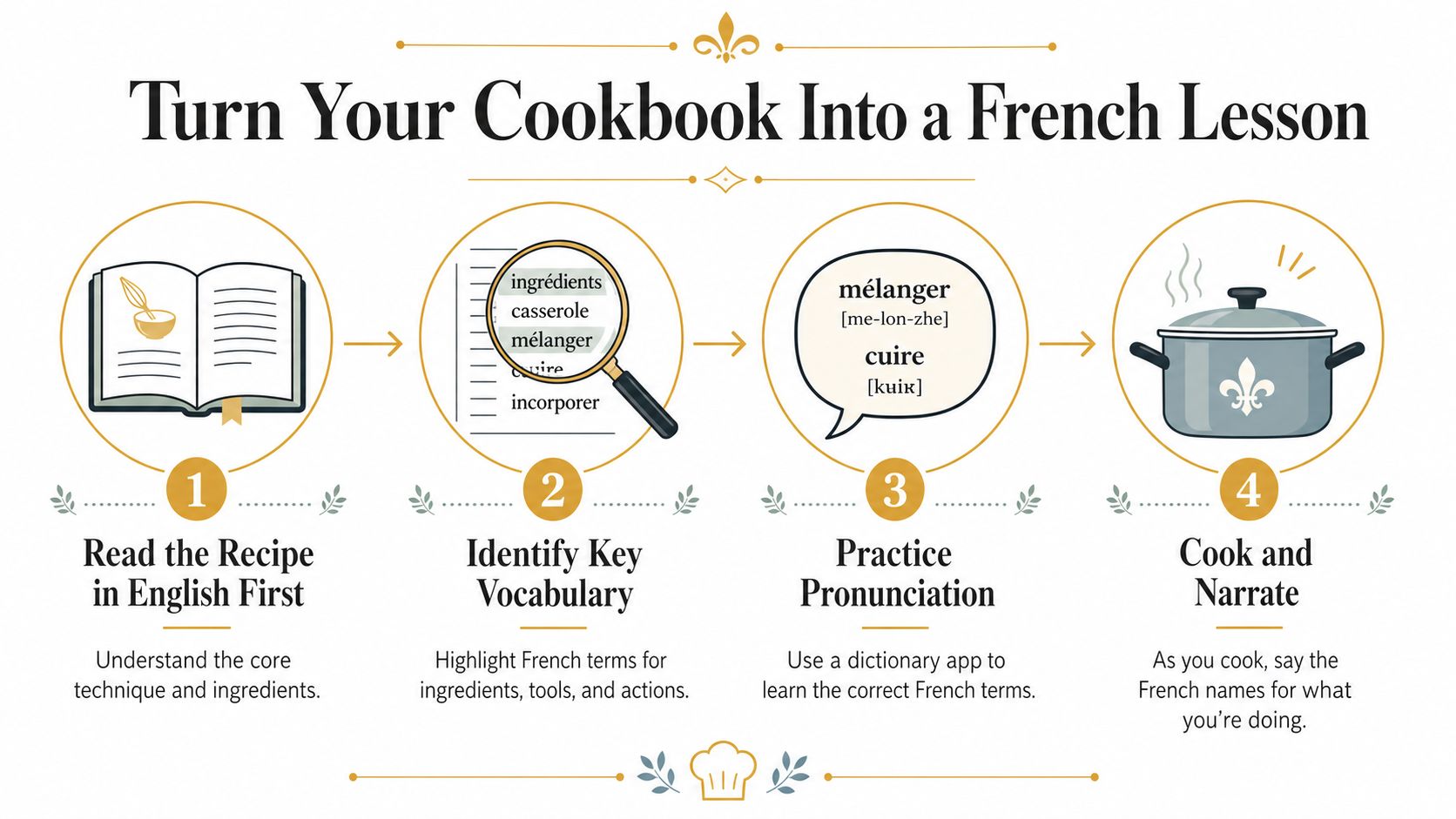
A French cookbook becomes much more valuable when you treat it like language material, not just dinner material. I like the simplest method: pick one recipe a week, skim it in English first if you have the option, then read the French aloud and underline the words that matter. Ingredients, verbs, textures, and timing words should become your vocabulary list. That's how the book starts paying rent in two currencies.
Monday works well for preview. Read the recipe, identify the nouns and action verbs, and write a short glossary by hand. Wednesday is for cooking and listening practice. Say the steps out loud as you work, even if your pronunciation is clumsy. Friday is for recap, which means explaining the recipe back to someone, or even to yourself, in French or a mix of French and English.
The key is repetition without pressure. You don't need to understand every word before you start. If the French is too advanced, use a parallel-translation format or keep a dictionary app open beside the book. The point is to reduce friction, not create a test. A solid companion like 4 activities to boost your French today fits naturally into that rhythm because short, repeatable practice beats heroic one-off study.
Practical method: learn the recipe once with your eyes, once with your hands, and once with your voice.
The benefit is that cookbook language is concrete. You learn verbs that live in the kitchen, not abstract textbook phrases you'll never say. That makes the book doubly useful, because every successful dish also becomes a memory anchor for vocabulary. If you already cook, you already have a study routine. You just need to use it deliberately.
A Student Story From the Tutoring Kitchen
One of our clients arrived with solid grammar but a stubborn speaking pause. She was preparing for a move to Paris, and she could read plenty of French on paper, but restaurant conversation still made her freeze. Between lessons, she started cooking from a regional French cookbook, not for perfection, but to force her mouth and memory to work together. The recipe that made things click for her was a simple roast chicken with thyme, because the vocabulary was practical and the steps were easy to repeat out loud.
She cooked it more than once, and that repetition mattered. The first time, she read every line with a dictionary nearby. The second time, she narrated the process while cooking. By the third round, she could talk through the sequence without notes, which is when the recipe stopped being a homework task and started being a speaking drill. Her tutor then used those same food words in conversation practice, so the kitchen work fed directly into class.
What changed for her
She reported cleaner pronunciation of food vocabulary, faster recall of the conditional tense when discussing substitutions, and less hesitation when ordering in restaurants. None of that came from memorizing a word list. It came from using one book consistently, in a real cooking context, with someone correcting her speech afterward. That's the pattern I trust most.
The strongest cookbook stories I see have this shape. The book gives structure, the cook gives repetition, and the tutor turns both into speech. That's why a cookbook can be more than a recipe source. It can become a speaking bridge.
Your Next Step With a Tutor and a Cookbook
You've already made the three decisions that matter. You know your profile, you know which category fits, and you know what buying filters will save you from regret. Don't stop there. The best French cookbook works hardest when it's tied to real conversation, corrections, and a plan that fits your level.
If you want help matching a book to your goals, a tutor can do that faster than guessing in a bookstore aisle. A focused conversation can save you from buying the wrong title, and it can also turn the right one into a practical study tool. If that's where you are, read more about whether a French tutor is worth the investment and then book a free 20-minute consultation with Elite French Tutoring so we can recommend the right cookbook and shape it into a lesson plan that helps you cook and speak with confidence.