Skip to content

You're qualified, your first interview went well, and then the hiring manager switches to French for round two. You can order lunch and chat about your weekend, but you can't explain a delayed project, calm an unhappy client, or defend a budget line. That's the moment candidates lose jobs that require French, and I've watched it happen too often.
The good news is that this gap is fixable once you know what an employer will test. Conversational French isn't the same as professional French for meetings, briefings, or sensitive conversations. That's why universities have started treating it as a career skill, not just an academic subject. A French advocacy report for the United States found that 58.7% of U.S. colleges and universities offered at least one course in French for professional purposes in 2019 to 2020.
We built this list differently from a generic careers roundup. For each role, I'll tell you the level employers test, the genuine entry path, and the preparation that matters. Some paths suit a strong B2 speaker with a trade skill. Others demand near-native command and years of specialist training. Be honest about your current level and timeline.
Pick one or two roles that fit your background, not ten that sound glamorous. French pays best when it's paired with law, healthcare, sales, teaching, or policy expertise. Start with the job, then train the French that job requires.
Table of Contents
- 1. UN Conference Interpreter
- 2. U.S. Foreign Service Officer (Diplomat)
- 3. Court Interpreter (French)
- 4. Bilingual or French Immersion Teacher (K–12)
- 5. Professional Translator and Localization Specialist
- 6. Medical Interpreter (English–French)
- 7. Luxury Hospitality or Retail Manager (French-Speaking Markets)
- 8. International Business Development or Export Manager
- 9. International Development or NGO Program Officer
- 10. Canadian Federal Public Service Bilingual Officer
- How the 10 French-Required Jobs Compare on Entry Requirements, Required French Level, and Work Setting
- Choosing the Right French Path for Your Next Role
1. UN Conference Interpreter
If you're already close to native in French and English, the United Nations is one of the few employers that pays you to interpret all day. You'll work simultaneously in General Assembly, Security Council, and agency meetings, rendering speeches as they're delivered. One hesitation or wrong term and delegates hear it instantly.
Entry is through UN competitive examinations, which test a different skill set than fluency alone. Examiners look for near-native command of both languages, deep knowledge of UN subject matter, and the stamina to perform in real time under pressure. I recommend this path only if you're ready for years of intensive, specialist training. A strong conversational level won't get you near the booth.
A typical week could mean staff interpreting in the Security Council chamber, or freelance assignments at a UN conference in Geneva on climate or trade. The range is wide, so build vocabulary by topic rather than relying on general fluency.
Watch how simultaneous interpreters handle speed and turn-taking before you commit.
How I'd prepare you
- Shadow daily: Repeat French speeches seconds behind the speaker to build speed and split attention.
- Do sight translation: Turn written UN documents into spoken English, and reverse it, against the clock.
- Build a specialty: Master human rights, climate, or trade terminology in both languages before exam preparation.
Machine translation keeps improving, but real-time interpretation under diplomatic stakes still demands human judgment and split-second precision. That makes this the hardest bar on this list, and the most rewarding if you clear it.
2. U.S. Foreign Service Officer (Diplomat)
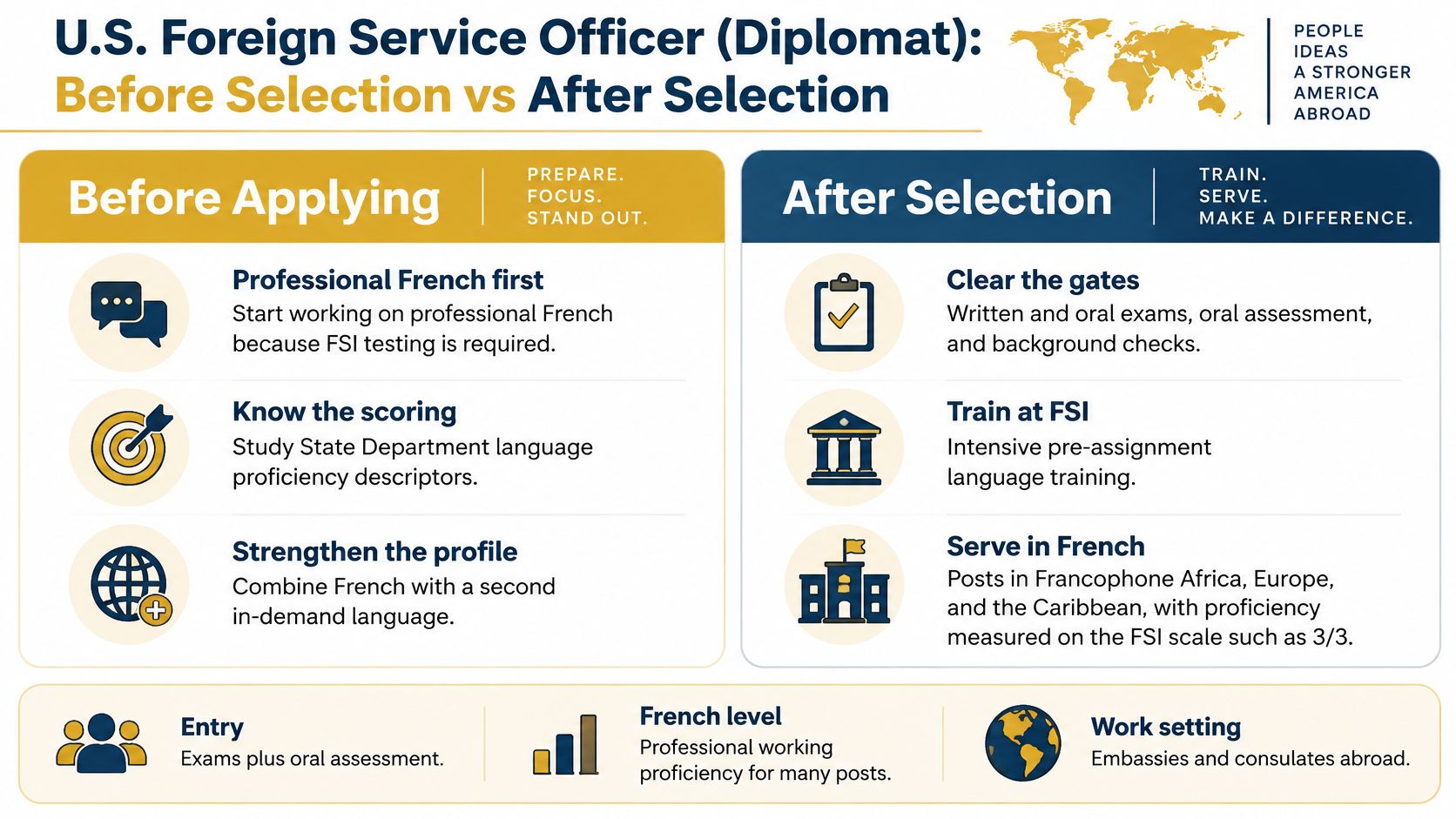
Many diplomatic posts require French, and one missed language score can stall your assignment and your promotion. As a Foreign Service Officer, you'll represent the United States at embassies and consulates, often in Francophone West Africa or other French-speaking posts. The Department of State assigns you based partly on tested language ability.
You'll face a rigorous selection process first, then language training before posting. The Foreign Service Institute (FSI) assesses your speaking and reading against defined proficiency descriptors. Don't wait until you're hired to start. Candidates who arrive with professional French test better and get more choice in assignments.
Picture a consular officer interviewing visa applicants in Dakar in the morning, then a political officer briefing French-speaking journalists in the afternoon. Both need formal register, political vocabulary, and cultural judgment, not textbook small talk.
This career path shows where French proficiency fits into each stage.
Your preparation plan
Start with spoken tasks FSI style, narrating past work and defending a policy position. Add current affairs vocabulary from French news every week. If you're serious, study our approach to French for diplomats and mirror that structure in your practice, timed answers, formal presentations, and press language.
Don't study French in general for this career. Study the briefing, the interview, and the negotiation you'll be scored on.
A second in-demand language strengthens your profile later, but get French to professional working level first.
3. Court Interpreter (French)
When a French speaker in court misunderstands one term, a plea, a testimony, or an outcome can change. Court interpreters make sure defendants, witnesses, and litigants follow everything accurately. You don't summarize here. You render exactly what's said, in the right register, without adding your opinion.
In New York, you must meet the Unified Court System's qualification requirements. Check the current certification rules before you apply, because conversational bilingualism won't pass. Employers in the wider interpreting field typically expect a bachelor's degree and fluency in English plus at least one additional language, according to the U.S. Bureau of Labor Statistics guide to interpreters and translators, which put the occupation at approximately 73,900 jobs in 2025.
Your work might place you beside a French-speaking defendant in criminal court one day, then in a deposition for an international commercial dispute the next. Both settings punish vague vocabulary.
Build court-ready precision
- Study legal glossaries: Learn charges, motions, and procedural terms in French and English as paired sets.
- Practice consecutive interpreting: Render short legal passages from memory, then check every missed term.
- Review terminology training: Use resources like our guide to French legal terminology to structure your vocabulary work.
This role suits calm, precise bilinguals who like rules. If you paraphrase under pressure, train that habit out before you test.
4. Bilingual or French Immersion Teacher (K–12)
Ask a principal outside a major city to find a qualified French immersion teacher and you'll hear the same frustration. Candidates are scarce. You'll teach core subjects in French or teach French as a world language in public immersion programs, private schools, and French-bilingual schools such as Lycée Français and UNIS.
Certification rules vary by state and by school, so confirm your state's world language or bilingual endorsement early. A French-national-curriculum school expects different credentials from a U.S. public immersion program. Your French must cover academic vocabulary for math, science, and classroom management, not just conversation.
Teaching is also where language graduates tend to land. The BLS field of degree data for foreign language graduates showed that in 2024, people with foreign-language degrees worked in educational instruction and library occupations at a 20% share.
A strong day in immersion elementary looks like this, reading, questioning, and correcting in French without switching to English.

Get classroom ready
Prepare for DELF or DALF certification if your school values an external proof of level. Practice giving instructions, parent updates, and feedback in French. If you can chat but can't explain fractions in French, that's your study list.
5. Professional Translator and Localization Specialist
A French campaign that's slightly off doesn't just sound awkward. It makes customers distrust the brand. Translators and localization specialists adapt websites, contracts, medical documents, and marketing so they read naturally for French-speaking audiences. Many work remotely, but remote doesn't mean easy to enter.
Specialization is how you get hired and paid properly. Pick legal, medical, financial, or marketing translation, build a portfolio in that niche, and pursue recognized certification such as credentials from the American Translators Association (ATA). Generalist translators compete with software. Specialists sell judgment.
The scale and spread of the work support that advice. The BLS May 2022 occupational estimates for interpreters and translators counted 52,160 jobs nationally, with professional, scientific, and technical services employing 18,910 people in the occupation.
Say a U.S. software firm launches in Quebec and France at once. You'll localize the interface, help pages, and contracts, and you'll flag terms that work in Paris but sound wrong in Montreal.
Your entry plan
- Learn one CAT tool: Clients expect translation memory and consistent terminology from day one.
- Build paired samples: Show source and translation side by side for your specialty, with brief notes on choices.
- Translate into your strongest language: Accuracy drops fast when you work the other way.
If you love writing and hate live pressure, choose this over interpreting.
6. Medical Interpreter (English–French)
A wrong dosage rendered in clean French is still wrong. Medical interpreters carry a three-way conversation among patient, provider, and family during intake, consent, emergencies, and discharge planning. The tested level is professional: accurate in both directions, neutral under pressure, and fast enough that no one waits while you search for a term.
Hospitals and clinics need qualified language support, so demand stays steady where francophone patients seek care. French by itself is not the credential. The entry path is strong French plus healthcare-specific training or certification, then supervised practice before you accept high-risk assignments.

Prepare for clinical accuracy
Build a symptom-to-procedure glossary in English and French, then drill it until dosage, allergies, contraindications, and warning signs come out automatically. Role-play intake, consent, and discharge calls at real speed. Our French for medical professionals page shows the scenario-based practice to copy, and you should research national medical interpreter certification before applying.
If a term fails once, mark it, relearn it, and test it again the next day. That loop is the job.
Practical rule: If you can't interpret dosage, allergies, and warning signs without pausing, you're not ready for patient work yet.
7. Luxury Hospitality or Retail Manager (French-Speaking Markets)
A luxury client who hears a warm, fluent welcome in French relaxes and spends differently. That's not fluff, it's revenue. Luxury hotels, boutiques, and fashion houses prefer managers who can serve French-speaking clients directly, handle complaints gracefully, and represent the brand at events without an interpreter.
French luxury groups including LVMH and Kering operate across markets and need French-capable managers for client relations and regional leadership. You might run a concierge team serving French-speaking travelers in New York, or manage a French fashion house flagship where headquarters calls are held in French.
Be realistic about geography. An OECD analysis of online vacancies across the EU27 and United Kingdom12/en/pdf) found French explicitly or implicitly requested in roughly 1% to 2% of all postings. In luxury niches, though, that small share is exactly where French separates finalists.
What employers actually test
They'll test a welcome, a product explanation, and a difficult-client conversation, often in the interview itself. Aim for DELF B2 as proof of professional level, then add hospitality vocabulary for bookings, complaints, and upselling.
Put client results on your résumé, not just language claims. Write that you retained French-speaking VIP clients or led French-language events, with outcomes attached. In this sector, French plus proven service revenue beats French plus a certificate every time.
8. International Business Development or Export Manager
Losing a deal in Montreal, Dakar, or Brussels often comes down to one thing. The other candidate could negotiate in French and you couldn't. Export and business development managers open Francophone markets across Canada, parts of Europe, and much of West and Central Africa, and they build the relationships that contracts depend on.
Employers in trade, logistics, finance, and consulting want French for negotiation, contract review, and relationship building. You don't need interpreter-level French here. You need confident professional French for presentations, calls, emails, and dinners where trust gets built.
Say you're an account manager negotiating distribution with a Quebec partner. You'll present pricing in French, answer objections live, then confirm terms in a clear French email that same day. If any of those three steps breaks, the deal slows down.
This is the cross-border planning work your French has to support.

Train for the deal cycle
- Learn negotiation language: Practice concessions, deadlines, and polite disagreement without sounding blunt.
- Study target-market norms: Quebec, Senegal, and Belgium don't do business the same way.
- Rehearse presentations: Record a ten-minute client pitch in French and fix the weak sections weekly.
Pair French with sales results or logistics expertise. That's the combination hiring managers pay for.
9. International Development or NGO Program Officer
Pick this path if you want French to decide real outcomes, not decorate a resume. Program officers at NGOs and development agencies run work across Francophone Africa, Haiti, and other French-speaking regions, talking straight to governments, communities, and partners. When a report goes out only in English and local partners can't follow it, the project stalls and the community waits.
Employers test for professional working French, the level where you brief a ministry contact, chair a partner meeting, and field questions without reaching for English. The demand is real: Hendrix College's summary of French in the U.S. job market counted roughly 22,300 U.S. vacancies seeking French-English bilingual candidates in 2015.
A typical week mixes languages. You write the donor report in English, then run the partner meeting in French. On an education project in Haiti, field visits happen entirely in French, with no translator between you and the people you serve.
Build field-ready French
Train proposal and report writing, budgets, and the grant vocabulary major donors use, then get field experience through volunteering or an internship so your French gets tested with real partners. Field time plus donor-ready writing moves an application from promising to hired, and preparing to communicate with Francophone communities on an NGO assignment shows what that preparation looks like up close.
Field test: Can you explain a delayed delivery to a local partner in French, calmly and clearly? That's the interview in miniature.
Mission passion opens the door. Accurate written French closes the hire.
10. Canadian Federal Public Service Bilingual Officer
If you want the clearest line from French study to a job offer, look at Canada's federal public service. Many posts in Ottawa and across Canada list French as essential, and candidates below the stated level get screened out before anyone reads their experience. There's no charming your way past a language profile.
Under the Official Languages Act, federal institutions must serve the public in English and French. That creates bilingual roles in policy, communications, and client services. A research article on French and employment mobility describes unusually broad employment relevance for French in Canada because official bilingualism creates demand across federal government and federally regulated sectors.
A communications officer might draft bilingual public messaging in the morning, while a policy analyst writes briefings in both languages for the afternoon. Both are assessed against defined second-language levels for reading, writing, and oral interaction.
Match the posted profile
- Read each posting closely: Note the exact level required for each skill and train to that profile.
- Practice formal writing: Briefings and reports need precise, neutral French, not conversational style.
- Run mock oral assessments: Timed answers on work scenarios expose gaps regular conversation hides.
Check your work authorization and credential recognition early too. Language qualifies you, but eligibility lets you start.
How the 10 French-Required Jobs Compare on Entry Requirements, Required French Level, and Work Setting
| Item | Typical Entry Requirement | French Level Needed | Work Setting |
|---|---|---|---|
| UN Conference Interpreter | Competitive UN exam and interpreting qualification | Near-native, bidirectional | Conference halls and international organizations |
| U.S. Foreign Service Officer (Diplomat) | Written and oral exams, oral assessment, and background checks | Professional working proficiency for many posts | Embassies and consulates abroad |
| Court Interpreter (French) | Court qualification exams or certification | Advanced, including legal terminology | Courts, law firms, and depositions |
| Bilingual or French Immersion Teacher (K–12) | Teaching license or endorsement; sometimes DELF/DALF | Advanced to near-native, including academic French | Public and private schools, bilingual campuses |
| Professional Translator and Localization Specialist | Degree or proven experience; ATA certification recommended | Near-native written French and English | Remote work, agencies, and in-house teams |
| Medical Interpreter (English–French) | Training program and national certification | Advanced, including medical terminology | Hospitals, clinics, and telehealth platforms |
| Luxury Hospitality or Retail Manager (French-Speaking Markets) | Hospitality or retail experience, plus French | Conversational to professional, depending on role | Luxury hotels, flagship stores, and resorts |
| International Business Development or Export Manager | Business degree or sales experience, plus French | Professional, for negotiation and written contracts | Corporate offices and travel to partner markets |
| International Development or NGO Program Officer | Relevant degree and field experience | Professional, for reports and partner work | NGO offices and field locations |
| Canadian Federal Public Service Bilingual Officer | Public service competition and language assessment | Defined second-language levels by position | Federal offices in Ottawa and regional centers |
Choosing the Right French Path for Your Next Role
Ten options is nine too many. Pick the role your current French can reach, then train for the tasks that role will test.
If you're at B1 to B2 today and need work within a year, start with luxury hospitality or retail management aimed at French-speaking markets. Employers there test conversational to professional French, which is a realistic jump in twelve months of focused lessons built around client conversations and presentations. Business development support roles become reachable once your French turns professional, so treat them as the second step, not the first. Immersion teaching asks for advanced to near-native French plus a state license, so it belongs on a longer timeline.
If you're at B2 to C1 with a specialty, aim higher. Medical interpreting, court interpreting, NGO program work, and Canadian federal roles all reward French paired with credentials you already hold or can finish soon. Translation and localization suit strong writers willing to specialize. UN interpreting and the Foreign Service are longer games, and you should enter them with eyes open about examinations, postings, and years of preparation.
Here's how I'd sequence your decision. Pick one target role, write down the exact tasks it requires in French, then test yourself on those tasks this week. Can you draft the email, run the meeting, interpret the discharge instructions, or present the briefing? Your honest answer becomes your study plan. Generic vocabulary lists won't close a specific gap.
What focused preparation can do
We see this shift when learners stop studying French in general. David, a marketing professional preparing to relocate to Paris for work, became fluent in French in 90 days after starting an intensive French course. His timeline was aggressive and his goal was specific: work in Paris, in marketing, in French. That clarity shaped every session.
Your goal should shape yours the same way. A future medical interpreter needs clinical role-play. A future export manager needs negotiation practice and French presentations. A future Canadian public servant needs formal writing and mock oral assessments. Same language, completely different training.
At Elite French Tutoring, we offer private in-person and online lessons with native French-speaking teachers, and our professional courses are built for people pursuing opportunities in the business and corporate worlds. We've helped thousands of clients since 2012, and we speak French exclusively during private lessons, with slight exceptions for beginners, so your working French gets built through use.
Your current French, your specialty, and your deadline decide which of these ten paths is realistic and which one would waste a year. Get assessed against the role you want, then train only what that role will test.
Book your free 20-minute consultation with Elite French Tutoring today, tell us the role you're targeting, and we'll assess your level, map the gap, and build a customized program to get you interview ready.