

You've probably had this moment already. You open a DELF A2 sample paper, look at the listening, the reading, the writing, the oral, and think: I can do some of this, but I'm not sure I can pass all of it on the same day.
That feeling is normal. Most students don't fail because they're lazy or incapable. They fail because their prep is scattered. They spend too long reviewing grammar they already half-know, not enough time producing real answers, and almost no time training the exact moments that create panic in the oral.
I've seen this pattern again and again with DELF A2 exam preparation. A learner studies alone for months, knows plenty of vocabulary, can read short texts fairly well, then freezes when asked to speak spontaneously or organize a short written response under pressure. The fix usually isn't “study more.” It's “study in the right order, with the right feedback.”
That's why a generic checklist rarely works. If you're doing everything from the same textbook in the same way, you're treating all four skills as if they have the same problem. They don't. Listening usually needs repeated exposure and better note-taking habits. Writing needs structure. Speaking needs live reaction speed. If you're still building your solo routine, this guide on how to learn French on your own is a useful companion to the plan below.
Table of Contents
- Feeling Stuck in Your DELF A2 Prep? You're Not Alone
- Decoding the DELF A2 Exam Format and Scoring
- Your Personalized 12-Week DELF A2 Study Roadmap
- Targeted Practice to Master Each Exam Skill
- When Self-Study Isn't Enough a Tutor Is Your Best Bet
- Your Next Step to Passing the DELF A2 with Confidence
Feeling Stuck in Your DELF A2 Prep? You're Not Alone
One of my students came to me after weeks of “serious” self-study. She had flashcards, grammar notes, a notebook full of useful expressions, and a growing sense that none of it was coming together. She could read simple prompts. She could even write decent sentences when she had time. But when she tried a speaking task, she shut down after the first question.
That's more common than most learners think.
The problem usually isn't motivation. It's that DELF A2 exam preparation feels deceptively simple from the outside. A2 is an elementary level, so people assume the exam will be forgiving. In reality, it rewards balanced performance, quick comprehension, and practical communication. If your prep leans too heavily toward one comfort zone, the exam exposes the gap fast.
What stuck learners usually get wrong
I don't say this to discourage anyone. I say it because once you see the pattern, you can fix it.
- They overinvest in grammar review. Useful, yes. Sufficient, no.
- They avoid timed practice. Then the exam feels harsher than their study routine.
- They delay speaking. That almost always backfires.
- They confuse familiarity with readiness. Recognizing a format isn't the same as producing under pressure.
Practical rule: If your prep never makes you slightly uncomfortable, it probably isn't close enough to the real exam.
What works better is a custom plan built around your weak points. A strong reader needs a different weekly structure than a student who already speaks comfortably but writes in short, error-heavy sentences. Good prep is diagnostic first, efficient second.
I've guided many students through that turning point. Once they stop asking, “What should I study next?” and start asking, “What specific exam problem am I solving this week?” their progress becomes much more consistent. Confidence usually follows after that, not before.
Decoding the DELF A2 Exam Format and Scoring
Many candidates prepare as if DELF A2 were one general French test. It isn't. It's four separate performances, each with its own pressure point, and the exam only feels manageable when you understand how the pieces fit together.
A useful starting point is understanding where A2 sits within the broader French CEFR levels framework. Candidates at this level aren't expected to sound advanced. They are expected to handle familiar, everyday tasks clearly enough and consistently enough under exam conditions.
What the exam is really testing
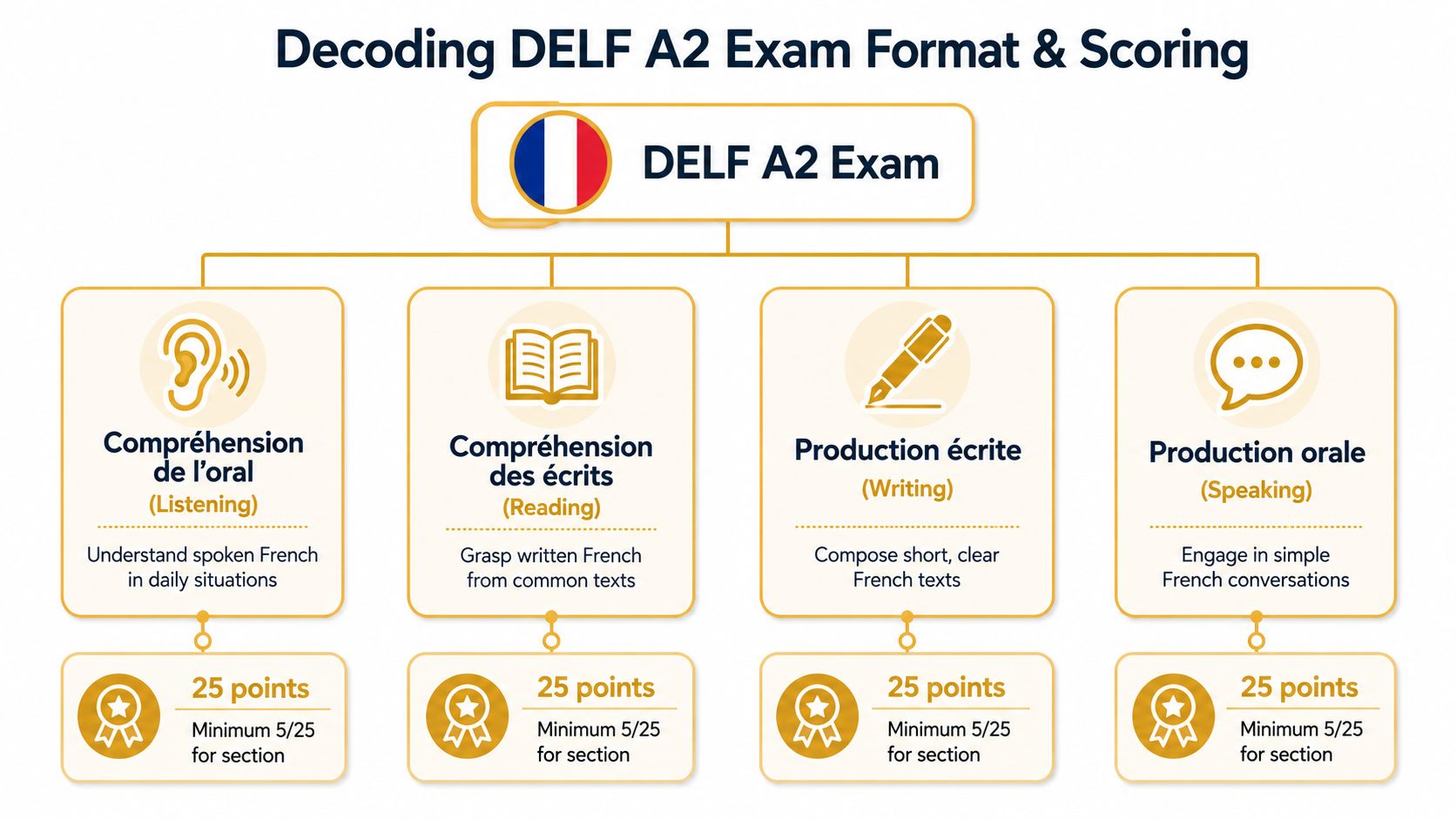
The DELF A2 exam is divided into four equally weighted skills worth 25 points each, for a total of 100 points. To pass, you need at least 50/100 overall and at least 5/25 in every skill, as outlined in this practical DELF A1 and A2 exam guide.
That single rule changes how I coach students.
You cannot compensate for a weak oral by crushing the reading. You cannot ignore writing because you “just need to pass.” The exam requires balanced competence. A candidate with one serious blind spot is at risk, even with a respectable total score.
The timing matters too. That same guide notes a tightly defined structure of roughly 25 minutes for listening, 30 minutes for reading, 45 minutes for writing, and 6 to 8 minutes of speaking, plus about 10 minutes of preparation for the oral exam.
Why the scoring changes your strategy
Here's the practical consequence. Your prep plan should not look like a normal language course.
A normal course often rewards your strengths. DELF rewards coverage.
- Listening punishes drifting attention.
- Reading punishes slow processing.
- Writing punishes weak structure.
- Speaking punishes hesitation and loss of interaction.
Strong DELF A2 candidates don't aim to be impressive. They aim to be reliable in all four skills.
That's also why I tell students to stop saying, “I'm bad at speaking” or “I'm a writing person.” Those labels aren't useful once the scoring starts. A better question is: where am I most likely to fall below the minimum requirement?
When you know that, your study decisions become easier. You stop wasting hours on low-impact review and start training for the actual pass condition.
Your Personalized 12-Week DELF A2 Study Roadmap
A fixed calendar helps, but a rigid one doesn't. The best DELF A2 exam preparation plans have structure without pretending every learner starts from the same place.
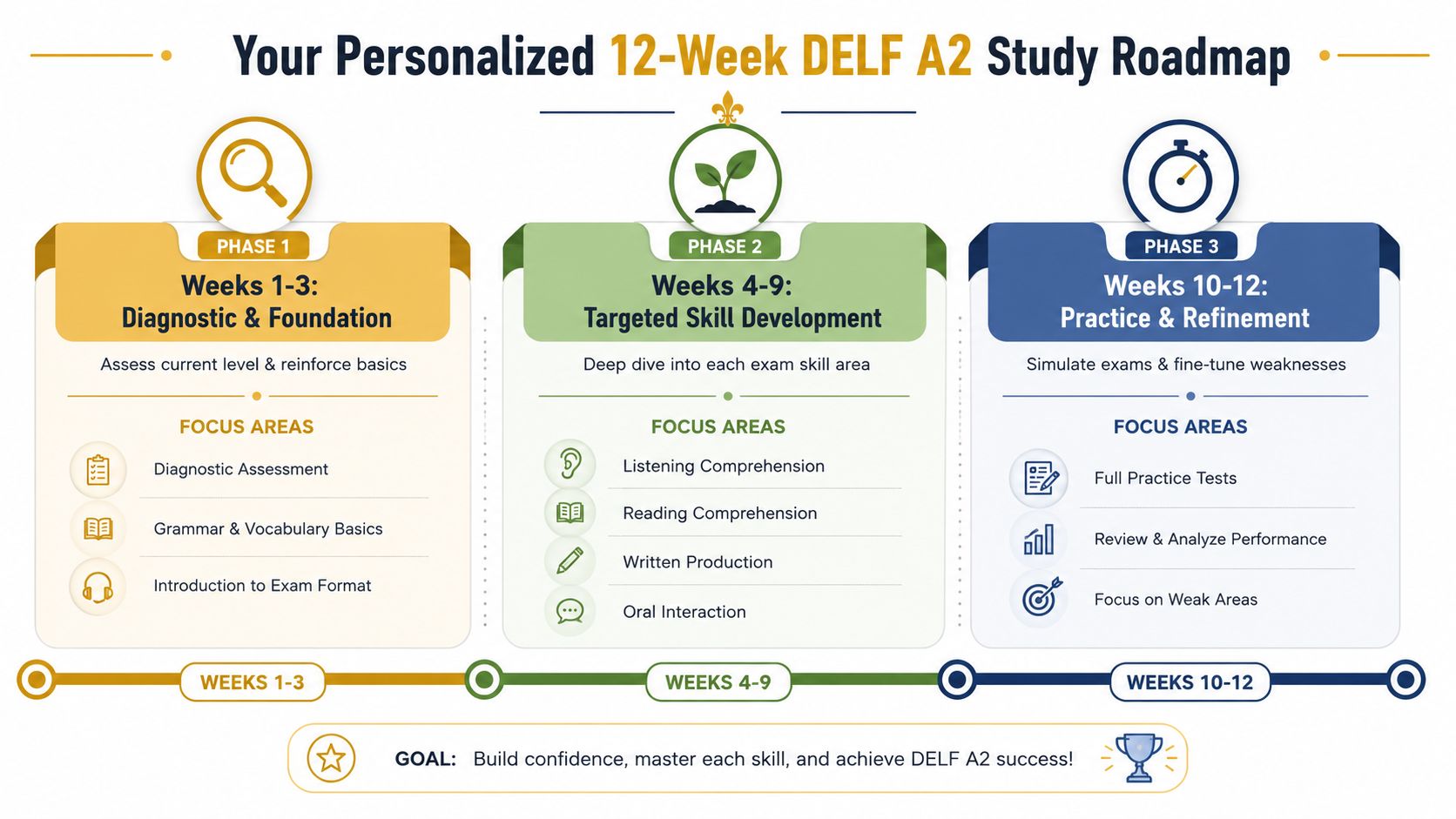
One reason a 12-week window works so well is that exam-focused programs often recommend an 8 to 12 week intensive phase before the test, with all four skills trained through timed practice. Reaching A2 commonly takes about 180 to 200 total study hours, and one source estimates about 100 to 120 additional hours beyond A1 for the A2 step, as described in this DELF exam preparation overview.
If you want a broader framework for organizing those weeks, a structured French study plan can help you map your time more realistically.
Start with a self-diagnostic
Before week one, do a simple audit. Not a perfect audit. A useful one.
Take one sample task from each skill and rate yourself with brutal honesty:
- Listening: Did you catch the main idea, or just isolated words?
- Reading: Could you identify purpose, detail, and tone quickly?
- Writing: Can you produce a short message with clear structure?
- Speaking: Can you answer, expand, and recover when you get stuck?
I usually tell students to classify each skill into one of three categories:
| Category | What it means | What to do |
|---|---|---|
| Stable | You can complete the task with only minor problems | Maintain it weekly |
| Fragile | You can do it, but errors or hesitation break your flow | Prioritize it twice a week |
| Critical | This skill could block your pass if it collapses on exam day | Train it almost daily |
That simple diagnosis is what turns a generic plan into your plan.
Weeks 1 to 4 build the base you actually need
These weeks are for cleaning up gaps, not collecting endless resources.
Focus on short, repeatable tasks. One listening clip. One reading text. One writing prompt. One speaking recording. Don't chase variety too early. Repetition gives you patterns, and patterns create speed.
A good foundation phase often includes:
- Short listening loops. Replay brief audio and note keywords, then check meaning.
- Reading for gist first. Train yourself to identify topic and purpose before details.
- Writing with templates. Invitations, apologies, simple requests, brief descriptions.
- Daily spoken output. Even a short self-recording helps.
Maria, one of my adult students, is a good example. She was already near the level in reading and listening, but speaking made her panic. We didn't overhaul everything. We kept her strong skills steady and added a short daily oral drill built around predictable A2 topics like routine, family, plans, and simple opinions. Within a few weeks, she stopped trying to produce perfect French and started producing usable French. That was the turning point that got her through the exam.
Here's a practical rhythm for this phase:
- Keep one primary resource. Too many platforms create friction.
- Use one correction notebook. Record recurring mistakes, not every mistake.
- Repeat old prompts. Improvement is easier to measure on familiar tasks.
Weeks 5 to 8 turn passive French into usable French
This is the middle stretch where many self-studiers lose momentum. They feel busier, but not sharper.
That usually happens because they continue consuming French instead of producing exam answers.
At this stage, every week should include more output than before. Write responses under time pressure. Record your speaking answers and listen back. Read prompts carefully and decide what the task wants before you answer it.
The best middle-phase prep feels slightly repetitive. That's a good sign. Exam performance grows from controlled repetition, not endless novelty.
A useful split here is to pair one receptive skill with one productive skill in the same session. For example:
- listening plus speaking
- reading plus writing
That pairing helps because the exam itself rewards transfer. If you read a practical message well, you're more likely to write one coherently. If you hear everyday phrases often, they surface more easily in the oral.
A video walkthrough can also help you visualize what a smart practice rhythm looks like before you adjust it to your own level.
Weeks 9 to 12 rehearse the exam, not just the language
The final phase is where weak plans fall apart or strong plans become decisive.
Now the question isn't “Do I know enough French?” It's “Can I deliver under DELF conditions?” That means timed sections, quick transitions, and repeated rehearsal of your weakest format.
I usually have students tighten their final phase around three habits:
Timed mini-mocks
Don't wait for a full mock exam every time. A short, timed writing task or oral simulation is often more useful.Error targeting
Stop reviewing broad grammar chapters. Focus on the errors you make yourself in your own work.Recovery training
Practice what to do when you blank, mishear, or lose a word. Recovery is part of performance.
By this point, your plan should feel narrower, not wider. Fewer resources. More precision. More exam realism. That's when a 12-week roadmap becomes more than a schedule. It becomes a filter that keeps your effort pointed at the score you need.
Targeted Practice to Master Each Exam Skill
DELF A2 rewards practical communication. It's also a lifelong credential, and the diploma is widely treated as proof that you can handle basic everyday situations such as simple forms, short emails, and familiar topics, as explained in this overview of the DELF A2 diploma. That's why the smartest prep looks ordinary on the surface. Everyday tasks. Short messages. Familiar audio. Real exchange.
If speaking is your weak point, regular French conversation practice usually gives a better return than more passive review.
Listening and reading need efficient habits
Listening and reading are where independent learners can make excellent progress, but only if they practice actively.
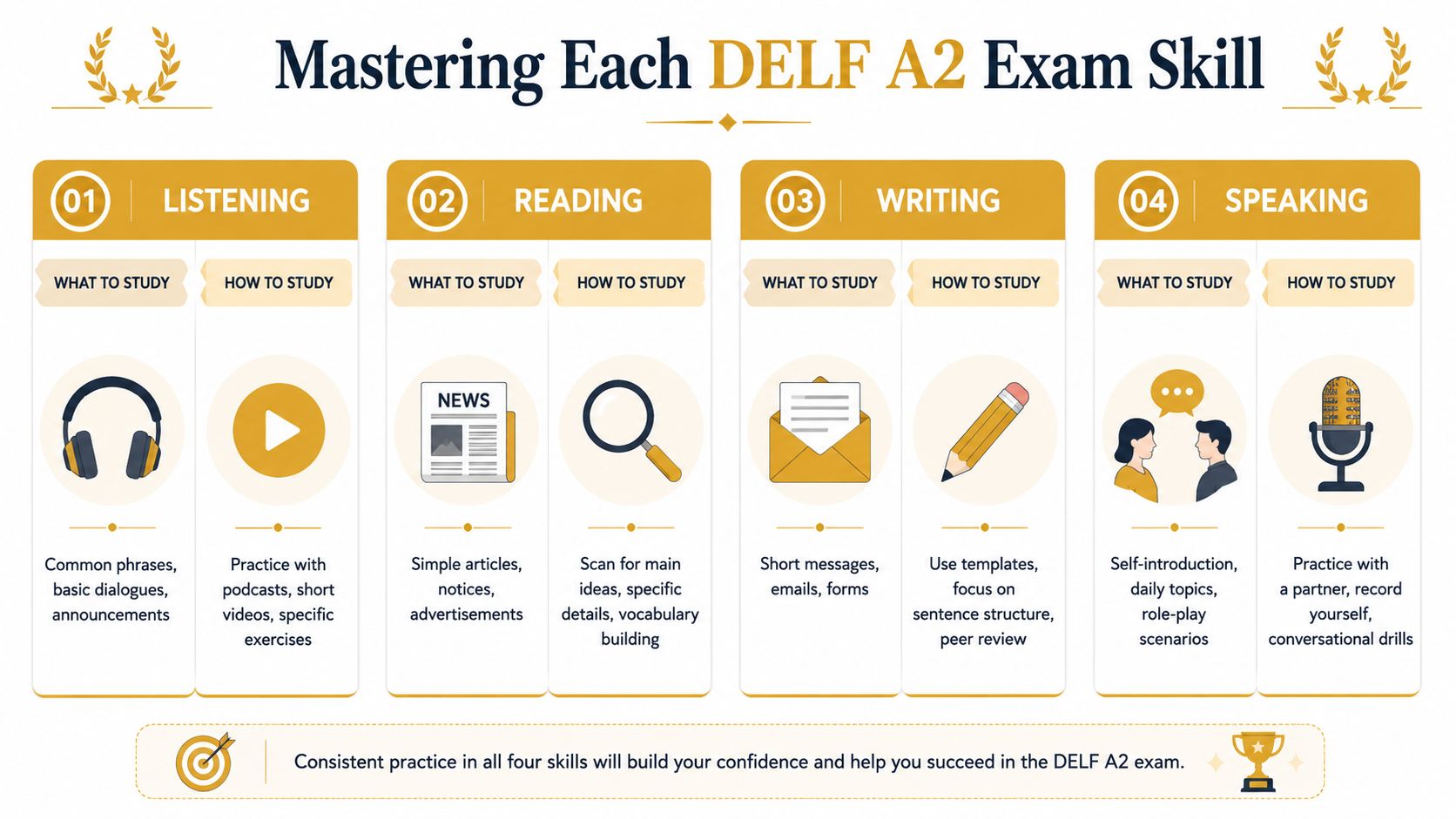
For listening, I like short audio with a narrow goal. Don't try to understand everything. Listen once for the situation. Listen again for practical details. Train your ear to catch who, where, when, and why.
For reading, speed matters almost as much as comprehension. Candidates often waste time wrestling with one unfamiliar word while missing the entire purpose of the text. At A2, the better move is usually to identify the context first. Is this an invitation, a notice, an email, an ad, a simple message?
Try this routine:
- Listening drill: Hear a short clip, write down keywords, then summarize the situation aloud.
- Reading drill: Skim the text, label the type of document, then answer detail questions.
- Vocabulary rule: Keep phrases, not isolated words.
- Review method: Reuse old texts and audios after a few days to build recognition speed.
Writing and speaking need correction, not just repetition
Writing and speaking improve fastest when someone catches what you can't hear in yourself.
For writing, the big issue usually isn't imagination. It's organization. Students know words, but they don't shape them into a clear task response. I train them to front-load the purpose of the message, keep the tone simple, and use reliable sentence patterns they can control.
For speaking, the biggest jump comes from practicing transitions and recovery. Many learners can answer a predictable question. Fewer can continue smoothly when the exchange changes direction.
Here's the trade-off I see most often:
| Skill | Effective Self-Study Method | Targeted Tutoring Advantage |
|---|---|---|
| Listening | Repeated short audio, note-taking, transcript comparison | Feedback on what you're missing and why |
| Reading | Timed skimming, gist-first reading, task-type recognition | Strategy correction when you misread prompts |
| Writing | Templates, model responses, self-editing checklists | Precise correction of recurring structure and register errors |
| Speaking | Self-recording, shadowing, topic rehearsal | Live interaction, follow-up questions, recovery training |
Some learners do well with self-study for three skills and need targeted help for one. That's common. A focused tutoring setup can also be very narrow. For example, Elite French Tutoring offers customized DELF and DALF preparation, which suits students who don't need a full course but do need correction on speaking or writing tasks.
Don't judge a study method by whether it feels productive. Judge it by whether it improves your next timed task.
That standard keeps your prep honest.
When Self-Study Isn't Enough a Tutor Is Your Best Bet
There's a point in DELF A2 exam preparation where more solo work stops solving the fundamental problem. The student is still studying, still showing up, still reviewing. But the same weaknesses keep appearing.

I see this most clearly in speaking. A common reason for failing the oral isn't poor grammar. It's weak interactive fluency. Candidates freeze, lose the thread, or don't know how to ask for clarification or paraphrase a missing word, a point discussed in this video on DELF A2 oral preparation and repair strategies.
The plateau is usually very specific
Students often say, “I think I need more confidence.” Usually, that's not the actual diagnosis.
The diagnosis is narrower:
- You answer, but you don't extend.
- You know the word in writing, but not in live speech.
- You write understandable French, but your message lacks task structure.
- You panic when the examiner's wording changes.
Those aren't motivation problems. They're performance problems.
A tutor is most useful when the issue is no longer input. At that point, you need someone to interrupt bad habits in real time. An app can give you repetition. A correction key can show the final answer. Neither can tell you why your speaking collapses after the first follow-up question.
What targeted tutoring changes
Good exam tutoring isn't a long detour back through beginner French. It's targeted intervention.
For an oral-focused student, I often use a lesson built around three moves:
Prompt response under pressure
Short questions, immediate answer, no overthinking.Expansion practice
The student adds one detail, one reason, one example.Repair strategy rehearsal
If a word is missing, the student learns how to keep going instead of stopping.
That last piece matters more than many learners realize. Examiners don't need perfection. They need evidence that you can communicate in real time.
Here's a writing example. One student kept producing answers that were technically understandable but incomplete. She wasn't failing because her grammar was disastrous. She was failing because she didn't fully respond to the prompt. We rebuilt her writing around a simple routine: identify purpose, include required information, close clearly, then edit only the mistakes she personally makes often. Her results improved once the task itself became more visible to her than the language.
If you keep missing the same kind of problem, you probably don't need more material. You need sharper feedback.
That's the moment when tutoring stops being a luxury and becomes a practical decision. Not forever. Not for every skill. Just where the return is highest.
Your Next Step to Passing the DELF A2 with Confidence
The students who pass DELF A2 most calmly usually aren't the ones who studied the most randomly. They're the ones who knew what the exam demanded, diagnosed their weak spots early, and trained those weak spots on purpose.
That's the advantage of a custom plan. It respects your starting point. If your reading is already steady, keep it steady. If your speaking breaks down under pressure, put your energy there. If your writing is vague or incomplete, train structure before elegance.
A solid DELF A2 exam preparation plan doesn't try to do everything at once. It sequences the work. First identify. Then build. Then rehearse. Then refine. That's what turns effort into a passable performance.
If you've read this and realized you'd benefit from a second set of eyes, the next sensible move is to compare lesson options or book a focused review session for your weakest skill. A short consultation can tell you very quickly whether self-study is still enough or whether targeted support would save you time and frustration.
If you want help building a custom DELF A2 prep plan around your current level, you can book a free 20-minute consultation with our team and see whether private lessons, mock oral practice, or writing correction makes the most sense for you.