
You've booked the exam, opened a sample paper, and immediately felt your confidence drop. Your reading seems decent. Your grammar is “not bad.” Then you look at the writing prompt or imagine the oral discussion, and the whole thing starts to feel unstable.
That reaction is normal. I see it constantly with students who are serious, hardworking, and already somewhere around the B1 to B2 border. They aren't lazy. They're just preparing the wrong way. They study French broadly when they need to train for a score-based exam with pressure, timing, and very specific performance demands.
I've guided many learners through DELF B2 exam preparation, and the students who improve fastest all make the same shift. They stop treating B2 like a vague fluency milestone and start treating it like a strategic project. That means diagnosing risk early, protecting weak sections, and practicing the exact tasks that decide the final result. If you're also trying to choose the right support, this guide pairs well with my advice on how to find the perfect French tutor for adult learners.
Table of Contents
- Your Starting Point on the Path to B2
- Deconstructing the DELF B2 Exam
- An 8-Week Strategic DELF B2 Study Plan
- Targeted Tactics for Each Exam Section
- Comparing Prep Methods Self-Study vs Personalized Tutoring
- Your Mock Exam and Final Week Strategy
Your Starting Point on the Path to B2
Most learners don't need more motivation. They need a better map.
A typical student comes to me with a stack of notes, a few podcasts, some grammar exercises, and a real deadline. University admission is waiting. A job application needs proof of level. A relocation plan is moving forward. The problem isn't effort. The problem is scattered effort.
I've worked with students who could explain the subjonctif perfectly and still struggled to defend an opinion out loud for more than a minute. I've also seen strong readers fail to organize a convincing written argument when the clock started. That disconnect matters because DELF B2 doesn't reward general familiarity with French. It rewards controlled performance across different tasks.
Practical rule: Stop asking, “How can I improve my French?” Start asking, “Which exam task is most likely to cost me points right now?”
That question changes everything. It forces you to identify your bottleneck instead of hiding inside your comfort zone. If speaking is shaky, that's the urgent problem. If your writing lacks structure, that's where your prep should tighten. If listening falls apart under time pressure, you train listening under time pressure, not vocabulary lists that feel productive but don't fix the issue.
Three starting points usually matter most:
- Your current level: If you're already a solid B1, your timeline can be much shorter than someone who is still building core control.
- Your weakest productive skill: Writing and speaking usually decide whether a preparation plan is realistic or fantasy.
- Your feedback loop: If nobody is correcting your essays or challenging your spoken arguments, you're guessing.
Students often resist this because strategy feels less exciting than “learning more French.” But strategy is what gets you over the line. The sooner you accept that, the faster your DELF B2 exam preparation becomes efficient instead of exhausting.
Deconstructing the DELF B2 Exam
If you don't understand the scoring logic, your study plan will be badly built from day one.
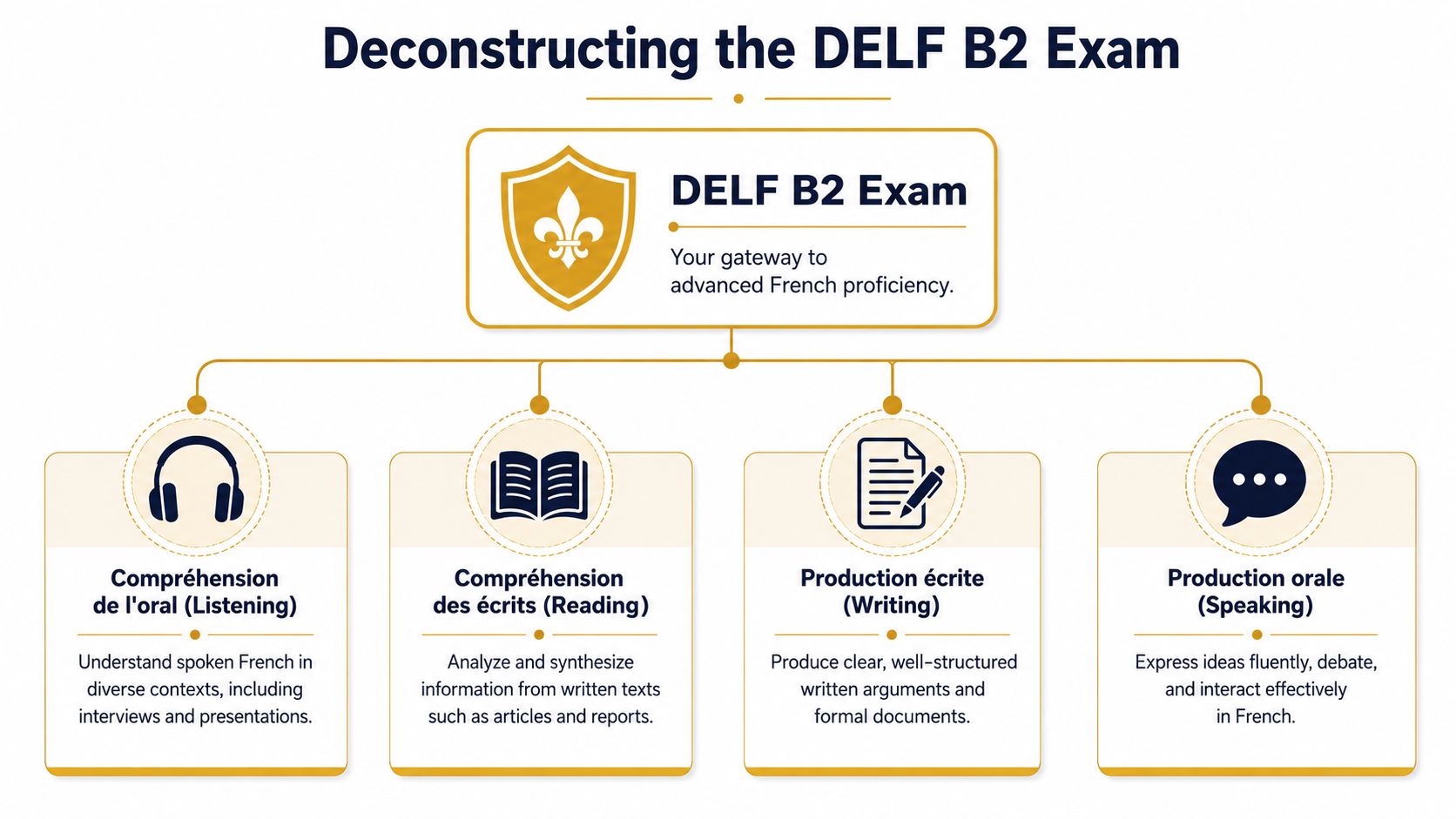
The DELF B2 is one of the four standard DELF levels in the diploma system, with A1, A2, B1, and B2 under DELF and C1 and C2 under DALF. The exam assesses four separate skills, each worth 25 points, for a total of 100 points. To pass, you need at least 50/100 overall, but any score below 5/25 in one skill is disqualifying, as explained in this DELF exam overview from CIA France.
The scoring rule that changes everything
That 5/25 minimum per section is the rule students underestimate most.
It means a high score in reading can't rescue a collapse in speaking. A strong listener can still fail if the writing falls apart. This is why I push students away from lopsided prep. Spending most of your time on the skill you already like is comforting, but it's weak strategy.
Your prep should follow a simple priority order:
- Identify the section nearest the floor
- Stabilize that section first
- Raise your total after the danger zone is under control
Balanced performance beats uneven brilliance on this exam.
That's also why isolated drills aren't enough. You need whole-paper training at some point, because stamina and transitions matter. A student who can do one decent essay on a quiet Sunday may still perform badly in a full exam sequence.
What each section is really testing
The four parts look straightforward on paper. In practice, they expose different weaknesses.
- Listening: This isn't about catching every word. It's about following ideas, identifying the speaker's point, and staying composed when audio moves quickly.
- Reading: You need to separate main argument from detail. Many candidates read too slowly or answer based on assumptions instead of what the text states.
- Writing: In writing, vague thinking is penalized. If your ideas are thin, your structure is loose, or your register is awkward, the score drops fast.
- Speaking: This section exposes whether you can think in French under pressure. Memorized phrases help, but they won't save you if you can't organize and defend an opinion.
A strong DELF B2 candidate isn't perfect. They're reliable. They can produce something coherent, organized, and defensible in every part of the exam.
That's the standard you should train for.
An 8-Week Strategic DELF B2 Study Plan
Cramming doesn't work well for B2. Smart sequencing does.
For a learner who is already around B1, a realistic benchmark is roughly 3 to 6 months of structured DELF B2 work. A lower-intermediate learner may need around 600 to 800 total hours over 18 to 24 months to reach B2 readiness. The same guidance stresses that faster progress comes from training the actual task types, especially timed mock exams and structured outlines, as outlined in this DELF B2 preparation timeline guide. If you want a broader framework for organizing your week, this companion resource on a structured French study plan is useful.
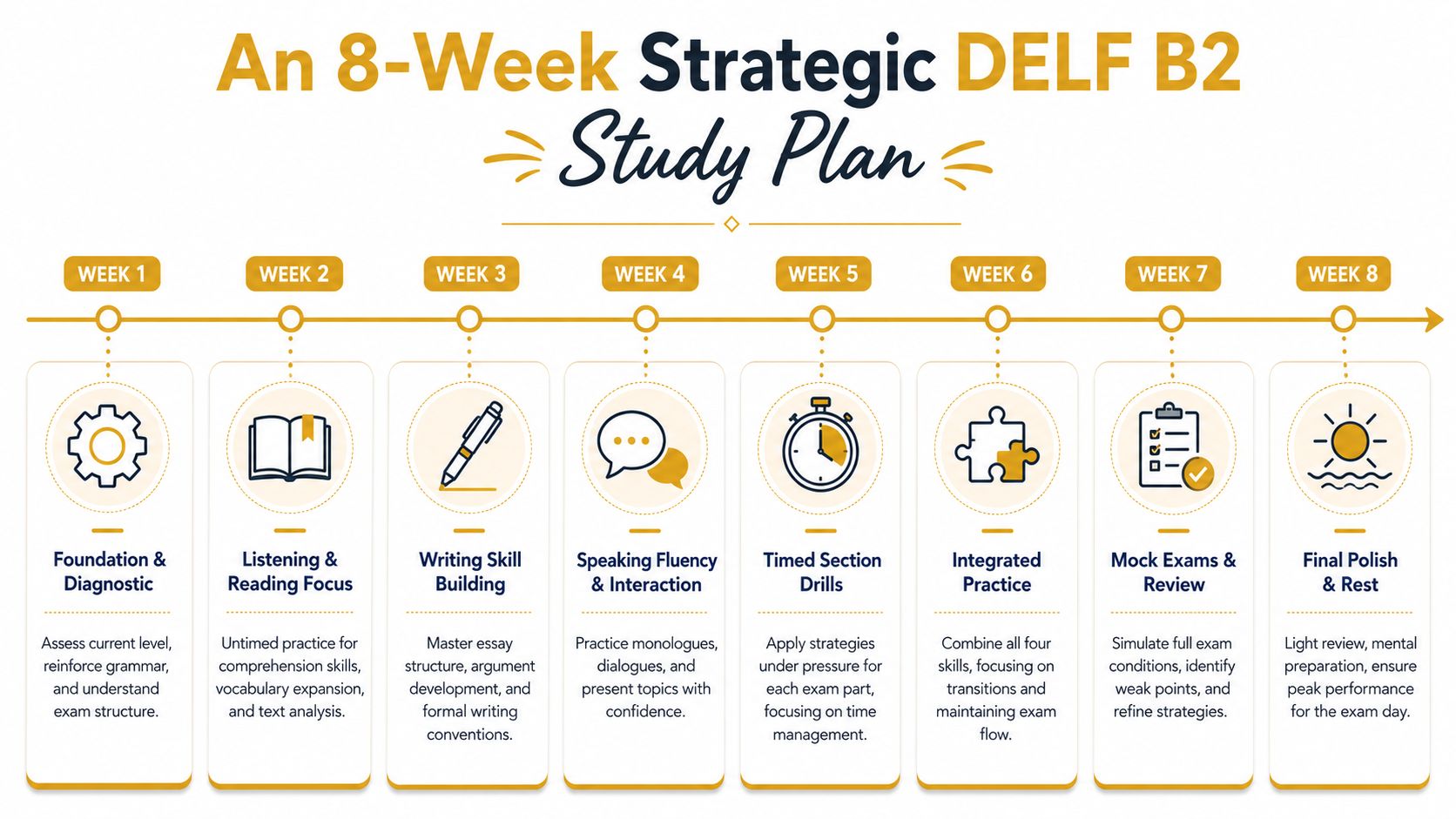
Weeks 1 to 2 build your base
Start with a diagnostic, not blind optimism.
Take sample tasks from all four skills and assess them. Don't just ask which section feels hard. Ask which one is most fragile. Usually, that's writing or speaking, but not always.
During these first two weeks:
- Audit your weaknesses: Keep notes on repeated grammar errors, timing problems, and task misunderstandings.
- Rebuild core control: Review the grammar and connectors you need for arguments, not every grammar point you've ever studied.
- Learn the task demands: Understand what a solid answer looks like in each section.
I want students to get specific fast. “My speaking is weak” is useless. “I lose structure when responding to follow-up questions” is actionable.
Weeks 3 to 4 sharpen input and argument
This phase should be heavy on listening, reading, and idea generation.
You need regular exposure to denser French, but you also need to train how you process it. Read opinion-based texts. Listen with a pen in your hand. Summarize arguments. Notice transitions, contrasts, examples, and conclusions.
Use these two weeks to build habits that support both comprehension and production:
- Question-first reading: Look for the argument before you get trapped in details.
- Listening with note selection: Write only the backbone of the message. Don't chase every phrase.
- Argument bank building: Collect useful topic vocabulary and flexible opinion structures.
- Synonym awareness: The exam often rewards meaning recognition, not exact word matching.
Students improve faster when they stop “studying content” and start training how arguments are built.
This is also the right time to begin short writing plans without always drafting full essays. Planning is a separate skill, and students who skip it usually ramble.
Weeks 5 to 6 train output under pressure
Now the productive sections move to the center.
Your writing needs a repeatable structure. Your speaking needs a repeatable thought process. I don't mean memorizing full answers. I mean building a method you can use on unfamiliar topics.
For writing, practice producing an argumentative text of more than 250 words with a clear intro, body, and conclusion. For speaking, prepare quick 2 or 3 part plans, use transitional phrases, and rehearse rebuttal practice. Those methods align with the task-focused preparation guidance already noted earlier.
A good weekly rhythm here looks like this:
- One full writing task: Draft, correct, rewrite.
- Several speaking rounds: Short prompt, fast outline, spoken response, follow-up challenge.
- Timed section drills: Put pressure on yourself before exam day does it for you.
The biggest mistake in these weeks is avoiding discomfort. If oral spontaneity scares you, that's exactly where your training should go.
Weeks 7 to 8 simulate and refine
Week 7 should feel demanding. Week 8 should feel controlled.
Run full mock exams under realistic conditions. Don't pause the clock. Don't check answers midway. Don't turn the exercise into a casual study session. Simulation matters because endurance matters.
Then review your mistakes by category:
| Review area | What to check |
|---|---|
| Timing | Where did you slow down or rush? |
| Comprehension | Did you miss the main argument or just one detail? |
| Writing | Was the structure clear from the start? |
| Speaking | Did you hold your position when challenged? |
Use Week 8 to clean up recurring weaknesses, not to reinvent your French.
That means:
- Review corrected work: Especially essays and oral notes.
- Reuse strong templates: Keep what works.
- Stay light but focused: Short listening and reading sessions are better than panic-studying.
- Protect confidence: Last-minute chaos hurts performance more than it helps.
An 8-week plan works best for learners who already have a decent base. If your level is still lower, stretch the same logic across a longer timeline. The structure stays useful. The pacing changes.
Targeted Tactics for Each Exam Section
Generic advice wastes time. Section-specific tactics save points.
Many candidates focus too much on memorizing the exam structure, but B2 is designed to test independent, argumentative language use. The core difficulty is handling unfamiliar prompts under pressure, especially in writing and speaking, as discussed in this analysis of what the DELF B2 really demands.

Listening and reading tactics that save points
Listening and reading often look safer than they are. Students get comfortable because these are passive on the surface. But passive habits create avoidable mistakes.
For listening, train with intent:
- Preview the task mentally: Before audio starts, predict what kind of information matters.
- Listen for structure: Introduction, contrast, example, conclusion. Those signals matter more than isolated vocabulary.
- Watch for distractors: If two ideas sound similar, the right answer usually depends on a nuance in position or emphasis.
For reading, become less loyal to the text and more loyal to the question. That sounds odd, but it works. Many students read every line with equal attention and then run out of time.
Try this instead:
- Read the question set quickly.
- Identify the text's central argument.
- Scan for the paragraph where the answer likely lives.
- Confirm with textual evidence, not guesswork.
A useful shift happens when you stop treating these sections as comprehension tests and start treating them as decision-making tasks. You're constantly asking, “What is the author or speaker doing here?”
Writing and speaking tactics that change outcomes
Here, many exams are won or lost.
For writing, don't improvise structure. Use one. I recommend a simple frame that can adapt to almost any argumentative prompt:
- Opening position: State the issue and your angle clearly.
- Development: Build two solid arguments instead of four weak ones.
- Counterpoint: Acknowledge another view, then answer it.
- Conclusion: End decisively, not vaguely.
Your writing score improves when the examiner never has to wonder where your argument is going.
For speaking, the key skill isn't eloquence. It's recoverability. You need to keep going when the topic is unfamiliar, when your first example isn't great, or when the examiner pushes back.
Use this oral routine in practice:
- Take a fast stance: Don't spend too long searching for the perfect opinion.
- Build a 3-part plan: Problem, position, support.
- Use transitions deliberately: They buy thinking time and make you sound organized.
- Expect resistance: Rebuttal practice should be part of your weekly prep.
If you freeze in the oral, it usually isn't a language problem. It's an organization problem.
I push students to practice spontaneous argumentation on unpredictable topics because that's where confidence becomes real. Anyone can sound prepared on familiar material. B2 asks whether you can think, organize, and defend your view when the topic isn't one you chose.
Comparing Prep Methods Self-Study vs Personalized Tutoring
Some learners can self-study effectively. Many think they can, then discover too late that they were practicing the wrong things.
The issue isn't discipline alone. It's calibration. Without strong external feedback, you can spend weeks reinforcing habits that won't hold up in the exam. If you're leaning toward independent prep, my guide on how to learn French on your own will help you do it more intelligently.
Where self-study works and where it breaks
Self-study is useful for reading practice, vocabulary review, and repetition. It becomes much less reliable when you need precise correction, oral pressure, and rubric-aware feedback.
Here's the practical comparison I give students:
| Factor | Self-Study | Elite French Tutoring |
|---|---|---|
| Study structure | You build your own plan and adjust it alone | Lessons are customized around your level, goals, and weak sections |
| Writing feedback | Often delayed, inconsistent, or missing | Direct correction on argument, structure, and recurring errors |
| Speaking practice | Hard to simulate pressure consistently | Live interaction with targeted rebuttal and fluency practice |
| Accountability | Depends entirely on your discipline | Regular sessions create momentum and external structure |
| Efficiency | Can be slow if you misdiagnose your weaknesses | Faster when a tutor identifies what actually needs work |
| Best fit | Independent learners with strong self-correction | Learners who want strategic guidance and focused exam prep |
This isn't a moral issue. It's a practical one. Some students need a coach because their problem is not effort. Their problem is wasted effort.
A real student result from targeted coaching
One student I worked with, David, is a good example. He didn't need help everywhere. His reading was already strong, and his listening was respectable. But the oral exam created panic.
His real problem wasn't vocabulary. It was performance under challenge. The moment he had to defend a position spontaneously, his structure disappeared. So we stopped pretending he needed “general French improvement” and trained the exact bottleneck. We ran repeated oral prompts, built fast planning habits, and practiced follow-up pressure until his responses became organized instead of reactive.
He passed with 21/25 in speaking.
That result didn't come from magic. It came from narrowing the target. That's what tutoring can do when it's specific.
Your Mock Exam and Final Week Strategy
The final stretch should be disciplined, not dramatic.
Too many students treat mock exams like a confidence ritual. They take one, glance at the score, feel either relieved or crushed, and move on. That's shallow prep. A mock only becomes useful when you dissect it.
How to use mock exams properly
Run full exam simulations under realistic conditions. Sit down, remove distractions, and finish the paper as if the result counted.
Afterward, review in layers:
- Timing errors: Where did you lose control?
- Task errors: Did you misunderstand what the question wanted?
- Language errors: Which grammar or vocabulary problems repeated?
- Performance errors: Did pressure change your decisions?
Don't ask only, “What score did I get?” Ask, “What failed first under pressure?”
That answer tells you what to fix in the final week.
What to do in the final days
Your last days should feel lighter but sharper. Review corrected writing. Reuse speaking plans that worked well. Do short listening and reading sessions to stay mentally active. Don't cram brand-new grammar and expect it to hold.
If you want one final external check before test day, it can help to look at how focused support works in practice. This short story about how DELF online prep helped Lucas gives a realistic example of what a final polish phase can look like.
Walk into the exam with a system, not hope. That's what good DELF B2 exam preparation gives you.
If you're deciding between self-study and guided support, the smartest next step is to compare your options based on your weakest section, timeline, and need for feedback. A short consultation or trial lesson can make that decision much clearer before you invest more time in the wrong prep method.