

A parent opens the report card and sees the same frustrating pattern: B+, strong participation, some careless errors in writing. The student insists they studied for hours. Both statements can be true. The student worked hard, but they practiced the wrong things for the points their French teacher awards.
That's the problem with chasing a French A+. Verb charts and vocabulary apps can help, but they won't automatically improve agreement, spontaneous speaking, listening inference, or timed writing. I've seen students move from a stubborn B+ to a reliable A range once they identify the exact rubric categories costing them marks and practice those weaknesses deliberately.
Table of Contents
- Why Most French Students Stay Stuck at a B+
- What Teachers Actually Score for an A+
- The Weekly Study Routine That Builds Real French
- Exam-Day Tactics That Lift the Grade
- Self-Study, Group Class, or Private Tutor
- Your 12-Week French A+ Roadmap
Why Most French Students Stay Stuck at a B+
A student I worked with once arrived after a disappointing writing assessment. She knew the vocabulary, could recite the relevant verb endings, and had spent the weekend reviewing notes. Her paragraph still lost marks because the verbs didn't agree with the subjects, the transitions were repetitive, and she never left time to proofread.
She hadn't failed to study. She had studied French as a memorization subject.
That distinction matters. Many students review familiar material because it feels productive. They reread conjugation tables, flip through flashcards they already know, and watch another explanation of a grammar rule. Then the test asks them to retrieve the rule inside an unfamiliar sentence, respond without preparation, or organize an argument under time pressure. Their knowledge is present, but it isn't available quickly enough.
My diagnosis: A B+ usually reflects a method problem before it reflects an ability problem.
Teachers don't award the highest marks for recognizing a verb chart. They award them for using the correct tense while expressing an original idea, understanding what a speaker implies, answering a follow-up question naturally, and catching an error before submitting written work. The student must perform accurately when the answer isn't sitting in front of them.
The gap between effort and marks
A student can spend substantial time studying and still miss the same categories repeatedly:
- Grammar accuracy: agreement, pronoun placement, tense selection, and articles.
- Written control: clear organization, connected ideas, and varied sentence patterns.
- Oral flexibility: responding beyond memorized sentences and repairing an answer when stuck.
- Comprehension: understanding meaning, tone, and implication rather than collecting isolated keywords.
The recurring errors are often visible in old papers. Look at the last few assignments and mark every error by type. If the same error appears across several pieces of work, more general revision won't fix it. The student needs a targeted correction loop, where they identify the rule, produce new examples, and use the structure again under pressure.
A useful starting point is this guide to common mistakes in French. The important question isn't whether a student makes mistakes. Every learner does. It's whether they know which mistakes cost marks and have a routine for removing them.
What Teachers Actually Score for an A+
An A+ response combines four kinds of control. A student doesn't need to be equally strong in all four, but one weak area can pull down an otherwise excellent average.
The four scoring buckets
Listening comprehension goes beyond hearing familiar words. Top-band students identify the speaker's purpose, distinguish an opinion from a fact, and use context to interpret an implied message. A B-level response often copies a recognizable word and builds an answer around it, even when the overall meaning points elsewhere.
Reading comprehension requires inference. Strong readers notice tone, connect pronouns to their referents, recognize a change in viewpoint, and support an answer with the relevant part of the text. Students lose marks when they translate every word but miss the author's attitude or the relationship between ideas.
Written production is where small errors multiply. Teachers look for accurate grammar, logical cohesion, relevant vocabulary, and sentence variety. A paragraph with ambitious ideas can still fall into the B range if subject-verb agreement slips, verb tenses shift without purpose, or every sentence follows the same pattern.
Speaking rewards communication, not recitation. A strong oral response has understandable pronunciation, connected ideas, natural pacing, and the ability to recover when a word is missing. Memorized answers often sound polished at first, then collapse when the teacher asks a slightly different question.
Use this quick diagnostic before choosing a study method:
| Skill Area | B+ Response Pattern | A+ Response Pattern |
|---|---|---|
| Listening | Catches familiar keywords but misses implied meaning | Identifies gist, detail, tone, and speaker intention |
| Reading | Translates accurately but struggles with inference | Explains meaning, viewpoint, and evidence from the text |
| Writing | Communicates ideas with recurring agreement or tense errors | Builds a cohesive response with accurate, varied structures |
| Speaking | Relies on prepared sentences and pauses when redirected | Responds spontaneously, pronounces clearly, and self-corrects |
Score the leaks honestly
Rate each area from 1 to 5, where 1 means the student regularly loses marks and 5 means the skill is dependable under timed conditions. Ask for evidence, not confidence. A student who says speaking is a 4 should record a response to an unfamiliar prompt and listen for pauses, pronunciation breakdowns, repetition, and grammatical repairs.
The lowest score is the first target. An A+ student isn't necessarily exceptional in every category. More often, they've removed the one or two weak spots that kept dragging the average below the top grade.
The Weekly Study Routine That Builds Real French
A sustainable routine beats a heroic weekend cram. I recommend a focused 20-minute weekday block, with each day assigned a different type of retrieval and production.
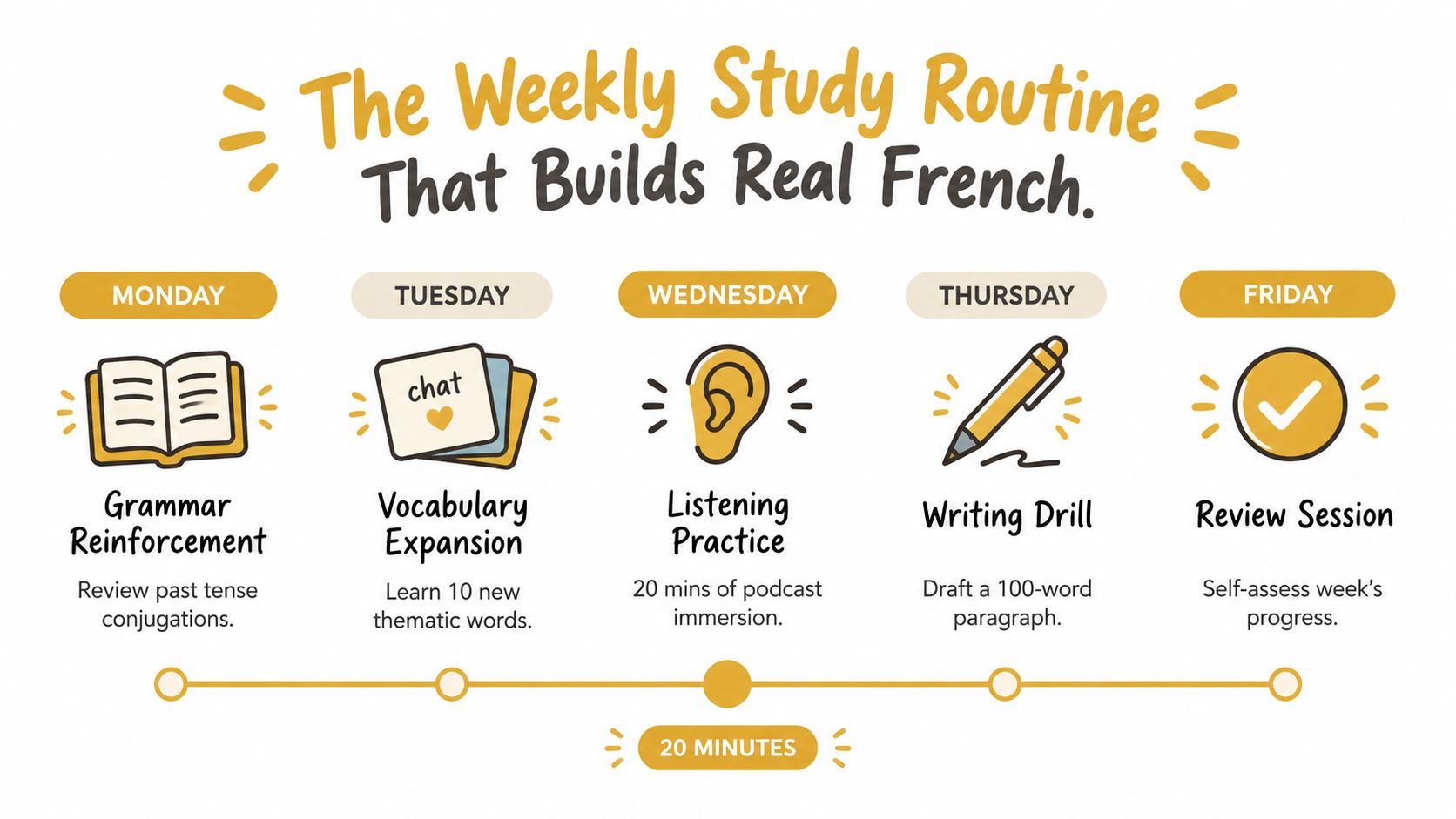
Monday and Tuesday repair errors
Monday should begin with the previous week's error log. The student chooses one grammar weakness, such as past-tense agreement or object pronoun placement, and completes a short set of targeted sentences without looking at the rule first. They then correct the work in a different color and write one sentence explaining why each error occurred.
Tuesday reinforces the same weakness in a new context. Instead of repeating identical exercises, the student writes a few original sentences connected to current class topics. This is retrieval practice. It forces the brain to produce the form rather than recognize it on a page.
For families who need a repeatable structure, a structured French study plan can turn scattered homework into a routine with visible priorities.
Wednesday and Thursday add sound and vocabulary
Wednesday is the listening block. Use one short song, podcast excerpt, or dictée. Listen once for the general message, again for details, then write a brief summary in French. The summary exposes whether the student understood the content or only recognized isolated words.
Thursday introduces 10 to 15 new words in example sentences, not as a disconnected list. The student should say the sentences aloud for five minutes and record a short response using as many of the new terms as possible. Speaking practice reveals gaps that silent study hides.
Friday produces evidence
Friday is for one timed writing piece. The student drafts, checks the work against a model or rubric, and adds every recurring error to the log. Over time, that log becomes more valuable than another stack of worksheets because it shows precisely what the student does under pressure.
The routine depends on spaced repetition, error journaling, and recorded speaking. It fails when the student spends the entire session rereading familiar pages. French improves when the learner retrieves, produces, receives correction, and tries again.
Exam-Day Tactics That Lift the Grade
The final forty-eight hours shouldn't be used to learn an entire unit. They should be used to make performance more reliable. The highest-value work is timed practice followed by correction, not passive review.
Listening and reading
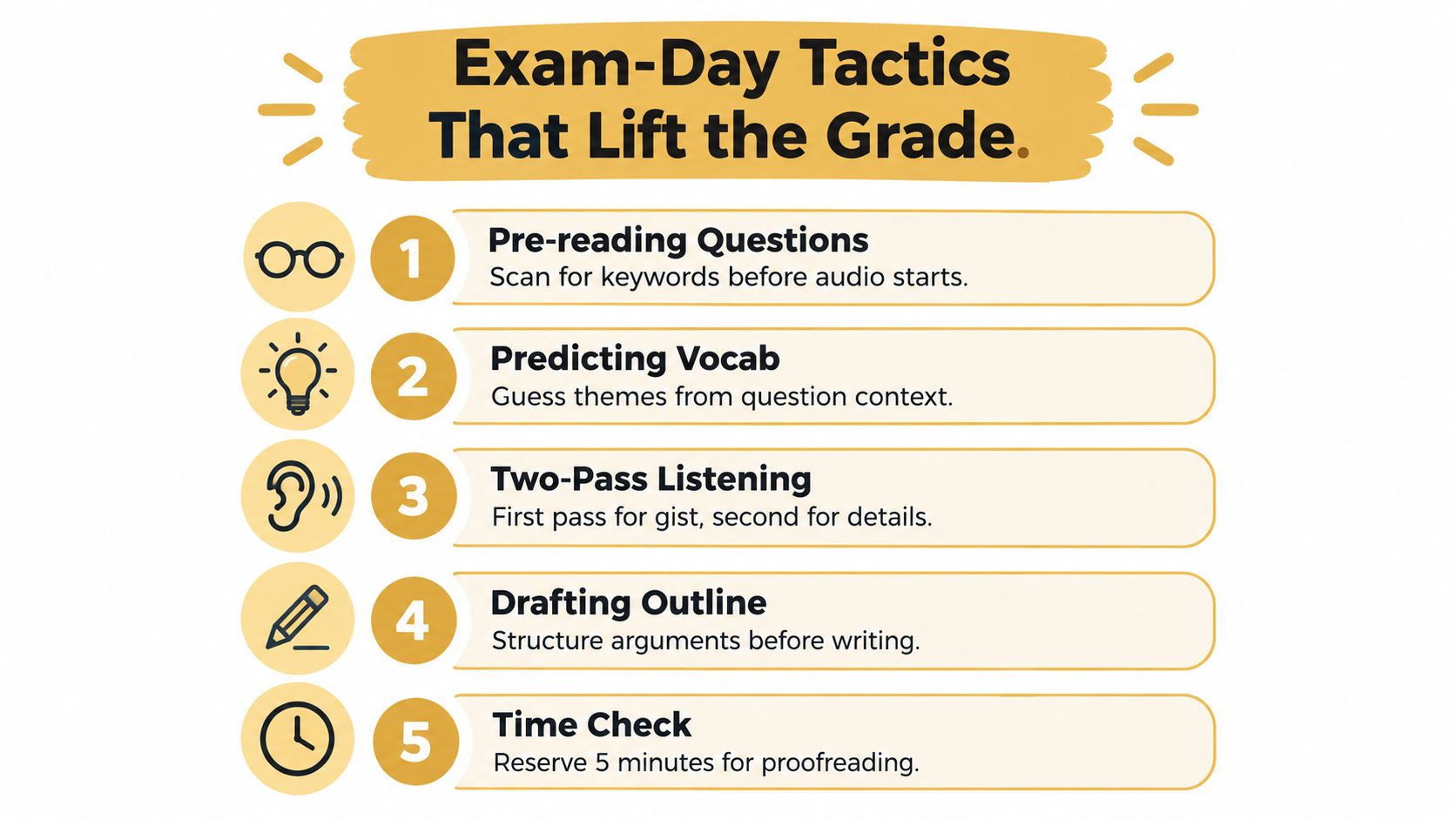
Before the audio begins, read every question you can. Circle names, places, time expressions, and question words. Predict the vocabulary or type of answer likely to appear. During the first pass, focus on the overall message. During the second, confirm details and resolve uncertainty.
For reading, annotate lightly. Mark the main claim, contrast words, evidence, and shifts in tone. Cognates can help, but they're dangerous when the student assumes a familiar-looking word has exactly the same meaning in English. Pace across the full paper instead of spending too long perfecting the first text.
Writing under pressure
A four-paragraph structure keeps ideas controlled:
- Introduction: answer the question and establish the position.
- First development paragraph: give one reason and a specific explanation.
- Second development paragraph: add a contrasting point, example, or consequence.
- Conclusion: restate the central idea without copying the introduction.
Students should prepare flexible transition phrases, not a memorized essay. In the final five minutes, check verbs, gender, subject-verb agreement, accents, articles, and tense consistency. A short proofreading pass often recovers marks that another round of vocabulary review cannot.
Examiner's perspective: A confident A+ response keeps communicating when the student forgets a word. A hesitant B+ response often stops, translates mentally, and abandons the idea.
Speaking preparation
Rehearse a 30-second self-introduction, then prepare five adaptable answers for common themes such as school, family, technology, travel, or future plans. Practice changing the details so the response doesn't sound memorized.
Record the answers and listen for anglicized vowel sounds, swallowed endings, and long pauses. The student should also practice repair phrases that allow them to rephrase instead of freezing. The night before, review lightly and prioritize sleep. On the morning of the test, complete a short warm-up with ten example questions, then stop cramming.
For a fuller preparation sequence, use these French test study strategies. The aim is controlled execution, not last-minute information overload.
Self-Study, Group Class, or Private Tutor
The right support depends on the size and type of the gap. Self-study is inexpensive and flexible, but students often skip speaking practice and receive no immediate correction. A group class supplies a schedule and peer energy, yet the teacher can't always diagnose one student's repeated pronoun or agreement errors during a busy lesson.
Private tutoring costs more per session, but the student spends the lesson producing French rather than waiting for a turn. The tutor can correct an error immediately, adjust the next exercise, and return to the same weakness until the student uses it accurately.
| Factor | Self-Study | Group Class | Private Tutor |
|---|---|---|---|
| Cost per term | Usually the lowest | Moderate and fixed by enrollment | Higher per teaching hour |
| Feedback speed | Often delayed or unavailable | Limited by class time | Immediate and specific |
| Personalization | Student chooses the material | Curriculum serves the group | Lesson follows the student's gaps |
| Speaking practice | Commonly inconsistent | Shared among classmates | Frequent individual production |
| Accountability | Depends on self-discipline | Built into attendance | Reinforced through scheduled goals |
| Grade impact | Gradual if practice is consistent | Useful for broad coverage | Strongest when the problem is targeted |
A practical decision rule
If the student is only a few percentage points below the A threshold, a focused tutoring block can be the quickest way to identify and close the specific leak. If the gap is substantially larger, tutoring should support classroom study over the full term rather than replace the foundation provided at school.
Choose private support when the same errors appear despite regular effort, the student can't explain why an answer was corrected, oral-exam anxiety is rising, or writing takes too long to complete. A student who knows the material but can't perform it reliably needs feedback and repetition, not another app subscription.
Online tutoring also deserves serious consideration for busy families. A market forecast projects France's tutoring market to grow from USD 2,669.81 million in 2025 to USD 5,583.3 million by 2034, with online tutoring identified as the leading service type in 2025 and the fastest-growing segment in the forecast, according to France tutoring market projections. That doesn't prove every online lesson is effective. It does show why families should compare delivery format, feedback quality, scheduling, and teacher fit rather than assume “online” means low-touch.
For example, Elite French Tutoring offers customized one-to-one lessons online and in person, with programs for school support, professional communication, and DELF or DALF preparation.
Your 12-Week French A+ Roadmap
A B+ student doesn't need twelve weeks of vague motivation. They need a sequence that turns the rubric into weekly evidence.
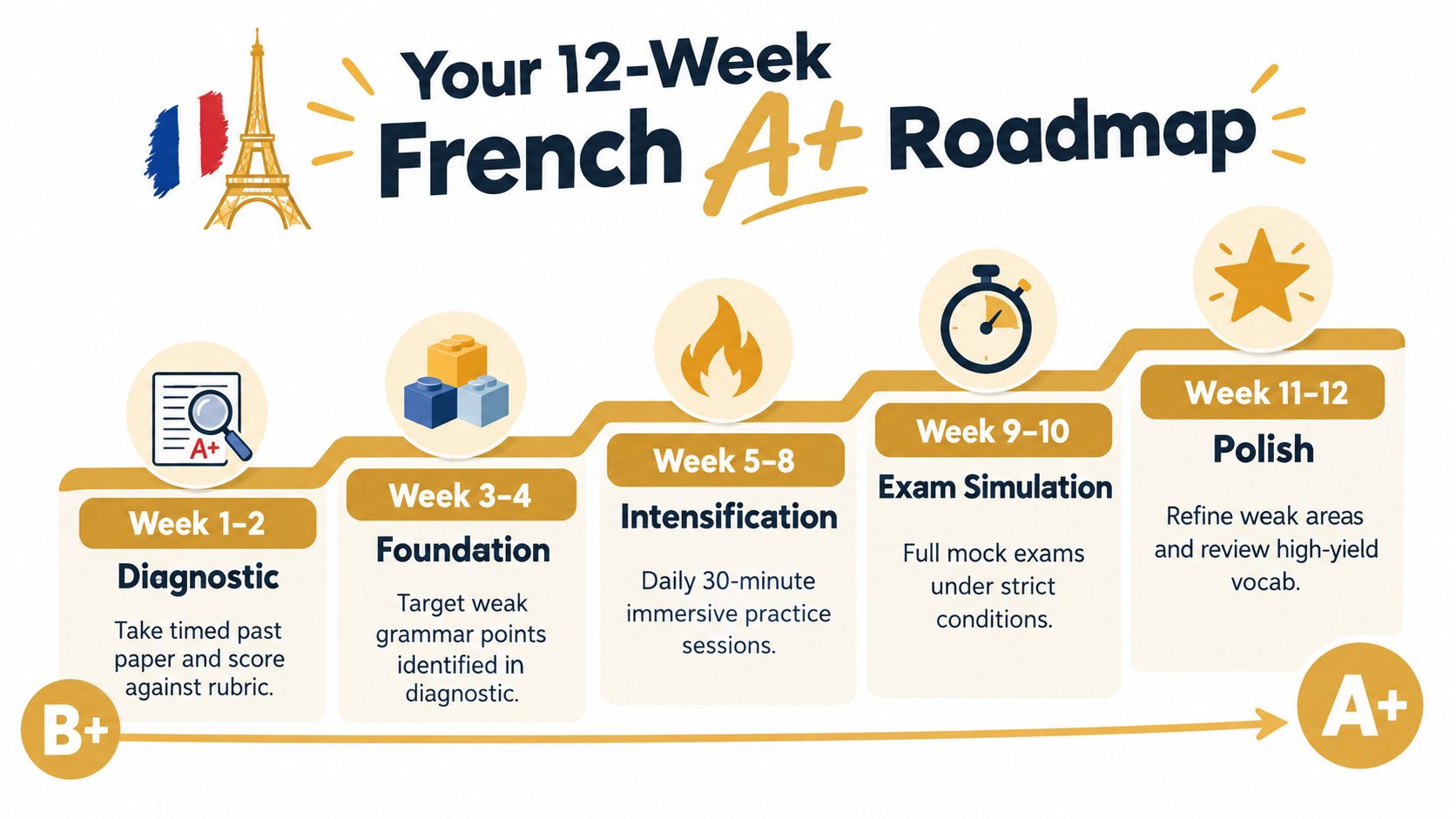
Weeks 1 and 2 find the real problem
Take a past paper under timed conditions. Score listening, reading, writing, and speaking separately against the school rubric. List the top three gaps, then choose the one that costs the most marks.
The parent check-in should ask for the paper, the error categories, and the student's next action. The milestone is a written diagnostic summary, not a promise to “work harder.”
Weeks 3 through 5 repair grammar
Target the highest-mark structures first. For many students, that means verb tenses, pronoun use, and agreement. Each week should include short retrieval drills, original sentences, one corrected paragraph, and a brief oral response using the same structures.
Don't move on because the student can explain the rule. Move on when they can use it accurately in unfamiliar sentences and catch their own mistakes.
Weeks 6 through 8 build usable vocabulary
Create themed word banks tied directly to the syllabus. Review them through spaced repetition, then use them in writing and speech. A word that only appears on a flashcard isn't yet available for an exam response.
The weekly milestone might be a completed thematic paragraph and a recorded oral answer using the new vocabulary naturally. Parent support is simple: check whether the student produced French, not whether they spent time looking at French.
Weeks 9 and 10 simulate the assessment
Complete one full past paper each week under strict conditions. Correct it the next day, while the decisions and errors are still easy to remember. Categorize every lost mark as knowledge, timing, comprehension, organization, or carelessness.
This distinction prevents wasted revision. A student who knows the grammar but leaves a writing task unfinished has a pacing problem, not a conjugation problem.
Weeks 11 and 12 polish confidence
Use oral rehearsals, timed writing, pronunciation repair, and high-yield vocabulary review. The final week should be lighter. It should reinforce reliable patterns, not introduce a pile of new material.
A useful external example is this account of how a complete beginner became fluent in 90 days. For an A+ student, the lesson isn't to copy someone else's schedule. It's to connect consistent output with a clearly defined target.
If your child is working hard but the grade remains stuck, book a free 20-minute placement consultation to identify the three highest-impact gaps and decide whether self-study, a group class, or individualized French tutoring fits the next twelve weeks.