Skip to content

Your French test is circled on the calendar, but your preparation still looks like a pile of vocabulary lists, unfinished grammar chapters, and random listening practice. You've spent hours reviewing, yet you still don't know whether the exam will reward conversation, written argument, translation, or careful comprehension. That uncertainty is the problem, not a lack of motivation.
The right answer to how to study for a French test starts with the test itself. Identify the format, find the scoring priorities, diagnose your weakest skill, and then buy or build support only where it can change your result. The plan below gives you a format-first schedule, skill-specific drills, a practical comparison of study options, and a final 14-day routine you can adapt to a DELF, AP, GCSE, A-Level, or school exam.
Table of Contents
- Why Most French Test Prep Plans Fail Before You Even Start
- Matching Your Study Plan to the Exact French Test You Face
- A Realistic Weekly Study Schedule That Survives Real Life
- Skill-Specific Drills That Move the Score the Most
- Choosing Between Self-Study, Group Classes, and 1 – 1 Tutoring
- A DELF B2 Win and What You Can Copy From It
- Your Final 14 Days Before the French Test
Why Most French Test Prep Plans Fail Before You Even Start
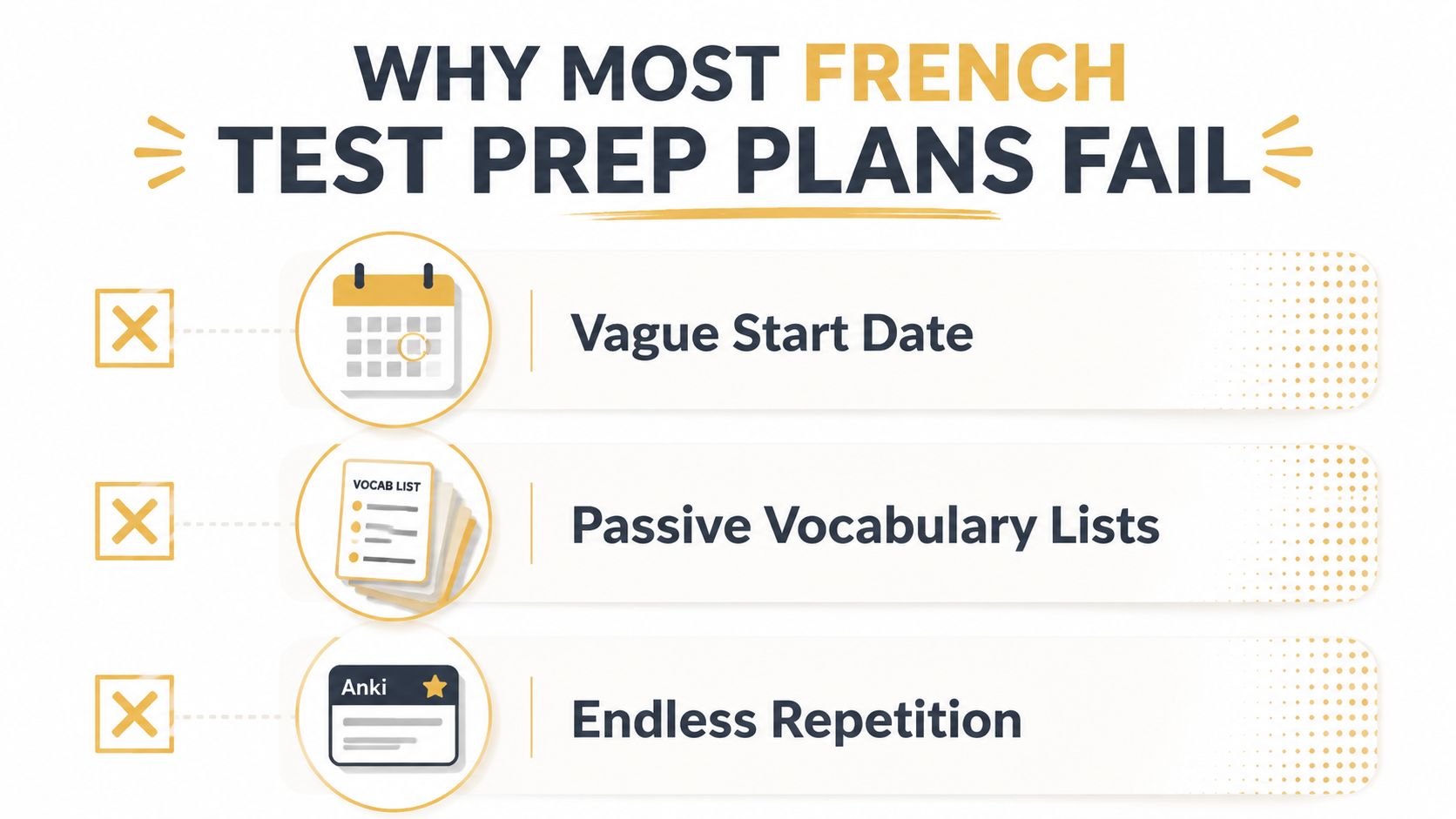
Most students begin with activity instead of diagnosis. They open Anki, copy vocabulary from a textbook, and reread grammar explanations because those tasks feel productive. A week later, they still struggle to understand a recording at normal speed or produce a timed paragraph.
Three habits waste the most preparation time:
- Studying in English: You recognize rules and translations, but recognition doesn't guarantee that you can retrieve French under pressure.
- Collecting grammar rules without producing French: Knowing the difference between the imperfect and passé composé won't help much if you can't use either tense in a sentence, email, or spoken answer.
- Reviewing unrelated vocabulary: A long list of household objects has limited value if your exam asks you to defend an opinion, summarize a source, or respond to a formal prompt.
The format decides the tactics. A DELF B2 candidate needs timed argumentation and oral interaction. An AP French student needs interpersonal writing, cultural comparison, and listening under a fixed clock. A school student may need precise control of the chapters and structures the teacher has assigned.
Start with a score-producing diagnosis
Before changing your study tools, complete a representative practice section. Use the official task type where possible, follow the time limit, and mark every error by cause:
- You didn't know the word.
- You knew the word but couldn't retrieve it quickly.
- You misunderstood the task.
- You ran out of time.
- Your answer lacked the required structure or language accuracy.
That list tells you what to fix. If vocabulary recognition is strong but writing collapses under time pressure, another vocabulary deck isn't the answer. If your ideas are good but your speaking is hesitant, you need recorded responses and live correction.
Spaced repetition still belongs in the plan, but it should serve the exam. A 2022 meta-analysis of second-language learning analyzed 98 effect sizes from 48 experiments involving 3,411 learners and found a medium-to-large advantage for spacing. On delayed tests, spaced practice produced a g = 1.15 advantage, while shorter spacing was less effective than longer spacing for later retention (second-language spacing meta-analysis). Use retrieval to remember the language you must produce, not to avoid producing it.
Matching Your Study Plan to the Exact French Test You Face
Don't buy a course or hire a tutor until you can name the exam and its task types. “French test” is too vague to guide preparation. DELF/DALF, AP French, GCSE or A-Level, and a school midterm can test overlapping abilities while demanding very different responses.
| Test Format | Skill Weighting | Time Pressure | Key Format Trap |
|---|---|---|---|
| DELF/DALF | Varies by level, with listening, reading, writing, and speaking assessed through official proficiency tasks | Section limits and task mechanics matter; DALF C1 writing lasts 2 hours 30 minutes | DALF C1 requires a synthesis of several source texts into roughly 220 words, followed by an argued essay (DALF C1 writing format) |
| AP French | Listening, reading, writing, and speaking are combined with interpersonal and presentational tasks | Fast transitions between task types punish slow planning | Interpersonal Writing requires an email reply, not a memorized essay |
| Standard school midterm | Determined by the teacher, textbook units, and classroom objectives | Often concentrated into one sitting with little time to recover from an early mistake | Students overprepare broad French and underprepare assigned vocabulary, grammar, and question styles |
| GCSE or A-Level | Reading, listening, speaking, and writing requirements depend on the specification and tier | Speaking preparation must account for role-play, interaction, and presentation demands | GCSE exams include mandatory role-play cards, so spontaneous response practice matters |
For DELF and DALF, the credential itself has a clear official status. DELF covers CEFR A1 to B2, DALF covers C1 to C2, and both diplomas are valid for life, with recognition by governments, universities, and employers worldwide (DELF and DALF credential overview). That makes rubric familiarity more valuable than general exposure.
DELF B2 preparation deserves particular precision. The written argument requires 250 words within 60 minutes, so your practice must include planning, paragraph control, connectors, examples, and a final correction pass. Reading articles for pleasure won't train that sequence.
Use the weighting to make the decision
Find the official specification or your teacher's grading breakdown. Assign your largest study block to the skill carrying the greatest share of the score. Then identify the section with the least time per point and train it under a clock.
If the exam emphasizes speaking, spend money on live feedback before buying another app. If writing carries the most weight, purchase correction or tutoring that uses the actual rubric. A format-first plan prevents you from paying for resources that improve general French while leaving your exam weakness untouched.
A Realistic Weekly Study Schedule That Survives Real Life
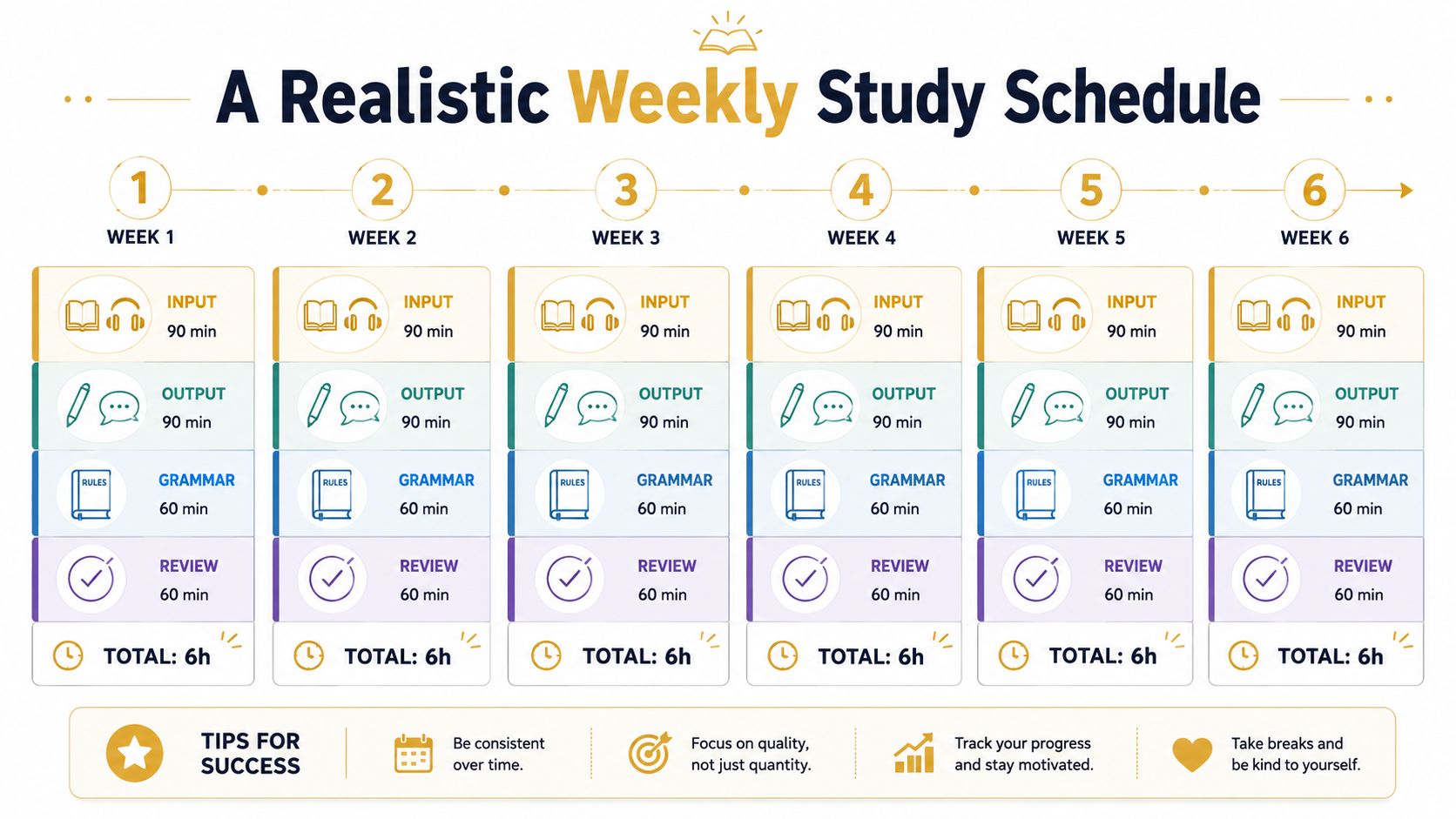
A good schedule must survive missed trains, work deadlines, homework, and family obligations. For a four-to-six-week preparation cycle, I recommend six weekly hours divided into four blocks: 90 minutes of input, 90 minutes of output, 60 minutes of grammar, and 60 minutes of spaced review. The remaining time can be used for exam-specific practice, correction, or a short tutoring session.
Put the work on the calendar
| Day | Task | Purpose |
|---|---|---|
| Monday | 30 minutes of listening and transcript review | Hear the sounds, then identify what you missed |
| Tuesday | 45 minutes of reading and 30 minutes of retrieval review | Extract useful language from exam-relevant texts |
| Wednesday | 45 minutes of timed writing and 30 minutes of grammar correction | Connect rules to errors you actually made |
| Thursday | 30 minutes of speaking and 30 minutes of spaced review | Produce language without a script |
| Friday | 45 minutes of listening or reading under time pressure | Build speed and concentration |
| Saturday | 45 minutes of speaking, then review missed items | Practice the productive skill that self-study handles poorly |
| Sunday | Rest, or a brief catch-up session | Protect consistency without turning preparation into punishment |
The input block combines reading and listening. Use a transcript only after your first attempt, because reading along immediately can hide the distinction between what you understood and what you merely saw. The output block is essential. Write one timed piece and record one spoken response every week, even when the result feels rough.
See our structured French study plan if you need a calendar you can adapt to your exam date.
Use this video as a short demonstration of how to organize consistent practice:
Add pressure in the final weeks
Weeks one through four should build accurate habits. In weeks five and six, introduce full timed sections and one mock test every Saturday. Stop adding new vocabulary in the final stretch. Retrieve the words, structures, connectors, and phrases already connected to your exam tasks.
If you miss a session, don't sacrifice output to catch up. Drop input or review first, then restore the writing or speaking block. Passive exposure is easier to replace than the productive practice that reveals whether you can perform.
Skill-Specific Drills That Move the Score the Most
Each skill needs a different drill. Playing French audio in the background is not listening preparation, and reading a news article without answering questions isn't reading preparation. Choose the task that resembles the scored performance.
| Skill | Highest-Leverage Drill | Hours/Week to Move a Band | Free Resource |
|---|---|---|---|
| Listening | Timed dictée followed by one-play comprehension and transcript error review | Use the largest block when listening carries the highest weighting | RFI Journal en français facile |
| Reading | Timed scan-and-summarize passages from past papers, with unknown vocabulary marked in the margin | Add more time when reading is your slowest scored section | TV5Monde learning resources |
| Writing | One exact-format response, followed by rubric scoring and targeted rewriting | Protect a weekly writing block throughout preparation | Lang-8 correction community |
| Speaking | Recorded answers, then live correction with a tutor or informed partner | Reserve two short sessions when oral performance is weak | French pronunciation guidance for English speakers |
Listening and reading require controlled difficulty
For listening, play the recording once if the exam does. Write down the main idea, speakers, attitude, and supporting details before consulting a transcript. A dictée exposes linking, silent letters, verb endings, and missing function words that passive podcast listening leaves unnoticed.
For reading, don't translate every sentence. Scan for the task's answer, summarize the paragraph in your own words, and track recurring vocabulary in the margin. Your review should ask why you missed an answer, not just reveal the correct letter.
Writing and speaking need an external mirror
Writing practice should match the rubric. For DELF B2, write a 250-word argumentative essay in the 60-minute limit, then score organization, task completion, vocabulary, grammar, and register against the official grid. Rewrite the weakest paragraph instead of starting an unrelated essay.
Speaking requires another person whenever possible. Record yourself answering common B1 or B2 prompts, listen for pauses and repeated words, and then practice the same response again with a clearer opening, two developed points, and a conclusion. A tutor earns their fee by identifying errors you can't hear yourself, especially pronunciation, interaction, and register problems.
Make review retrieval-based
Learn a small set of exam-relevant words, cover the answer, produce the French, and place the item back into review after a delay. A 2024 vocabulary study reported recall of about 79.77% after 10 days, near 79.57% after 18 days, 78.27% after 31 days, and around 75.27% after 60 days without practice (spaced-repetition vocabulary study). The practical lesson is simple. Repeated retrieval over several weeks beats a single cram session.
A review of retrieval research found a strong benefit for spaced retrieval over massed retrieval, with g = 0.74 (spaced retrieval review). Keep cards short, include the article with nouns, add a sentence you can say, and test from English or an idea into French when the exam demands production.
Choosing Between Self-Study, Group Classes, and 1 – 1 Tutoring
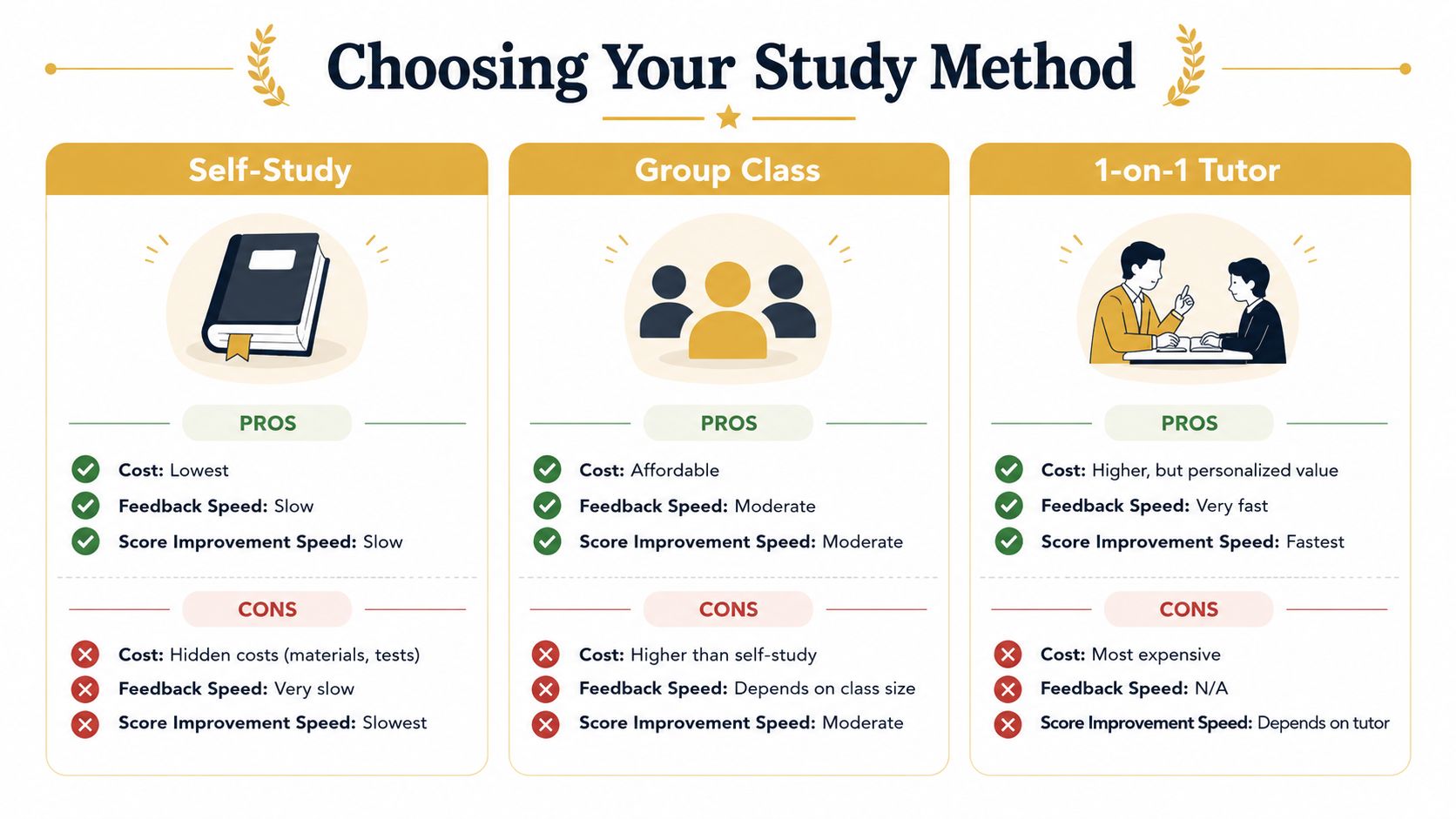
The right support model depends on the bottleneck. Self-study is efficient for vocabulary, reading, and grammar review. It is much less reliable for writing and speaking because you can repeat the same error without noticing it.
| Study Model | Cost | Feedback Speed | Exam-Readiness Trade-Off |
|---|---|---|---|
| Self-study | Near-zero cost with free materials and existing tools | Slow or absent | Strong for independent review, weak for productive correction |
| Group class | Roughly $20–$40 per session, a qualitative market estimate from the planning brief | Faster than solo work, but shared across learners | Adds structure and peer pressure, but rarely targets one student's rubric gap |
| 1-to-1 tutoring | Roughly $40–$90 per hour in the planning brief; independent 2026 pricing guides place private online French lessons commonly around $25–$50 per hour, with broader ranges around $15–$60 (online French lesson pricing guide) | Immediate and individualized | Best suited to a specific weakness, but costs more and depends on tutor quality |
A hybrid usually makes the most sense. Use self-study as the base layer for retrieval, reading, and listening. Add a group class if you need accountability. Use a short burst of individual tutoring in the final three to four weeks to correct the two or three issues that self-correction can't solve.
Vet the person, not just the platform
Ask a prospective tutor which DELF, AP, GCSE, or school formats they coach. Request a diagnostic mock before agreeing to a package, and ask how they score writing and speaking. Don't sign a long-term contract before you understand the tutor's correction method and whether the feedback changes your performance.
Elite French Tutoring offers customized online lessons and exam preparation after an assessment, so it can be one option for learners who want a format-specific plan. Compare that approach with a local teacher, a group course, or independent preparation before choosing.
Use this guide to evaluate a French tutor for adult learners.
A DELF B2 Win and What You Can Copy From It
Maya was a working professional preparing for DELF B2. She failed her first attempt with a 58, then scored 78 six months later. The change didn't come from adding endless study hours. She changed what those hours were doing.
She removed general French Netflix listening from her core routine and replaced it with one timed RFI passage each day. She added two 30-minute speaking sessions per week with a tutor trained for B2 work and completed a full mock exam every third Saturday. Her writing improved most after she began pre-writing argument templates instead of improvising every response.

The transferable decisions
Maya's result came from three choices worth copying:
- Diagnose before buying resources: She used a real mock to identify the score-limiting skill rather than guessing.
- Protect the weakest skill: Speaking received two scheduled sessions each week, not leftover time.
- Use templates without memorizing essays: She prepared flexible argument structures, connectors, and examples that could adapt to the prompt.
Her final 14 days focused on mocks, review, and correction rather than new material. That decision matters because the exam rewards controlled performance, not the size of your study archive.
You can use the same logic with a school exam. Take a representative test, mark the skill or task that costs you the most points, and give it protected practice. For targeted B2 preparation, compare your needs with a DELF B2 exam preparation program, then choose only the support that addresses your diagnostic.
Your Final 14 Days Before the French Test
The final two weeks should reduce uncertainty, not create another mountain of material. Keep your daily work focused, timed, and tied to the actual sections you'll face.
Days 14 to 11 build reliable retrieval
Spend roughly one focused study block each day on foundational review:
- Listening: Complete one exam-style recording, then review the transcript and classify missed details.
- Reading: Finish a timed passage and summarize its argument without translating line by line.
- Writing: Produce a short plan, introduction, or paragraph using the exam's required register.
- Speaking: Record a response to a representative prompt and note pronunciation, hesitation, and missing development.
- Review: Retrieve previously learned vocabulary and grammar from memory. Don't just reread the answer.
Keep the first block practical. You're refreshing material that must be available quickly, not collecting new lists.
Days 10 to 7 run the mock cycle
Complete one full timed practice test during this block under strict conditions. Put your phone away, use the permitted materials only, and respect every section limit.
Afterward, create an error log with four columns: task, mistake, cause, correction. A missed listening answer caused by a misunderstood distractor requires a different fix from a missed answer caused by unknown vocabulary. Spend the next sessions correcting patterns, not admiring your raw score.
Your mock exam is a diagnostic instrument, not a verdict. The value is in the error log you build afterward.
Days 6 to 3 remediate one weakness
Choose the skill with the clearest score cost. Give it the first study block each day:
- Listening weakness gets one-play comprehension and dictée work.
- Reading weakness gets timed scanning and evidence location.
- Writing weakness gets one planned response and a rewrite.
- Speaking weakness gets recorded answers plus live correction if available.
Complete a lighter second mock around Day 5, then review it without adding unrelated material. Stop new vocabulary lists, unrelated grammar chapters, and social media French that doesn't resemble your exam tasks.
Days 2 to 1 taper and handle logistics
Reduce the workload. Review your error log, key connectors, essential irregular forms, and a small set of exam-relevant retrieval cards. Don't attempt to repair your entire French level overnight.
Prepare identification, permitted stationery, confirmation details, and travel plans. Protect sleep, hydrate normally, and leave enough time to reach the test center without rushing. On the final day, a short speaking warm-up and brief listening exercise are useful. A late-night cram session isn't.
If you want help mapping this routine to a specific DELF, AP, or school exam date, book a strategy consultation with a qualified French tutor and bring your test specification, latest practice work, and available weekly schedule. You'll get a much clearer buying decision when the recommendation starts with your actual scoring gap.
If your exam date is approaching, choose the format first, complete one realistic diagnostic, and protect output practice on your calendar this week. Then compare a self-study plan, group support, or targeted tutoring based on the exact skill that can move your score.