
You've got three weeks before a work trip to Lyon, a phrasebook you haven't opened, and a calendar that's already full. You need to introduce yourself, order lunch, and understand what happens after someone replies in French.
A French language crash course can prepare you for those moments. It won't make you fluent before departure. I'd choose a course by how much supported speaking it gives you, how precisely it targets your pronunciation, and whether you can finish the schedule without sacrificing sleep.
Table of Contents
- Choose a Crash Course Length You Can Finish
- Prioritize the Grammar and Words That Unlock Sentences
- Set Up a Daily Routine That Locks Words In
- Pronunciation Priorities Based on Your First Language
- Speaking and Listening Drills That Build Real Conversation
- Assessment Checkpoints Against DELF B1 Rules
- Pick Your Support and Book a Free Assessment
Choose a Crash Course Length You Can Finish
Plan length sets the scope of your outcome. A short course buys rehearsed survival French; a longer intensive course gives you more room to adapt when a conversation stops following the script.
Before booking, separate your deadline from your ambition. Getting through a hotel check-in is a smaller task than contributing to a client meeting, even if both happen on the same trip.
Match the schedule to the task
Use this proposed schedule as a planning tool, not a level guarantee. The guided-hour totals assume you study every day and that all scheduled time is instructor-guided; if part is independent homework, your purchased guided hours will be lower.
Crash course length, daily time and realistic outcome
| Plan | Daily study time | Guided hours | Realistic CEFR target |
|---|---|---|---|
| 1 week | 90 minutes | About 10 hours | Survival A1: greetings, orders, directions |
| 2 weeks | 2 hours | About 28 hours | Solid A1 with first A2 phrases |
| 4 weeks | 2 hours | 56 hours | Low A2: routine talk about yourself and work |
| 4 weeks | 3 hours | 84 hours | Upper A2 with short structured messages |
These are working targets for course selection, not promises of certification. A complete beginner may reach only selected tasks within the target level, while someone returning to school French may progress further.
The Learn Any Language French-learning report places beginner-to-independent B1 development at roughly 150–250 guided hours, while noting that the CEFR itself doesn't prescribe fixed hour requirements. Prior language knowledge, intensity, exposure quality, and independent practice all affect the outcome.
Choose the plan you can actually attend
For a short trip, I'd choose the one-week or two-week option and narrow the syllabus to transactions, directions, introductions, and clarification. For relocation or a work deadline, I'd favor four weeks at two or three hours daily, provided your calendar can support it.
The longer option has a real cost beyond tuition: mental fatigue. Splitting study into a lesson and a separate practice block is often more manageable than attempting everything after a demanding workday.
Booking rule: Buy a schedule you can complete, not the most ambitious package you can afford.
Before paying, agree on observable outcomes: understanding key details in slow speech, completing a transaction, and writing a short message. If you can't deliver a two-minute self-introduction by the end of week one, extend the plan or reduce its scope rather than cramming harder.
Prioritize the Grammar and Words That Unlock Sentences
You recognize réunion, demain, and bureau, but you still can't tell a colleague when you'll arrive. That's a sentence-building problem, not a shortage of nouns.
A useful beginner course teaches grammar in the order you'll need it for speaking. I'd expect the tutor to move through the following sequence, checking that you can change each example rather than just repeat it.
Build a usable sentence before adding complexity
- Start with être and avoir. Je suis disponible. J'ai une réservation. These verbs let you describe your situation and say what you have.
- Add regular -er verbs in the present. Je travaille à Lyon. Practice changing the subject and the workplace before learning another verb family.
- Make the sentence negative. Je ne travaille pas demain. Put ne before the conjugated verb and pas after it; learn the full form even though conversational French often drops ne.
- Turn statements into questions. Est-ce que vous travaillez ici ? Then practice Vous travaillez ici ? with rising intonation, so you recognize both forms.
- Express the near future. Je vais appeler un taxi. Conjugate aller, then leave the next verb in its infinitive form.
- Introduce the passé composé. J'ai réservé une chambre. Begin with avoir, then add common movement verbs that use être, such as Je suis arrivé or Je suis arrivée, with the appropriate agreement.
Use our French sentence structure guide to support practice between lessons. It's more useful to rebuild a sentence with different details than to reread a rule you already recognize.
Buy a focused syllabus, not a large vocabulary list
Add numbers from zero to one hundred, days, times, and vocabulary for food, transport, directions, shopping, and your work. Practice them inside requests: Je voudrais un café, s'il vous plaît is immediately usable in a way that memorizing café alone isn't.
Our founder and other tutors are fluent in English, which can help first-time private students grasp fine points such as gender and agreement. A brief explanation can prevent a long, frustrating guessing exercise.
Master a tense well enough to use it aloud before adding another to your active speaking practice.
By the end of the first week, aim to say who you are, where you work, what you need, and what you're going to do next. A course that covers more grammar but leaves you unable to do those things has moved too quickly.
Set Up a Daily Routine That Locks Words In
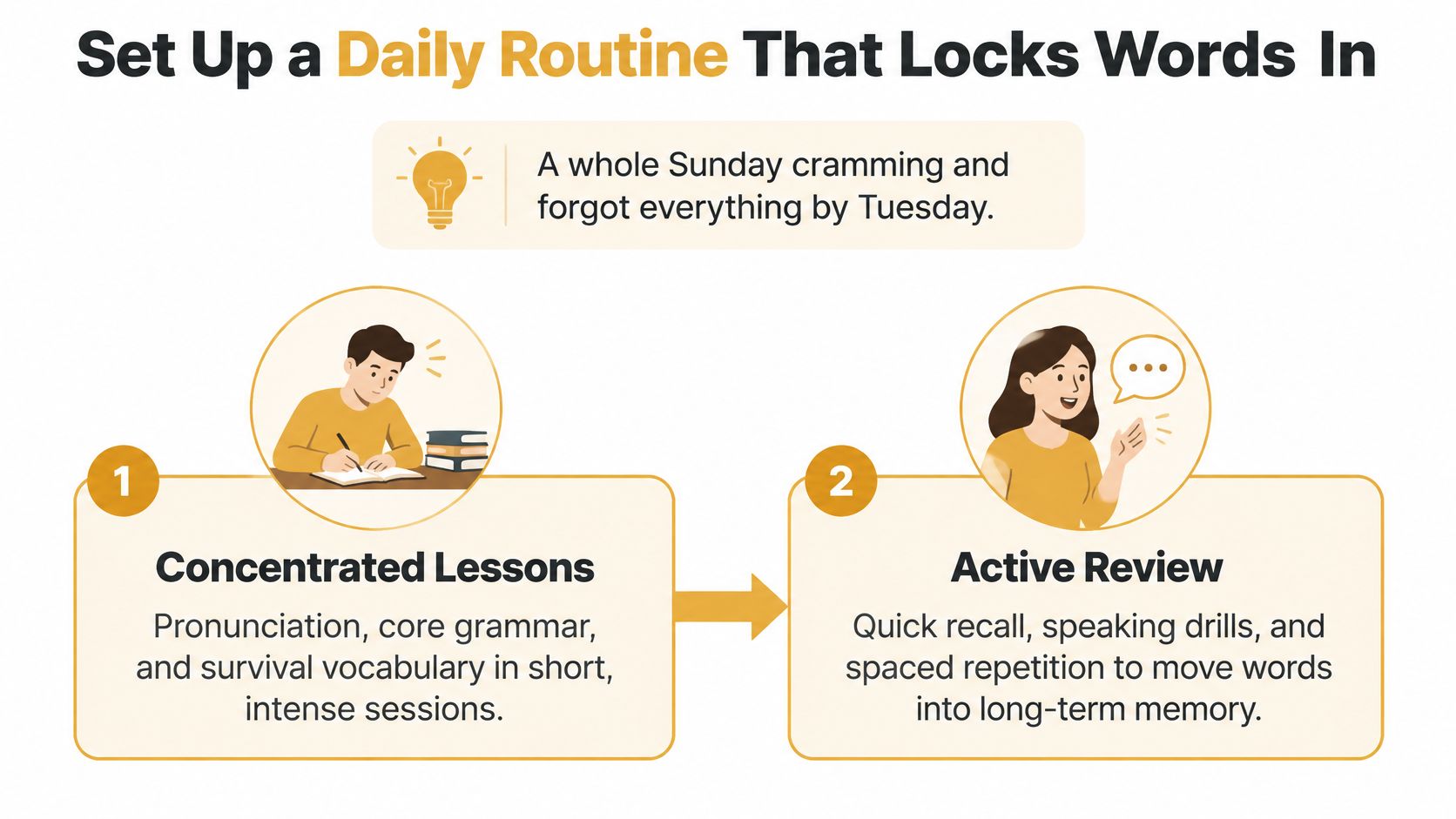
You spend a whole Sunday cramming and forget almost everything by Tuesday. The problem isn't necessarily effort; you may have spent the session recognizing answers rather than retrieving them.
Use a cycle of concentrated lessons followed by active review. A comparison of intensive French instruction found stronger immediate reading and writing results for the intensive group, while listening and speaking outcomes were broadly equivalent. That's a reason to assess skills separately, not assume a demanding timetable improves everything equally.
The routine below keeps instruction connected to recall and speaking.
A practical two-hour study session
Ten minutes of retrieval. Recall yesterday's expressions and a complete sentence before checking your notes, because retrieving language shows what you can access. The common slip is opening the notebook immediately; finish by saying the corrected sentence without looking.
Twenty-five minutes on a grammar pattern. Use a verb in three meaningful sentences, changing the person or situation so you practice a rule rather than memorize an example. Don't spend the block highlighting conjugations; end by answering an unexpected question with the pattern.
Twenty minutes on vocabulary chunks. Practice expressions such as je voudrais and est-ce que with interchangeable endings because these give you a usable starting point. Avoid collecting isolated nouns; close the activity by making a request from a picture or situation prompt.
Forty minutes of task-based speaking. Introduce yourself, order food, or describe last weekend, with the tutor changing details so you must choose your own words. The trap is reading a polished dialogue; finish with the same task without the script.
Fifteen minutes of slow listening and repetition. Listen for meaning, check the transcript, then repeat aloud to connect sound with the expressions you've practiced. Don't leave subtitles on throughout; finish by summarizing what you understood in simple French.
Ten minutes arranging spaced reviews. Schedule recall after one, three, and seven days so older material returns alongside new lessons. A reminder alone isn't practice; finish by answering an older prompt before closing your materials.
Protect the speaking block
If you're comparing course packages, ask how the timetable divides live instruction, independent exercises, and review. A package can sound intensive while leaving most spoken production to homework.
Keep a phone recorder, a notebook, and a flashcard tool such as Anki available. Put a situation on the front of a card, such as asking whether a train stops at Lyon, rather than placing the French answer where you'll see it first.
At the end of each session, say three new sentences unaided. If you can only recognize them on the page, repeat the production task before adding more material.
Pronunciation Priorities Based on Your First Language
An English speaker may pronounce rue like “roo” and say bon without its nasal quality. Applying familiar English vowel patterns to French can make otherwise correct sentences difficult to understand.
Your first language should inform the diagnostic, not determine a fixed remedial syllabus. A multilingual-classroom study in the Nigerian Journal of Humanities identifies language transfer, nasal sounds, silent letters, and liaison among constraints on communicative competence.
Diagnose before buying more pronunciation lessons
I'd use this sequence to set priorities:
- Record a baseline. Read a short paragraph for sixty seconds, then add a spontaneous introduction. Reading and free speech can reveal different problems.
- Choose the errors that obstruct understanding. Compare the recording with a native model and mark the three most consequential differences, preferably with a tutor.
- Separate nasal and oral vowels. Practice on, an, and in, including contrasts such as bon and bonne. Listen before repeating.
- Contrast u and ou. Alternate tu and tout. For French u, try keeping the tongue position of ee while rounding your lips.
- Connect familiar phrases. Practice liaison in les amis and vous êtes, then use those phrases inside sentences.
- Leave harmless accent features alone. A slightly different r can wait if listeners understand you. Don't let accent anxiety prevent useful speaking.
Our French pronunciation guidance for English speakers can help you prepare for a diagnostic rather than arrive with an unfocused request to improve your accent.
Adjust drills to the learner
- Spanish speakers: Nasal vowels and silent final letters deserve an early check, especially when spelling encourages an extra consonant.
- Arabic speakers: Check the rounded front vowel in tu and the nasal vowels, while accounting for the learner's particular Arabic variety.
- Mandarin speakers: Start by checking word endings, final consonants, and liaison in connected speech.
- English speakers: Check vowel substitutions before spending substantial time polishing the French r.
These are starting hypotheses, not guarantees about an individual. Learners whose first language has a different vowel system may need more vowel work than rhythm practice; the recording should decide.
Intelligibility is the buying criterion. A useful pronunciation lesson improves the phrases you need to say, not merely your ability to imitate isolated sounds.
Speaking and Listening Drills That Build Real Conversation
In the Institut français survey of Europeans aged 16–25, 40% identified a lack of opportunities to practice French in real-life conditions as their primary barrier, ahead of course cost and poor educational experiences. More vocabulary won't fix that on its own.
I'd choose fewer topics with more guided interaction. You need to handle a reply, an interruption, or a request to repeat, not just deliver your opening line.
A guided lesson gives the tutor room to change the situation while you're speaking.

Practice recovering when the script breaks
- Record a timed introduction. Speak for sixty seconds, replay it, and identify where you stopped communicating. Repeat from prompts rather than memorizing a polished paragraph.
- Add an interruption. In a café or pharmacy role-play, have the tutor ask you to repeat or clarify. Your task is to complete the transaction despite the disruption.
- Describe last weekend. Use the passé composé where appropriate. Hesitation is allowed, but repair a sentence that sends the wrong message.
- Rehearse repair language. Practice Pardon, vous pouvez répéter ? and Je ne comprends pas. Add Plus lentement, s'il vous plaît when speed is the problem.
- Write a short dictation. Transcribe three sentences from slow audio, check them, then say the corrected versions aloud. Look for words you know on paper but miss in connected speech.
- Hear another accent. Repeat the same situation with a different speaker. Keeping the task familiar lets you concentrate on listening rather than learning more vocabulary.
During our private lessons for adults, children, and companies, French is spoken exclusively, with slight exceptions for beginners. Those exceptions make an essential instruction understandable; they shouldn't turn the speaking task into an English discussion about French.
Use this video as additional listening material, then respond aloud rather than watching passively.
Transfer test: Can you complete the task when the other person gives an answer you didn't rehearse?
For a tourist, that task might be changing an order. For a relocating professional, it might be explaining a delayed arrival. Aim for an unscripted five-minute conversation by week two, with clarification allowed and no script on screen.
Assessment Checkpoints Against DELF B1 Rules
You've studied for a fortnight and feel more comfortable, but you still don't know whether you're exam-ready. Confidence alone can't answer that question.
The official DELF B1 candidate manual from France Éducation international sets a pass mark of 50 out of 100, with four components worth 25 points each, and makes any component score below 5 out of 25 eliminatory. The manual also gives the component timings summarized below.
What the scoring rules mean for your course
DELF B1 components, time and pass rules
| Component | Points | Time | Rule |
|---|---|---|---|
| Listening | 25 | About 25 minutes | Below 5 out of 25 is eliminatory |
| Reading | 25 | 35–45 minutes | Below 5 out of 25 is eliminatory |
| Writing | 25 | About 45 minutes | Below 5 out of 25 is eliminatory |
| Speaking | 25 | 10–15 minutes plus 10 minutes preparation | Below 5 out of 25 is eliminatory |
| Total | 100 | About 2 hours 5 to 2 hours 20 minutes including speaking preparation | Pass at 50 out of 100 |
The total duration is the sum of those component ranges, not a promise about the examination-day schedule. A strong speaker can still fail because of writing, so a conversation-only package isn't sufficient exam preparation.
For beginners, these rules provide a way to understand assessment priorities, not evidence that a short course will produce B1 readiness. Formal scoring needs level-appropriate tasks and a tutor who can apply the criteria.
Use a weekly evidence trail
- Week one: Record a self-introduction and complete diagnostic reading and listening tasks. Identify your weakest skill before allocating the remaining lessons.
- Week two: Complete a reading paper under the official time limit. Review whether errors came from vocabulary, misunderstood questions, or poor time management.
- Week three: Complete a timed writing task. Check task completion, register, organization, verb forms, and agreement before receiving rubric-based feedback.
- Week four: Complete a mock oral with the official preparation and speaking limits. Include examiner-style follow-up questions rather than treating it as an uninterrupted presentation.
Our DELF B1 preparation overview is a useful starting point when comparing general conversation support with exam-focused study.
Ask for separate component scores and specific correction priorities, not just an overall impression. A B2 candidate also needs argument practice from the outset; a comfortable personal introduction won't demonstrate the sustained reasoning that higher-level oral work demands.
Pick Your Support and Book a Free Assessment
Around the second week, the buying question becomes practical: is an app enough, would a class help, or is a tutor worth it for this deadline?
I'd decide by the work you need corrected, not by the quantity of content included.
- Choose self-study for maintenance. It's useful for keeping familiar vocabulary accessible, but it won't reliably diagnose why a listener misunderstands you.
- Choose a group for structure and peers. You gain a regular timetable and shared practice, but speaking turns are divided among learners.
- Choose private tutoring for a specific deadline. An exam weakness, work role, or pronunciation problem needs targeted correction.
- Choose intensive private blocks for imminent relocation. Longer blocks allow connected simulations, provided you can sustain attention and complete review between sessions.
Compare what happens during the lesson
Support options compared on the criteria that matter for a crash course
| Option | Speaking turns | Error feedback | Exam alignment | Best fit |
|---|---|---|---|---|
| Self-study app | Few, mostly recognition | Automatic and general | Low | Keeping existing vocabulary fresh |
| Group class | Shared, limited per learner | Periodic from the teacher | Medium, set syllabus | Structure and peer motivation |
| Private tutoring, online | Most of the session | Immediate and targeted | High when set to DELF level | Deadline-driven goals and exam prep |
| Intensive private, in person or online | Most of the session, in longer blocks | Immediate | High when set to DELF level | Relocation or work role within weeks |
These are practical comparisons, not guarantees about every app or classroom. A private lesson also loses value if the teacher speaks throughout and you only listen.
Use our guide to choosing a French tutor for adults to clarify what you need from the teaching relationship. Bring a real task, such as a client introduction or exam writing sample, rather than asking only for general improvement.
Put success stories in context
David, a marketing professional preparing to relocate to Paris for work, became fluent in French in 90 days after starting an intensive French course. Emma, who hadn't previously studied a foreign language seriously, mastered French in six months.
Those successes don't establish a universal timetable or a specific DELF result. Starting level, guided hours, and practice affect what another learner can achieve; neither story justifies promising beginner-to-fluent progress within a short crash course.
For your own plan, track CEFR-aligned tasks instead of choosing a fixed fluency date. Keep recordings and corrected work so progress means something more concrete than feeling that lessons are getting easier.
Check that exam support matches the level
The France Éducation international DELF B2 candidate manual specifies an oral examination lasting up to 20 minutes, with 30 minutes of preparation and an argued presentation of approximately 5–7 minutes, followed by interaction. That requires sustained argument, timed planning, and responses to challenges, not a longer version of beginner travel practice.
Before committing, clarify whether the proposed course includes recorded speaking practice, rubric-based feedback, and mock exams aligned with your target level. Our courses adapt to improving skills, with learners tested and extended during each session by experienced native French teachers.
If you're comparing lesson options for a deadline, Elite French Tutoring offers a complimentary 10–20 minute assessment call. We can assess your current French level and discuss your objectives so you can choose a manageable plan built around what you need to do in French.