Skip to content


You're comparing a train fare, an apartment listing, and an airport transfer when you realize they all depend on each other. The cheaper train leaves from a station across Paris, the apartment host hasn't confirmed late check-in, and your flight lands at Charles de Gaulle at 10 p.m. with tired kids and four suitcases.
I'd settle those connections before buying anything nonrefundable. Most frustrating travel problems begin with a booking that looked sensible on its own but didn't fit the rest of the day.
The answer isn't to buy the most expensive option. It's to spend where flexibility, assistance, or a simpler journey will make a genuine difference, then skip extras you won't use.
These French travel tips focus on eight decisions: rail, airport transfers, museums, rental cars, accommodation, dining, guided tours, and mobile data. Each comes with a buy-or-skip recommendation and practical French you can use when a booking screen or conversation gets complicated.
We'll compare the actual journey, not just the advertised price. That means checking the station, the stairs, the cancellation terms, and whether your phone will work when you need help. A little preparation leaves more room for the enjoyable parts of France, without turning your holiday into a scheduling exercise.
Table of Contents
- 1. Booking TGV and Ouigo Train Tickets for Paris to Regional France
- 2. Choosing the Right Paris Airport Transfer Between RER B, Roissybus, and Private Car
- 3. Reserving Timed Entry for the Louvre and Paris Museum Pass Options
- 4. Renting a Car in France and Checking Crit'Air, Licenses, and Rental Choices
- 5. Booking Accommodation in France Across Hotels, Gîtes, and Short-Term Rentals
- 6. Using Restaurant Reservation Platforms and Choosing the Right French Dining Format
- 7. Booking Guided Tours and Skip-the-Line Experiences from Licensed Guides
- 8. Choosing a Mobile Plan or eSIM for France Across Roaming and Local Options
- How the eight France travel decisions compare on cost, best use, and main constraint
- Your France Trip Checklist and Next Steps
1. Booking TGV and Ouigo Train Tickets for Paris to Regional France
For Paris to Lyon, Marseille, or Bordeaux, I'd compare TGV INOUI and OUIGO before considering a rental car. High-speed rail is a sensible city-to-city choice, but the lowest fare isn't necessarily the lowest total cost.
Compare the departure station, arrival station, luggage allowance, seat options, and change conditions. OUIGO can suit travelers with light bags and firm plans; TGV INOUI may suit travelers who value its available service and fare options, but don't assume every ticket is flexible.
Buy flexibility only when you need it
For eligible TGV INOUI and mandatory-booking INTERCITÉS tickets, SNCF Connect's fare conditions allow free exchanges or cancellations up to seven days before departure. Read the conditions attached to your actual ticket, including any fare difference payable when changing trains.
Say you're traveling to Lyon for meetings that might finish late. A changeable ticket may justify a higher purchase price; for a settled holiday itinerary, a restricted fare may be perfectly reasonable.
- Check the station: Gare de Lyon and Gare Montparnasse aren't interchangeable. Confirm the exact departure point before arranging your hotel transfer.
- Compare the complete basket: Add required luggage and seat options before deciding which operator is cheaper.
- Save access offline: Download your e-ticket and keep a screenshot of the booking reference.
Use our French travel itinerary guide to connect regional journeys without overloading your arrival day.
Buy or skip: Buy a fare whose restrictions you can accept. Skip flexibility you won't use, but don't gamble an important meeting on an inflexible return.
French to use: Ce billet est-il échangeable ? means Is this ticket exchangeable? De quelle gare part le train ? means Which station does the train leave from?
2. Choosing the Right Paris Airport Transfer Between RER B, Roissybus, and Private Car
Count your passengers and bags before comparing airport transfers. A solo traveler staying near an RER B station faces a different decision from a parent managing children, luggage, and an unfamiliar hotel entrance.
Use this visual comparison as a starting point, then verify current services and routes before booking.
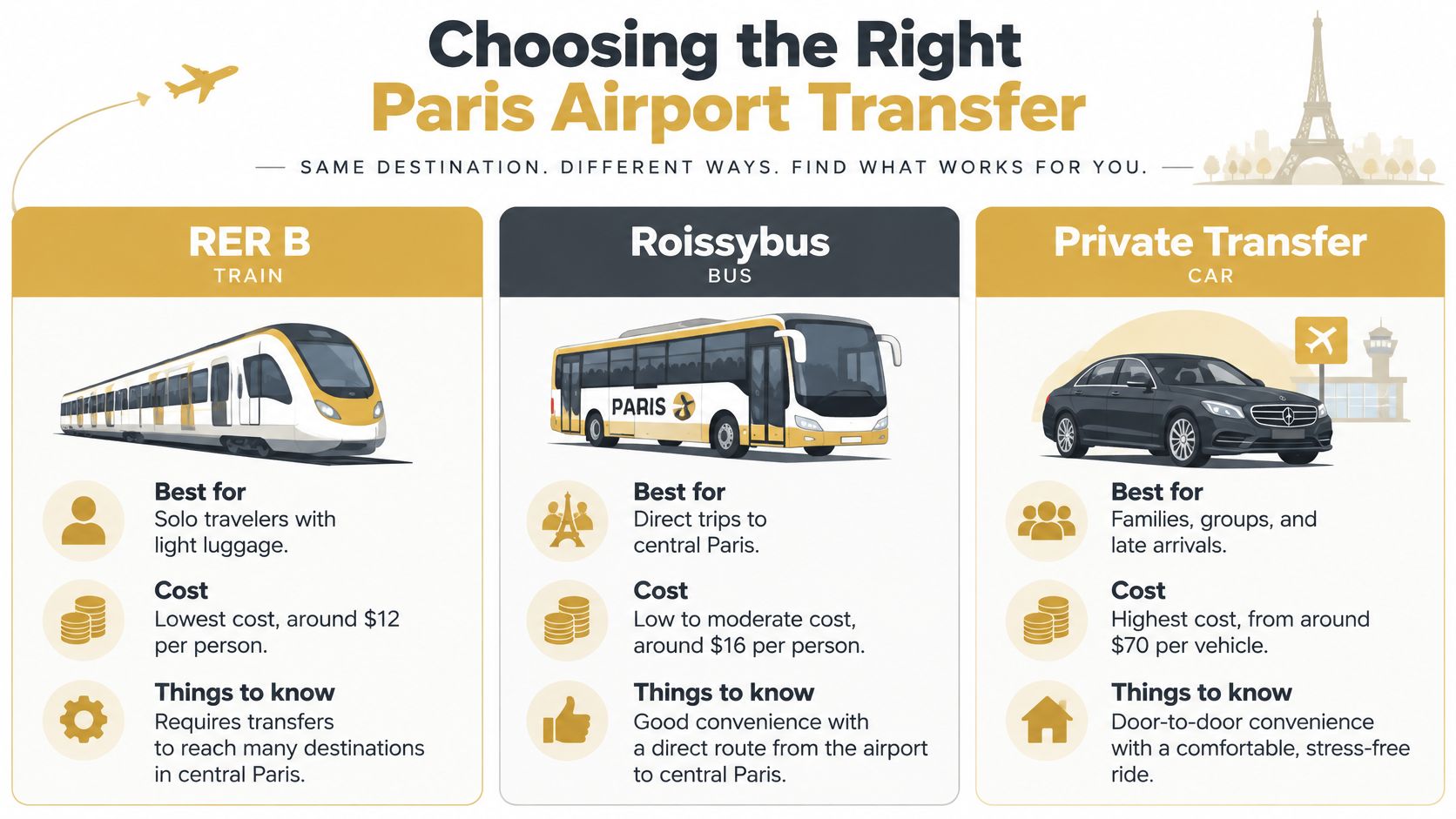
The RER B makes sense when its route fits your destination and you can manage your luggage through stations. For Roissybus or any airport coach shown in an older guide, verify that the service operates on your dates rather than building your arrival around an outdated route.
Pay for a simpler arrival when it removes a real obstacle, not merely because a booking website calls it premium.
A pre-booked private car can be worthwhile for a family heading to accommodation far from a convenient station. Confirm the vehicle's luggage capacity, child-seat arrangements, terminal meeting point, and policy for delayed flights.
For a visual introduction to airport transport, this video can help you prepare questions about your route.
Buy or skip: Buy a private transfer when accessibility, baggage, or arrival logistics justify it. Skip it when a straightforward rail journey gets you close to your hotel.
Use official taxi stands or your confirmed pickup service, not unsolicited offers inside arrivals.
French to use: Où est le point de rendez-vous ? means Where is the meeting point? Pouvez-vous nous déposer à cette adresse ? means Can you drop us at this address?
3. Reserving Timed Entry for the Louvre and Paris Museum Pass Options
A museum pass is only good value if it covers places you want to visit. I'd choose your museums first, check available entry slots, and compare the pass against individual tickets afterward.
Don't assume that holding a Paris Museum Pass replaces every reservation requirement. Check each attraction's official booking instructions, including the Louvre, Musée d'Orsay, and Sainte-Chapelle.
Have your admission confirmation ready before reaching the entrance.

Compare the itinerary you'll actually enjoy
Say a couple wants an unhurried Louvre visit, café stops, and time exploring neighborhoods. Individual tickets may fit better than a pass that encourages them to squeeze in attractions they wouldn't otherwise choose.
A museum-focused traveler should compare the pass's current inclusions, validity rules, and reservation availability against the same itinerary bought separately. Include any booking charges and excluded exhibitions in that comparison.
- Check closures individually: Museums don't share a universal closing day. Verify the calendar for every planned visit.
- Separate admission from queues: A timed reservation doesn't mean you can bypass security.
- Protect your arrival day: Avoid a tightly timed museum booking immediately after a flight or an intercity journey.
Buy or skip: Buy the pass when its included visits fit your pace and cost less than your intended individual purchases. Skip it if you're buying mainly to feel that you've covered Paris.
French to use: Faut-il réserver un créneau avec ce pass ? means Do I need to reserve a time slot with this pass? Où est l'entrée pour les réservations ? means Where is the entrance for reservations?
4. Renting a Car in France and Checking Crit'Air, Licenses, and Rental Choices
Rent for the countryside you want to explore, not for the entire trip by default. A car can be useful for villages in Provence, vineyard visits in Burgundy, or rural accommodation in the Loire, while becoming an expensive inconvenience in central Paris.
Consider a family taking the train south, then collecting a rental near their regional base. They avoid driving across Paris and pay for the car only when it serves their itinerary.
Check the driver and vehicle separately
License acceptance depends on your circumstances, so confirm the rules for your issuing country and the rental company's requirements. Check whether you need an International Driving Permit or an official translation alongside your original license.
For low-emission zones, verify current local restrictions and the vehicle's Crit'Air status. With a French rental, ask the agency whether the vehicle already has the required certificate rather than ordering a duplicate.
- Choose the transmission deliberately: Reserve an automatic if you can't comfortably drive a manual.
- Compare insurance exclusions: Check the excess, deposit, tires, glass, roadside assistance, and your card's eligibility conditions.
- Inspect at pickup: Photograph existing damage and confirm the fuel or charging return requirements.
Road safety deserves attention: the European Commission's France road-safety overview reports that 3,181 people were killed in mainland France road crashes in 2024. Don't collect a car after an exhausting flight if you're too tired to drive safely.
Buy or skip: Buy a regional rental when it solves rural access. Skip a car for a city itinerary with workable public transport.
French to use: Le véhicule a-t-il une vignette Crit'Air ? means Does the vehicle have a Crit'Air sticker? Quel est le montant de la franchise ? means What is the insurance excess?
5. Booking Accommodation in France Across Hotels, Gîtes, and Short-Term Rentals
An attractive apartment isn't a bargain if you can't comfortably reach its front door. Before paying, verify the floor, elevator access, entrance steps, sleeping arrangements, and arrival procedure.
I'd choose accommodation around the stay you're planning. A hotel suits travelers who value reception support; an apartment offers domestic space; a rural gîte works best when you've also solved transport, shopping, and check-in.
Before you pay: Ask about the feature you need in concrete terms. Accessible, quiet, and family-friendly can mean different things to different hosts.
For example, a traveler accompanying a wheelchair user should request doorway measurements, bathroom details, and step-free route information. A general accessibility label isn't a substitute for checking the route from the pavement to the bed.
Compare the whole stay
For friends booking a Dordogne gîte, kitchen facilities and shared space may outweigh the convenience of hotel reception. However, they should price the rental car and check where they'll buy food before treating the accommodation as a saving.
- Confirm arrival access: Ask what happens if your flight is delayed or the host isn't present.
- Check listing details: For a Paris short-term rental, look for registration information and query anything missing or inconsistent.
- Read the total: Review cleaning charges, deposits, local tourist tax, and cancellation terms before checkout.
Our Paris vacation planning guide can help you match a neighborhood to the journeys you'll make.
Buy or skip: Buy location, verified accessibility, and workable check-in. Skip photogenic accommodation that creates daily transport problems.
French to use: Y a-t-il un ascenseur jusqu'à l'appartement ? means Is there an elevator all the way to the apartment? Peut-on arriver tard ? means Can we arrive late?
6. Using Restaurant Reservation Platforms and Choosing the Right French Dining Format
Choose the meal format before choosing the booking platform. A Lyon bouchon, a neighborhood brasserie, and a tasting-menu restaurant offer different experiences, and the most elaborate option isn't automatically the best fit.
For a working lunch, I'd compare the lunch formule with ordering à la carte. For a family celebration, I'd prioritize suitable dishes, seating, and a reservation time everyone can manage.
Keep the menu and reservation details accessible when you arrive.

Reserve the meal you want
TheFork can help compare available tables, but read the conditions attached to promotions and set menus. Direct booking is useful when you need to discuss allergies, mobility, a quiet table, or children's options.
Say your team needs lunch before a presentation. Ask whether the restaurant can accommodate your departure time, rather than assuming a fixed menu guarantees fast service.
- Check what's included: Drinks, supplements, and optional courses can change the comparison.
- Confirm dietary needs: Describe the ingredient or allergy clearly; don't rely on a vague preference note.
- Cancel promptly: Review any card guarantee and no-show conditions before reserving.
Our French dining etiquette guide explains the interactions around ordering and paying.
Buy or skip: Book a set menu when the dishes and pace suit you. Skip a prepaid dining experience that leaves little flexibility for appetite, children, or changing plans.
French to use: Je voudrais réserver une table au nom de Martin. means I'd like to reserve a table under Martin. Avez-vous une formule déjeuner ? means Do you offer a lunch set menu?
7. Booking Guided Tours and Skip-the-Line Experiences from Licensed Guides
A skip-the-line label doesn't tell you whether the guide is good, the group is manageable, or the advertised admission is included. Read the itinerary as carefully as you'd read a train ticket.
I'd pay for interpretation when it adds something you value: architectural context, a focused museum visit, or a route adapted to your family's interests. I wouldn't buy a tour because the listing makes ordinary admission sound complicated.
Buy expertise, not a vague promise
For a Versailles visit, compare a guided palace experience against independent admission with an audioguide. A small-group tour may suit travelers who want questions answered, while independent entry offers more control over pace.
For a corporate group interested in architecture, a private walking tour may be a better purchase than a general sightseeing package. Confirm the subject focus and guiding language in writing before paying.
Priority admission is not permission to bypass security, and a meeting-point walk is not necessarily a guided visit inside the attraction.
Check credentials appropriate to the venue, including a guide-conférencier qualification where relevant. Read recent reviews for comments about explanations, audibility, organization, and the actual group experience.
- Confirm inclusions: Identify admission, transport, headsets, and any areas excluded from the visit.
- Check the meeting point: Know whether you meet outside the attraction or at an operator's office.
- Read cancellation terms: Distinguish your cancellation from the operator canceling or the venue closing.
Buy or skip: Buy a clearly described experience with suitable expertise and group size. Skip vague access claims without specific inclusions.
French to use: Le billet d'entrée est-il compris ? means Is admission included? La visite se déroule-t-elle en anglais ? means Is the tour conducted in English?
8. Choosing a Mobile Plan or eSIM for France Across Roaming and Local Options
Keep your home plan if its France roaming allowance already meets your needs. Buying an eSIM on top of adequate included roaming adds expense without solving a problem.
Otherwise, compare a roaming add-on, a French prepaid SIM, and a travel eSIM. Check device compatibility, carrier restrictions, activation rules, coverage, hotspot permission, and whether the plan includes calls or only data.
An Opodo study summarized in France travel-market reporting found that 78% of travelers planned trips online in 2024. For your own trip, the practical priority is having reliable access to the bookings you've made, with an offline backup.
Test before you leave
Say you're visiting Paris and Lyon for work. A data-only eSIM may handle maps and messaging, but you still need a plan for hotel calls and authentication messages sent to your home number.
A family sharing a hotspot should check that tethering is permitted and remember that everyone loses access when the hotspot phone runs flat.
- Compare the complete price: Check validity, activation timing, fees, and what happens when the allowance runs out.
- Set the correct data line: On a dual-SIM phone, prevent accidental roaming on the wrong plan.
- Save essentials offline: Download maps, tickets, hotel details, and the transfer meeting point.
Our French telephone etiquette guide can help when an app isn't enough and you need to call.
Buy or skip: Buy the smallest suitable plan with the functions you need. Skip a large data allowance that lacks essential calling or hotspot features.
French to use: Ce forfait comprend-il les appels ? means Does this plan include calls? Pouvez-vous m'envoyer la confirmation par SMS ? means Can you send the confirmation by text?
How the eight France travel decisions compare on cost, best use, and main constraint
Costs depend on route, dates, group size, and booking terms. Use these typical cost levels to compare options, then check the final price before you book.
| Item | Best For | Cost Level | Key Constraint |
|---|---|---|---|
| Booking TGV and Ouigo Train Tickets for Paris to Regional France | Comparing high-speed rail options for regional trips | Low to high, depending on operator and timing | Budget fares have stricter luggage and change rules |
| Choosing the Right Paris Airport Transfer: RER B, Roissybus, or Private Car | Matching airport transport to group size, luggage, and arrival time | Lowest for RER B; highest for private transfer | Public transit can be difficult with heavy luggage |
| Reserving Timed Entry for the Louvre and Paris Museum Pass Options | Planning museum visits around timed entry and a multi-site pass | Per-site tickets or an upfront multi-day pass | Popular time slots can sell out in advance |
| Renting a Car in France: Crit'Air Rules, Licenses, and Rental Choices | Exploring rural regions and villages | Moderate to high, plus fuel and tolls | City parking, low-emission rules, and license requirements |
| Booking Accommodation in France: Hotels, Gîtes, and Short-Term Rentals | Choosing stays based on service, space, or rural setting | Budget to high-end, depending on location, season, and property | Verify accessibility, registration, and cancellation terms |
| Using Restaurant Reservation Platforms and Choosing the Right French Dining Format | Comparing dining options and securing busy restaurant tables | Reservations are generally free; meals range from inexpensive cafés to high-end restaurants | Popular restaurants may book up, and no-shows may incur charges |
| Booking Guided Tours and Skip-the-Line Experiences from Licensed Guides | Choosing cultural tours by group size, language, and level of personalization | Lower per person for larger groups; higher for private guides | Tour quality and skip-the-line access vary |
| Choosing a Mobile Plan or eSIM for France: Roaming, Local SIMs, and Data Options | Staying connected based on trip length and data needs | Low for a small data allowance; higher for more data, calls, or longer validity | eSIM requires a compatible, unlocked phone |
Your France Trip Checklist and Next Steps
Before paying the remaining balances, review your bookings as a connected journey. I'd start with arrival and work forward, checking that each reservation leaves enough room for the next.
A flexible hotel booking won't solve an impossible airport connection. Likewise, a cheap regional rental won't help if its collection desk closes before your train arrives.
- Rail: Compare complete fares, stations, luggage rules, and change conditions.
- Airport transfer: Confirm the route or pickup point, baggage capacity, and delayed-arrival arrangements.
- Museums: Reserve required entry slots and compare passes against your intended visits.
- Car rental: Check license documents, insurance, transmission, and restrictions along your route.
- Accommodation: Verify access, check-in, total charges, and cancellation terms.
- Restaurants: Reserve important meals and communicate dietary or timing needs.
- Tours: Confirm guide credentials, language, admission, group format, and refunds.
- Mobile data: Activate the right plan and save essential documents offline.
Preparation also means deciding what you'll do if something changes. Save the operator's contact details, keep booking references together, and know where to check official disruption notices rather than relying entirely on an aggregator.
For qualifying exceptional rail disruptions, SNCF Voyageurs' guidance says affected passengers may need to cancel before departure to obtain a full refund. Don't assume that an unused ticket will automatically be reimbursed.
Focused language preparation can make these decisions easier to carry out. David, a marketing professional preparing to relocate to Paris for work, became fluent in French in 90 days after starting an intensive course with us.
His result isn't a timetable every traveler should expect. It shows what focused preparation can achieve when the learning has a clear purpose; for a holiday, your immediate goal may be explaining a delayed arrival or understanding a booking condition.
If you'd like help preparing for those conversations, we offer a complimentary 10-20 minute call at Elite French Tutoring to assess your current level and goals. We can discuss practical French for the counters, restaurants, and taxi stands on your route, without treating travel preparation as a requirement to master everything.
Start with J'ai une réservation (I have a reservation), Pouvez-vous parler plus lentement ? (Can you speak more slowly?), and Pouvez-vous me l'écrire ? (Can you write it down for me?). I'd rather you use a few useful phrases confidently than memorize a long list you can't retrieve when you're tired.