Skip to content

You've drafted an email to a French client three times already. The English version feels polished, but every French version sounds either stiff, vague, or oddly blunt. That's the moment most professionals realize the primary challenge isn't vocabulary. It's choosing the right level of formality for the situation in front of you.
I see this constantly in coaching sessions with executives, founders, legal teams, and managers working across France, Belgium, Switzerland, Quebec, and Francophone Africa. Strong professionals often know enough French to be understood. What slows them down is french business writing that sounds culturally right. A message can be grammatically acceptable and still miss the mark if the tone, structure, or closing formula feels off.
The divergence in expectations holds particular importance. Traditional business French still expects visible structure, hierarchy, and politeness. At the same time, startup teams and modern French Tech environments often prefer tighter, more active writing. If you don't know which code you're stepping into, you can sound either too cold or too ceremonial.
Table of Contents
The Core Principles of French Business Communication
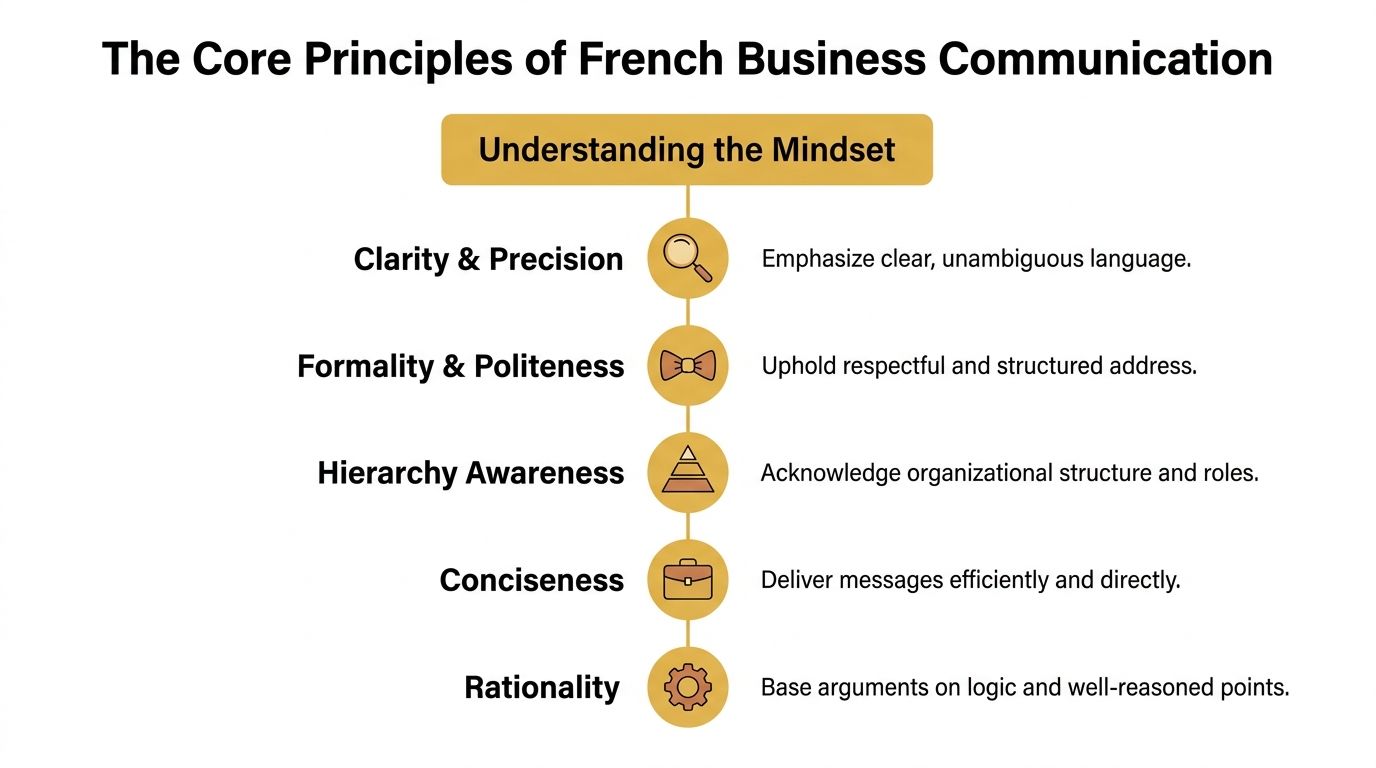
The first mistake I try to stop early is treating French business writing like translated English. That almost always produces writing that is technically understandable but professionally misaligned. In French, the document itself carries signals about respect, seriousness, and competence.
French business writing is defined by a mandatory, rigid structural framework that requires specific formal elements, including headers, a precise date, a subject line, a formal salutation, organized body paragraphs, a formal closing, and a signature, as explained in this overview of French professional correspondence. In practice, that means readers often judge the message before they judge the argument.
Respect shows up in the format
French professional communication tends to make hierarchy visible. Titles matter. Salutations matter. The distinction between vous and tu matters. Even spacing, margins, and the sequencing of elements can shape how credible your message feels.
When English-speaking professionals write directly to “save time,” they often remove the exact features French readers use to assess professionalism. That's why a short English-style email can land as abrupt rather than efficient.
Practical rule: In French business writing, efficiency matters, but respect must remain visible on the page.
A useful starting point is to think in three layers:
Relationship layer
Are you writing to a prospect, senior executive, public institution, internal colleague, or startup founder? Each audience tolerates a different level of directness.Document layer
An email, memo, proposal, and report don't follow the same rhythm. French readers expect the form to fit the purpose.Language layer
Word choice, sentence structure, and formality all signal whether you understand the professional context.
Logic matters as much as politeness
French business writing also values structured reasoning. In more formal contexts, arguments often follow a Thesis, Antithesis, Synthesis pattern, with complete and elegant sentences rather than a string of bullets, as noted in this guide to French workplace norms. That doesn't mean every email should sound academic. It means your ideas should unfold in a deliberate order.
I often tell students to stop asking, “What phrase should I use?” and start asking, “What kind of reasoning is my reader expecting?” That shift changes everything.
Here's what usually works:
State the context clearly so the reader knows why you're writing.
Develop the point logically instead of dropping into fragmented shorthand.
Close with a respectful next step that keeps the exchange smooth.
If you're still learning those patterns, it helps to study broader French language rules and etiquette alongside business-specific examples. The writing improves faster when you understand the cultural logic behind the formulas.
Comparing Formal vs Modern French Writing Styles
One of the biggest professional risks isn't being too formal. It's using the wrong formal level for the industry. A bank, law office, ministry, and family-owned manufacturer may still expect conventional phrasing. A startup team in Paris or a growth-stage SaaS company may prefer concise, active communication that gets to the point faster.
That contrast is real. Existing content on French business writing overwhelmingly prescribes rigid formulas, creating a gap for the modern French Tech and startup ecosystem where the norm has shifted to concise, active styles like “Cordialement” and a focus on impactful, memorable writing over complex vocabulary, according to this French Tech writing perspective.
French Writing Style Comparison Traditional vs. Modern Startup
| Element | Traditional/Corporate | Modern/Startup |
|---|---|---|
| Greeting | Formal salutation with title and surname | Still respectful, but less ceremonial |
| Opening | Longer framing before the request | Faster entry into the purpose |
| Sentence style | More elaborate and layered | Shorter, active, easier to scan |
| Requests | Indirect and carefully cushioned | Polite, but more concise |
| Vocabulary | Conventional, sometimes elevated | Clear, practical, memorable |
| Closing | Can be highly formulaic | Often ends with Cordialement |
| Overall impression | Institutional, careful, hierarchical | Human, efficient, brand-aware |
When traditional style works better
If the message involves compliance, negotiation, high-stakes introductions, official review, or a senior audience, traditional style is usually safer. In those contexts, formal signals don't feel old-fashioned. They feel competent.
A few situations where I advise clients to stay conservative:
First contact with a new partner
Don't try to sound relaxed too early.Communication with legal, finance, HR, or public bodies
These readers often expect stronger formal framing.Written negotiation or conflict-sensitive topics
Formality gives the exchange structure and distance.
When modern style works better
Modern startup writing isn't sloppy French with the corners cut off. Good startup-style French is still polished. It's just tighter. The tone is often more conversational, the verbs are more active, and the reader doesn't have to dig through ceremonial phrases to find the point.
Use modern style when speed, clarity, and relationship-building matter more than institutional display.
I encourage professionals to evaluate four things before drafting:
Audience seniority
Industry culture
Whether it's first contact
Whether the message may be forwarded upward
If any of those factors point toward caution, write one level more formal than your instinct suggests.
What doesn't work
The weakest option is a hybrid that mixes casual English instincts with random formal French phrases. That's how you get messages that open stiffly, pivot into blunt demands, and end with a closing that doesn't match the tone.
I've edited many emails that looked like this in spirit:
very formal opening
abrupt request in the present tense
short final line translated from English
closing formula chosen by guesswork
That combination feels unstable. French readers notice.
The good news is that once you learn the difference between traditional corporate French and modern professional French, your writing becomes much easier to control. You stop copying templates blindly and start matching the tone to the room.
A Practical Guide to Writing Professional French Emails
Most business problems in French writing show up first in email. That's where professionals try to move quickly, and that's where tone mistakes become visible.
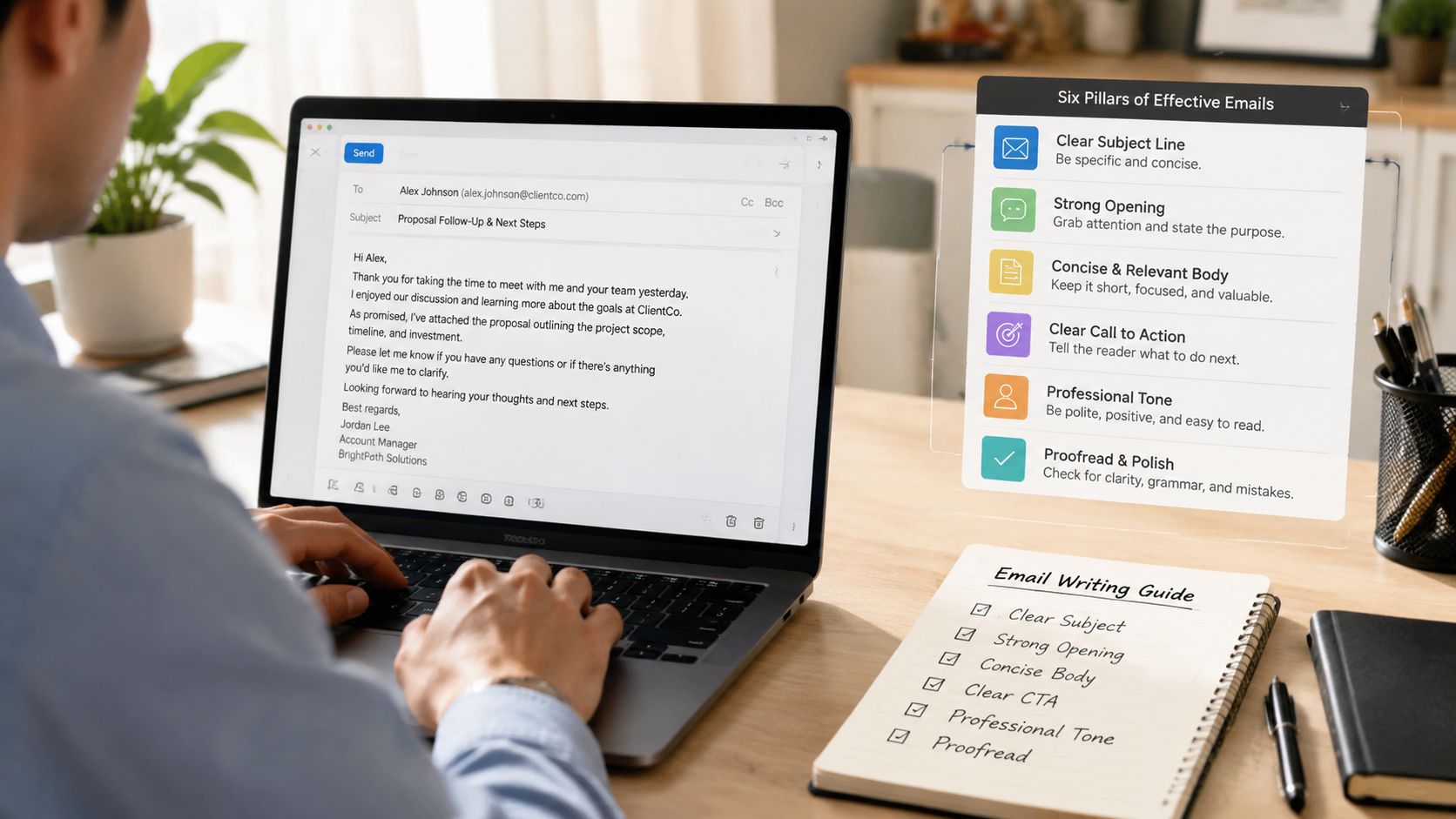
A strong French business email has a recognizable structure. It should feel courteous, readable, and intentional from the subject line onward.
Start with the six pillars
A reliable business email in French usually includes these core moves:
A clear subject line labeled Objet
A formal greeting adapted to the relationship
Exclusive use of vous
A brief contextual opening
Requests written in the conditional
A closing formula that matches the setting
The conditional is the point many learners underestimate. A critical success factor in French business emails is the mandatory use of the conditional mood, such as “je voudrais” or “pourriez-vous,” to soften requests, and neglecting this can reduce the likelihood of a favorable response by over 40% in formal corporate settings, according to this business email guide.
That statistic matches what I see in real edits. The direct present tense often sounds efficient to English speakers and pushy to French readers.
A simple email blueprint
Here's the sequence I recommend in lessons:
Objet
Keep it concrete and easy to scan.Greeting
Use a proper salutation, not a casual approximation.Opening line
Anchor the context. Why are you writing now?Purpose of the message
State the request or update clearly.Action line in the conditional
Ask without sounding demanding.Closing
End with the right degree of professionalism.
“Polite doesn't mean vague. In French email writing, the goal is controlled clarity.”
A real student success story
One of my students was a marketing director at a U.S. firm managing partnerships with French counterparts. Her English emails were excellent. Her French emails were accurate enough, but she kept telling me the same thing: replies felt delayed, lukewarm, or evasive.
When we reviewed her drafts, the pattern was obvious. She was translating her English structure too closely. Her messages opened quickly, asked for action in the present tense, and closed with formulas that didn't fit the relationship.
We changed three things.
First, we rewrote her requests in the conditional.
Second, we added a short contextual opener before the ask.
Third, we adjusted her closing formulas based on whether she was writing to a long-term partner, a senior stakeholder, or a new contact.
Her emails immediately sounded calmer and more professional. More importantly, she stopped second-guessing every sentence. That's usually the real win. Better writing reduces hesitation.
If your team needs that kind of applied practice, a focused French for business program can help you work with your actual emails, meeting follow-ups, and client communication instead of generic classroom examples.
A before and after shift
Here is the kind of change I often make in sessions:
Too direct
Envoyez-moi le document aujourd'hui.Professionally aligned
Pourriez-vous m'envoyer le document aujourd'hui, s'il vous plaît ?
The second version isn't weaker. It's more workable in a French professional setting.
A short demonstration helps:
What to keep on your desk
I tell busy professionals to keep a mini checklist next to their inbox:
Check the register
Is this first contact, senior contact, or startup contact?Check the verb mood
If you're asking for something, the conditional is often the safer choice.Check the closing
Your final line should match the tone of the rest of the message.Check the visual shape
Dense blocks and abrupt one-liners both create friction.
Once those habits are in place, French business email stops feeling mysterious. It becomes procedural, and that's exactly what most professionals need.
Structuring Formal Reports and Internal Memos
Reports and internal memos demand a different skill set from email. The standard is higher, the structure is stricter, and readers expect you to guide them through the document instead of dropping information onto the page.
In formal French documentation, structure is part of the argument. French technical methodology adheres to the Rule of 4 Cs, “Correct, Concis, Concret, Convaincant,” and requires a logical “annonce de plan” at the introduction, which must be strictly respected throughout the document, as outlined in this technical writing reference.
Build the introduction first
Many English-speaking professionals draft the body and improvise the introduction later. In French report writing, that often creates a weak result. The introduction needs to announce the path the document will follow.
A strong opening usually does three jobs:
Defines the context
States the objective
Announces the plan
That announced plan matters. If you promise a sequence, the rest of the document should follow it. When students ignore that rule, the writing starts to feel fragmented even when the content itself is solid.
Use the 4 Cs as an editing tool
The Rule of 4 Cs works well as a revision framework:
Correct
Grammar and syntax need to be clean. Errors distract and lower confidence in the content.Concis
Define acronyms and keep the wording efficient. Concise in French doesn't mean skeletal. It means controlled.Concret
Avoid airy phrasing. State what happened, what matters, and what follows.Convaincant
The reasoning must hold together from beginning to end.
A French report doesn't just present information. It shows that the writer can organize thought with discipline.
A practical memo framework
For internal memos, I often recommend this sequence:
| Part | What it should do |
|---|---|
| Introduction | Establish context and announce the plan |
| Development Part 1 | Present the current state or issue |
| Development Part 2 | Analyze implications or options |
| Conclusion | State the decision, recommendation, or next step |
This isn't flashy, but it works. French managers often respond well to writing that feels ordered, transparent, and easy to follow.
For professionals who need guided practice with reports, presentations, and internal documentation, one option is to learn professional French with a teacher using your own materials rather than generic prompts. That format is especially useful when your role involves memos, board notes, policy summaries, or cross-border internal communication.
Common Mistakes That Undermine Your Credibility
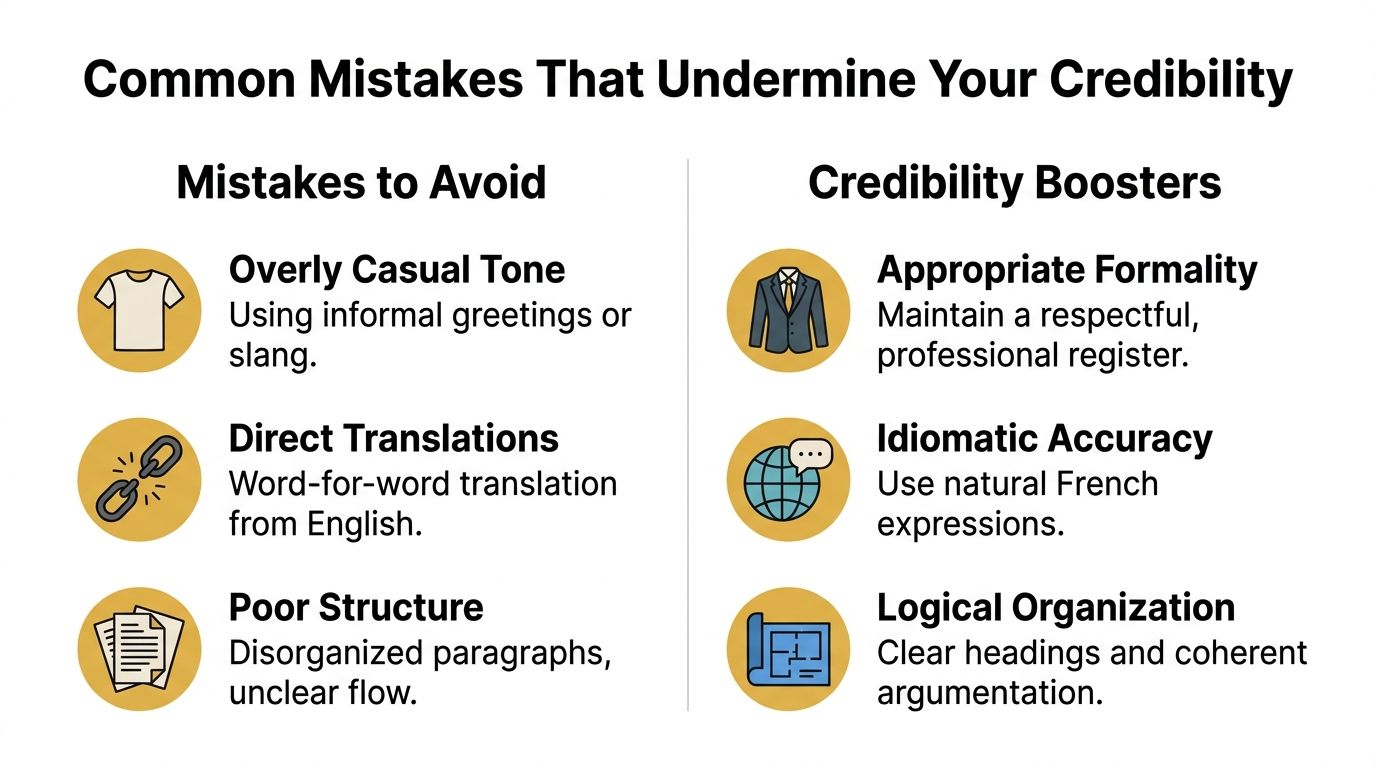
Most credibility problems in French business writing aren't dramatic grammar failures. They're small signals that tell the reader you don't yet control the register. Those signals matter because professional French is highly coded. Readers notice whether you understand the conventions, and they notice fast.
One rule is especially important in first contact. French business emails must always include a clear subject line labeled “Objet” and begin with the formal greeting “Monsieur,” or “Madame,” never using “Cher/Chère” in first contact because it is considered too familiar for professional settings, as explained in this guide to French business email formulas.
The mistakes I correct most often
Some errors keep appearing across industries because they come from reasonable instincts in English.
Opening too casually
“Cher” feels natural to many English speakers because “Dear” is standard in English business writing. In French first contact, it can sound overly familiar.Translating tone instead of meaning
A sentence can be grammatically translated and still sound culturally wrong.Dropping structure for speed
Short isn't always clear. If the message loses its greeting, context, or proper closing, it can feel abrupt.Guessing the closing formula
Closings are not interchangeable. A mismatch at the end of the email can undo an otherwise solid draft.
Why these details carry so much weight
In business French, etiquette is part of competence. If the greeting, request style, or closing sounds off, the reader may start questioning your judgment before they evaluate the substance of your message.
That's why I push back when students say, “They'll understand what I mean.” Yes, they probably will. But being understood and sounding credible are not the same thing.
Credibility check: If your email could be mistaken for an English message translated line by line, revise it.
A quick do and don't list
Here's a shortlist I use in proofreading sessions:
Do keep “Objet” visible
It helps the reader classify the message immediately.Do open with Monsieur or Madame in first contact
Start formal, then relax only when the relationship clearly allows it.Don't use Cher or Chère too early
What feels warm in English may feel intrusive in French.Don't force literal translations
Rewrite for French rhythm, not English sentence shape.Do review the closing formula last
Endings carry more social meaning than many learners expect.
A lot of professionals also struggle with closings such as Cordialement, Bien à vous, and longer formal formulas. I usually teach them by context, not by memorization. If you learn where each one fits, you stop sounding uncertain. If you memorize lists without context, you'll hesitate every time you hit “send.”
For a deeper cleanup of recurring issues, I often recommend reviewing common mistakes in French alongside your own business writing samples. That combination makes patterns visible very quickly.
One more issue professionals overlook
When the writer is not a French speaker, internal reports may also need to be available in French for legal and workplace reasons. French language guidance from the Ministry of Culture notes that internal reports should be translated into French, and business applications and intranet tools must be available to employees in French or their country's work language. If your company operates in a French-speaking environment, writing choices can affect not only tone but also compliance.
Your Action Plan for Mastering French Business Writing
The fastest improvement comes from treating French business writing as a decision process, not a phrase collection.
Start with the audience. Decide whether you're writing to a traditional corporate reader or someone in a more modern startup-style environment. Then build the message around the format that reader expects.
Use this working checklist:
Choose the right register based on industry, seniority, and whether it's first contact.
Shape the document properly so the format supports your credibility.
Write requests politely instead of translating English directness.
Keep the logic visible in emails, memos, and reports.
Proofread the greeting and closing last because that's where tone mistakes often hide.
If your goal is professional fluency, aim beyond survival French. Reaching the B2 level is the threshold identified as professional proficiency for effective corporate communication, and a learner starting from zero typically needs about 10 to 14 months to reach B2 with 2 hours of weekly lessons, according to this business French proficiency guide. That same guide notes that A2 generally takes about 3 to 4 months on that schedule, while intensive study can reduce the timeline by a factor of 3 to 4.
That timeline matters because it helps professionals plan realistically. You don't need perfect French to write better this month. But if you need dependable performance in negotiations, reports, or client communication, structured training pays off.
If you want to compare lesson formats before committing, a short consultation can help you decide whether private coaching, team sessions, or document-focused tutoring fits your work best.