Skip to content

You've pressed play on a French playlist with the best intentions, caught maybe three words in the first chorus, and switched back to something familiar. I've seen that moment frustrate capable learners who can handle a textbook dialogue but lose the thread when a singer speeds up, slurs a liaison, or reaches for slang. The problem usually isn't your ear. It's a mismatch between the voice you've chosen and the job you're asking it to do.
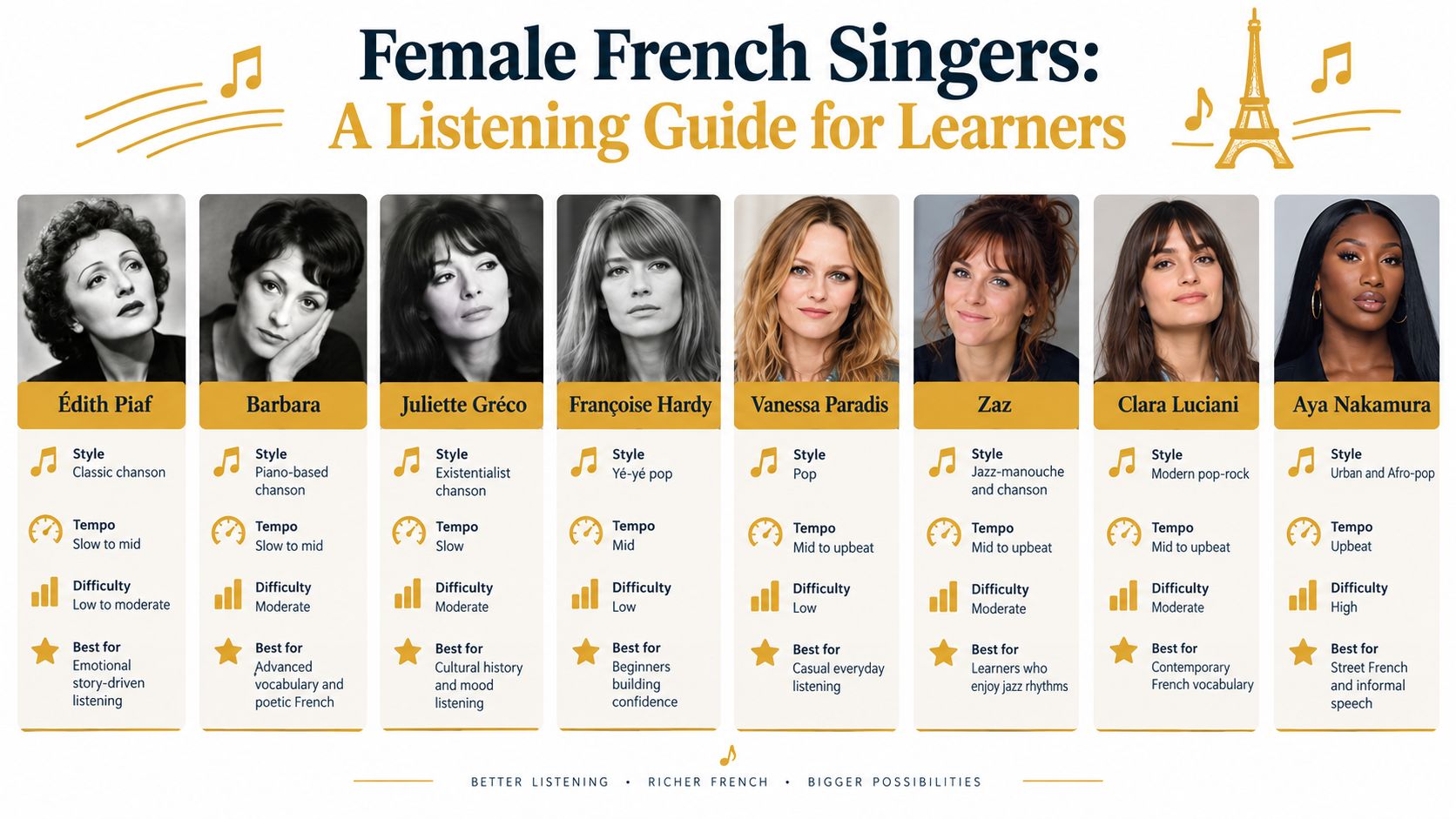
That's why I teach listening the way I'd choose a course. Pick female French singers by level, diction, tempo, and register, not just by fame. Below, we're pairing eight artists across chanson, yé-yé, pop, jazz manouche, pop rock, and urban Afro pop with starter tracks and a specific way to study each one. You'll also find a comparison table after the list, directions for building playlists from official artist pages, and a consented student story from our teaching practice that shows how short, repeated listening can feed directly into speaking.
Use this as a buying guide for your time. If you're a beginner, start where success comes quickly. If you're preparing for conversation or an exam, choose the singer who stretches the exact skill you're missing. One well matched voice, revisited all week, will teach you more than a huge playlist you only half hear.
Table of Contents
- 1. Édith Piaf Dramatic Chanson for Emotional Classic French Listening
- 2. Barbara Poetic Piano Chanson for Advanced Listening
- 3. Juliette Gréco Existentialist Chanson for Mood Based Listening
- 4. Françoise Hardy Yé-Yé Pop for Confident Beginner Listening
- 5. Vanessa Paradis Accessible Pop for Everyday French Listening
- 6. Zaz Jazz Manouche Energy for Rhythmic Upbeat French
- 7. Clara Luciani Modern Pop Rock for Contemporary French Vocabulary
- 8. Aya Nakamura Urban Afro Pop for Street Level French
- 8 French Female Singers Compared: Styles and Listening Levels
- Build a French Listening Routine You Will Keep
1. Édith Piaf Dramatic Chanson for Emotional Classic French Listening
If you've ever played a French song and understood almost nothing, start with the singer who gives you time to catch up. Édith Piaf phrases deliberately, lands hard on emotional keywords, and repeats the lines that matter most. Her delivery feels theatrical, but for learning that's a gift. You can hear where one thought ends and the next begins.
Piaf was born in Paris in 1915, and songs such as "La Vie en rose" and "Non, je ne regrette rien" made her one of France's most internationally recognized vocalists, as her career from the 1930s until her death in 1963 shows. That long arc makes her a reference point for French chanson, the story driven tradition that still shapes how later singers write about love, loss, memory, and resilience. For broader context on where she sits among other voices, our guide to French singers across generations is a useful companion.
How I'd Study Piaf This Week
Choose "La Vie en rose" first because its lyric structure is short and repetitive. Transcribe the first verse by hand before you check the printed words, then circle the sounds you missed. Move to "Non, je ne regrette rien" when you want past tense narration and a compact set of emotional verbs you can reuse in speech.
- Dictate first: Listen without lyrics and write what you hear, even if gaps remain.
- Shadow the refrain: Speak with her at the same pace to copy rhythm, not just pronunciation.
- Retell it: Summarize the song aloud in two French sentences before you translate anything.
Piaf suits adult learners who want listening stamina and a richer emotional vocabulary. She won't teach you current slang, and that's fine. She's your foundation for clear vowels, sentence stress, and the cultural references French speakers still recognize instantly.
2. Barbara Poetic Piano Chanson for Advanced Listening
Barbara is where comfortable learners meet literary French and discover whether they enjoy it. Born Monique Serf, she wrote her own songs and performed them at the piano, usually at a measured pace that leaves space around every image. You won't be rescued by a simple chorus here. You'll need to sit with metaphor, memory, and sentences that unfold slowly.
That difficulty is exactly her value for intermediate and advanced learners. If everyday conversation no longer challenges you, Barbara trains you to follow nuance. Her songs reward annotation. A single verse can give you descriptive adjectives, place vocabulary, and a way of linking past and present that a textbook rarely models so elegantly.
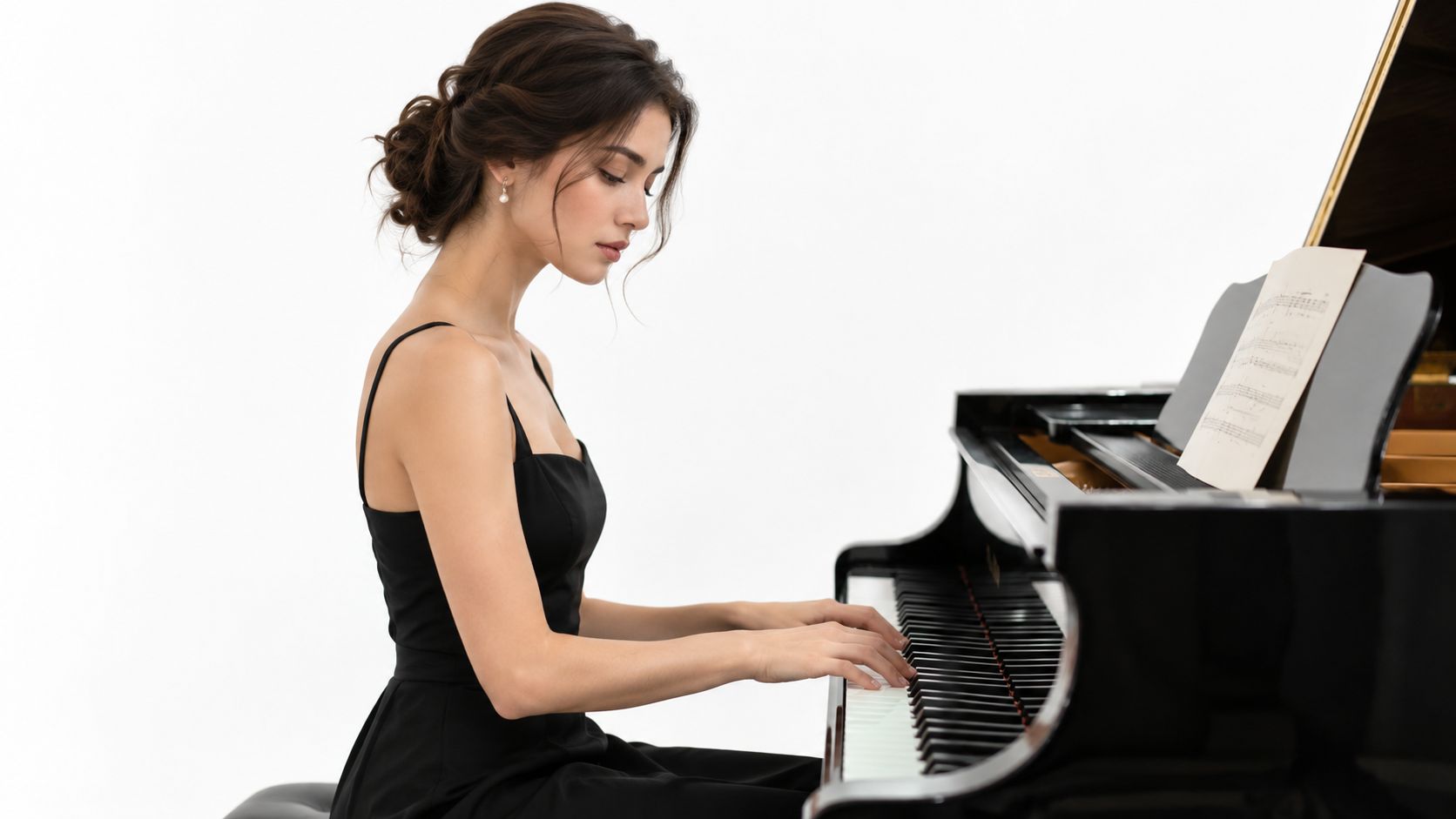
Start with "Dis, quand reviendras-tu?" for questions and future forms in a conversational frame. Try "Göttingen" for reflective description, then "Nantes" when you're ready for narrative listening and place based storytelling. Read each text after listening, not before, so your ear has to work first.
A Paraphrase Routine That Builds Speaking
Print the lyrics and mark every metaphor you can find. Then paraphrase each verse in simpler French, out loud, without looking at an English translation. That one move turns passive admiration into active production. You're forced to keep the meaning while changing the words, which is what fluent speakers do when they're stuck.
My rule for Barbara: If you can't paraphrase a verse simply, you haven't understood it yet, even if you can translate every word.
Barbara isn't background music for a commute, and she isn't a beginner shortcut. Choose her when you want precision, emotional range, and French that prepares you for literature, theatre, and serious conversation. One song studied carefully will do more than an album skimmed.
3. Juliette Gréco Existentialist Chanson for Mood Based Listening
Some learners don't need faster French. They need French they want to live inside for twenty minutes. Juliette Gréco gives you that atmosphere. Emerging from the Saint Germain des Prés scene after World War II, she paired intellectual, reflective lyrics with a restrained, smoky delivery that never rushes you.
Her calm pacing helps comprehension, though you'll meet older expressions that don't belong in a modern office email. Treat those phrases as cultural vocabulary. Note them, understand them, and ask whether a French speaker today would still use them. That judgment is part of advanced listening, and Gréco is an ideal teacher for it because mood carries so much of her meaning.
Tracks and Pairings to Try
Begin with "Si tu t'imagines" and listen for imagined scenarios and conditional thinking. Then explore her live recordings from the postwar decades, where introductions and audience atmosphere add cultural context you won't get from a studio track alone. I often pair a Gréco recording with a short Paris set film scene, subtitled in French, so students hear the same register in speech and song.
- Read alongside: Listen while reading a short biography in French to pick up cultural and historical terms.
- Compress the meaning: Summarize each song in two sentences, no more.
- Talk about tone: Describe whether a performance feels ironic, tender, or defiant, and name the words that create that effect.
Gréco suits learners who are motivated by art, philosophy, and postwar Paris rather than chart hits. She offers fewer everyday phrases than Vanessa Paradis or Clara Luciani, so don't make her your only source. Use her to deepen interpretation. When you can explain not just what she sang but how it felt, your French has moved forward.
4. Françoise Hardy Yé-Yé Pop for Confident Beginner Listening
For a true beginner, confidence matters more than prestige. Françoise Hardy is the singer I reach for when a student needs an early win. Her 1960s yé-yé pop uses bright melodies, simple sentence patterns, and choruses that repeat until you can't help joining in. The language circles love, friendship, and youth, so the same useful nouns and verbs return constantly.
Hardy also shows why we shouldn't treat female French singers as a France only category. At the 1963 Eurovision Song Contest in London, she represented Monaco with "L'Amour s'en va" and finished fifth, an early example of a French language performer reaching a pan European audience described in coverage of Hardy's career milestones. She recorded in other languages too, which makes her a friendly bridge if you're comparing how a phrase sounds across versions.
"Tous les garçons et les filles" is the obvious starting point for common nouns and clean, repeatable patterns. Translate it line by line in a notebook, then sing only the chorus until the intonation feels natural. Our selection of the best songs to learn French by level can help you decide what to add next once Hardy feels easy.
Keep a running list of five new phrases per song and use each one in a short spoken sentence about your own life. That last step matters. A phrase you have only sung belongs to Hardy. A phrase you've used about your friends, your city, or your weekend starts to belong to you. That's how a gentle pop song becomes speaking practice rather than pleasant exposure.
5. Vanessa Paradis Accessible Pop for Everyday French Listening
You don't need a desk, a dictionary, and a free hour for every listening session. Vanessa Paradis is my recommendation for French that fits a drive, a walk, or cooking dinner. Her pop is contemporary without being slang heavy, her vocals stay clear, and her tempos let you follow complete thoughts instead of chasing fragments.
She broke through with "Joe le taxi", a light, rhythmic track that remains useful for simple narration and for hearing how French sentences lock into a beat. Her later work moves between pop, rock, and a more intimate singer songwriter sound. That range is practical. You can stay with one familiar voice while the arrangements and vocabulary gradually widen.
Build a Low Stress Weekly Playlist
Put together ten Paradis tracks from her official pages on Spotify, Apple Music, YouTube, or Deezer and keep that same set for a full week. Repetition is not a failure of imagination. It's how your ear starts predicting sounds, and prediction is what makes real conversation feel slower.
- Catch informal language: Note two relaxed expressions per song and check where you'd safely use them.
- Follow sentence stress: Tap the rhythm lightly as she sings and notice which syllable carries each phrase.
- Upgrade one track: Each week, move one song from background listening to lyric study and shadowing.
Paradis won't stretch advanced learners the way Barbara will, and she won't prepare you for rapid youth slang. Her strength is sustainability. For busy adults who want modern, natural French in daily routines, she's often the artist who keeps the habit alive long enough for harder material to become manageable.
6. Zaz Jazz Manouche Energy for Rhythmic Upbeat French
When study starts to feel like homework, I change the energy before I change the method. Zaz, born Isabelle Geffroy, blends chanson with jazz, gypsy swing, and accordion driven rhythm. Her breakthrough brought many international listeners to French music that feels joyful and physical. You don't just decode her songs. You move with them.
That speed is both the benefit and the trade off. Zaz trains you to recognize words when they're linked, clipped, and pushed forward by a band. Her global reach is substantial too. Billboard derived figures reported by RTBF place Zaz at approximately 1.3 billion cumulative Spotify streams, in a ranking led by Céline Dion and Aya Nakamura in RTBF's report on the most streamed Francophone female artists worldwide. Popularity alone doesn't make her right for you, but it does mean her catalog is easy to find and culturally familiar.
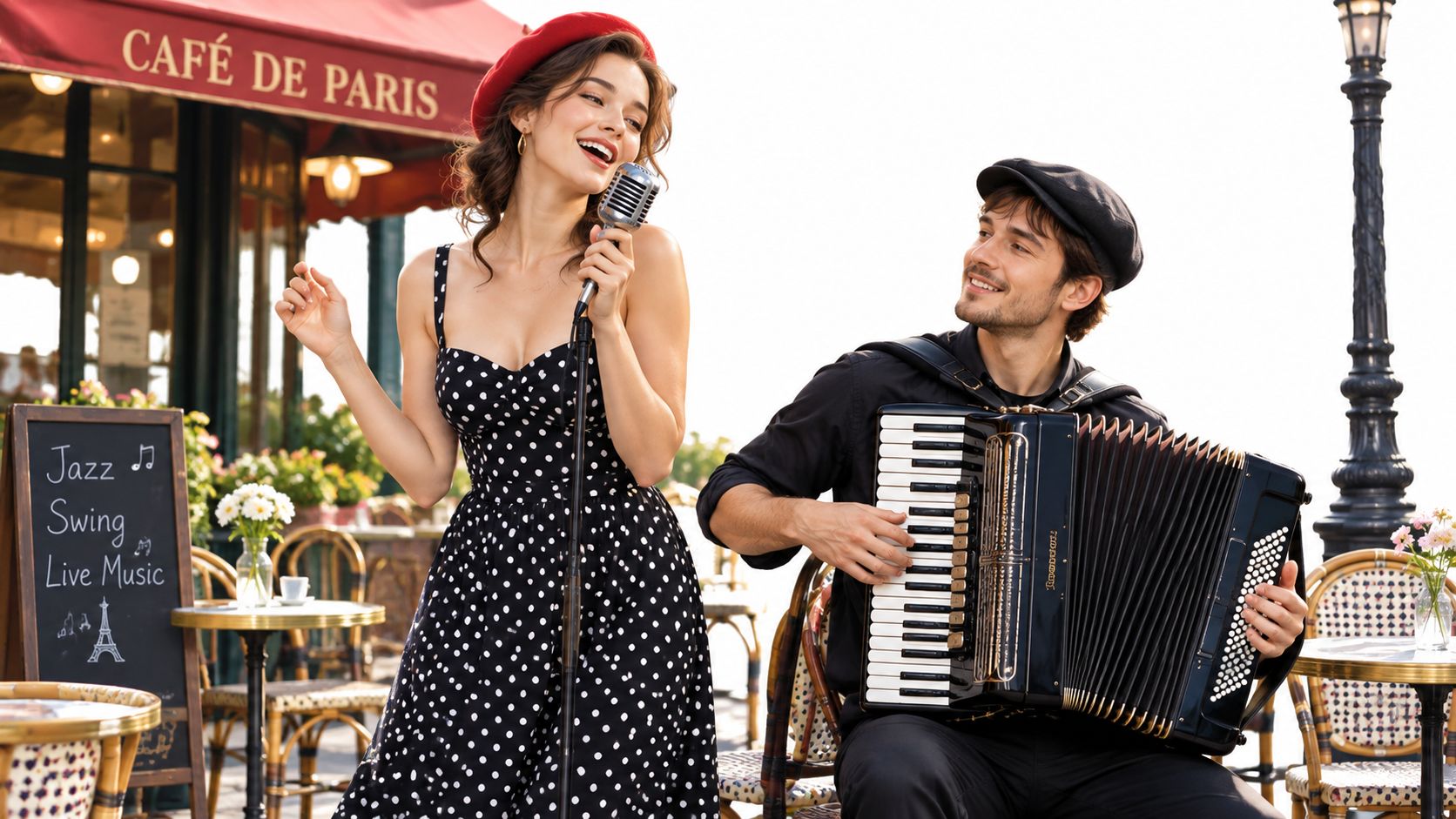
Start with "Je veux" for expressions of desire and everyday requests. Learn the chorus until the linking between words feels automatic, then watch a live performance to hear spoken introductions and audience interaction. If you're browsing beyond this list, our overview of popular French artists for learners helps place her beside other contemporary names.
Begin with her slower tracks and earn the faster ones. Singing along builds speaking speed, but only if you're articulating rather than mumbling through the hard parts. Slow a difficult line down, master it, then restore the tempo. Zaz suits intermediate learners who understand more on paper than they can catch at natural speed.
7. Clara Luciani Modern Pop Rock for Contemporary French Vocabulary
Textbook French can leave you perfectly prepared for a dialogue nobody under forty would have. Clara Luciani closes that gap. Her modern pop rock is emotionally direct, her diction stays clear over mid tempo arrangements, and her lyrics use the contemporary expressions you'll hear in current media, interviews, and everyday conversation.
"La Grenade" is the track most students ask about, and it's a strong place to practice modern ways of expressing emotion, boundaries, and self assertion. Listen to an album in order rather than shuffling singles. You'll notice recurring images and shifts in tone, and that repetition across songs helps new vocabulary stick without formal drilling.
From Song Lyric to Spoken French
My favorite Luciani exercise pairs a song with a short interview. First, build a list of modern expressions from the lyric and check how each one is used. Then listen to her speak and note which of those words appear in conversation and which belong mainly to songwriting. That distinction protects you from sounding like a lyric sheet in real life.
A contemporary phrase isn't yours until you know where it sounds natural and where it sounds borrowed.
Finish by writing a short emotional description in French, perhaps about a difficult week or a piece of good news, using three expressions from the song. Read it aloud twice. Luciani is an excellent fit for professionals and younger learners who want current French without jumping straight into dense slang. She gives you present day vocabulary while keeping pronunciation accessible enough for focused study and relaxed listening alike.
8. Aya Nakamura Urban Afro Pop for Street Level French
Aya Nakamura is the artist students request most and understand least on first listen. Born in Mali and raised in France, she fuses Afro pop and urban beats with conversational lyrics packed with informal slang and fast, stylized delivery. That combination makes her thrilling and, for beginners, discouraging. Timing matters here.
Her scale explains why she's unavoidable in contemporary French. Billboard derived figures reported in 2025 place Nakamura at approximately 4 billion cumulative Spotify streams worldwide, second in that ranking only to Céline Dion, according to Billboard France's methodology defining Francophone artists by a discography more than 50% in French. Yet the wider industry still gives women limited space. That contrast is worth discussing with advanced students alongside the music itself, using our guide to French female artists and their cultural impact for context.
Start with "Djadja" to identify informal expressions, then "Pookie" for casual conversational phrasing. Listen twice with different jobs. First pass, chase meaning. Second pass, ignore translation and track rhythm, stress, and where words seem to disappear into the beat.
Handle Slang With Care
- Build a glossary: Write each expression, its plain French equivalent, and who you'd say it to.
- Label the register: Mark items as friendly, playful, confrontational, or best understood but not used.
- Check before using: Run new slang past a tutor before trying it at work or with older speakers.
Nakamura rewards learners who already have a solid foundation and want to understand how many young French speakers talk. She isn't a pronunciation model for formal settings, and she shouldn't be your first teacher. As a final stage in this progression, though, she's unmatched.
8 French Female Singers Compared: Styles and Listening Levels
| Artist & Style | Pace ⚡ | Listening Difficulty 🔄 | Expected Learning Outcome 📊 | Ideal Use Case 💡 | Key Advantage ⭐ |
|---|---|---|---|---|---|
| Édith Piaf, classic chanson | Slow to mid-tempo | Low to moderate | Build listening stamina and reinforce expressive vocabulary | Story-driven listening and exam practice | Clear diction and repeated refrains |
| Barbara, piano-based chanson | Slow to moderate | Moderate | Develop literary vocabulary and interpretive skills | Advanced listening and poetry analysis | Rich imagery and measured delivery |
| Juliette Gréco, existentialist chanson | Slow | Moderate | Gain cultural context and reflective vocabulary | Mood-based listening and cultural study | Calm delivery and postwar cultural perspective |
| Françoise Hardy, yé-yé pop | Mid-tempo | Low | Build beginner confidence and learn common phrases | A1–A2 practice and pronunciation | Simple, repetitive lyrics |
| Vanessa Paradis, pop | Mid-tempo to upbeat | Low | Improve familiarity with conversational French | Casual, routine listening | Accessible vocals and everyday language |
| Zaz, jazz-manouche and chanson | Mid-tempo to upbeat | Moderate | Train listening speed and rhythmic comprehension | Upbeat practice for intermediate learners | Energetic rhythms encourage repeated listening |
| Clara Luciani, modern pop-rock | Mid-tempo to upbeat | Moderate | Learn contemporary vocabulary and expressions | Current media and everyday French practice | Clear vocals and modern phrasing |
| Aya Nakamura, urban Afro-pop | Upbeat | High | Recognize slang, informal expressions, and verlan | Advanced study of informal French | Strong exposure to contemporary youth speech |
Build a French Listening Routine You Will Keep
Choose one artist who matches your current level, not the level you wish you had. If you're starting out, let Hardy or Piaf give you clean repetition and early confidence. If you already follow everyday speech, move toward Paradis, Zaz, or Luciani for modern phrasing at manageable speeds. Save Barbara for poetic depth and Nakamura for informal register once your foundation can support them. The comparison table above works as your progression map, so revisit it whenever a singer starts to feel too easy or mysteriously hard.
Build your playlist from official YouTube, Spotify, Apple Music, or Deezer artist pages so you're always working from verified catalog entries with reliable audio. Pick two or three tracks, not thirty. Then repeat the same weekly cycle. Listen once without lyrics. Listen again while reading them. Annotate unfamiliar words, shadow the singer line by line, and summarize the song aloud in two or three French sentences. That final summary is required in our lessons: it is the point where listening becomes speaking.
It also helps to understand the context you're listening within. France's Centre national de la musique found that female led artists represented 29% of non instrumental phonograms produced and registered in France in 2023, up from 17% in 2019, in the CNM assessment of women's presence in the music sector. Earlier CNM analysis of approximately 8,500 qualified artistic entities found only 17% had a female lead, detailed in the CNM 2023 report on women in popular music. Choosing female French singers deliberately therefore widens your exposure to accents, registers, and stories that default playlists may underrepresent.
One of our adult students, a busy professional preparing for regular travel to Paris, came to us able to read French far better than she could follow it aloud. With her consent, we built her practice around Hardy for confidence, then Luciani for contemporary expression, using the listen, annotate, shadow, summarize cycle between lessons. She later told us the turning point came when she started recognizing words she already knew at natural speed, then reusing them in our conversations without translating first. That is measurable progress you can hear in a lesson, even before any test measures it.
Keep your routine small enough to survive a busy week. Fifteen focused minutes with one chorus beats an ambitious Sunday session you abandon. Rotate artists every few weeks so your ear doesn't overfit to a single voice. Keep a notebook page for phrases you've spoken, separate from words you've merely looked up. You'll be surprised how motivating that spoken list becomes.
If you'd like us to match these artists to your level, goals, and schedule, compare our private in person lessons in New York with our flexible online options across the U.S. and worldwide, then book a free 20 minute consultation with Elite French Tutoring. We'll evaluate where your listening breaks down, choose your starting singer together, and build a personalized routine that turns the music you love into French you can speak with confidence.