Skip to content

You're staring at a French sentence, and the first word doesn't tell you much. The second word doesn't help either. Then you catch the verb, and suddenly the sentence starts to make sense. That shift, from panic to pattern, is the turning point for French sentence structure.
I teach students to stop hunting for a special trick and start looking for the conjugated verb. In modern French, that verb is the syntactic anchor, the point everything else orbits around, which is why French feels orderly once you know where to look. Historically, French moved from a looser medieval system toward a more fixed Subject-Verb-Object pattern, with the subject settling in front of the verb over time, especially from the 14th century onward, as described in academic work on the language's development HAL Paris document on French syntax history.
That's the system I want you to see. Not a pile of exceptions, but a sentence engine with a clear center. Once that clicks, pronouns, negation, and questions stop feeling random, and you can start predicting where each piece belongs instead of memorizing one-off patterns.
Table of Contents
- Staring at a French Sentence and Not Knowing Where to Start
- The SVO Backbone and the Conjugated Verb as Anchor
- How Pronouns, Negation, and Inversion Shift Around the Verb
- Clitic Pronoun Order in a Single Fixed Sequence
- Three Ways to Ask Questions in French
- Building Complex and Subordinate Clauses Step by Step
- Formal Versus Spoken French and How Passive Voice Works
- Practice Drills, Common Mistakes, and How to Keep Improving
Staring at a French Sentence and Not Knowing Where to Start
A student once showed me this problem in real time. She could translate Je vois Marie without hesitation, but when the sentence changed shape, she froze. “Do I start with the subject, the object, or the verb?” she asked, and that question is exactly where most learners get stuck.
The honest answer is that you start with the verb. More precisely, you start with the conjugated verb, because it tells you who is doing the action, when it happens, and where the other pieces belong. French has a neutral SVO base, but the sentence doesn't feel stable until you identify the verb as the center of gravity.
A good tutor's job is to make that center visible. In plain declarative French, the order is usually straightforward, but learners often miss how much of the rest of the sentence is built in relation to that one verb. Once you can spot it quickly, you can place the subject, object, pronouns, and even question forms with more confidence.
Practical rule: if you can find the conjugated verb first, the rest of the sentence becomes much easier to sort.
That's the lens for everything that follows. We'll keep returning to the same idea, because French really does reward that habit. The trick isn't learning a thousand separate patterns, it's learning how the same center behaves when pronouns move in, negation wraps around it, or the sentence becomes a question.
The SVO Backbone and the Conjugated Verb as Anchor
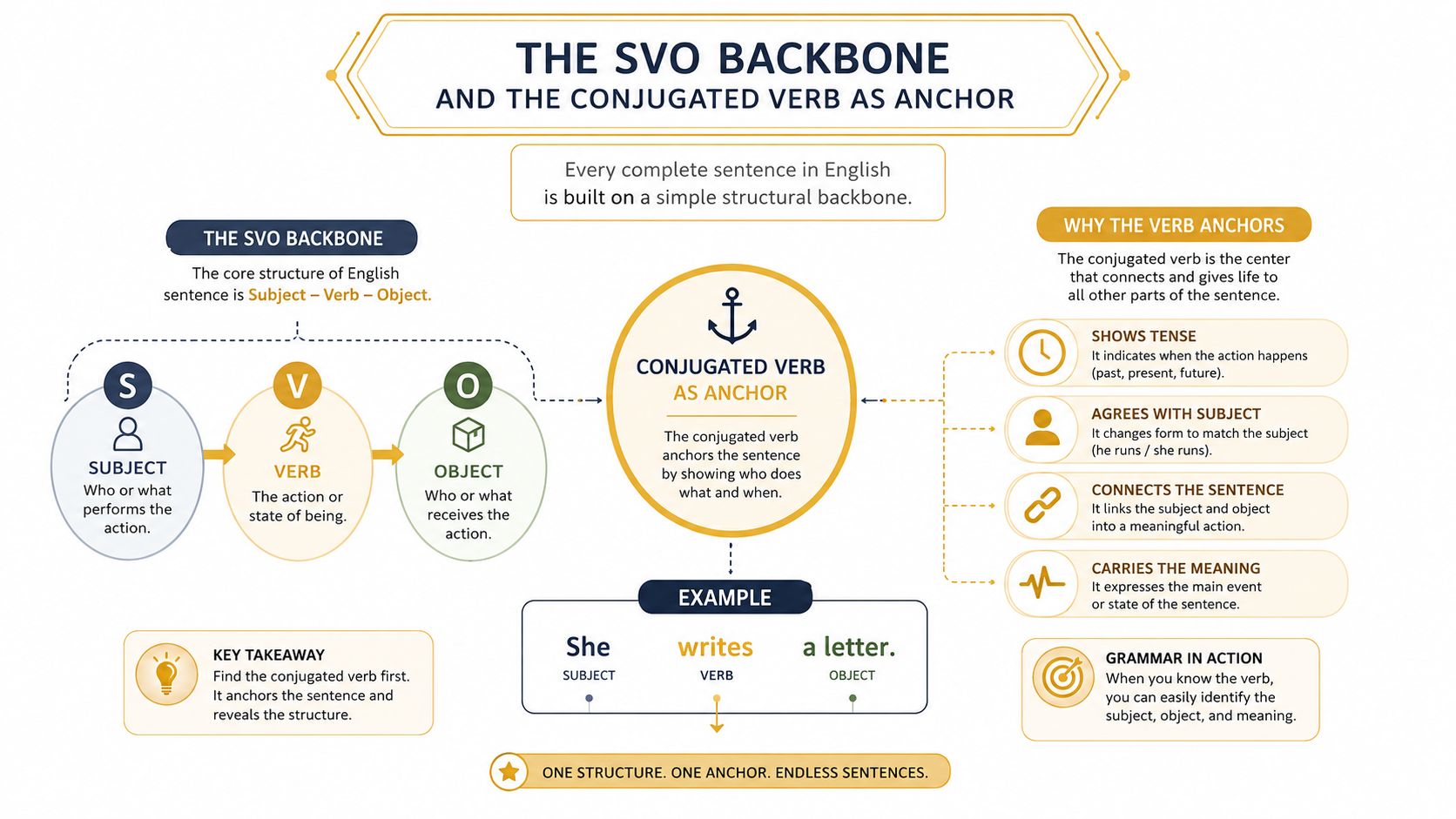
French declarative sentences usually follow Subject-Verb-Object, and that's the easiest place to begin. Marie lit un livre means “Marie reads a book,” and Nous mangeons une pomme means “We eat an apple.” The order is the same basic pattern English speakers already know, which is why many beginners understand the meaning faster than they expect.
Why the verb matters more than the label order
The conjugated verb is the anchor because it controls the sentence's grammar. It carries tense, agrees with the subject, and determines where many other elements can sit. That's why a sentence can still feel wrong even when the broad SVO order looks correct.
Adverbs help show this clearly. In French, souvent often sits near the verb, as in Je mange souvent ici. Bien can also cluster close to the verb, as in Elle chante bien. Time expressions like demain often come near the end, as in Nous partons demain. The point isn't to memorize every possible location at once, it's to notice that the verb stays central while other pieces arrange themselves around it.
Useful habit: read the verb first, then ask what the subject does, then ask what the verb acts on.
That habit also helps you avoid English-based guessing. French isn't just English with French words swapped in. The surface order may look familiar, but the sentence is still organized around the verb, and that becomes much more obvious once pronouns and negation enter the picture.
How Pronouns, Negation, and Inversion Shift Around the Verb
Take one base sentence: Il mange la pomme. Once you understand that core, French starts moving pieces in predictable ways. The sentence can shift for pronouns, for negation, or for a question, but the verb stays at the center of every transformation.
Three common shifts around the same verb
| Transformation | Sentence | What Moved |
|---|---|---|
| Object pronoun | Il la mange | la moved before the conjugated verb |
| Negation | Il ne mange pas la pomme | ne came before the verb, pas after it |
| Inversion | Mange-t-il la pomme ? | the subject pronoun moved after the verb |
The hardest one for many learners is negation, because French wraps the verb in a kind of frame. In standard form, ne appears before the pronoun cluster or before the verb if there's no pronoun, and pas comes after the conjugated verb. So the verb remains the anchor, but it gets bracketed by the negative structure. That's the part that usually feels odd at first, especially if you try to translate word for word from English.
Pronouns create a different kind of movement. Instead of following the verb, they usually move in front of it. A learner who expects Il mange la will get stuck fast, because French wants the object pronoun in the pre-verb space. Once you see that move as structural rather than arbitrary, the sentence feels less like a memorization test.
Questions add a third shift. In formal inversion, the subject pronoun slips behind the verb, and the sentence turns to Mange-t-il la pomme ? That little t is there to keep the pronunciation smooth when the verb ends in a vowel, and the hyphen is part of the formal pattern learners need to recognize. Spoken French often avoids this route, but the written form still matters.
French conversation questions and answers can help if you want more practice seeing how the same idea changes form across registers.
Clitic Pronoun Order in a Single Fixed Sequence
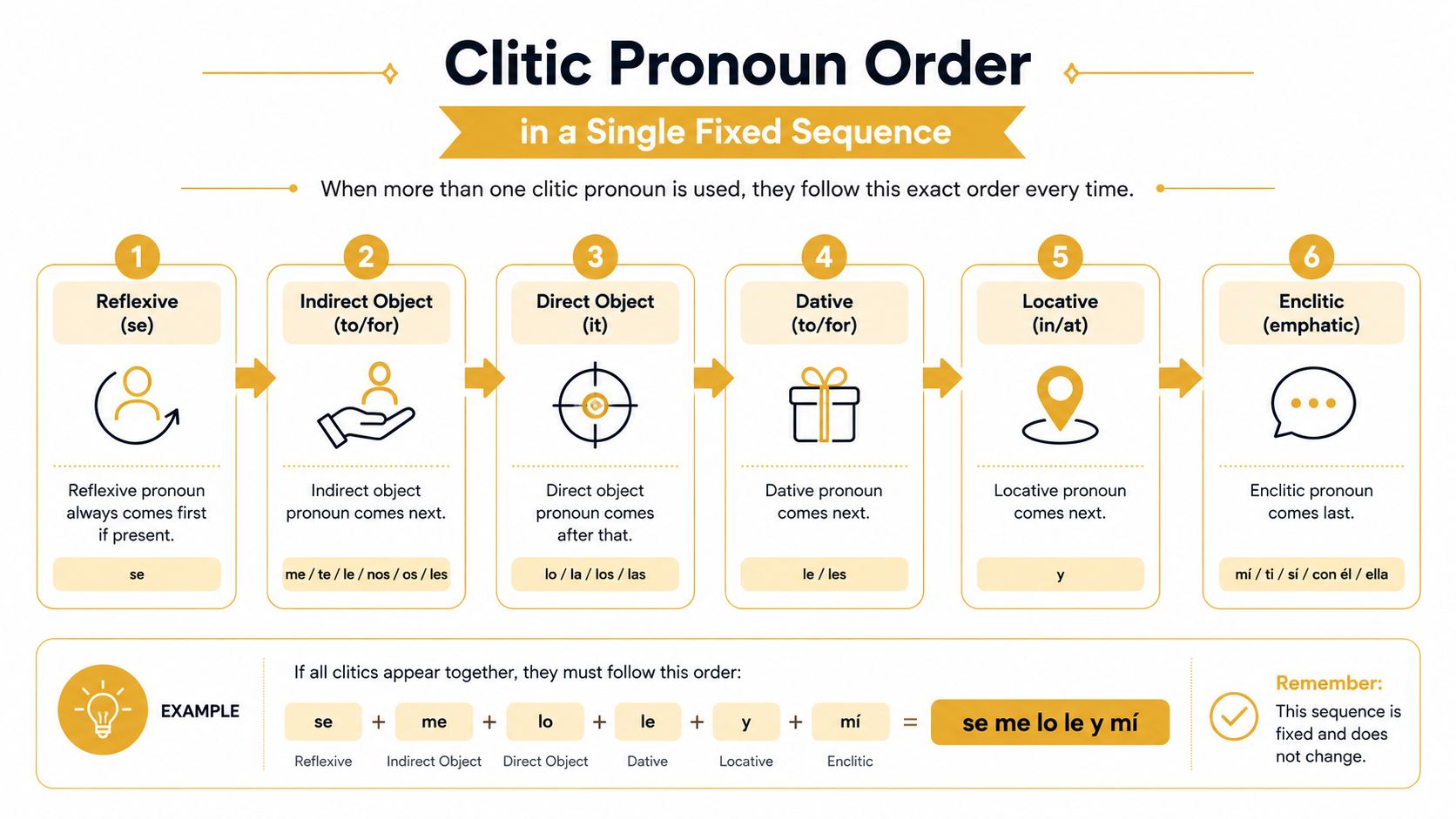
When French puts more than one pronoun in front of the verb, the order is fixed. That's good news, because once you know the sequence, you don't have to improvise. The usual stack starts with me, te, se, nous, vous, then le, la, les, then lui, leur, then y, then en.
A sentence that shows the stack
Start simple: Je le lui donne. Here, le comes before lui, because direct objects come before indirect objects in the pronoun cluster. If you reverse them, the sentence stops sounding French. The verb still anchors the whole structure, but the pronouns compress into a fixed line before it.
With more material, the same logic still holds. In a sentence like Elle me les y apporte, the cluster stays in order even though it looks dense. The pronouns don't shuffle randomly. They follow the hierarchy, and y comes before en when both appear.
The trap that trips people up most often is leur versus les. The order doesn't work by meaning alone, it works by class. Learners often want to place everything by English logic, but French syntax asks for the pronoun type first, then the pronoun role, then the fixed sequence. That's why targeted practice matters here more than broad reading alone.
French pronoun clusters look intimidating until you rebuild them from the end of the sentence backward.
Try this mini rebuild: take Je donne le livre à Paul. Strip it to the idea, then replace the pieces. The book becomes le, Paul becomes lui, and the sentence becomes Je le lui donne. Once you can do that with one example, you can do it again with a new verb and new objects. The pattern is fixed, even when the content changes.
Three Ways to Ask Questions in French
French gives you three common routes into a yes/no question, and each one fits a different setting. The choice isn't just grammatical, it's social. If you pick the wrong form for the moment, the sentence can sound too casual, too stiff, or unnecessarily formal.
| Form | Example sentence | Register / when to use |
|---|---|---|
| Rising intonation | Tu viens ? | Informal speech, everyday conversation |
| Est-ce que | Est-ce que tu viens ? | Neutral conversation, writing, and safe default form |
| Inversion | Viens-tu ? | Formal writing, literature, oral exams, polished style |
Picking the right level of formality
I usually tell students to learn est-ce que first, because native speakers use it constantly and it stays stable across many situations. Inversion belongs to a more formal register, and in speech it can sound marked or overly polished. Intonation is the easiest in casual conversation, but it's not the form I'd reach for in a careful email or classroom answer.
The grammar details matter too. In inversion, a hyphen joins the verb and subject pronoun, and if the verb ends in a vowel, French often inserts t to keep the sound smooth. That's why you see forms like A-t-il and Va-t-elle. With a third-person pronoun, inversion can also appear in fuller structures like Pensez-vous qu'il vienne ?, where the first clause uses inversion and the embedded clause carries its own verb pattern.
Spoken French often prefers est-ce que over inversion, even when the written register could support both. That gap between speech and writing is one of the places where learners sound “correct” but not quite natural.
Building Complex and Subordinate Clauses Step by Step
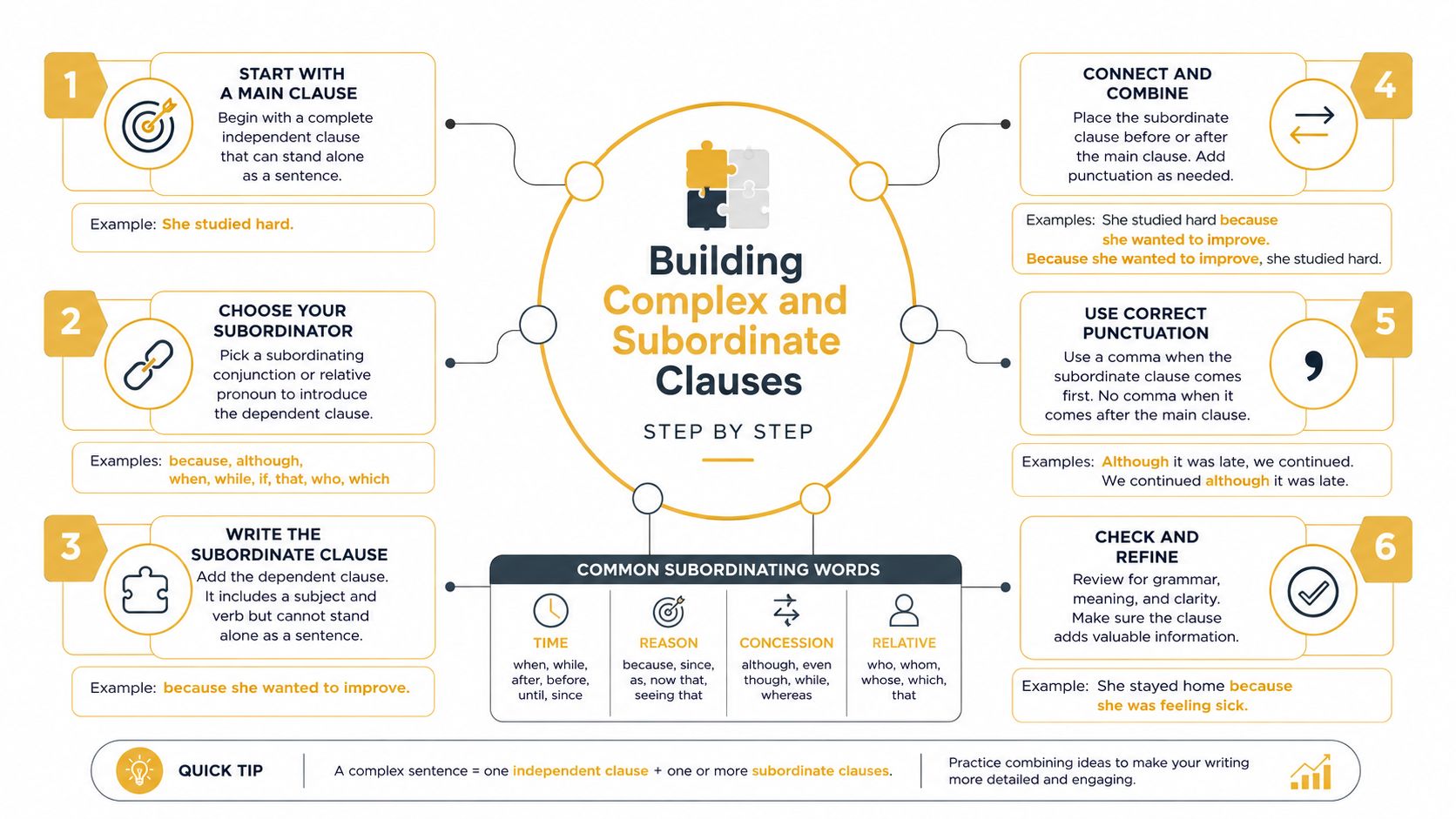
French becomes much more interesting when one clause depends on another. A simple sentence has one conjugated verb, while a complex sentence has a main clause plus a subordinate clause, each with its own verb structure. That's where words like qui, que, dont, où, lequel and conjunctions like parce que, lorsque, bien que, si do real work.
Who does what inside the clause
Compare Je vois l'homme with Je vois l'homme qui parle. In the first sentence, the structure is simple. In the second, qui introduces a clause where the man becomes the subject of parle. Now compare that with Je vois l'homme que tu connais. Here, que introduces a clause where the man is the object of connais. That subject-versus-object shift is one of the clearest ways to understand relative pronouns.
The same anchor logic still applies. The subordinate clause has its own conjugated verb, and the main clause still holds its own. When you say Je sais qu'il les a lus, the pronoun les sits in the subordinate clause before a lus, not back in the main clause. That boundary is where learners often hesitate, but the rule is consistent once you see each clause as a self-contained verb system.
For deeper practice with embedded structures, French subjunctive is a useful next stop when the conjunction or the verb choice pushes the sentence into a more advanced register.
A subordinate clause isn't a decoration on the sentence, it's another verb-centered structure attached to the first one.
That's why complex French feels advanced. It's not just longer. It requires you to track which verb governs which phrase, and that's exactly the kind of skill that marks real control of the language.
Formal Versus Spoken French and How Passive Voice Works
Formal French and spoken French often say the same thing with different mechanics. A learner who only knows textbook forms can sound stiff in conversation, while someone who only copies casual speech can lose precision in writing. The right choice depends on the setting, not on which version feels more “real.”
| Context | Formal French | Spoken French |
|---|---|---|
| Asking a question | Est-ce que vous venez ? | Vous venez ? |
| Referring to a place | Je vais à la banque demain. | Je vais à la banque demain. |
| Giving information in writing | Il convient de préciser que… | Faut préciser que… |
Passive voice without overcomplicating it
The passive voice in French uses être + past participle, and the participle agrees with the subject in gender and number. So if the subject is feminine or plural, the form changes accordingly. The active version keeps the subject as the actor, while the passive version makes the subject the receiver of the action.
That matters in real reading and writing, especially when the focus shifts away from who did the action. French also uses a pronominal or reflexive passive in everyday language, as in forms built with se, which can feel more natural than the full passive in some contexts.
I saw this click for one adult student who had been translating every sentence too literally. Once she started noticing the difference between formal wording and the way people speak, her classroom answers stopped sounding like dictionary entries. She didn't just memorize new forms, she began choosing the form that matched the situation, and that changed the way her French came across immediately.
For etiquette, register, and what feels appropriate in real interactions, French language rules and etiquette is a good companion resource.
Practice Drills, Common Mistakes, and How to Keep Improving
The fastest progress comes from short, targeted drills. Work on one pattern at a time, then say it aloud until the placement feels automatic. I'd rather see a student build five clean sentences than read fifty pages without producing any French.
Try these focus areas:
- Pronoun order: Je le lui donne, then switch the nouns and rebuild the pronouns.
- Negation placement: Il ne parle pas, then move to a compound tense and keep the structure intact.
- Inversion: turn Tu viens into Viens-tu ? and notice what changes.
- Agreement: check the past participle when the subject is feminine or plural, especially in passive forms.
Here are a few common mistakes and cleaner alternatives:
- Misplaced pronouns: Je donne le lui becomes Je le lui donne.
- Double negatives from English habits: avoid adding extra negative words that don't belong.
- Wrong participle agreement: when the subject changes, the past participle may need to change too.
Common mistakes in French can help you spot the errors that show up again and again.
Read aloud, shadow native audio, and keep a short journal in simple SVO sentences before adding subordinate clauses. If you want feedback that's suited to your level, book a free consultation with Elite French Tutoring and get a lesson plan that matches your goals, whether you're preparing for an exam, improving conversation, or tightening up your grammar.