
You can survive a dinner rush with shaky knife skills, but you can't survive it long when the pass is firing and nobody can tell you what “all day” means in the language the room is using. I've watched strong cooks freeze for a beat, not because they lacked talent, but because the brigade call hit them in French and the ticket rail didn't slow down to translate. That's exactly why French for chefs matters, not as a school subject, but as a working toolkit for service, prep, and promotion.
French became the professional kitchen's shared code because the modern culinary system was built that way. Historical sources trace the standardization of kitchen vocabulary through François Pierre de La Varenne in the 1600s, then through Marie-Antoine Carême and Auguste Escoffier, whose Le Guide Culinaire spread far beyond France and helped fix the language of hierarchy, technique, and menu structure across professional kitchens. In practical terms, words like chef de cuisine, saucier, pâtissier, garde-manger, and mise en place aren't decorative. They're part of the operating system. The historical arc of French culinary terminology still shows up every time a line cook in Copenhagen, New York, Dubai, or Tokyo shortens a command into a French phrase that everyone on the team understands.
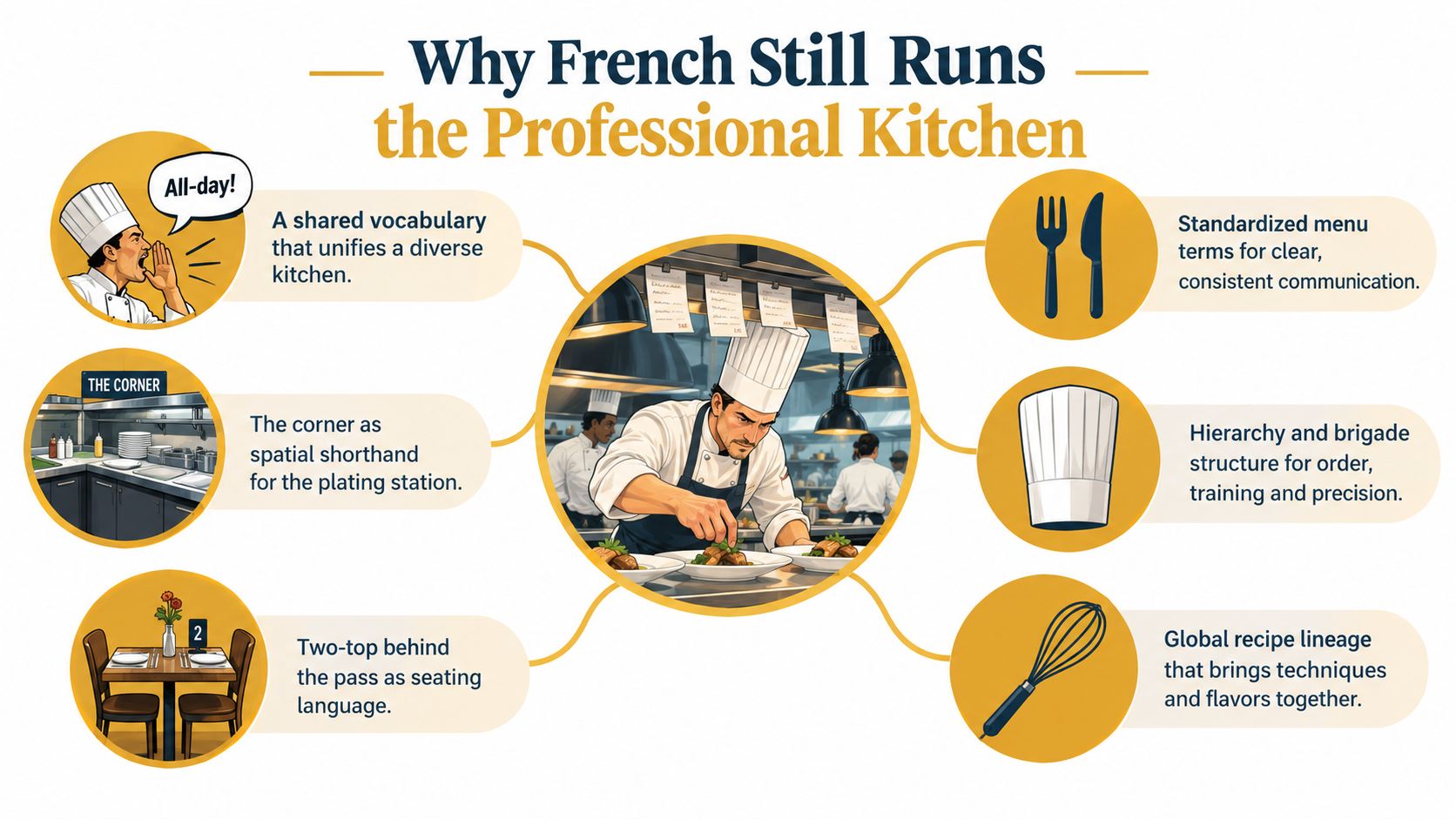
Table of Contents
- Why French Still Runs the Professional Kitchen
- The Core Vocabulary Chefs Actually Use on the Line
- Comparing the Best Ways to Learn French for Chefs
- A Realistic Four-Week Study Plan for Working Chefs
- From the Pass to the Plate, a Student Success Story
- Practice Activities That Stick Between Services
- Choosing Your Next Step With Confidence
Why French Still Runs the Professional Kitchen
The first time I saw a new cook miss a call, it wasn't a grammar problem. It was service pressure. The chef called the all-day count, the corner, and the two-top behind the pass in quick French, and the cook heard sound instead of structure. The room didn't fail him, the language did what it was designed to do, compress meaning into a few hard syllables and keep the line moving.
The language is built for speed and control
That compression is why French survives in kitchens that have nothing else in common. The brigade system, with its chef de cuisine, sous-chef, chef de partie, and commis roles, is more than a hierarchy. It's a control system that reduces chatter, assigns responsibility, and keeps each station accountable during service. When everyone knows the vocabulary, the pass gets cleaner and the timing gets tighter.
French also travels with the food itself. Menu terms and classical method words move across borders because the cuisine moved first, then the language followed. A cook who understands mise en place is already partway into the logic of the station, and a cook who recognizes classical terminology can read a menu, a recipe, or a prep sheet with far less friction.
Practical rule: learn the French words that organize the room before you learn the ones that decorate the menu.
The same words still appear everywhere
I've seen French used as a working shorthand in kitchens where no one would call themselves “Francophone.” That happens because the words are efficient, not because the room is pretending to be Paris. Suppliers and importers in French-speaking markets still default to those same culinary terms, especially for cheese, wine, and charcuterie, so a chef who can speak a little French can move more confidently between the kitchen, the market, and the menu.
The word chef itself shows how deep the borrowing runs. Merriam-Webster notes that it was borrowed twice from French, first as chief, then again in the 1800s with the kitchen meaning of skilled cook, from chef de cuisine. That matters because it marks the moment French stopped being an imported style label and became part of modern professional training. Merriam-Webster's history of “chef” makes that pathway clear.
If you're deciding whether this is worth studying, start with the actual payoff. The language is still tied to how kitchens organize labor, pace service, and label technique. That's why a focused lesson plan beats random vocabulary cramming, and why a practical overview like why French language matters in professional training can help you choose what to learn first.
The Core Vocabulary Chefs Actually Use on the Line
A lot of learners waste time memorizing words they'll never say out loud on a service line. I teach French for chefs differently. I group it by moments in the shift, because that's how the language gets used when the tickets start stacking up.
Brigade roles and station names
The most useful terms are the ones that tell you who owns what. Chef de partie is the station lead, saucier handles sauces, poissonnier works fish, pâtissier owns pastry, and garde manger covers cold prep. Communard is the staff meal cook, which is exactly the kind of word that helps a new hire understand a house's rhythm fast.
A line conversation might sound like this. “Ask the saucier if the reduction is ready.” “Tell the pâtissier the desserts are going on in five.” “The garde manger needs more herbs.” Once those roles are clear, the rest of the room gets easier to read.
Prep language and movement words
Prep vocabulary turns action into precision. Tourner shapes vegetables, ciseler means to finely chop herbs or aromatics, émincer slices thinly, dégorger draws out moisture or bitterness, saisir means to sear, and monter au beurre finishes a sauce with butter. These aren't just words to recognize. They tell you what the food should look and feel like before it leaves the prep table.
A practical note from the line, the more exact the verb, the fewer corrections later. If I tell a cook to émincer onions, I know the cut should be clean and even. If I tell them to saisir a fillet, I'm talking about heat, surface color, and timing, not just “cook it.”
Chef's shortcut: if the word changes the texture, finish, or moisture of the food, learn it early.
Service phrases and front-of-house basics
Service language has its own pace. En place means ready. À feu refers to heat. À point, bien cuit, saignant, and bleu describe doneness. Renvoyez tells the team to re-fire a dish. Couvert means place setting or guest cover, and addition is the bill. When a guest asks, l'addition s'il vous plaît, you want to understand it instantly, not after the table is already looking at you.
Here's the kind of sentence I want a chef to be able to say naturally: “The salmon is à point, the lamb is saignant, and the spinach needs one more minute before we renvoyez the ticket.” That kind of simple control is what buys you calm.
Supplier phrases and false friends
At the market, keep it human and direct. “Bonjour monsieur le fromager, je cherche du comté affiné douze mois, combien le kilo?” is a useful sentence because it does real work. It tells the supplier what you want, what age you need, and that you can talk business without fumbling.
Watch the false friends too. Restaurer doesn't mean to run a restaurant, it means to restore. Biscuit can mean cake in a pastry context. Gelée is jelly or set aspic, not generic gelatin dessert. Those mistakes are small on paper and expensive in the kitchen.
| Context | French Term | English Gloss | Used When |
|---|---|---|---|
| Brigade | chef de partie | station chef | Assigning responsibility |
| Brigade | saucier | sauce cook | Sauce and pan work |
| Prep | émincer | thin-slice | Knife prep |
| Prep | monter au beurre | finish with butter | Sauce finishing |
| Service | à point | medium doneness | Calling plates |
| FOH | l'addition s'il vous plaît | the bill, please | Guest-facing service |
For a quick vocabulary refresher, I also point people to a targeted way to improve French vocabulary when they want words tied to use, not just flashcards.
Comparing the Best Ways to Learn French for Chefs
Not every kitchen learner needs the same format. A stagiaire, a sous-chef, and a restaurant owner all need French for different reasons, and the best option depends on how quickly the language has to show up in real service. I'd compare the choices the same way I compare prep methods, by output, not by romance.
The four formats side by side
| Format | Time to Conversational | Monthly Cost | Kitchen Customization | Schedule Flexibility | Best For |
|---|---|---|---|---|---|
| Self-study apps and podcasts | Slower, but useful for recognition | Low | Low | High | Reading menus, building exposure |
| Group classes | Moderate | Moderate | Medium | Medium | Learners who want structure and peer pace |
| Private one-to-one tutoring | Fastest for targeted use | Higher | High | High | Brigade calls, supplier visits, menu writing |
| Culinary-school bundled modules | Varies by program | Varies | High | Lower | Students already in formal training |
The biggest difference is not grammar. It's context. Apps help you recognize words, but they don't make you answer a supplier on the spot. Group classes give you accountability, but they usually can't simulate your exact line. Private tutoring can, if the tutor builds drills around your station calls, your menu, and your service rhythm. A bundled culinary module fits best when language and technique are already moving together.
A simple decision rule
If your goal is to read menus and recipes within a month, an app plus a targeted vocabulary list can get you moving. If your goal is to lead a brigade in French inside a quarter, private tutoring is the faster path because it can rehearse the exact moments you'll face. That's where a service like Elite French Tutoring fits naturally, since its private lessons can be shaped around professional goals rather than a fixed syllabus.
If you've got irregular shifts, look for formats that let you miss one session without losing the thread. If you learn better with pressure, choose the option that makes you speak, not just review.
My rule in the kitchen applies here too: choose the method that matches the job you need to do next week, not the one that sounds strongest on a website.
For a structured comparison of learning routes, the fastest ways to learn French is the kind of page I'd read before booking anything.
A Realistic Four-Week Study Plan for Working Chefs
Working chefs don't need a fantasy plan. They need something that fits between prep, service, commute, and the hour when their brain is still awake enough to learn. I like a four-week structure because it gives the language a shape without pretending life will cooperate perfectly.
Week by week, with small wins
| Week | Focus | Daily Minutes | Vocabulary Target | Milestone |
|---|---|---|---|---|
| 1 | Brigade titles and station language | 15 to 20 | 25 to 30 terms | Name every station aloud |
| 2 | Service calls and ticket timing | 20 to 25 | 25 to 30 terms | Hold a two-minute briefing in French |
| 3 | Supplier and front-of-house language | 20 to 30 | 20 to 25 terms | Place a supplier order by phone |
| 4 | Menu writing and recipe review | 20 to 30 | 20 to 25 terms | Rewrite one prep sheet in French |
I'd keep the sessions short on purpose. Fifteen minutes before mise en place is enough for repetition, and twenty minutes after close is enough for recall. That pattern works because it respects how chefs live.
What each week should feel like
Week 1 should sound mechanical. You're building the names of stations, tools, and roles until they stop feeling foreign. Week 2 should feel louder, with call-and-response drills for the pass. Week 3 shifts to practical speaking with suppliers and guests, and Week 4 ties it together by rewriting one dish description, one prep list, or one recipe fragment in French.
Milestone to watch: if you can call three tickets cleanly without translating in your head, you're already using the language the way kitchens need it.
A focused tutor can compress this work because the tutor can correct the exact sentence you'll need at the exact moment you'll need it. If you prefer a more planned path, a structured French study plan gives you a helpful model for keeping the month realistic.
From the Pass to the Plate, a Student Success Story
One of the clearest examples I've seen came from a sous-chef at a busy brasserie who wanted a stage in Lyon. She could cook, but the first time she heard brigade calls on her own line, she hesitated just long enough to feel it. That hesitation bothered her more than any knife test ever could, so she started taking structured French lessons with a kitchen focus.
At first, her wins were small. She could name stations, read a prep list, and answer simple questions without freezing. Then she handled her first phone order with a fromager, and that changed the tone of her work. She also caught a sauce name on the menu that had been written incorrectly and corrected it before service, which is the kind of detail that tells a chef she's no longer guessing.
During the stage, she started writing the daily specials in French and taking fish deliveries without needing someone beside her. The turning point came when she realized she could joke with the Lyon brigade, not just survive them. By the end, she was reading classic recipes without translation, and the stage turned into a permanent position offer.
That's the point I want readers to notice. Targeted French didn't make her “fluent” in some abstract sense. It made her more employable, more relaxed in the room, and faster in the work that mattered.
Practice Activities That Stick Between Services
The chefs who improve fastest usually don't have the most free time. They have the best habits. I'm a fan of practice that piggybacks on work you already do, because that's the only kind that tends to survive a brutal week.
Habits that fit real service rhythms
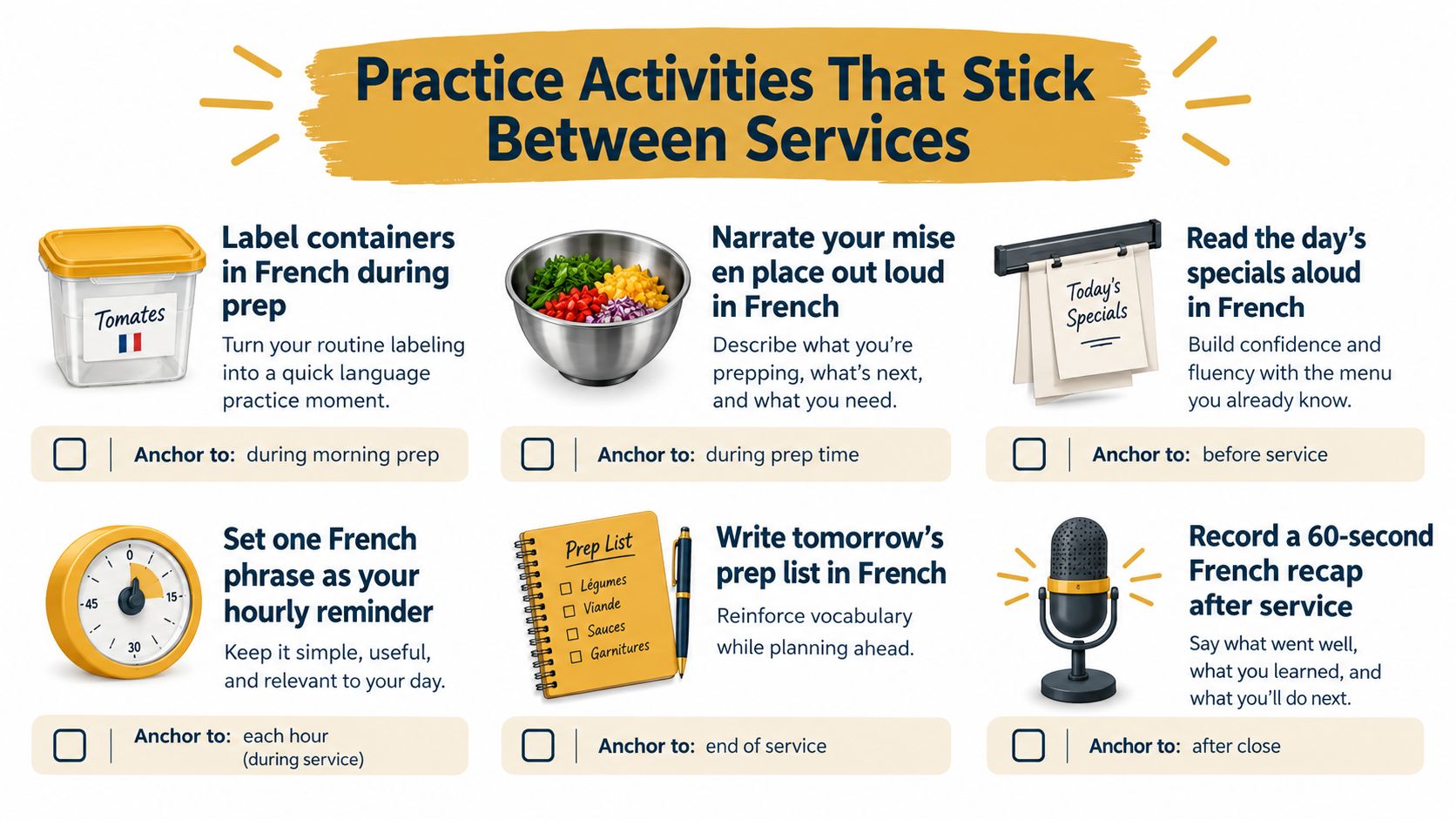
- Label containers in French during prep. If you're already taping boxes, write the ingredient names in French and say them once out loud.
- Narrate your mise en place. Describe every station you set in two sentences, even if you're alone.
- Read the specials before service. Call out three tickets as if they just landed, then check whether your phrasing is clear.
- Use one phrase as a reminder. Set a timer label in French so the words come back during the day instead of only in lessons.
- Write tomorrow's prep list in French. Keep it short and practical, not literary.
- Record a 60-second recap after close. Say what sold, what stalled, and what you'd change.
The reason these work is simple. They turn dead time into repeated exposure, and repetition is what makes the words usable when service starts moving. A weekly check-in helps too, just rate your confidence in three areas, station language, service calls, and supplier talk, then decide which one needs more attention next week.
Choosing Your Next Step With Confidence
I tell chefs to make this decision the same way they choose a training regimen. First, decide how fast you need the improvement to show up. Then define the exact kitchen context, brigade calls, supplier orders, menu writing, or front-of-house coordination. Last, be honest about the budget and weekly hours you can consistently protect.
If you're the self-directed type, a good app, a notebook, and a steady routine can carry you a long way with menu reading and prep vocabulary. If you're a culinary student aiming for a stage or a career pivot, a mixed plan with structured lessons and kitchen practice usually makes more sense. If you're a working chef trying to earn a promotion or lead service abroad, private tutoring is often the shortest route because it can be built around your exact pressure points.
The most useful first session should cover three things, your current level, your target kitchen scenario, and the number of hours you can protect each week. That's the diagnosis that tells you whether you need group energy, one-to-one correction, or a hybrid plan. If private lessons fit your schedule, booking a consultation is the cleanest next move, because it lets you compare lesson options before you commit to a format that doesn't match your service life.
If you're serious about making French useful in the kitchen, compare lesson formats, choose the one that fits your next service goal, and book a first conversation with a tutor who can map the language to your actual station, schedule, and career target.