
You're already past the easy part if you've lived in France long enough to think about citizenship. The hard part is this, the rulebook changed, and plenty of applicants are still planning around the old B1 target while the file now needs B2, plus a civic exam that isn't forgiving. If you're in the middle of residency, working full time, and trying to decide whether to book a test, hire a tutor, or delay the dossier, the smart move is to stop treating French for citizenship like one generic hurdle and start matching your prep to the exact path you're on.
In 2026, that distinction matters more than ever. For applications lodged from 1 January 2026, France requires B2-level French for naturalization and for nationality by declaration after marriage, replacing the older B1 threshold, and the new framework includes a civic exam as well as language proof (The Local). If you want a clean plan, not a vague one, you need to choose the right level, the right exam, and the right timeline from day one.
Table of Contents
- What Changed for French Citizenship Applicants in 2026
- Choosing the Right French Level and Exam for Your Path
- Inside the New Civic Exam You Must Also Pass
- A Realistic Study Timeline and Weekly Plan
- Speaking and Interview Practice for the Prefecture
- Documentation Checklist and Common Pitfalls
- Choosing Between Self-Study and Personalized Tutoring
What Changed for French Citizenship Applicants in 2026
You should treat 2026 as a harder gate, not a small policy tweak. If you are several years into residency, working full time, and thinking about naturalization, the rulebook now expects B2 French for citizenship, not B1, and it adds a civic exam on top of the language proof (Refugies.info).
That shift matters in practice. B1 is enough for basic interaction and familiar topics. B2 demands clearer argument, stronger comprehension of longer texts, and better control when a conversation moves quickly. In a prefecture interview, that difference is obvious. You are not just showing that you can manage daily life, you are showing that you can handle the level expected of someone ready for nationality.
What still applies at the residence stage
The thresholds are still different depending on the permit. A2 remains tied to the early multi-year residence stage, B1 still appears for the first 10-year resident card and some other long-term residence routes, and B2 is the level that now matters for citizenship (French Permit). Applicants mix these up all the time, then waste months preparing for the wrong milestone.
Practical rule: prepare for the next file you can actually submit, then keep building from there.
That is the approach I would use. If you are still renewing a residence permit, do not train as if your naturalization file is around the corner. If you are already close to filing for nationality, stop treating B1 as the target and build straight toward B2, with the civic exam included in your plan.
For people who are also sorting out work-based status, the immigration timeline can affect everything else. The overlap is easy to miss, so it helps to compare your language plan with your permit route, including a practical guide to work visas in France.
The new civic exam is now part of the deal
The civic exam is not decorative. Applicants face 40 multiple-choice questions on republican values, institutions, daily life, and history, and they need at least 32/40 to pass, so a few weak guesses can sink the result (VisaHQ).
That is why I tell candidates to take it seriously from the start. Reporting on the new format also noted that the test can feel harder than expected, even for people comfortable with spoken French, because the listening section moves fast and several choices look similar on paper. The lesson is simple. Do not assume the civic test is the easy part. It is a separate hurdle, and it can fail you even if your French is already solid.
Choosing the Right French Level and Exam for Your Path
A lot of applicants choose an exam first and only then look at the level they need. That wastes time. Start with your filing stage, then pick the proof that matches your deadline, the format you can handle, and whether you need a permanent result or a time-limited one.
Match the level to the application stage
Keep the path clear. A2 fits the earlier residence stage. B1 fits long-term residence cards and some family-linked routes. B2 is the level that matters for citizenship. If naturalization is your goal, do not spend months overworking A2 material or hoping B1 will be accepted for a citizenship file, because it will not.
For citizenship, accepted proof can include DELF B2, TCF, TEF, or certain qualifying French diplomas, and the proof must go into the dossier (Easy France Now). If you are still comparing French language certification options, use the rules of your own filing date, not a generic study target. For TCF, the B1 benchmark used in practice is tied to the test's official scoring bands, so applicants below B2 need to plan carefully (French Entrée).
My recommendation: if you have more than six months before filing, aim for DELF B2. It is the cleanest proof to put in a citizenship file.
I say that plainly because DELF B2 is a permanent credential, while TCF and TEF expire (Prep My French). If your file gets delayed, a permanent diploma gives you breathing room. Time-limited results force you to manage validity windows, and that is where good candidates lose control of the process.
Comparison table for the decision
| Pathway Stage | Required Level | Accepted Exams | Validity |
|---|---|---|---|
| Multi-year residence permit | A2 | Test-based proof accepted under the residence rules | Depends on the certificate |
| First 10-year resident card | B1 | Test-based proof accepted under the residence rules | Depends on the certificate |
| Naturalization and citizenship | B2 | DELF B2, TCF, TEF, qualifying diplomas | DELF B2 is permanent, test-based proof is time-limited |
If your filing date is close, TCF or TEF can be the practical choice. They are computer-based, so booking is usually easier and results tend to move faster. If you have the calendar to spare, I still tell people to choose DELF B2, because durable proof is better than deadline stress.
One detail people miss, the TEF Canada result is not the one you want for mainland France. If you are applying in France, choose the version that matches the French file, not the Canadian one.
Inside the New Civic Exam You Must Also Pass
The civic exam catches out strong speakers because they assume everyday French is enough. It is not. You need to know how the Republic is organized, what its values mean in practice, and how France fits into the wider European framework.
What the exam tests
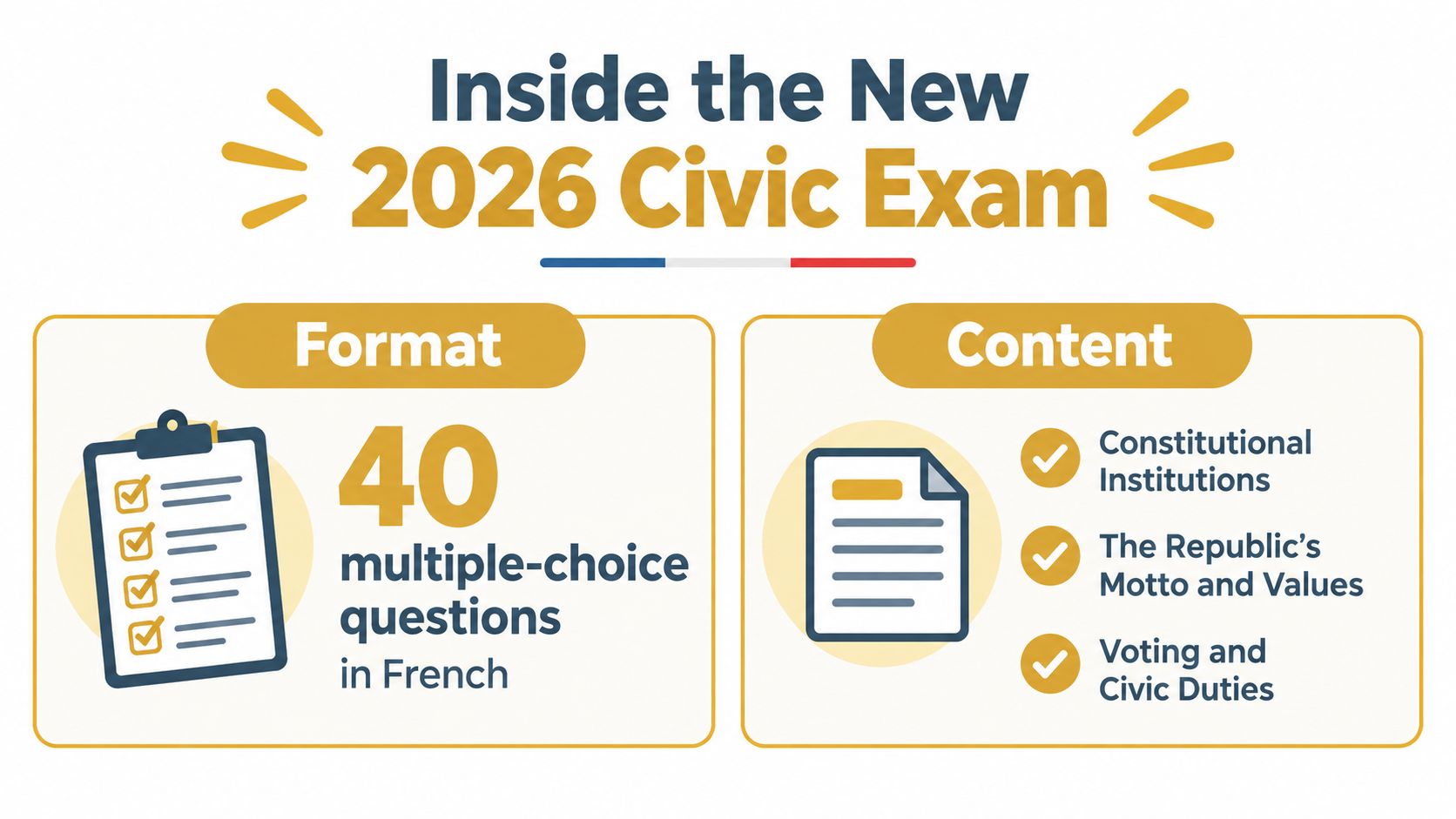
The official format is simple, which is exactly why you should learn it by heart. There are 40 multiple-choice questions in French, covering constitutional institutions, the Republic's motto and values, voting and civic duties, key historical milestones, and France's place in the EU (VisaHQ). You need 32/40 to pass, so careless errors matter.
The listening section is where many candidates lose points. Questions are timed, and some use audio clips from regional news or political debate formats. If your French only works in calm, one-on-one conversation, the civic exam will expose the gap fast.
How I'd prepare for it
Start with current-affairs listening, not only civics books. Read Le Monde and France 24 every day for two months. You need repeated exposure to formal written French and to topics that sound official rather than conversational. Then build a facts list you can recite without hesitation.
Use this short prep stack:
- Memorize the Republics: learn the five Republics and their dates.
- Review institutions: know the President, Parliament, government, and how they relate.
- Practice listening at native pace: do not slow everything down, because the exam will not.
- Answer under time pressure: stop pausing after every question and train speed.
The civic exam does not replace B2 language proof. You need both, and you need both in shape at the same time. If your listening is weak, fix that first, because the test rewards fast processing, not just memorized facts.
Here is the bottom line. Candidates who pass cleanly train the format, not just the content.
A Realistic Study Timeline and Weekly Plan
A lot of applicants ask for “the” study plan. There isn't one. There are three workable paths, and the right one depends on how close you are to filing. Pick the wrong timeline and you either rush the speaking work or waste weeks on material you will never use.
Pick the timeline that matches your deadline
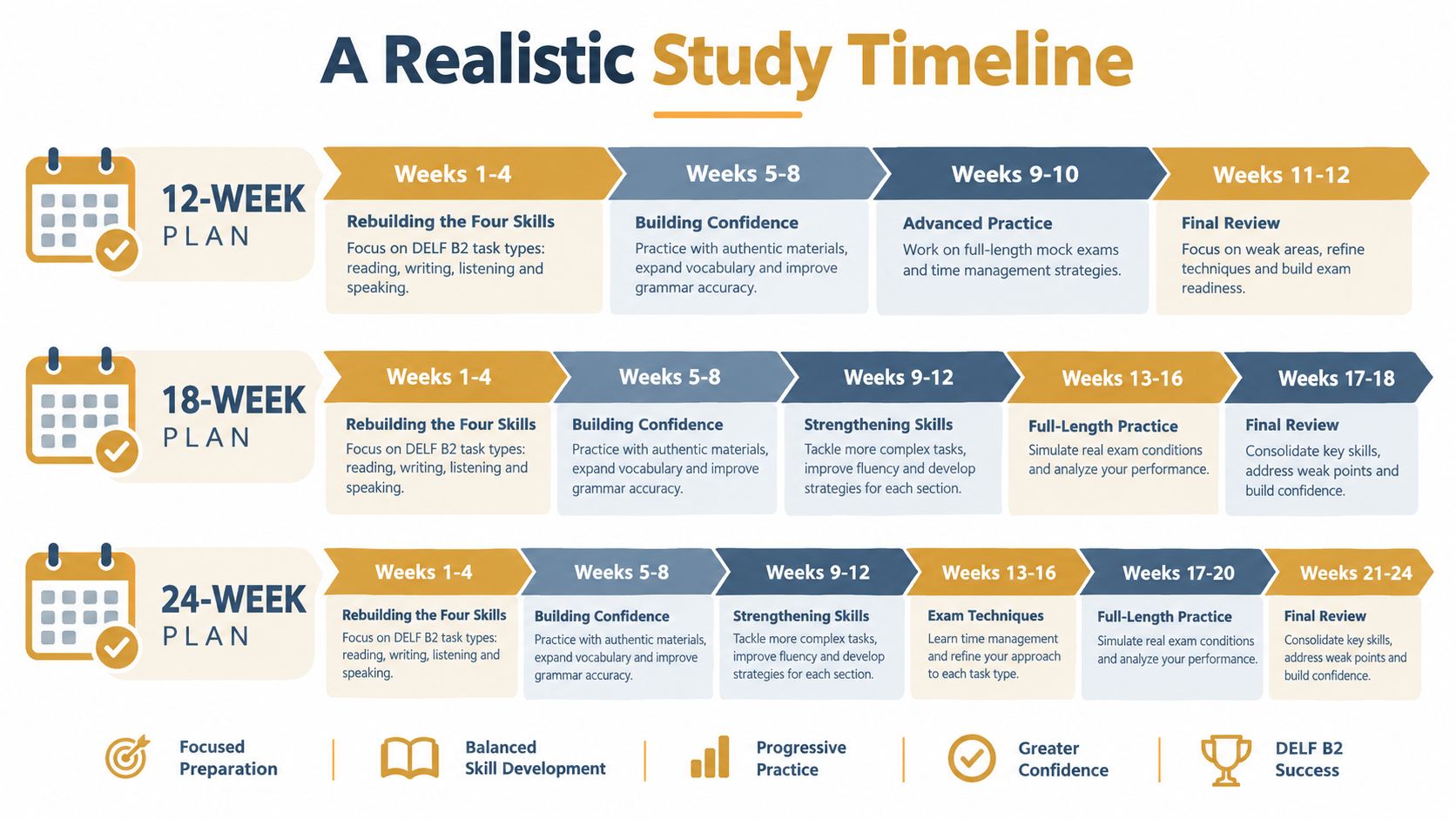
A 12-week plan suits applicants who are already close to B2 and need a focused sprint. An 18-week plan fits serious candidates who can work steadily without burning out. A 24-week plan is for borderline speakers, busy professionals, or anyone who needs to rebuild confidence before the exam.
The first month should rebuild all four skills around DELF B2 task types. That means long-turn speaking prompts, written argument essays, listening at native speed, and reading longer texts, not random app exercises. In the middle phase, switch to timed practice with TCF and TEF papers if those are the exams you are considering, because format familiarity matters as much as grammar accuracy.
A week-by-week roadmap
- Weeks 1 to 4: rebuild speaking, writing, listening, and reading around B2 tasks.
- Weeks 5 to 10: add timed mock papers and tighten grammar, especially connectors and complex sentence control.
- Weeks 11 to 16: layer civic exam drilling on top of language work.
- Weeks 17 to 24: run full mock cycles, track errors, and taper before the exam.
You can study solo, but solo candidates need discipline. In my experience, they need 10 to 12 hours a week of honest work, not passive background exposure. That is the difference between feeling busy and improving.
If you want structure, start with a targeted exam-prep program such as DELF B1 preparation if you are still climbing out of intermediate level, then move quickly into B2 work. The point is sequencing, not collecting resources.
Practical rule: do not spend the whole timeline reviewing. If you are not producing speech and writing every week, you are not preparing for citizenship.
What an 18-week week looks like
For an 18-week candidate, I would build the week like this. Two speaking sessions, one listening session with note-taking, one writing task, one grammar repair block, and one civics block. The remaining time should go into reading and correction.
The first two weeks are often humbling. That is normal. By week 8, you should hear fewer false starts in your speech. By week 14, the civics material should feel predictable. By the final two weeks, stop learning new content and polish what you already know.
Speaking and Interview Practice for the Prefecture
A lot of people “practice speaking” by chatting. That is not enough. Citizenship speaking is structured, timed, and judged for clarity under pressure. You need output that sounds like an argument, not a relaxed conversation.
Use tasks, not free talk
The DELF B2 monologue is a good training model because it forces shape. You defend a position on a societal question for about 3 minutes, and the best structure is thesis, two arguments, a counterargument, and a conclusion. If your answer drifts, you are not ready.
For the naturalization interview, I want a short personal narrative ready at all times. It should cover your arrival, your integration milestones, and your ties to France in about 90 seconds. After that, rehearse follow-up questions on daily life, civic duties, and current events so you do not freeze when the topic changes.
A typical case: a software engineer from Lyon came to me speaking around solid B1 but collapsing whenever an examiner interrupted him. He kept over-explaining and never landed a clean conclusion. We switched him to recorded monologues, weekly written corrections, and pair drills on current events, and he passed by speaking in shorter, clearer blocks rather than trying to sound “advanced.”
What to rehearse out loud
Use timed prompts from past TCF expression orale tasks. Practice explaining a graph, defending an opinion on housing policy, and summarizing a news article. That mix trains the exact muscles the examiner will test: speed, flexibility, and control.
The correction loop matters more than people think. Record yourself, listen back, and mark your own mistakes against CEFR B2 descriptors, not against whether it “sounded okay.” If you sound fluent but leave grammar loose, the examiner will hear it immediately.
I also suggest pair drills twice a week, especially if you tend to memorize answers. The interviewer can redirect the topic mid-answer, so you need automaticity, not scripted performance. For sample practice prompts, our French conversation questions and answers page is a useful place to borrow structures, then adapt them to citizenship topics.
Documentation Checklist and Common Pitfalls
The file fails on paperwork far more often than people admit. Strong French doesn't save a dossier with bad translations or expired proof. If you want the prefecture to move quickly, assemble the evidence in categories and keep the naming consistent.
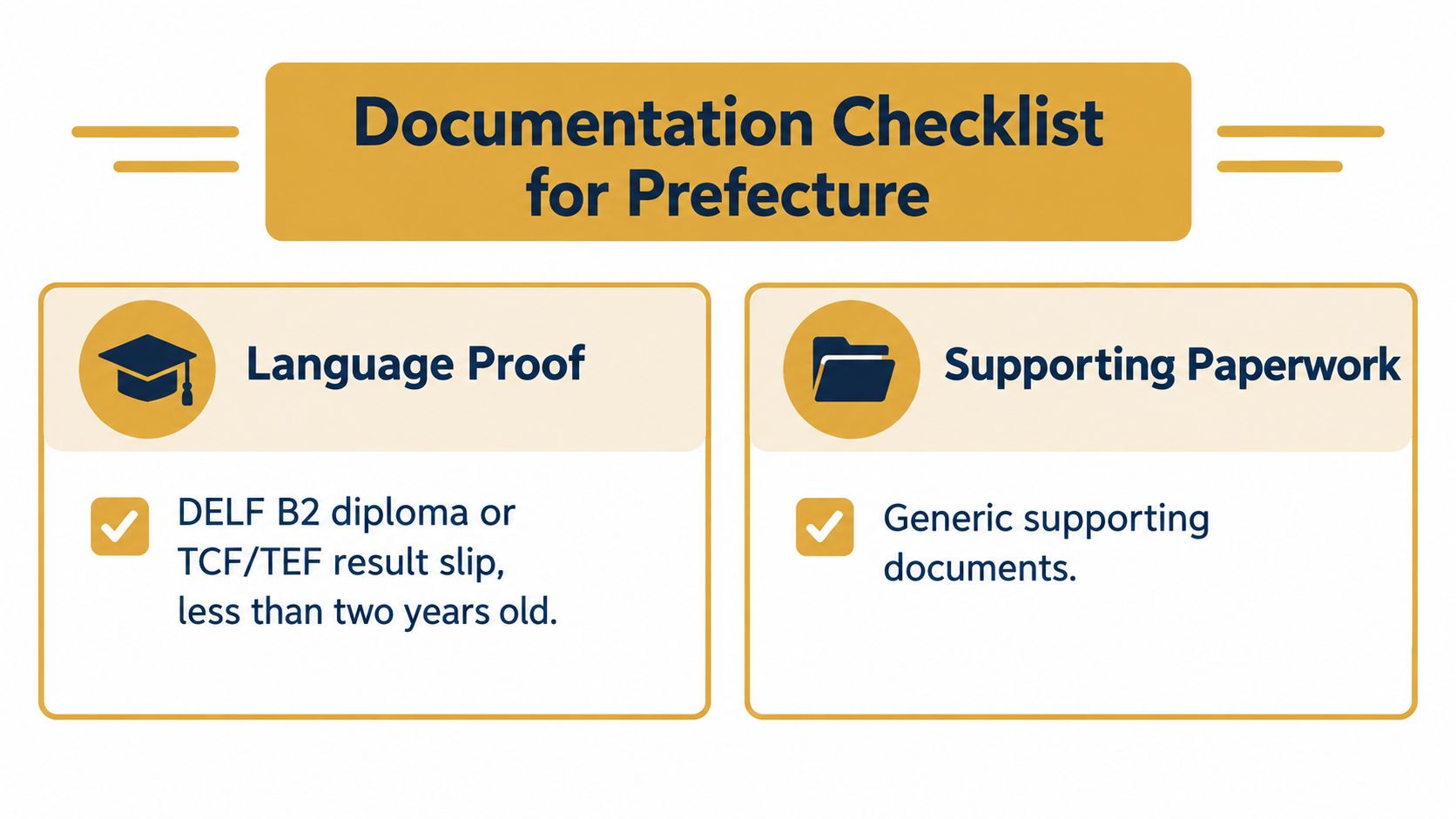
What belongs in the dossier
Start with language proof. That's your DELF B2 diploma or your TCF/TEF result slip, and the result has to be recent enough for the file rules. The name on the certificate must match your passport exactly, or you create avoidable verification delays.
Then gather civil status documents. That means your birth certificate, apostille or sworn translation if required, and marriage or divorce records if they apply to your situation. Add proof of residence for the qualifying period, because the prefecture wants to see continuity, not just a French address.
Integration evidence should be selected, not dumped in. Include tax notices, employment contracts, employer attestations, and children's school records where relevant. The goal is to show stability and attachment to France, not to overwhelm the reviewer with random paperwork.
Once your civic exam result is issued, add the confirmation of registration and the pass certificate to the file. If you're using a refugee route, don't forget the OFPRA letter where required.
The recurring mistakes that slow files
- Using non-sworn translations: if the translation isn't accepted, the document may as well not exist.
- Submitting the wrong TEF version: TEF Canada is not the same thing as the proof needed for mainland France.
- Uploading expired results: a test slip that looked valid when you booked the exam can be dead by submission day.
- Missing signatures: one unsigned page can trigger a needless return.
- Ignoring civil-status consistency: different spellings across documents create friction.
Here's the last step I'd use before submission. Spend the final two weeks making certified copies, checking color scans, and organizing everything in a folder labeled by prefecture category. That sounds tedious because it is. It also saves weeks.
Choosing Between Self-Study and Personalized Tutoring
People like to imagine self-study is the cheap route and tutoring is the expensive one. That's too simple. The question is whether you can self-correct under pressure and keep momentum long enough to reach B2 before your filing date.
When self-study is enough
Self-study apps, textbooks, and free YouTube channels can work if you're already sitting near B1, have 9 or more months before your interview, and can catch your own accent and grammar mistakes. In that case, you don't need rescue. You need structure, consistency, and enough repetition to make your speech more controlled.
I'd also choose self-study if the civic exam isn't urgent and your writing is already strong. Some applicants do fine when they can read, outline, and rehearse on their own without drifting. If that's you, keep your plan tight and measure progress every week.
When tutoring is the smarter move
If you're facing the B1 to B2 jump, weak in writing, or working with a citizenship deadline inside 6 months, tutoring is the faster route. Borderline candidates usually don't fail because they lack vocabulary. They fail because nobody forces enough output, catches their mistakes, or simulates the interview pressure properly.
I've seen that happen repeatedly. A candidate feels “almost ready,” delays corrections, then discovers too late that the examiner wants cleaner arguments and tighter control than their self-study habits can produce. A tutor shortens that gap by making speaking unavoidable and by correcting writing before errors harden.
Self-study vs personalized tutoring for French citizenship prep
| Factor | Self-Study | Personalized Tutoring |
|---|---|---|
| Best for | Strong independent learners already near B1 | Borderline B1 speakers, weak writers, deadline-driven applicants |
| Timeline | Works best with a long runway | Compresses preparation for faster progress |
| Speaking | Easy to under-train | Forced output, live correction, interview pressure |
| Writing | Often neglected | Weekly correction and targeted fixes |
| Exam fit | Can work for diligent, organized learners | Especially useful for DELF B2 and interview prep |
| Discipline needed | High | Lower, because the schedule is external |
If you want a concrete benchmark, a self-study stack might stay around the cost of books and apps over a long runway, while a tutoring plan is a real time investment in live correction and guided practice. I won't pretend the math is the same for everyone. What matters is the tradeoff between money, speed, and confidence on test day.
For some candidates, a free diagnostic is the right first step before committing to either route. Elite French Tutoring offers a free consultation that maps your current level, target certification, and timeline, which is useful if you're still deciding whether to self-study, hire support, or shift from a time-limited test to DELF B2.
If you're preparing for French citizenship this year, don't guess your way through the process. Pick your target level, choose the right exam, and build a timeline that matches your file date, then book a free consultation or compare lesson options before you spend another month studying the wrong version of French for citizenship.