

Your child's French schedule is probably being built around everyone else's calendar. School ends, homework starts, traffic slows the trip across Chicago, and the one weekly class you managed to book gets canceled for a holiday or sports event. Then you're left wondering whether a prestigious immersion label matters more than a realistic routine your child can actually maintain.
For most busy families, consistent weekly contact beats impressive branding. Chicago has strong options, from full-time French schools and preschool immersion to after-school programs and private online lessons. The right choice depends less on the name above the door and more on your child's age, current level, speaking opportunities, commute, and ability to attend regularly.
Table of Contents
- Navigating the Chicago French Learning Landscape
- Comparing In-Person Immersion and Online Tutoring
- What to Look for in a Quality French Program
- Real Student Success Stories and Measurable Outcomes
- Navigating Pricing, Scheduling, and Summer Camps
- Your Local Checklist for Evaluating Providers
- Next Steps to Start Your Child's French Journey
Navigating the Chicago French Learning Landscape
A parent searching for French classes for kids in Chicago can quickly feel buried under options. One provider offers preschool immersion, another runs after-school classes, a French school accepts applications by grade, and private tutors promise a schedule that works around soccer and music lessons. The labels sound different, but the practical question is simple: where will your child hear, understand, and use French consistently?
Chicago's French-learning ecosystem has unusually deep roots. Alliance Française de Chicago was founded in 1897 to promote French culture and now reports nearly 2,000 members and more than 3,500 enrollments each year. That history places today's children's programs within a local tradition that spans more than 125 years, rather than treating French enrichment as a passing trend. Alliance Française de Chicago describes its history and current community.
That context matters when you compare providers. A mature ecosystem usually supports different entry points, from preschool and elementary enrichment to youth classes, formal proficiency preparation, and adult education. You shouldn't expect the same teaching model to suit a three-year-old beginning oral exposure and an eighth grader preparing for a formal assessment.
Chicago offers more than one route
Lycée Français de Chicago serves Pre-K through Grade 12 and reports about 760 students. Its admissions information says non-French speakers may enter primary school from pre-K through Grade 5 through the Welcoming Language Program, depending on space. The school also publishes age milestones, including turning 3 by December 31 for pre-K and 5 by December 31 for kindergarten, with PK through Grade 8 applications due by December 31 each year. Review the Lycée Français admissions requirements.
That makes a full-school route appealing for families seeking an integrated academic environment. It also creates real constraints, including admissions timing, available places, school-day commitment, and the need to make French part of your child's daily education.
For families who want enrichment without changing schools, smaller programs may fit better. Alliance Française's preschool classes cap groups at 11 children, and its youth offerings include age-specific programming plus 30-minute family classes for ages 0 to 4. Explore children's and teen programming at Alliance Française.
I advise parents to begin with logistics, not prestige. If a program is too far away, too rigid, or too exhausting to attend, its theoretical advantages won't translate into sustained learning. Use Chicago's established French infrastructure as a strength, then choose the format your household can support week after week. Compare local French lesson options for children.
Comparing In-Person Immersion and Online Tutoring
Full-time immersion and private tutoring solve different problems. Immersion gives children sustained exposure across academic and social contexts. Private tutoring gives a learner concentrated attention, flexible scheduling, and a lesson designed around specific gaps. After-school enrichment sits between the two, offering peer interaction without asking a family to change schools.
The mistake is treating these formats as interchangeable. A child may spend many hours in a classroom but speak very little individually. Another child may receive far less total exposure but get frequent opportunities to answer, ask questions, and receive immediate correction. For a working family, the best program is the one that combines meaningful speaking practice with attendance you can protect.
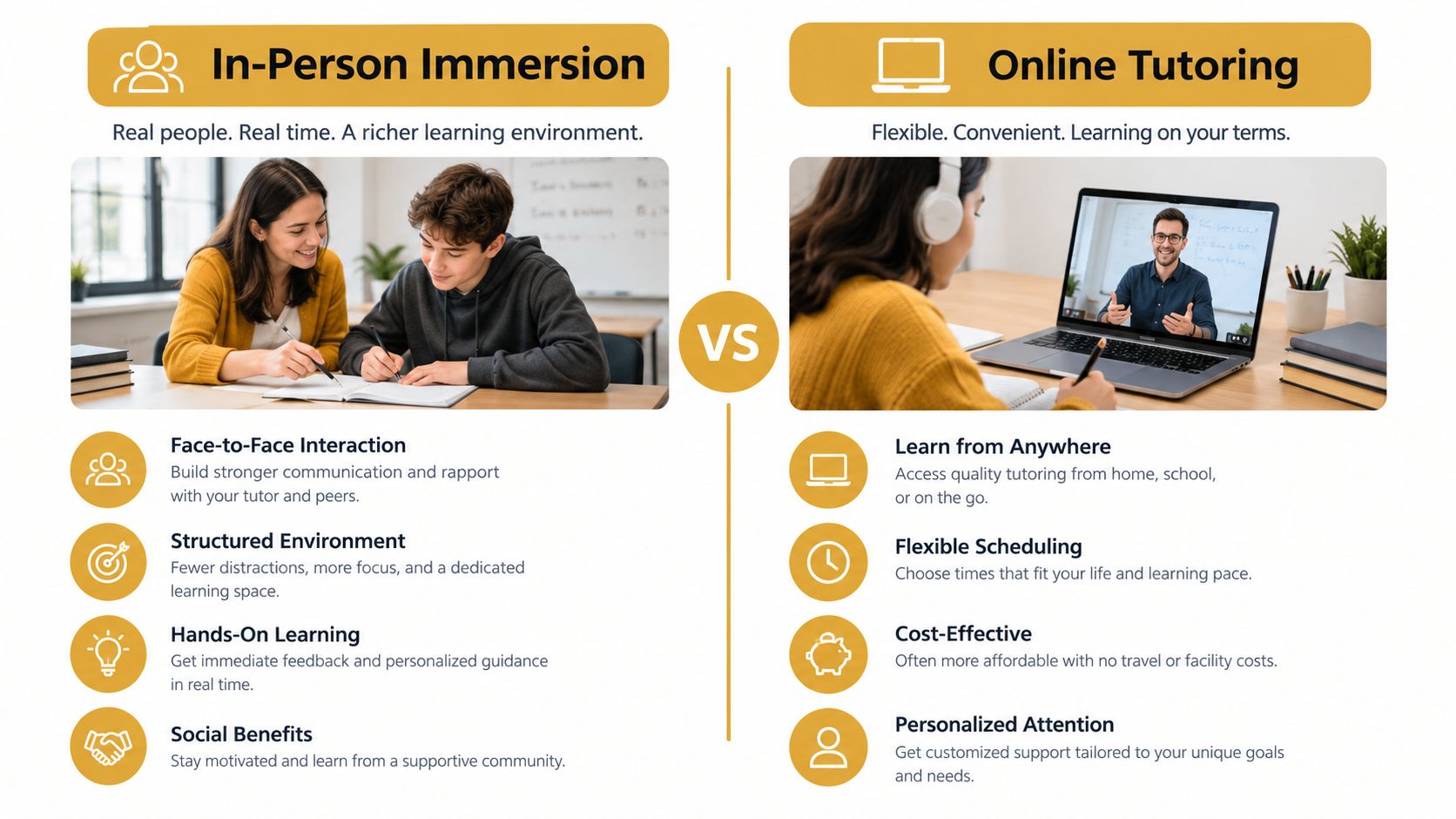
Chicago French Instruction Formats Compared
| Format | Weekly Contact Hours | Schedule Flexibility | Best For |
|---|---|---|---|
| Full-school immersion | Built into the school day and academic program | Low, because attendance follows the school calendar | Families seeking French-medium schooling and broad peer interaction |
| After-school enrichment | Scheduled classes outside regular school hours | Moderate, depending on provider and term | Children needing structured exposure while remaining in an English-language school |
| Private online tutoring | Set by the family and tutor | High, with lessons arranged around household commitments | Learners needing targeted support, speaking practice, exam preparation, or a flexible routine |
Research summarized through the University of Minnesota's Center for Advanced Research on Language Acquisition points toward the value of immersion and bilingual models for functional proficiency, especially when instruction is consistent and connected to meaningful content. Review the cited immersion and bilingual education research. That doesn't mean every child needs full-time immersion. It means a weekly plan should create enough continuity for French to remain active between lessons.
Choose the format your week can sustain
A full-school program may be the strongest academic fit for a family committed to French-medium education. It may also be the wrong choice if the commute creates daily stress or if your child needs more individualized support than a classroom can provide.
After-school classes offer peer energy and predictable structure, but parents should ask how much time each child spends speaking. Online tutoring removes the commute and can focus on the child's school vocabulary, pronunciation, reading, or DELF objectives. It won't recreate the social environment of a school, so home activities and occasional group interaction may matter.
Practical rule: Choose the highest level of immersion your family can maintain without making attendance fragile.
For parents comparing digital options, this guide to online French classes for children, teens, and adults can help clarify what to ask about lesson structure, interaction, and age suitability.
What to Look for in a Quality French Program
Your child may enjoy a polished trial lesson, then lose momentum if the schedule, level, or teaching approach does not fit your week. Judge a program by the learning system behind its branding: placement, lesson design, teacher preparation, feedback, and dependable attendance. A modest program with careful age grouping and frequent speaking practice will usually serve your child better than a prestigious name paired with worksheets and missed sessions.
Start with the lesson itself. Younger children need activities suited to their development, not shortened adult classes. Songs, stories, movement, picture prompts, routines, and brief exchanges build comprehension without making every activity a translation exercise. Older learners need a clear progression through reading, writing, conversation, grammar, and content connected to schoolwork or exam aims.
Ask how the program creates speaking time
A small group only helps when the teacher manages participation deliberately. Ask for a measurable example. A program that schedules two short speaking turns for each child during a 30-minute lesson gives parents a concrete interaction floor to discuss during a trial. Private tutoring can create more individual speaking time, but group classes may add peer listening and social motivation. Choose the advantage your child will use consistently.
Ask these questions before enrolling:
- Placement: How does the provider assess comprehension, speaking, reading, and writing before assigning a level?
- Age bands: Are preschoolers, early elementary students, and older children separated when their needs differ?
- Teacher expertise: Does the instructor have native or near-native French fluency and experience with the child's age group?
- Class participation: How often does each child speak during a typical lesson?
- Feedback: Will parents receive specific information about what the child understands and can produce?
- Continuity: Does the curriculum build from one term to the next, or does each session start from scratch?
Teacher temperament matters too. Children participate more readily when mistakes become useful feedback rather than public embarrassment. Frequent, low-pressure practice helps them recognize vocabulary first and use it spontaneously later. A weekly cadence your family can protect often produces more progress than an impressive program attended irregularly.
Match the curriculum to the outcome
If your child attends a bilingual or French school, tutoring should connect with current classroom expectations. A learner struggling with a science unit in French may need content-based support rather than another general vocabulary list. A student preparing for DELF needs practice with relevant communication skills and task types, not only informal conversation.
Look for progression described through observable results. “More confidence” can be a valid aim, but the provider should explain how you will see it. Useful examples include answering routine questions without switching to English, retelling a familiar story, reading a short passage, or sustaining a conversation about a practiced topic.
Families seeking individualized support can compare children's language classes from Elite French Tutoring with local group programs. The label matters less than the fit between lesson design, teacher, feedback, and the weekly schedule your child can maintain.
Real Student Success Stories and Measurable Outcomes
A realistic success story should show a process, not promise a miracle. Consider a Chicago family whose elementary-age daughter enjoyed French but couldn't manage a long commute after school. Her parents compared a full immersion route with private tutoring and chose a shorter online session at a consistent time each week, supported by brief French reading and conversation at home.
That decision didn't give her the same environment as a French-medium school. It did remove a major attendance barrier. The tutor could target pronunciation, everyday vocabulary, reading fluency, and the communication tasks associated with DELF Prim preparation instead of following a broad group lesson plan.

Define progress before you buy lessons
The family tracked progress through practical milestones. Their daughter began answering familiar questions more readily, reading aloud with less hesitation, and using rehearsed phrases without waiting for an English translation. Her parents also asked the tutor to identify which skills were developing and which needed more practice.
Those are useful signals even before an exam. A formal goal, such as DELF Prim readiness, can add structure, but parents shouldn't confuse exam preparation with general fluency. The right measure depends on the child's objective. For one learner, success may mean keeping up in a bilingual class. For another, it may mean participating in a family trip to France with greater independence.
This kind of individualized trajectory is the focus of a detailed account of Emma's French-learning progress. Read it critically, as you should read every tutoring story. Look for the starting point, the routine, the feedback process, and the outcomes described, rather than relying on a dramatic headline.
A child who attends a prestigious program but misses frequently may progress more slowly than a child who receives regular, focused practice in a less glamorous format. That isn't an argument against immersion. It's an argument for matching the learning environment to the child's actual life.
Families can also use media strategically. A short French story, a picture book, or a guided conversation can reinforce lesson vocabulary without creating another heavy homework block.
Here is a related video resource for families evaluating French-learning approaches:
The most useful question after any trial lesson is not “Did my child seem entertained?” Ask instead: What can my child do in French now that they couldn't do before, and what will we practice next?
Navigating Pricing, Scheduling, and Summer Camps
Budgeting for French means budgeting for continuity. The cheapest class isn't economical if your child loses momentum between sessions, while the most intensive option may create pressure that makes attendance difficult. I recommend building an annual plan around the routine you can protect first, then adding camps or extra practice where they genuinely support the goal.
Summer camps can provide a useful concentrated environment, especially for children who need French contact outside the school year. Alliance Française separates its summer camp into Pre-School ages 3 to 5 and Kids Camp ages 6 to 12. Families can enroll by the week or for the full 9-week session, with full-session and early-bird weekly discounts available. Review Alliance Française summer camp options.
That structure gives parents flexibility, but it also requires planning. A weekly camp can work as a seasonal boost. It shouldn't be treated as a substitute for a sustainable school-year routine if the child's goal is ongoing proficiency.
Compare the full-day commitment carefully
Lycée Français de Chicago's French camps use age-based placement for children ages 4 to 11. The camps run Monday through Friday from 9:00 a.m. to 3:30 p.m., with drop-off as early as 8:00 a.m. and free after-camp care until 5:30 p.m. The listed price is $1,845 per child. Check the published camp schedule and pricing.
Those details matter more than a general description of “immersion.” A full-day camp may solve childcare and offer sustained French exposure, but it also demands transportation planning, physical energy, and a substantial block of family budget. A shorter private lesson may provide less total exposure but fit reliably around work and school.
When comparing prices, include the hidden costs:
- Travel: Count the time and transportation required for every class.
- Materials: Ask whether books and activities are included or purchased separately.
- Missed sessions: Check policies for holidays, illness, and schedule conflicts.
- Practice support: Find out whether the provider gives realistic home activities.
- Family capacity: Don't schedule so much French that your child starts resisting it.
A practical calendar often combines one dependable school-year format with a seasonal camp or reading routine. The goal is not maximum French at any price. It's a pattern your child can sustain with enough recovery time to stay engaged.
Your Local Checklist for Evaluating Providers
The most expensive or recognizable program isn't automatically the best fit. Prestige can open doors, but it can't guarantee that your child will be placed correctly, speak often, receive useful feedback, or attend consistently. Use the provider's answers, not the marketing language, to make your decision.
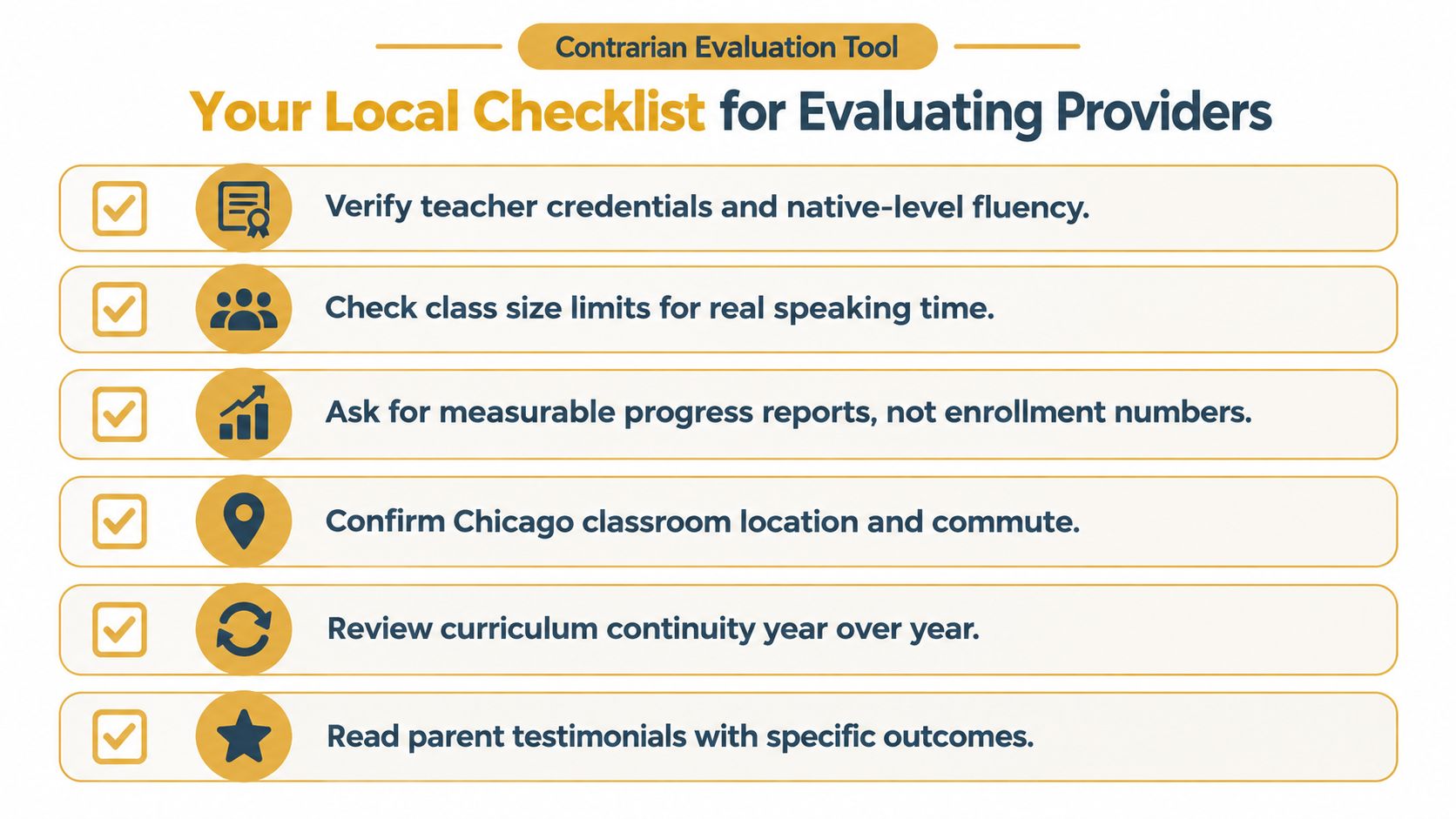
Bring these questions to a consultation
- Teacher credentials: Can the provider explain the instructor's French fluency and experience with your child's age?
- Class size: How many children attend, and how much individual speaking time does each receive?
- Progress reporting: Will you receive concrete examples of developing skills rather than only attendance or enrollment information?
- Location and commute: Can your family reach the classroom without making regular attendance unrealistic?
- Curriculum continuity: What changes from one level or term to the next?
- Parent communication: Who contacts you when a child is struggling, disengaged, or ready for more challenge?
Also ask about cultural integration. French should appear as a living language through stories, music, food, geography, celebrations, and age-appropriate content, not only as isolated vocabulary drills. Cultural material should support communication rather than replace it.
Watch for avoidable red flags
Be cautious when a program mixes very wide age or ability ranges without explaining how instruction is differentiated. Worksheet-heavy lessons can have a place, especially for writing and review, but they shouldn't dominate a child's language experience.
Another warning sign is a provider that cannot describe what progress looks like. You don't need a guarantee or an invented percentage. You do need a clear explanation of how teachers observe comprehension, speaking, reading, and writing over time.
The right program should make it easy for a parent to understand what the child is practicing, why it matters, and what happens next.
Next Steps to Start Your Child's French Journey
Start with an assessment, not a long-term commitment. Before choosing a class, identify your child's current exposure, comfort speaking, reading ability, school demands, and personal objective. A child entering a bilingual track needs a different plan from a beginner preparing for a family trip or a student working toward DELF.
I also recommend testing the schedule against a normal week, not an ideal one. Can your child attend after a full school day? Will homework, sports, and dinner make the lesson rushed? If the answer is yes, a private online format may be more practical than a program that looks stronger on paper.
Build a plan around one clear objective
Choose a primary target for the first stage:
- School support: Align lessons with vocabulary, reading, and assignments from the child's current program.
- Speaking confidence: Prioritize guided conversation, listening comprehension, and low-pressure correction.
- Exam preparation: Map instruction to the relevant DELF objectives and identify skills that need deliberate practice.
- Cultural and family enrichment: Use stories, games, and everyday conversation to make French part of home life.
A complimentary consultation can help a tutor identify the child's level, learning style, and practical constraints before recommending a cadence. Elite French Tutoring offers a free 20-minute consultation for families considering a customized online program, with lessons designed around objectives such as school support, conversation, or DELF preparation.
Don't wait for the perfect semester, the perfect commute, or the perfect immersion label. Start with a manageable schedule, ask how progress will be measured, and review the plan after your child has had enough consistent exposure to show a meaningful pattern.
If you're comparing French classes for kids in Chicago, book a free 20-minute consultation with Elite French Tutoring to discuss your child's level, goals, and schedule. You'll leave with a clearer view of whether flexible private tutoring is the right fit, or whether a local immersion or group program better matches your family.
When you're ready, choose the option your child can attend consistently, then protect that routine. A practical plan with regular speaking opportunities will take your family further than a prestigious program that never fits the week.