
You've found a French company willing to interview you, but three questions remain unanswered: Can you legally work there, will the placement be paid, and can you arrive with the right visa? Those questions determine whether your summer plan becomes a signed internship or an expensive administrative dead end.
I advise students to choose their legal route before they send applications. Summer internships in France fall into two practical tracks, and the right choice depends on your nationality, academic enrollment, placement length, and budget. The students who succeed don't treat paperwork, French preparation, and job searching as separate tasks. They build one plan that connects all three.
Table of Contents
- The Intern Sitting in a Paris Café With No Idea What's Legal
- Two Internship Tracks You Need to Pick Between
- Where Real Summer Internships in France Actually Get Found
- Your October to June Application Timeline
- French CV, Cover Letter, and Interview Norms That Trip People Up
- Language Prep as a Hiring Filter, Not a Nice-to-Have
- How Maya Landed Her Offer and What You Should Do This Week
The Intern Sitting in a Paris Café With No Idea What's Legal
Last May, Sarah, a Boston junior, sat in a café near Canal Saint-Martin with her laptop open and her internship offer saved in an email. A Paris startup had agreed to let her help with market research. She had spoken with the founder, shaken hands, and assumed that agreement made her an intern.
It didn't.
Sarah had entered France under the rules applying to a short visit. Her company had no completed convention de stage, the tripartite agreement connecting the student, school, and host organization. She also hadn't mapped her arrival and departure dates against the 90-day short-stay visa boundary. Her informal arrangement looked simple to the startup, but it didn't create the legal structure required for a proper French internship.
My advice: Never accept “we'll sort out the paperwork later” from a French employer. The paperwork is part of the placement, not an administrative detail after the offer.
A French internship is a regulated form of work-based learning. The framework became more structured after the 2006 French law on internships and the 2014 reform, which required compensation for placements lasting more than two months. In practice, the statutory minimum has historically translated into about €4.35 per hour, or roughly €600 per month for a full-time placement, based on 15% of the French social security hourly ceiling. You can review the broader work and visa considerations in this guide to work visas in France.
Sarah's confusion is common because people use “internship” to describe several different arrangements. A three-week studio project, a paid placement lasting through the summer, and a university-linked stage for a non-EU student can involve different documents and immigration steps.

The rest of this guide uses a two-track framework. One route suits students who need a longer placement, a formal academic agreement, and potentially a long-stay visa. The other can suit a shorter placement that stays within the short-stay rules, although it still needs careful documentation and academic legitimacy.
By the next section, you'll know which track fits your passport, your budget, and your summer length, without relying on legal guesswork.
Two Internship Tracks You Need to Pick Between
I draw the distinction this way: the long-stay paid track is a structured academic placement, while the short-stay track is a tightly limited summer project. Don't apply for both casually. Choose the route that matches your actual dates and eligibility.
| Dimension | Long-stay paid track | Short-stay track |
|---|---|---|
| Best fit | Students needing a longer, formal placement | Students completing a brief academic project |
| Immigration route | Placements over 90 days require a long-stay visa validated after arrival | Placements of 90 days or less use the short-stay route |
| Academic paperwork | Convention de stage, school approval, host-company documentation | Convention de stage and proof of the academic connection |
| Compensation | Mandatory once the internship exceeds two months; the 2026 rate is about €4.50 gross per hour in official guidance | May be unpaid when the placement stays below the legal payment threshold |
| Key legal trigger | More than two months activates mandatory compensation | Two consecutive months, about 44 working days or 308 hours, activates mandatory compensation |
| Realistic candidate | A U.S. business major targeting a Paris strategy consultancy | A UK design student completing a three-week studio sprint |
The 90-day distinction is the first filter. Official guidance separates placements of 90 days or less from those exceeding 90 days. A longer placement needs a long-stay visa equivalent to a residence permit, with validation after arrival, as explained by Sorbonne University's visa guidance.
The two-month payment trigger is separate from the visa trigger. Payment becomes mandatory only after two consecutive months, approximately 44 working days or 308 hours. For 2026, official guidance places the minimum around €4.50 gross per hour, while another French employment guide describes the statutory calculation as 15% of the hourly Social Security ceiling, producing €4.35 per hour under the stated ceiling. Treat the employer's written calculation as something to verify, not something to assume.
The hidden administrative workload
A late planner sees an offer. A prepared student sees a chain of dependencies:
- Convention de stage: Your school and host company must approve the agreement.
- Financial proof: Non-EU applicants may need to demonstrate at least €615 per month, and the stipend can matter in the assessment for longer placements, according to France-Visas guidance for student trainees.
- Presence tracking: The same host organization can host a student for a maximum of six months per teaching year, counted as 924 hours of actual presence. French rules convert attendance using seven hours for one day and 22 days for one month, so your school and employer need accurate records. See the French Service Public internship rules.
- Immigration timing: A visa appointment, document review, and arrival validation can all affect your start date.
Use three questions to self-select:
- Will the placement exceed 90 days? If yes, plan for the long-stay route.
- Will it exceed two consecutive months? If yes, include mandatory compensation in your financial planning.
- Can your school sign the convention de stage? If not, stop applying until you have a compliant academic path.
A U.S. business major pursuing a longer Paris consultancy placement should build around the paid long-stay track. A UK design student completing a three-week studio sprint has a different case, but shouldn't mistake short duration for permission to work without documentation.
Where Real Summer Internships in France Actually Get Found
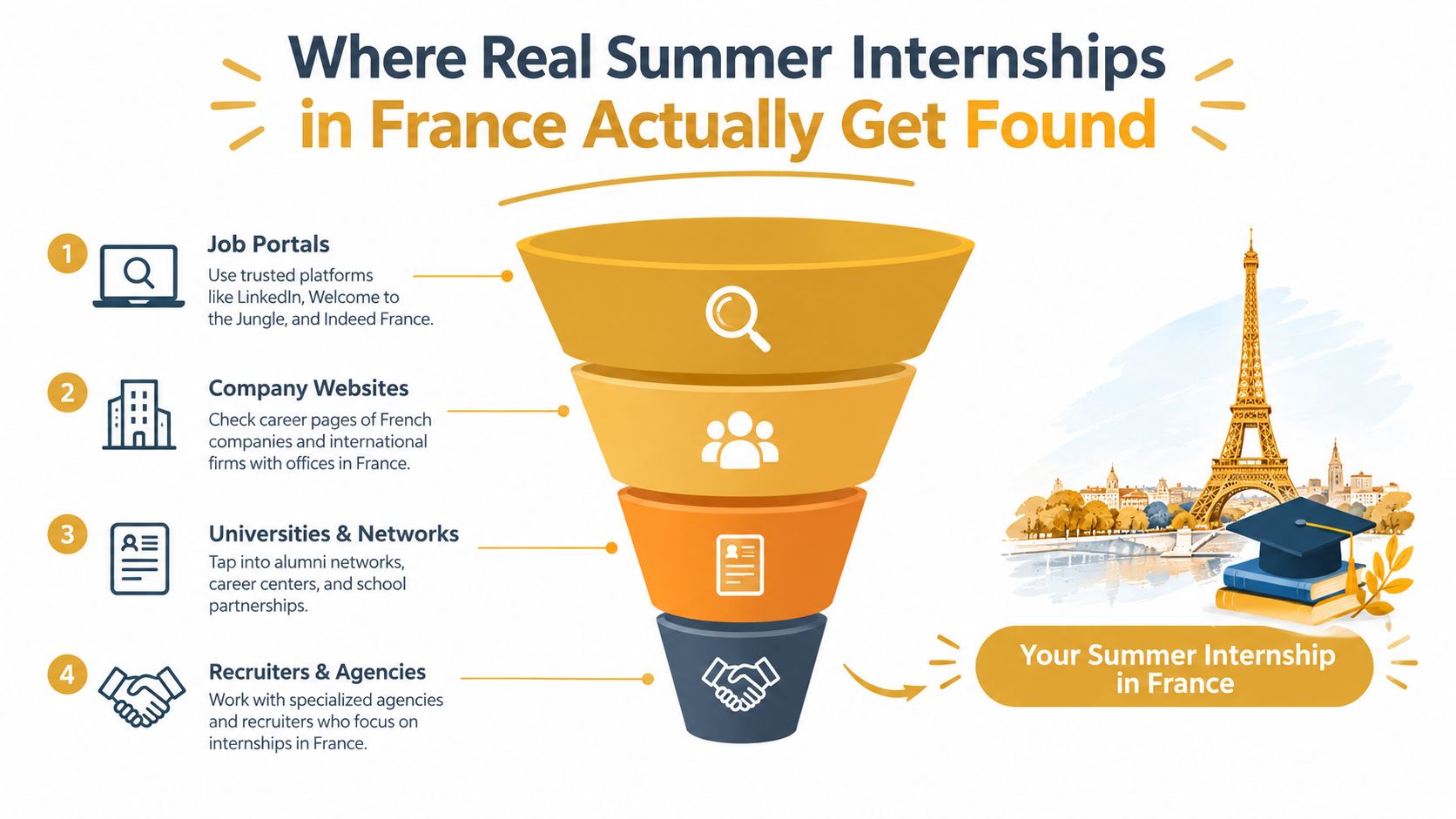
The strongest channel for international students is usually the one closest to their academic institution. Start with your university's career office, exchange office, departmental faculty, and Erasmus+ contacts before spending hours on public job boards. These channels can clarify whether a host company can sign your convention de stage and whether your placement fits your academic program.
Rank channels by fit, not popularity
School and Erasmus+ channels come first. They give you context, institutional credibility, and a faster way to check eligibility. Ask for employers that have already hosted international students, particularly in Paris, Lyon, Strasbourg, and tourism-focused regions.
French job platforms come next, but use each for a purpose:
- Welcome to the Jungle: Strong for startups, technology, communications, and modern corporate roles, especially when the listing explains its working language.
- StageMoteur: Useful for French-language internship searches and students willing to work through conventional French recruitment processes.
- APEC: More relevant to graduate-level and professional roles, so read requirements carefully before applying as an undergraduate.
- My Internship Abroad: Useful for internationally oriented placements, but verify who handles the academic agreement, immigration documentation, and employer relationship.
Cold outreach to mid-sized French companies deserves more attention than another hour of passive scrolling. A concise email can work:
Objet: Candidature pour un stage en marketing, juin à août
Bonjour Madame [Name],
Je suis étudiant(e) en [program] at [university], and I'm seeking a stage in [field] for [dates]. I can support [specific business task], and I'm attaching my CV and a short explanation of my academic program. My school can provide and sign a convention de stage.
Seriez-vous disponible pour un court échange cette semaine?
Bien cordialement,
[Name]
Target companies with a reason for contacting them. Luxury houses, hospitality groups in tourism corridors, biotech companies around Lyon and Strasbourg, and Paris fintechs are sensible sectors to investigate during summer hiring cycles. Your email should show that you understand the company, not merely that you want to live in France.
I'd also use a targeted French work opportunities resource while preparing outreach, particularly if you need professional vocabulary for emails and calls.
Avoid generic LinkedIn Easy Apply campaigns, unpaid NGO aggregators with unclear employers, and anyone selling a “visa run” as a shortcut. Those routes create activity without necessarily creating a compliant placement.
My channel rule: Spend your effort where a school, a named recruiter, or a real company contact can confirm the role and paperwork. Job-board volume is not the same as opportunity quality.
Your October to June Application Timeline
A summer placement is won through deliverables, not optimism. I'd use the following calendar and adjust the dates only after checking your school's academic deadlines and your consulate's process.
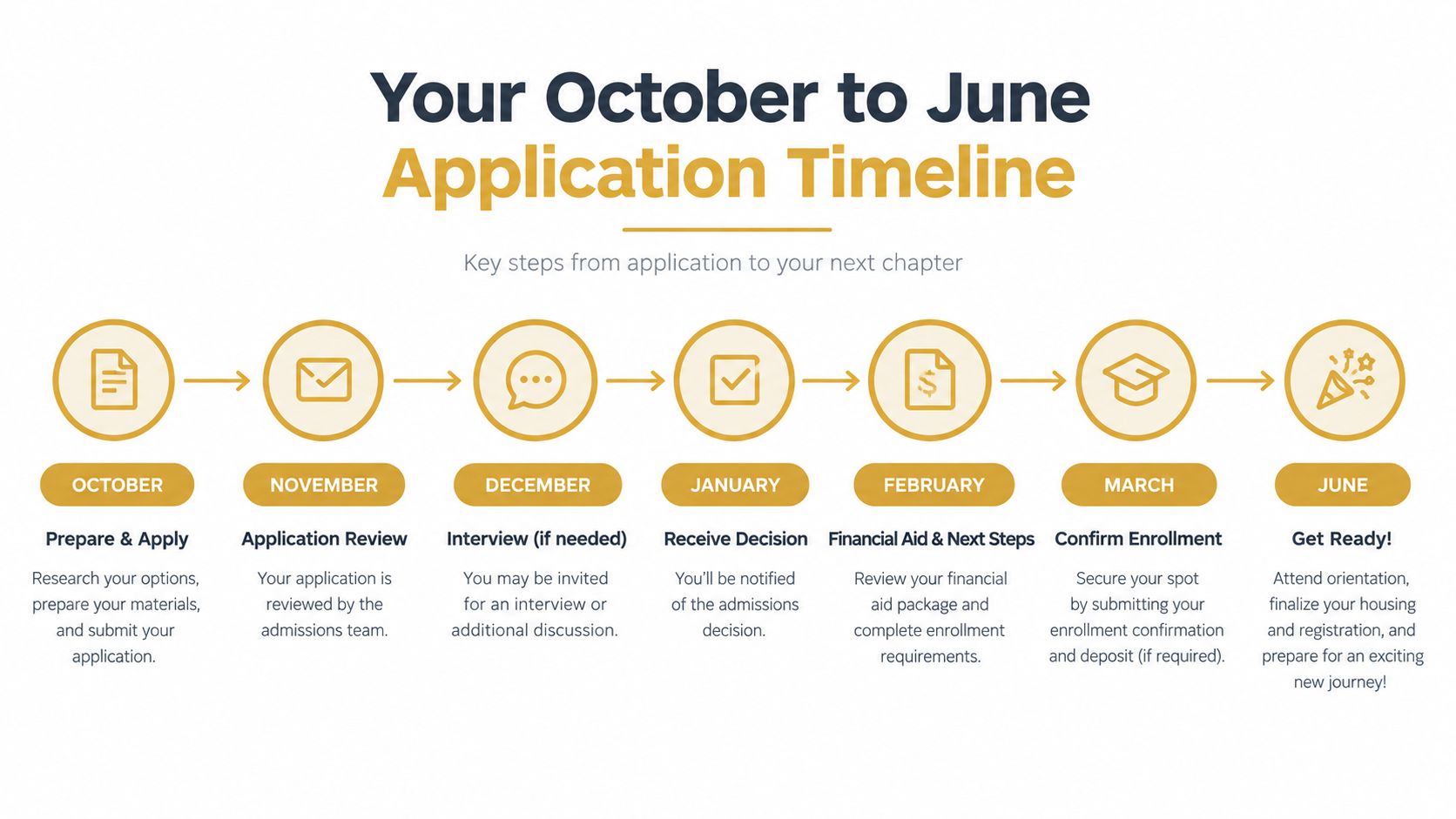
October through December
Define your target sector, preferred city, working-language preference, and maximum budget. Build a list of 30 companies, then identify the relevant recruiter, team leader, or department contact for each one.
Attend career fairs and speak with your academic office about the convention de stage. Start a French CV and collect the information you'll need for a French cover letter. If you're non-EU, check the visa route before you present a preferred start date to employers.
January and February
Send the first serious application wave before holiday closures and slow response periods interfere with recruiting. Apply to roles that state their language expectations clearly, then send personalized cold emails to selected mid-sized companies.
Your application folder should contain a CV, a cover letter base document, an enrollment confirmation, a passport copy where appropriate, and a short explanation of your academic placement requirements. Don't wait for an offer to discover that your institution can't sign the agreement.
March
Expect interviews for short-stay roles and rolling paid positions. Practice explaining your visa status, academic connection, dates, and French level without hesitation.
March is also a practical moment for students traveling from the United States to investigate visa appointment availability for a summer arrival. If your placement will exceed 90 days, the short-stay route doesn't solve your problem. If it will exceed two consecutive months, map the payment trigger against your exact working days and hours.
April through early May
This is the decision window. Confirm the host company, sign the convention de stage, and file the long-stay visa application if your placement exceeds 90 days. Review the financial documentation, accommodation evidence, and employer paperwork as one file, because a missing document can affect the entire sequence.
Late May through June
Lock housing, arrival transport, insurance questions, and your first-day logistics. Confirm who will handle any remaining registration or validation steps after arrival.
Keep a written date map. A placement that seems comfortably short can cross the 90-day Schengen cutoff or the two-month compensation trigger when arrival, attendance, and end dates shift. Your calendar should show those boundaries before you book anything nonrefundable.
French CV, Cover Letter, and Interview Norms That Trip People Up
A French application should make the recruiter's decision easy. Keep the CV to one page, put your strongest skills and languages where they can be seen quickly, and use an honest CEFR level for French. A professional photo is customary on many French CVs, while personal details such as marital status don't belong in your application.
The bigger mistake is translating an American résumé word for word. U.S. candidates often list responsibilities. French recruiters want a clear connection between your experience, the target role, and the company's needs.
A worked application example
Weak bullet:
- Helped with social media for a student organization.
Stronger version:
- Developed a content calendar for a student organization, coordinated weekly posts, and monitored engagement trends to support event promotion.
The rewrite is better because it identifies the work, the process, and the business purpose. Add a real result only when you can verify it. Don't manufacture a percentage or inflate a project to make the bullet look impressive.
Your lettre de motivation should follow a compact three-part logic:
- Who you are: State your program, academic focus, and availability.
- What you want: Name the internship function and the type of contribution you can make.
- Why this company: Connect one specific company activity to your skills and goals.
A sentence such as “I'm interested in your company because it's international” is empty. Mention a product, market, client category, research area, or business challenge that connects to your experience.
You can use a focused resource for French cover letter preparation, but don't copy a template without adapting its vocabulary and evidence.
Interviews reward preparation over performance
French interviews can move more slowly than an American screening call. You may meet a hierarchical panel, receive direct questions about motivation, and be asked to explain your language level and visa status before discussing behavioral examples.
Prepare clear answers to:
- Why this company and this team?
- What can you do independently?
- How will your academic program support the stage?
- What is your current French level?
- Which visa or residence route applies to you?
Disclose your visa situation in writing early. A recruiter may still consider you, but they can't plan around an immigration issue they learn about only after making an offer.
Language Prep as a Hiring Filter, Not a Nice-to-Have
French ability becomes a hiring filter the moment the role includes internal meetings, client contact, administrative follow-up, or a manager who prefers French. English may be the advertised working language, but recruiters still need to know whether you can greet a colleague, understand a fast instruction, write a clear update, and recover when a conversation changes direction.
For short-stay startup and tourism roles, spoken French around B1 can sometimes be workable, particularly in international Paris teams. Paid placements in finance, consulting, legal, and government typically demand stronger written and spoken control, often around B2 written and C1 spoken expectations. Treat those levels as preparation targets, not promises that every employer uses the same test.
Prepare for the moments that decide an interview
Professional phone French matters during the first HR screen. Practice confirming your availability, spelling your email address, describing your academic program, and answering “Pourquoi cette entreprise?” without switching immediately to English.
Written email French affects every stage. Recruiters notice whether you can write a concise follow-up, thank someone after an interview, ask for a document, and explain a scheduling conflict politely. Your cover letter is only the first sample.
Sector vocabulary should match the internship. A finance applicant needs terms for reporting, analysis, and clients. A marketing applicant needs language for campaigns, audiences, positioning, and performance. A biotech applicant should know how to discuss research tasks without pretending to understand technical material they haven't studied.
Listening at meeting speed is the skill many students neglect. Use one French podcast and one French news outlet for daily shadowing. Pause, repeat, and summarize aloud instead of listening passively.
I recommend an 8- to 12-week preparation arc that pairs weekly tutoring with daily shadowing. In the first phase, build core interview answers. Then add sector vocabulary and written corrections. Finish with timed mock interviews, voicemail practice, and meeting simulations.
A language assessment or certification plan can help you organize that work. French language certification preparation is useful when you need an external benchmark, but the interview itself remains the true test.
Elite French Tutoring is one option for customized private lessons, including professional communication and DELF preparation. The useful feature for this goal is targeted practice around your actual role, not general conversation disconnected from recruitment.
Hiring reality: French doesn't need to be perfect. It needs to be reliable in the exact situations your internship will create.
How Maya Landed Her Offer and What You Should Do This Week
Maya, a U.S. business student, began applying in December with no French. Her first approach was too broad. She applied to English-language roles in several cities without deciding whether her dates, school, and immigration route matched the placements.
By March, she changed direction. She focused on Lyon marketing roles, committed to the paid long-stay track, and asked her university to confirm its ability to issue a convention de stage. She also prepared for the DELF and passed at B1, then practiced a video interview in French until she could explain her coursework, marketing interests, availability, and visa situation without freezing.
She secured a Lyon marketing internship by April. The offer worked because the legal route, academic agreement, and language preparation supported one another. Her French wasn't flawless, but she could handle the moments that mattered.
Your 14-day reset plan
Days 1 to 3, rebuild the application base
- Convert your résumé into a one-page French CV.
- Put language skills and relevant tools near the top.
- Remove personal details that don't belong.
- Write a two-sentence explanation of your academic program and convention de stage eligibility.
Days 4 to 7, create real application momentum
- Register on Welcome to the Jungle, StageMoteur, and one internationally focused portal such as My Internship Abroad.
- Select five companies that fit your sector and dates.
- Send five personalized cold emails, each addressed to a named contact.
- Record every application, response, document request, and follow-up date.
Days 8 to 10, test feasibility before you commit
- Book a visa information session or consult the official route for your nationality.
- Complete a French language assessment.
- Compare your planned dates with the 90-day immigration boundary.
- Check whether your placement may cross the two-month compensation threshold.
Days 11 to 14, prepare for conversion
- Draft a flexible cover letter template with a company-specific paragraph.
- Request two references.
- Practice a short French introduction and a clear explanation of your visa status.
- Schedule mock interview practice focused on your target sector.
Maya's turning point wasn't sending more applications. It was choosing a viable route and preparing the language she needed for that route. If French is the lever holding back your interviews, targeted tutoring can help you practice the calls, emails, vocabulary, and interview answers your summer placement will require.
Book a focused French consultation before you apply, then bring your target role, CV, and preferred dates to the session. You'll leave with a clearer language plan and a more credible application for summer internships in France.