

Your child is sitting at the kitchen table, staring at a French worksheet, and you're trying to help without speaking French yourself. You can tell something is off. Maybe the grades are slipping. Maybe homework takes forever. Maybe your child says, “I understand it in class, but I can't do it on my own.”
I work with families in this exact situation all the time. The mistake most parents make is hiring “some French tutor” before they've diagnosed the underlying problem. That wastes time, money, and patience. If you want French for school to work, you need support that matches the curriculum, the timeline, and your child's specific bottleneck.
There's also a bigger reason school French matters. Standard French didn't become broadly shared across France overnight. One historical estimate says that before the French Revolution, only 3 million of 28 million citizens could understand standard French, and even by 1940, half of French citizens still spoke a regional dialect at home, which shows why structured school instruction became so important over time (history of French standardization). School French has always been about more than vocabulary lists. It's about mastering an academic language in a structured system.
Table of Contents
- Pinpointing Your Child's Exact Needs
- Choosing the Right Tutoring Format for Your Family
- How to Find a Truly School-Aligned Tutor
- Building a Realistic Lesson Plan and Timeline
- How to Support Learning at Home (When You Don't Speak French)
- Your Partner in Your Child's French Success
Pinpointing Your Child's Exact Needs
When a child is struggling in French, I don't start with tutor recommendations. I start with diagnosis. A good doctor doesn't prescribe before identifying the problem, and you shouldn't hire support before you know what's failing.
For French for school, I use three pillars. Current level. Specific pain point. Curriculum type. If you get these right, your search gets much easier.
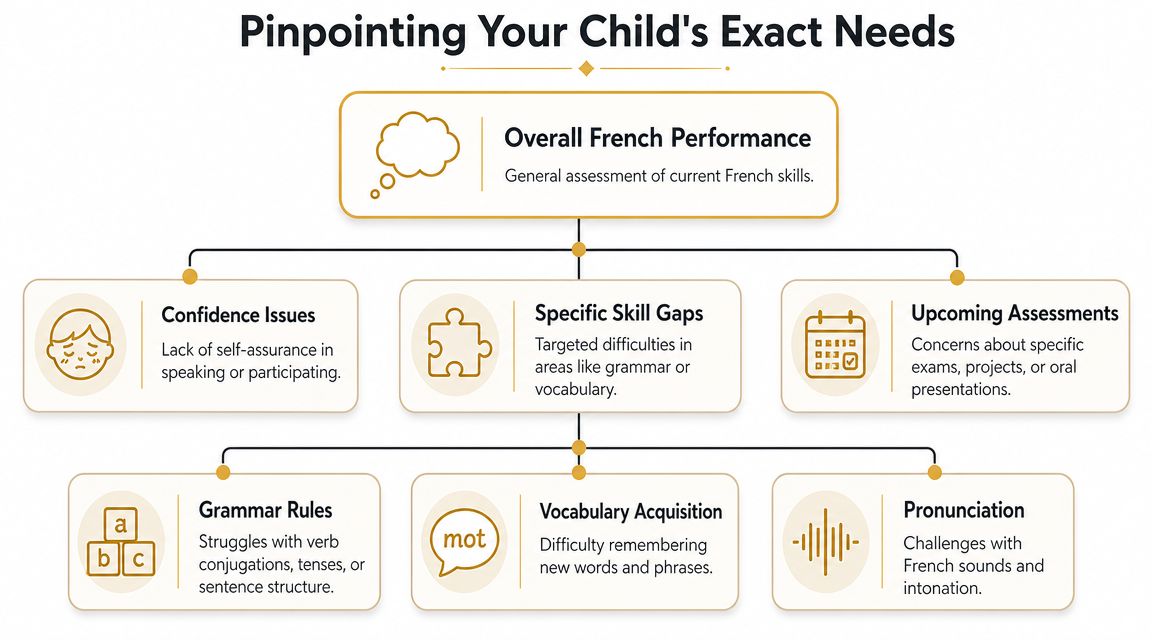
Use the three-pillar diagnosis
Start with current level. If your child's school uses CEFR labels like A1, A2, or B1, that helps. If it doesn't, use school evidence instead: recent writing samples, quiz results, oral feedback, report card comments, and whether your child can read instructions independently.
If you want a cleaner baseline, use a formal French placement test for students. That gives you something objective to compare against classroom performance.
Then identify the specific pain point. Don't accept “they're bad at French” as an answer. That's too vague to fix. Usually the underlying issue falls into one of these categories:
- Output problem: your child understands class content but freezes when speaking or writing.
- Accuracy problem: they participate confidently but make recurring grammar, spelling, or agreement errors.
- School-fit problem: they know everyday French but can't handle the format their school expects.
- Workload problem: they could succeed, but they're disorganized and fall behind.
Practical rule: If your child says “I know it when I see it, but I can't do it alone,” you're usually looking at a retrieval and application problem, not a knowledge problem.
The third pillar is curriculum type, and parents often miss this one. A child in a French immersion public school needs different support from a child at a Lycée Français, an IB program, an AP track, or a bilingual private school. The assignment style, writing expectations, oral assessments, and pacing can be completely different.
Write one clear problem statement
I tell parents to write a one-sentence problem statement before they contact any tutor. Something like:
- My child understands classroom French but struggles to write structured answers for IB assessments.
- My child is fine with vocabulary memorization but can't follow grammar-heavy homework in a bilingual elementary program.
- My child needs speaking confidence for oral presentations and teacher interaction, not beginner conversation practice.
That sentence will save you from hiring the wrong person.
If this feels messy right now, that's normal. A short consultation with someone who knows school systems can sort the issue quickly. The point is to buy the right kind of help, not just more help.
Choosing the Right Tutoring Format for Your Family
Once you know the problem, the next decision is format. Parents often treat this as a scheduling issue. It's not. It's a results issue.
I'm not ideological about online versus in-person. I care about fit. The right setup depends on whether your child needs accountability, deep curriculum customization, exam coaching, or just steady reinforcement.
A useful reality check comes from immersion education. In a large evaluation, French-immersion students were as proficient in English-language arts as peers in English-only schools by Grades 3, 5, and 8, and they outperformed peers in mathematics by 14 to 39 percentage points and in science by 9 to 25 percentage points (French-immersion academic outcomes). The takeaway I care about is simple: sustained, content-linked language instruction works better than isolated, casual exposure.
Tutoring format comparison for school French
| Feature | Private Online Tutoring | Private In-Person Tutoring | Group Classes |
|---|---|---|---|
| Curriculum customization | Strong, especially if the tutor reviews school materials in advance | Strong, especially for younger students who benefit from physical presence | Usually limited |
| Scheduling flexibility | Highest. Easiest for busy families and travel-heavy schedules | Moderate. Depends on location and commute | Lowest. Fixed times |
| Parent oversight | Easy to monitor through shared notes, digital homework review, and recordings when available | Good, but depends on how the tutor communicates after sessions | Harder because feedback is less individualized |
| Fit for exam preparation | Excellent if the tutor knows the specific exam or school system | Excellent if the tutor is specialized | Uneven |
| Fit for confidence-building | Very good for teens comfortable on screen | Very good for younger children or students who need close presence | Mixed |
| Social interaction | Limited to tutor-student dynamic | Limited to tutor-student dynamic | Strongest |
| Efficiency for fixing grade issues | High | High | Usually lower |
| Best for | Busy families, niche curriculum needs, precise academic support | Students who focus better face-to-face, younger children, local families | Supplementary exposure, conversational practice, social motivation |
My practical recommendation
If your child needs to raise school performance, I usually recommend private tutoring, not group classes. Group classes can be pleasant and motivating, but they rarely move fast enough to solve a specific grade, writing, or curriculum problem.
I also lean online more often than many parents expect. A good online tutor can annotate essays live, review school portals, share vocabulary decks, and build lessons around tomorrow's quiz. That's efficient. For many families, online French classes for kids, teens, and adults are the most practical route because they remove commuting friction and make consistency much easier.
A tutoring format is only “good value” if your child actually attends consistently and gets support tied to real school demands.
Choose in-person if your child is young, distractible, or performs better with another adult physically in the room. Choose group classes if your goal is enrichment, not rescue.
How to Find a Truly School-Aligned Tutor
A native speaker is not automatically the right tutor for French for school. That sounds obvious, but parents ignore it all the time. Fluency is not the same as instructional precision.
The tutor you want is someone who can look at a school prompt, a grading rubric, and a report comment, then build a response plan around them.

What happened with Sophie
One student I'll call Sophie came to us in an IB program completely discouraged. She already had a tutor. That tutor was a native French speaker, warm and articulate, and absolutely the wrong fit.
Sophie's sessions were mostly conversation and vocabulary review. Nice in theory. Useless for the problem she had. She needed help decoding IB-style written tasks, handling literary commentary, organizing oral responses, and working under school-specific expectations.
Once she switched to a tutor who understood that curriculum, everything changed. The sessions became targeted. They used her actual assignments, likely exam formats, and teacher feedback. Her confidence improved because the work finally matched the pressure she was facing in school.
That's what parents should learn from stories like Sophie's. Don't hire for accent. Hire for alignment.
Questions I'd ask before hiring anyone
Ask direct questions. If a tutor gets vague, move on.
- Which school systems have you supported? Look for direct experience with bilingual schools, Lycée Français, IB, AP, DELF/DALF, or local district immersion programs.
- How do you use school materials? The right answer includes current textbooks, rubrics, past assignments, and teacher comments.
- How do you report progress to parents? You want concise, regular feedback in English if needed.
- What happens when a child is overwhelmed or behind? Listen for prioritization, not platitudes.
- Do you teach conversation, or do you teach academic French? These are different services.
If a tutor says “we'll just build confidence first” but can't explain how they'll tackle your child's school tasks, keep looking.
I also like to see a clear teaching process. This is one reason parents often compare providers by methodology, not just availability. If you want a benchmark for what that can look like, review a structured French tutoring methodology and compare it against any tutor you're considering.
A short video can also help you spot whether a tutor's style feels academic, practical, and organized enough for school support:
The best school-aligned tutors don't just “practice French.” They translate school expectations into weekly action.
Building a Realistic Lesson Plan and Timeline
Most families underestimate how much sustained work French for school requires. I'm going to be blunt. One casual lesson a week usually isn't enough if your child is behind, aiming for bilingual academic performance, or preparing for a serious exam.
The CEFR hour estimates are helpful because they force honesty. A structured program often targets about 90 to 100 hours to move from A1 to A2, 350 to 400 hours from A2 to B1, 500 to 600 hours from B1 to B2, and 700 to 800 hours for C1 (CEFR French learning hour estimates). B2 is described there as the level where someone can handle professional email writing and complex discussion.
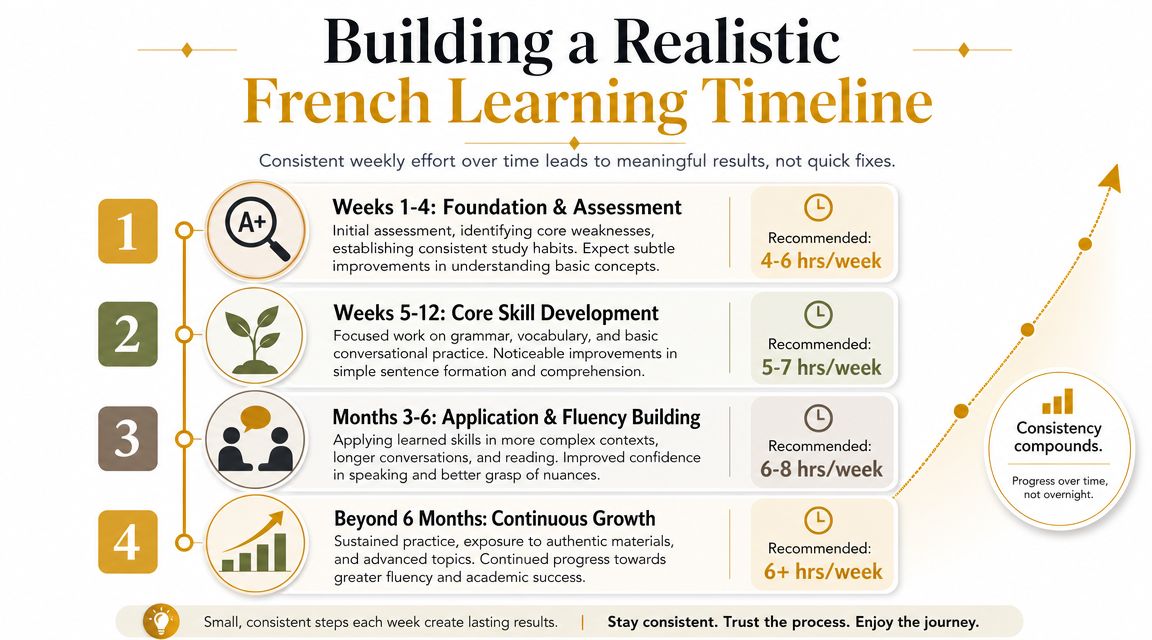
What the hour estimates actually mean
Parents hear “B1” or “B2” and assume those are labels. They're not. They represent a lot of accumulated exposure, correction, and productive use.
If your child is in school French and struggling with classroom writing, oral presentations, and reading comprehension, don't build a plan around wishful thinking. Build it around hours and deadlines.
Here's how I see it:
- Short-term rescue means focusing tightly on the next assessment cycle. That may involve weekly tutoring plus assigned practice between sessions.
- Academic stabilization means closing recurring gaps so homework stops feeling like a crisis.
- Level-building means accumulating enough guided hours to shift what your child can do independently.
Reality check: If the goal is meaningful school improvement by next term, the lesson itself is only part of the plan. Independent review between sessions matters too.
How I'd plan by goal
Different goals need different timelines.
For a child who just needs support with weekly homework and class confidence, I'd prioritize consistency over intensity. For a child targeting B2-level academic performance, I'd be much more aggressive about weekly engagement because the hours required are substantial.
A practical family plan should answer five questions:
- What is the immediate target? Better grades, oral confidence, exam prep, or school transition.
- What is the current baseline? School evidence first, level labels second.
- How much weekly time is realistic? Not idealized. Realistic.
- What will happen between lessons? Reading, vocabulary review, writing corrections, audio practice.
- How will progress be measured? Better quiz scores, stronger writing, faster homework completion, stronger oral participation.
If you're comparing providers, ask who helps build that timeline with you. Some services, including Elite French Tutoring, start with a consultation that looks at objectives, current level, and learning style, then shape a private plan around those inputs. That's the sort of structure I'd want as a parent.
How to Support Learning at Home (When You Don't Speak French)
This is the part parents underestimate. If you don't speak French, you can still make a major difference. In many bilingual and immersion settings, children are already learning in households where the parents aren't francophone, and that's exactly why practical home support matters so much, as noted in this discussion of parent questions around immersion schools (supporting a child when parents don't speak French).
Your job is not to become the French teacher. Your job is to become the project manager.
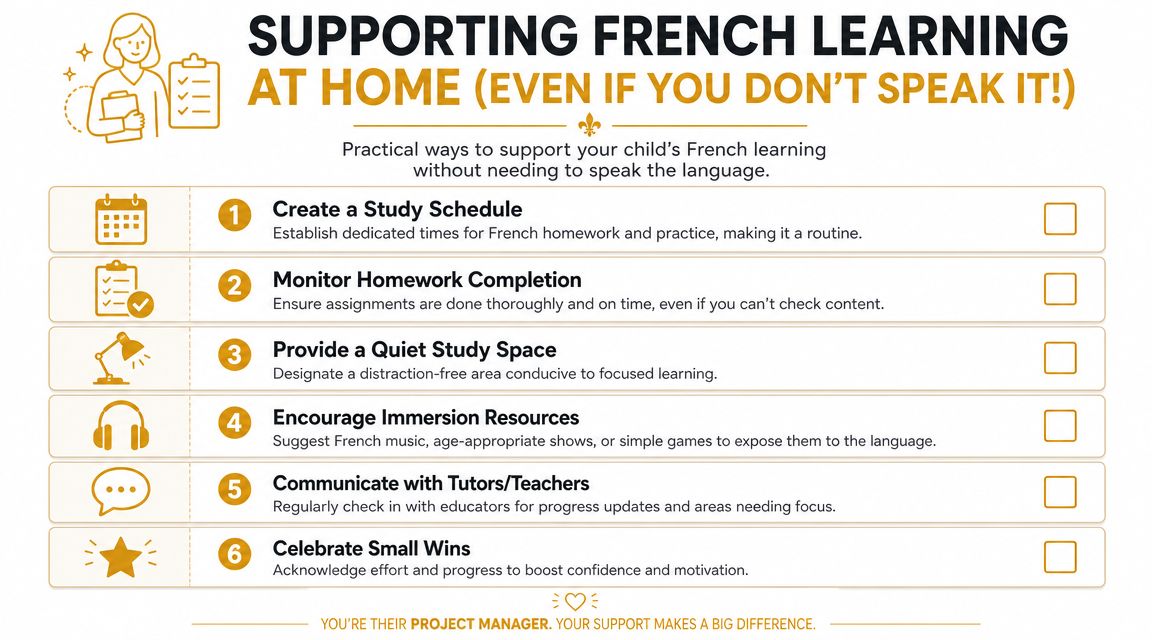
Your job is not to teach French
Parents get stuck because they think help must mean explaining grammar. It doesn't. Most children don't need a second teacher at home. They need structure, follow-through, and someone noticing when things are drifting.
Here's what helps:
- Own the calendar. Know test dates, oral presentation deadlines, and project milestones before they become emergencies.
- Check completion, not correctness. You can verify that homework is finished, organized, and submitted even if you can't evaluate every sentence.
- Use teacher feedback strategically. If the report says “needs more detail in written responses,” send that exact phrase to the tutor.
- Create a routine. Same days, same time, same workspace. Less negotiation, less friction.
“I don't speak French” is not a reason to step back. It's a reason to get more organized.
What to do each week
I like a simple weekly operating system. Nothing fancy.
First, ask your child to show you the current French folder, notebook, school portal, or class app. You're checking for missing work, unclear instructions, and upcoming deadlines. You're also looking for patterns, especially repeated corrections from the teacher.
Second, keep one running note for the tutor. Put in three things only:
- What's due soon
- What's going badly
- What the teacher last said
That gives the tutor enough context to stay aligned.
Third, add low-pressure exposure at home. Not “extra homework.” Just normal contact with the language. French songs, dubbed shows, simple audio, or age-appropriate series can reduce resistance and increase familiarity. If you need ideas, start with curated French kids' shows for language exposure at home.
Finally, praise effort that leads to momentum. Finished the essay draft on time. Asked a question in class. Redid corrections without complaining. Those are the habits that support long-term school success.
Your Partner in Your Child's French Success
French for school gets much easier when you stop treating it as a vague language problem and start treating it as an academic support problem. Identify the exact need. Choose the format that fits your family. Hire for curriculum alignment, not just fluency. Build a timeline that matches the goal. Then run home support like a calm, consistent system.
That's what works.
If you want a second opinion before committing to lessons, compare a few tutoring options carefully and ask for a plan tied to your child's actual school demands. If you'd like help thinking it through, a consultation is a sensible next step. A good one should leave you with clarity, even before the first lesson.