

Your teen has a French class grade to protect, other Regents to think about, and a school counselor who casually mentions the “French Regents exam” as if everyone already knows what that means. Then the questions start. Is it a real Regents? What's on it? How do you prepare without wasting weeks on generic worksheets?
I've seen this stress up close. Families often come in after trying broad online tips that say “practice vocabulary” or “stay calm,” but they still don't know how the exam works or why their student freezes during speaking tasks. That's where focused prep changes everything. A smart plan doesn't just pile on more study time. It clears up the naming confusion, shows what skills are scored, and gives students repeatable ways to respond under pressure.
If your family is sorting out whether French is worth the effort long term, this broader look at why learning French opens academic and personal doors can help frame the bigger picture while you handle the immediate exam goal.
Table of Contents
- Introduction to the French Regents Exam
- Exam Purpose Eligibility and Diploma Requirements
- Exam Format and Timing
- Common Topics and Question Types
- Sample Study Plan and Timeline
- Targeted Prep Strategies with Elite French Tutoring
- Sample Lesson and Checklist for Students and Parents
- Conclusion and Next Steps
Introduction to the French Regents Exam
One student I worked with had a familiar problem. She wasn't lazy, and she wasn't weak in French. She was hearing three different versions of the same exam from classmates, teachers, and search results. By the time she sat down to study, she felt behind before she had even started.
That confusion is common because “French Regents exam” sounds more straightforward than it really is. Parents often search for a state test packet and students expect a single standardized format. Then they discover the preparation advice online is broad, repetitive, and light on the speaking strategies that often make the biggest difference in confidence.
Practical rule: A student calms down faster when the exam stops feeling mysterious.
The families who do best usually simplify the process early. They learn what the exam is called at school, how it fits into graduation planning, what four skills matter, and which practice methods produce usable results instead of busywork. Once that's clear, study decisions become much easier.
Exam Purpose Eligibility and Diploma Requirements
A parent will often ask me, “So where do I find the official French Regents packet?” That question tells me the confusion has already started.
The phrase French Regents Exam is common, but it is not the most accurate name. As noted in New York State Regents background information summarized here, students are usually meeting a locally developed checkpoint exam in a language other than English, not one single statewide French test given in the same form everywhere. I like to explain it this way: families hear “Regents” and expect one master blueprint, but the reality works more like a school-based final built within state graduation rules.
That difference affects preparation. A student may be fully capable in French and still feel thrown off if they prepare for a generic online version instead of the exam style their own school uses. Parents usually feel relief once they understand this point, because it turns a vague search into a practical question: what does your school expect at checkpoint level?
Why eligibility and diploma planning matter
For graduation, students complete a language sequence and must pass the checkpoint requirement connected to that sequence. The benchmark families usually need to remember is 65 or higher.
I tell families to treat this as part of diploma planning, not just as “the French test.” If a student is meeting expectations in class but has uneven speaking confidence, that can still affect whether the requirement feels straightforward or stressful. School counselors and language departments can confirm exactly how the requirement is being applied at your child's school, which is especially helpful for transfer students or families coming from private, bilingual, or out-of-state programs.
If your child needs support tied closely to classroom expectations, French tutoring for school-based courses and assessments can be more useful than broad test prep alone.
What the score levels mean in plain English
Families usually want to know one thing first. What counts as passing?
Here is the score scale referenced earlier:
| Performance level | Score range |
|---|---|
| Level 1 | 0–54 |
| Level 2 | 55–64 |
| Level 3 | 65–75 |
| Level 4 | 76–84 |
| Level 5 | 85–100 |
The practical reading of that table is simple. Level 3 begins at 65, and that is the passing point families usually focus on for the diploma requirement. Level 4 and Level 5 show stronger performance, but the first goal for many students is to clear the requirement with confidence.
That is why I caution parents against relying only on report card averages. A student can look solid on paper and still lose points in live language use, especially if spontaneous speaking feels harder than homework.
Who should pay extra attention
Some students need targeted prep earlier because the exam requirement exposes a mismatch between class performance and usable exam skills.
I watch closely for these patterns:
- Strong reader, quiet speaker: The student understands passages well but hesitates when asked to respond aloud.
- Good grades, shaky test performance: The class average looks fine, but timed tasks create panic or blanking out.
- Transfer student: The student may know French content but not the local format or teacher expectations.
- Student who argues in English but freezes in French: This matters more than families expect because oral tasks often reward a clear opinion, a brief concession, and then a rebound to the student's main point.
That last pattern is one standard guides often miss. In speaking tasks, students do better when they practice small debate moves, not just memorized answers. I teach them to concede briefly, then recover control. For example: “Oui, je comprends cet argument, mais à mon avis…” That simple concession plus rebound structure helps a student sound flexible, organized, and more natural under pressure.
Once families understand the naming issue, the graduation requirement, and the kind of student who tends to struggle, prep becomes much easier to plan.
Exam Format and Timing
Families usually relax once they understand that the score doesn't come from one isolated task. The exam is built to measure language use across several skills.
The key fact is this: the final score for the New York Regents French exam is calculated as the sum of points from four distinct sections: speaking, listening, reading, and writing, according to the New York State world languages assessment document.
What the four-part structure means for prep
That four-part structure changes how I advise students to study. A child can't rely on being “the writing kid” or “the good listener” and ignore the rest. The scoring model rewards balanced ability.
Here's the practical takeaway:
- Speaking matters because it reveals active control: Students have to produce language, not just recognize it.
- Listening rewards concentration under pressure: Missing a key detail early can throw off a response.
- Reading checks whether vocabulary and grammar hold up in context: This is often where strong class students feel safest.
- Writing exposes gaps quickly: Verb forms, organization, and clarity all show up on the page.
When a student is weak in one area, I don't treat that as a side issue. I adjust the whole study plan around it because the final result is composite.
Comparison table for families choosing prep priorities
The challenge in this section is timing. I can't responsibly give exact section durations here because that timing data wasn't provided in the verified materials. What I can give you is a clear decision table that helps families choose where to spend extra prep time.
Exam Sections and Timing Overview
| Section | Duration |
|---|---|
| Speaking | Check your school's locally issued exam directions |
| Listening | Check your school's locally issued exam directions |
| Reading | Check your school's locally issued exam directions |
| Writing | Check your school's locally issued exam directions |
That may seem unsatisfying at first, but it's the honest answer. Because the exam is locally developed, your school's materials should be your timing authority.
A useful parent move is to ask for three things from the teacher or department:
- The exact local format
- Any sample prompts or prior practice sheets
- The timing used in school-based mock practice
Bring the local exam packet into tutoring if you can. Prep becomes much sharper when we work from the school's actual structure instead of a generic French workbook.
Students usually improve faster when they prepare in pairs of skills rather than in isolation. For example, reading plus writing fits naturally together, while listening plus speaking often reveals the same hesitation patterns. That kind of pairing makes home practice more efficient and less draining.
Common Topics and Question Types
Students get rattled less by difficulty than by surprise. If a prompt looks familiar in shape, they're more likely to stay composed and produce usable French.
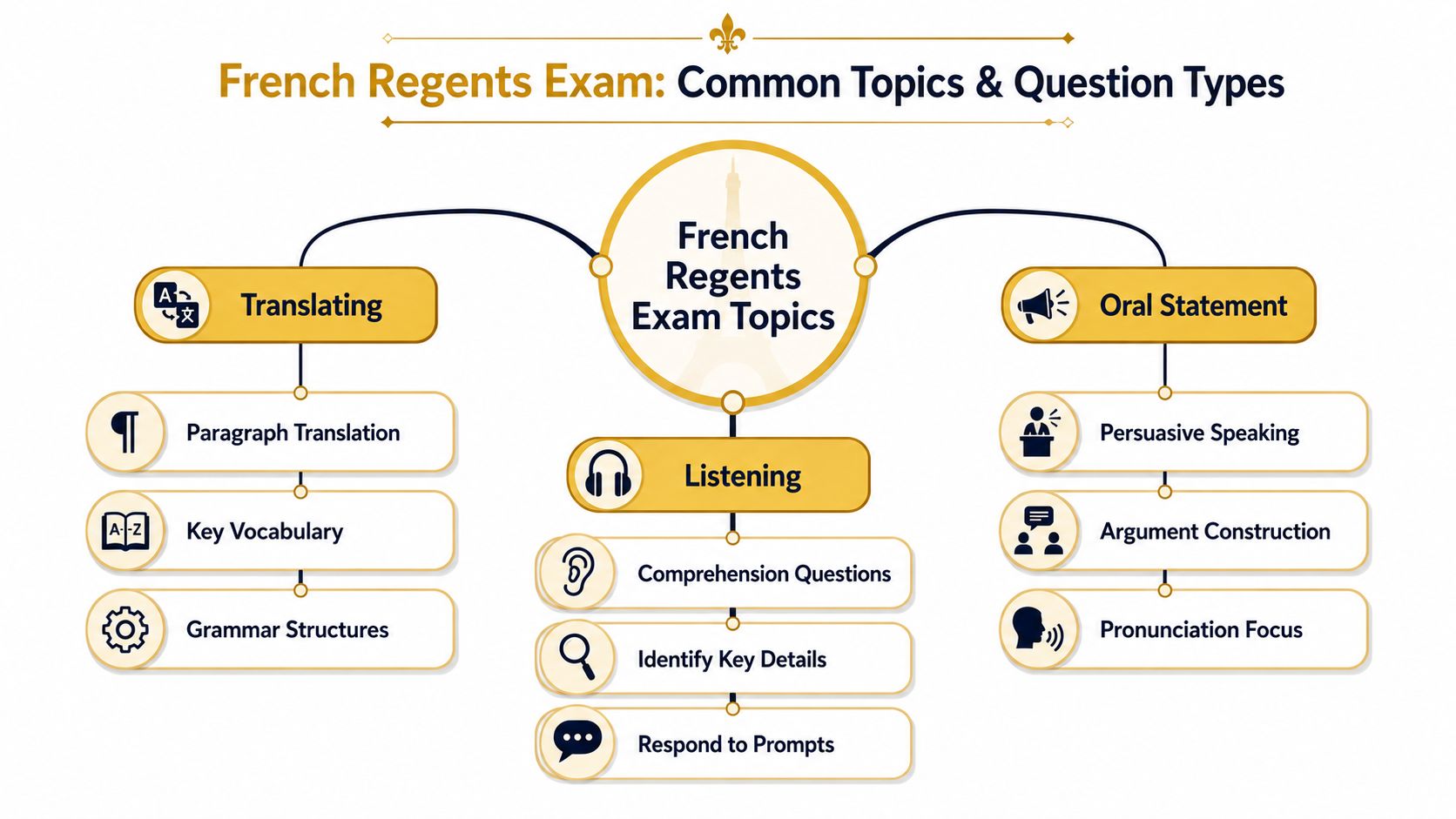
For students who also want extra high-level skill work, especially on advanced reading and interpretation, I sometimes suggest looking at AP French practice materials for stretch practice, not because the exams are identical, but because stronger students benefit from richer input.
What students usually see by skill area
A local French checkpoint exam typically revolves around everyday communication rather than obscure literary analysis. That means students should expect language connected to school, family, routines, opinions, and practical situations.
Here's how that often shows up:
- Reading tasks: Students read short passages and identify the main idea, specific details, or the meaning of a phrase from context.
- Listening prompts: They hear spoken French and must catch key information, tone, or intent.
- Writing responses: They organize thoughts in clear French rather than listing disconnected words.
- Speaking tasks: They respond aloud, often under time pressure, with enough structure to sound purposeful.
One common mistake is assuming “translation” is the whole game. In reality, students do better when they treat each prompt as communication first, language puzzle second.
Where students lose points unnecessarily
I see four repeated habits.
| Question type | Common mistake | Better response habit |
|---|---|---|
| Listening | Waiting for every word | Listen for the situation, speaker, and key detail |
| Reading | Translating line by line | Read once for gist, then return for specifics |
| Writing | Overreaching with fancy grammar | Use clear sentences you can control |
| Speaking | Starting without a structure | Open, support, and conclude with a clear line of thought |
Students also struggle when they answer too narrowly. If a speaking prompt asks for an opinion, a one-word answer may be correct in spirit but too thin to score strongly. A fuller response gives the examiner more evidence of control.
A good exam answer doesn't sound perfect. It sounds organized.
That's why I train students to use anchor phrases they can retrieve quickly. In reading and listening, anchor habits are about noticing patterns. In speaking and writing, anchor phrases help them build complete responses even when they're nervous.
Sample Study Plan and Timeline
A good study plan should lower stress, not create another full-time job. The strongest plans are balanced, realistic, and easy to resume after a busy school week.
Early on, many families either do too little or too much. They either wait until the final stretch or they try to tackle every grammar topic at once. A steadier rhythm works better.
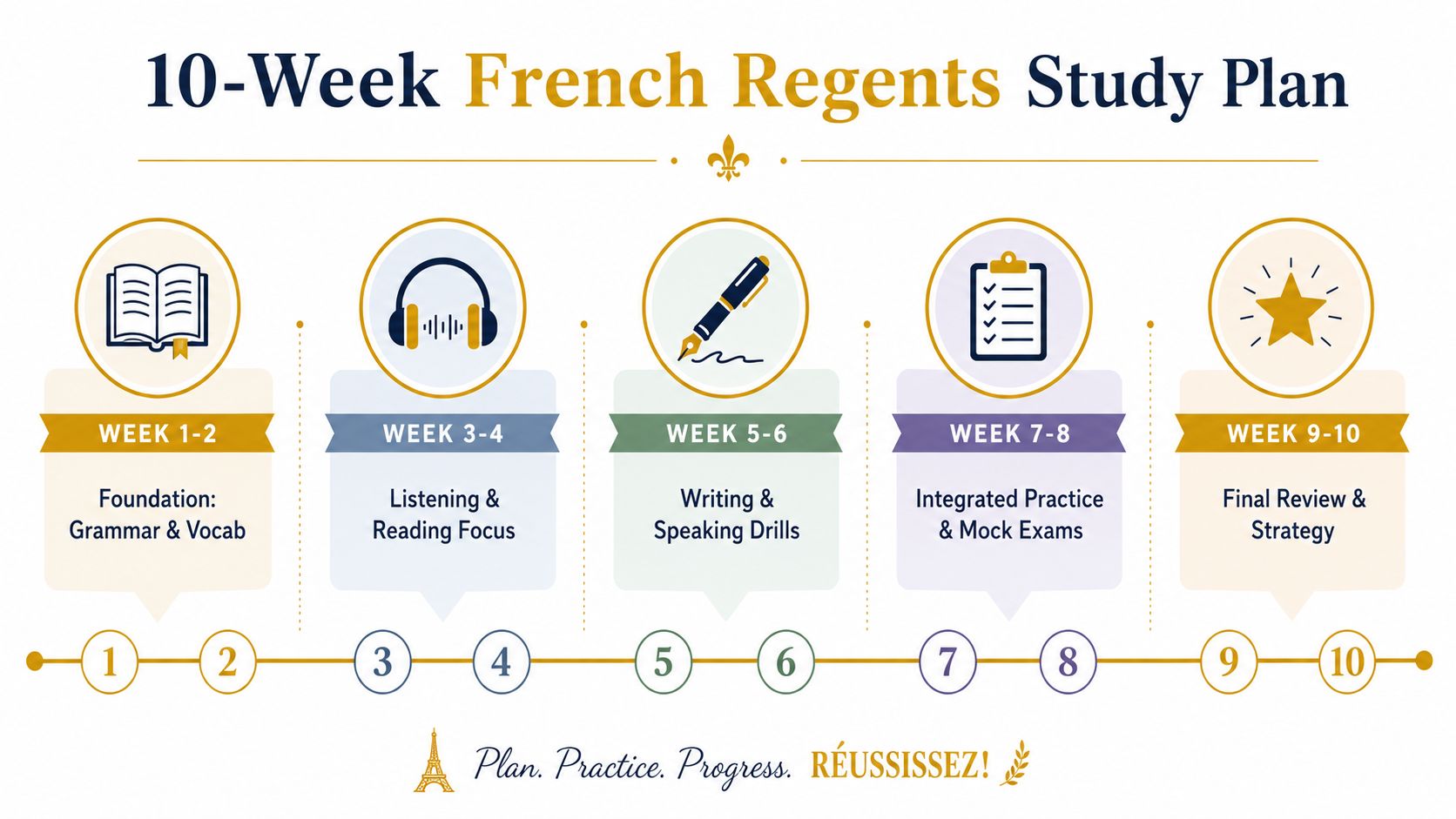
Students who need more structure between sessions often do well with a guided structured French study plan.
A balanced weekly rhythm
Here's a practical 10-week approach that keeps all four skills active without making every week feel identical.
- Weeks 1 and 2: Rebuild foundations. Review core verb patterns, high-frequency vocabulary, and basic sentence control. Keep speaking low pressure and frequent.
- Weeks 3 and 4: Shift attention to listening and reading. Practice identifying gist first, then details. Students should stop trying to decode every word.
- Weeks 5 and 6: Bring in writing and speaking drills. Short responses beat long, unfocused ones. Students need repetition with feedback.
- Weeks 7 and 8: Combine skills. Read, summarize, respond aloud, then write. During this phase, endurance starts to matter.
- Weeks 9 and 10: Tighten strategy. Focus on recurring errors, prompt handling, and calm execution.
A short visual overview can help students see the arc before they dive into the details.
How to adjust the plan when school gets busy
No student follows a perfect ten-week schedule. That's normal.
When midterms, sports, or family travel interrupt the plan, I use a simple priority order:
- Keep speaking alive, even if it's just brief oral responses.
- Protect listening exposure, since that skill fades quickly without contact.
- Trim writing length before cutting writing entirely.
- Use reading as recovery work, because it's easier to re-enter after a busy week.
A lighter week might look like this:
- one short listening task
- one oral response practice
- one reading passage
- one paragraph of writing
That still keeps the exam muscles active. Consistency beats dramatic bursts of motivation.
Targeted Prep Strategies with Elite French Tutoring
Generic exam advice usually sounds fine until a student hits a live speaking prompt and stalls. “Stay confident” doesn't help much in that moment. A structure does.
The most overlooked gap in French Regents exam prep is oral argument handling. According to this exam-prep analysis of student panic triggers and oral strategy gaps, most guides ignore oral debate strategy, and students aren't taught how to structure a concession + rebound argument, even though that approach directly correlates to top-tier oral rubric criteria. The same analysis notes 6 distinct panic triggers and says standard guides address only 1–2 of them.
The oral tactic most guides miss
This is the pattern I teach when a prompt asks for an opinion, comparison, or defense of an idea:
Concession + rebound
In French, that can sound like:
- Certes… Toutefois…
- Je comprends ce point de vue… Mais je pense que…
- Il est vrai que… En revanche…
Why does this help? Because nervous students often think speaking means producing a brilliant argument on the spot. It doesn't. They need a dependable response shape. Concession + rebound gives them one.
Here's a plain example:
Prompt idea: Is it better for students to study alone or in groups?
A shaky answer often sounds like a scattered list of words. A stronger answer sounds more deliberate:
Certes, travailler en groupe peut être motivant. Toutefois, pour réviser avant un examen, je préfère étudier seul parce que je peux me concentrer et organiser mon temps.
That response shows flexibility, contrast, and control. It feels more mature even when the grammar is simple.
A real student success story
One of our students came to us sounding fluent enough in casual conversation but disorganized in formal oral responses. She could speak, but she couldn't land her ideas cleanly when a prompt required opinion and support.
We spent four weeks training two things only: response structure and cultural comparison “home base” material. We prebuilt a few reliable comparison themes she could adapt quickly, such as school routines, family expectations, and daily life habits. During the exam, that gave her something stable to reach for instead of improvising from panic.
The result mattered. She raised her oral performance by two performance levels in that period.
What changed was not magic vocabulary. It was structure under pressure.
When private prep makes sense
Some students can self-study effectively. Others need guided correction because they repeat the same weak habits without noticing.
Private prep is usually worth comparing when:
| Student pattern | What usually helps most |
|---|---|
| Freezes in speaking tasks | Live coached oral drills with immediate correction |
| Writes too little or too much | Prompt-specific writing feedback |
| Understands classwork but underperforms on tests | Timed practice with strategy coaching |
| Gets overwhelmed by “study everything” advice | Customized weekly plan and narrowed priorities |
The best tutoring isn't about adding more material. It's about removing noise, building response habits, and targeting the skill that breaks down first under pressure.
If you're comparing options, a free consultation with Elite French Tutoring can help you decide whether your child needs weekly support, short-term exam prep, or just a focused speaking plan before test day.
Sample Lesson and Checklist for Students and Parents
A strong French Regents exam lesson doesn't jump randomly from worksheet to worksheet. It has a sequence. The student should feel momentum from the first minutes to the last.
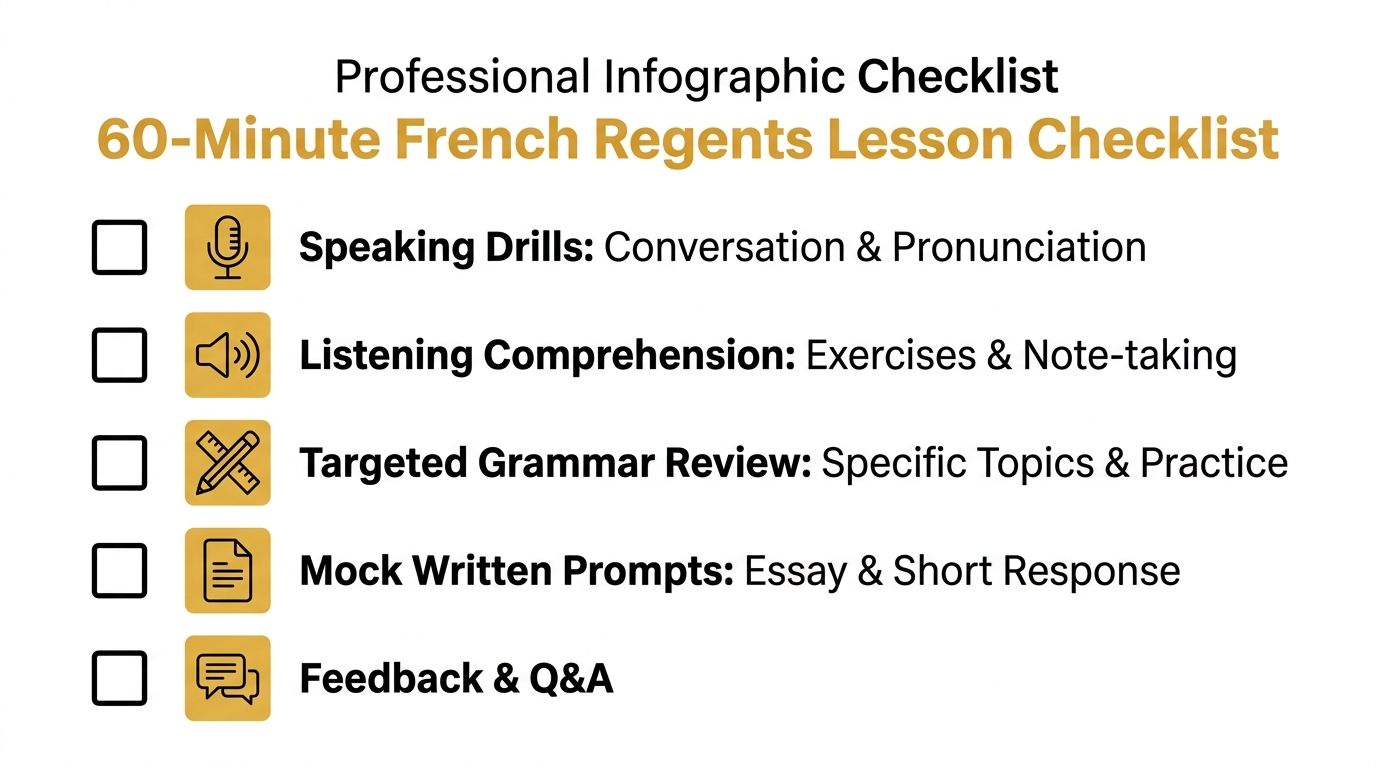
A sample 60-minute lesson
Here's a model I like because it keeps all major skills active without making the hour feel rushed.
| Lesson segment | What happens |
|---|---|
| Opening speaking warm-up | Short opinion questions and pronunciation correction |
| Listening task | Brief audio with note-taking and follow-up responses |
| Grammar repair | One targeted topic that caused errors in real work |
| Writing practice | Timed response to a school-style prompt |
| Feedback and wrap-up | Error review, next-step assignment, parent summary |
That sequence works because it starts with output, moves through comprehension, then returns to production. Students stay mentally engaged.
A sample flow might look like this in plain language:
- Speaking first: The student answers familiar questions so we can hear confidence, hesitations, and pronunciation patterns right away.
- Listening second: We train attention before fatigue sets in.
- Grammar third: We fix what appeared in the student's errors instead of reviewing random textbook chapters.
- Writing fourth: The student applies the correction immediately.
- Feedback last: We leave with clear takeaways, not vague encouragement.
Parent student checklist
Families stay calmer when they track a few essentials consistently.
- Materials ready: Bring the school prompt packet, notebook, and corrected classwork.
- Speaking practiced: Record at least one short oral response between lessons.
- Listening active: Do one focused listening task with notes, not passive background audio.
- Errors tracked: Keep a running list of repeated grammar and vocabulary mistakes.
- Next task visible: End each session with one concrete assignment and one confidence goal.
The best checklist isn't the longest one. It's the one your family will actually use every week.
This kind of lesson plan also makes it easier to compare tutors. If a program can't explain how it balances speaking, listening, reading, and writing in a single session, it may not be focused enough for exam prep.
Conclusion and Next Steps
A lot of stress around the french regents exam starts with the name. Families hear “Regents” and expect one clear statewide test. In practice, the label often hides local differences in format and expectations, which is why students can feel surprised even after they have studied hard.
I tell families to treat the exam like a four-part performance, not a single quiz. A strong reader can still get stuck during speaking. A confident speaker can still lose points if listening practice has been too light. Once students see the whole picture, preparation becomes calmer and more precise.
One detail many general guides skip is the oral response itself. On opinion or debate-style prompts, students do better when they use a simple pattern they can remember under pressure: state the point, give a reason, concede one possible counterpoint, then rebound clearly. For example: Je comprends cet argument, mais dans ce cas… That small turn helps a student sound organized instead of rushed.
By the end of prep, the goal is clarity. Your child should know which version of the exam the school gives, what each section asks for, and how to respond out loud without freezing. That is usually the difference between last-minute cramming and steady, confident review.