You're probably doing one of two things right now. You're either typing “French jobs New York” into every job board you can find and getting a messy pile of listings, or you're wondering whether your French is worth anything in NYC beyond a line on your resume.
I'll be blunt. French only pays when you position it correctly. If you market yourself as “bilingual,” you get lumped into broad searches. If you market yourself as someone who can solve a business, education, client, or family-office problem because you're fluent in French, you get better interviews and better offers.
New York is one of the few U.S. cities where that distinction matters every day. The employers hiring for French aren't all looking for the same person. Some need a teacher. Some need a private assistant. Some need someone who can handle clients, children, executives, or cross-border communication without slowing down the room. That's where strategy beats volume.
Table of Contents
- Why Your French Skills Are a Superpower in NYC
- Targeting Where Your French Pays a Premium
- How to Frame Your Fluency for American Recruiters
- Niche Job Boards vs Mainstream Platforms
- Building Connections and Proving Your Proficiency
- Your Action Plan for Landing a French Job in NYC
Why Your French Skills Are a Superpower in NYC
A lot of strong candidates make the same mistake. They assume French is “nice to have,” so they tuck it near the bottom of the resume and hope recruiters notice. In New York, that's the wrong move.
The market already tells you French has hiring value. A current snapshot shows 989 French-speaking jobs listed on Indeed in New York, NY, while Glassdoor reported 985 open French-speaking jobs in the city in June 2026. ZipRecruiter also estimated average yearly pay for French-speaking roles in New York, NY at $57,235 as of June 10, 2026, according to Indeed's French-speaking jobs snapshot for New York.
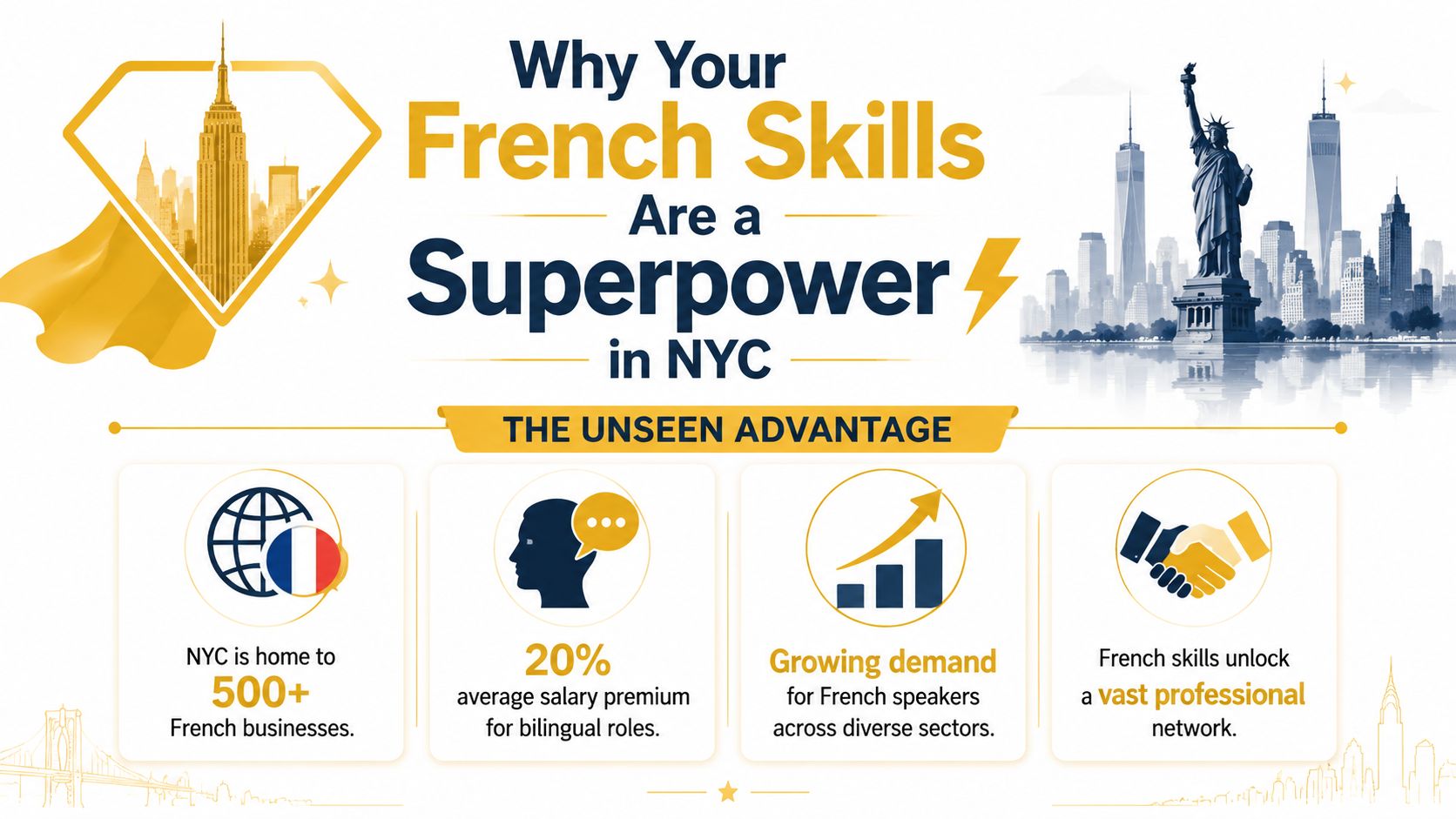
That doesn't mean every French listing is a great listing. It means the city has enough demand that your language skill can be monetized, if you stop treating it like a decorative extra.
What employers are actually buying
In NYC, employers rarely pay for “French” in the abstract. They pay for what French lets you do:
- Serve clients smoothly in hospitality, luxury, and professional services
- Teach and manage families in schools, tutoring, and childcare
- Handle international communication without translation lag
- Represent institutions well in diplomatic, nonprofit, and multicultural settings
That's the shift I want clients to make. Don't say, “I speak French.” Say, “I can manage French-speaking stakeholders, families, students, or customers with no hand-holding.”
Practical rule: In New York, French becomes valuable when it reduces friction for the employer.
There's also a confidence problem I see all the time. Candidates who grew up with French or learned it to a high level often underestimate how rare it is to combine fluency with polished U.S.-style interviewing, concise resumes, and sector-specific experience. That combination is what wins.
If you need help thinking about French as a business asset rather than a school subject, this guide on why French improves your business opportunities is a useful mindset reset.
The real takeaway
The French jobs New York market is not tiny. It's fragmented. That's different, and better.
Fragmented markets reward candidates who know where their language changes the economics of the role. If your French helps a school place you in front of students, helps a family trust you with communication, or helps a company manage French-speaking clients, you're not just bilingual. You're commercially useful.
Targeting Where Your French Pays a Premium
Stop searching “French jobs” as if all listings are equal. They aren't. Some roles use French occasionally. Others use French as a gatekeeper. You want the second group.
The clearest signal comes from compensation across occupations. A bilingual French personal assistant role might advertise at $55K–$65K, while a world-language teacher role can range from $61K to $150K, based on this New York bilingual French role data from Phaxis. That tells you something important. The premium sits in the profession first, and the language second.
Where French is a screening skill
These are the sectors where I see candidates waste time because they chase any listing with “French” in it:
- General admin roles where French is mentioned but not central
- Broad customer service postings with loose language requirements
- Mixed-title listings that combine unrelated duties and fuzzy expectations
Those jobs can be fine if you need immediate income. They're not where I'd build a long-term strategy if salary growth matters.
Where French is worth more
I push candidates toward roles where French changes trust, access, or service quality.
| Role area | How French adds value | What to watch for |
|---|---|---|
| Education | Direct instruction, parent communication, curriculum delivery | Schools that specify fluent French, not “preferred” |
| Private staffing | Family communication, travel coordination, child-facing trust | Roles that require discretion and polished written French |
| Client-facing business roles | Relationship management with French-speaking accounts | Employers that tie French to territory, clients, or markets |
| International and cultural institutions | Stakeholder communication and mission-aligned work | Roles that require professional fluency, not casual ability |
If you're serious about better-paying French jobs New York opportunities, use this filter: Would the employer struggle to hire for this role without strong French? If the answer is no, your language won't carry much weight.
A high-value French role usually has a non-language core. Teaching. Operations. Client service. Executive support. The language sharpens the value. It doesn't replace the job.
My recommendation for targeting
I'd split your search into three buckets.
First, go after education if you have teaching ability, tutoring experience, classroom experience, or strong child-facing communication. French can directly affect hiring there.
Second, look at private family staffing and executive support if you're organized, discreet, and comfortable in high-touch environments. These jobs often reward maturity and polish.
Third, target business-facing roles only if you can clearly connect your French to sales support, account management, operations, partnerships, or cross-border communication. If you can't make that case in one sentence, recruiters won't do it for you.
If your French needs to become more polished for meetings, presentations, or client interaction, business French coaching options can help you close that gap before interviews.
How to Frame Your Fluency for American Recruiters
American recruiters don't hire language talent based on vibes. They scan for relevance, clarity, and proof. If your resume says “bilingual French/English” and leaves it there, you're making them guess.
That's a problem because French-linked employers have real scale in the U.S. French companies have created 741,000 jobs in the United States, and recruiters assess candidates on hard skills, soft skills, and professional experience, according to Alexander Hughes on the France-U.S. business relationship. Your French needs to strengthen all three.
Rewrite your headline first
Don't bury French in the skills section. Put it in the top third of the page and tie it to a function.
Weak:
- Bilingual English/French
- Speaks French fluently
Better:
- Client-facing operations professional with native French fluency
- Marketing coordinator with French-language account support experience
- French and English educator with classroom, parent, and curriculum communication experience
That wording tells recruiters where the language matters.
Show how French improves your work
Most candidates list language. Strong candidates describe outcomes qualitatively.
Try bullets like these:
- Managed French- and English-speaking client communication across scheduling, follow-up, and issue resolution
- Supported cross-border collaboration by handling meetings, written updates, and stakeholder questions in French and English
- Built trust with French-speaking families through clear verbal and written communication
You don't need fake metrics. You need precise context.
Recruiters don't reward “bilingual” by itself. They reward evidence that your fluency made you easier to hire.
A real student story
Chloé came to me after applying broadly with almost no traction. She had solid marketing experience, excellent French, and a decent background, but her documents read like she was one of many junior candidates.
We changed the frame. Instead of presenting her as a marketer who happened to speak French, we presented her as someone who could handle French-language client communication, cross-Atlantic coordination, and polished bilingual messaging. We also tightened her LinkedIn headline and rewrote her experience bullets around stakeholder-facing work.
That shift got her more relevant conversations because recruiters could instantly see the business use case.
What to fix on LinkedIn
Use your About section to answer one hiring question: why should someone hire you for a role where French matters?
Include:
- Your level clearly. Native fluency, professional fluency, or advanced working proficiency
- Your use cases. Clients, students, families, executives, operations, content, support
- Your setting. Education, hospitality, nonprofit, private staffing, corporate, international
If you're rusty in spoken French and want sharper interview performance, French conversation classes in NYC can be a practical way to rebuild confidence before you start interviewing.
Niche Job Boards vs Mainstream Platforms
Mainstream platforms give you volume. Niche platforms give you fit. You need both, but not in equal doses.
The trap with mainstream search is obvious. You type in “French,” hit apply, and end up wading through a swamp of weak matches. Indeed reports nearly 1,000 French jobs in New York, but those listings are broad and need careful filtering. The practical move is to prioritize roles that explicitly require fluent French, as noted in Indeed's broader French jobs search for New York.
The platform strategy I recommend
Use mainstream sites to map demand. Use niche channels to find cleaner leads.
Mainstream platforms can show you which job titles repeat, which employers hire often, and how companies phrase language requirements. But niche boards and community networks often surface roles that are more targeted and less noisy.
Here's how I think about it.
Comparing Job Search Platforms for French Speakers in NYC
| Platform | Best For | Pros | Cons |
|---|---|---|---|
| Indeed | Broad market scan | High volume, useful keyword testing, fast alerts | Too many vague listings, mixed-quality roles |
| LinkedIn Jobs | Professional and corporate roles | Easy networking crossover, recruiter visibility | Titles can be inflated, language requirements may be fuzzy |
| Glassdoor | Company-led search | Helpful for employer discovery and role comparison | Can overlap heavily with other boards |
| French-American community boards | Targeted French-speaking opportunities | Stronger relevance, better cultural fit | Lower volume, openings may appear irregularly |
| School and institution career pages | Education and mission-driven roles | Direct access to serious employers | Slower to search manually |
| Family office and staffing firms | Private assistant and household roles | Better fit for high-trust bilingual jobs | Less transparent process |
What to do on mainstream sites
Don't just search “French.” Use tighter combinations:
- French + teacher
- French + assistant
- French + client services
- French + operations
- French + school
- French + family
- French + coordinator
Then read for the words that matter: fluent French, native-level French, professional proficiency, French-speaking clients, French-speaking families.
If the listing only tosses in French at the end, I usually tell clients not to build their week around it.
What to do on niche channels
Here, relationships matter more than algorithms. Search French-American organizations, local community groups, alumni circles, bilingual school pages, and French-speaking professional communities. These channels often produce roles with a clearer reason for the language requirement.
A niche board won't replace Indeed or LinkedIn. It will save you from wasting your best energy on the wrong roles.
Broad platforms are for discovery. Niche platforms are for precision.
My blunt advice is this: spend less time submitting generic applications and more time identifying where French is operationally necessary. That's how you find the listings worth customizing for.
Building Connections and Proving Your Proficiency
New York runs on referrals, introductions, and soft recommendations. That matters even more when you're selling a skill that some recruiters can't evaluate quickly on paper.
The broader labor market is large enough to support specialized candidates. The U.S. Bureau of Labor Statistics reported 372,000 job openings in New York in December 2025, according to the BLS New York job openings release. In a market that active, networking isn't optional. It's how you hear about openings before they become crowded.

A networking message that works
Skip long introductions. Send short, respectful outreach with a reason.
Use something like this:
Hi [Name], I'm a French-English [your role] based in New York, and I'm targeting roles where French is used in [education/client service/operations/private staffing]. I came across your background and would love to ask a few brief questions about your path, if you're open to a short conversation.
That works because it's specific. It doesn't ask for a job. It asks for context.
Why certification helps
A lot of employers don't know how to judge French fluency beyond “sounds good” or “studied abroad.” That creates hesitation.
A DELF or DALF credential gives hiring managers a cleaner signal, especially if your role involves instruction, formal writing, institutional communication, or high-trust client contact. It won't replace experience, but it can remove doubt.
Here's when I especially recommend certification:
- You learned French outside a formal academic path
- You're competing against native speakers
- You need a standardized credential for schools or international environments
- You speak well but your writing needs proof
Where networking and proof meet
The strongest candidates combine both. They meet people first, then make it easy for those people to vouch for them. If someone says, “She's fluent, she's polished, and she has the credential to back it up,” your profile becomes much easier to move forward.
Keep your proof simple:
- Updated LinkedIn
- Resume with French positioned near the top
- Short writing sample if relevant
- Certification status if you have it or are actively preparing for it
That package travels well in New York. People can forward it quickly, and that's exactly what you want.
Your Action Plan for Landing a French Job in NYC
If your search has felt scattered, fix the process before you blame the market. French jobs New York searches get better when you narrow the role, tighten the message, and create weekly momentum.
This visual is a good checklist to work from:
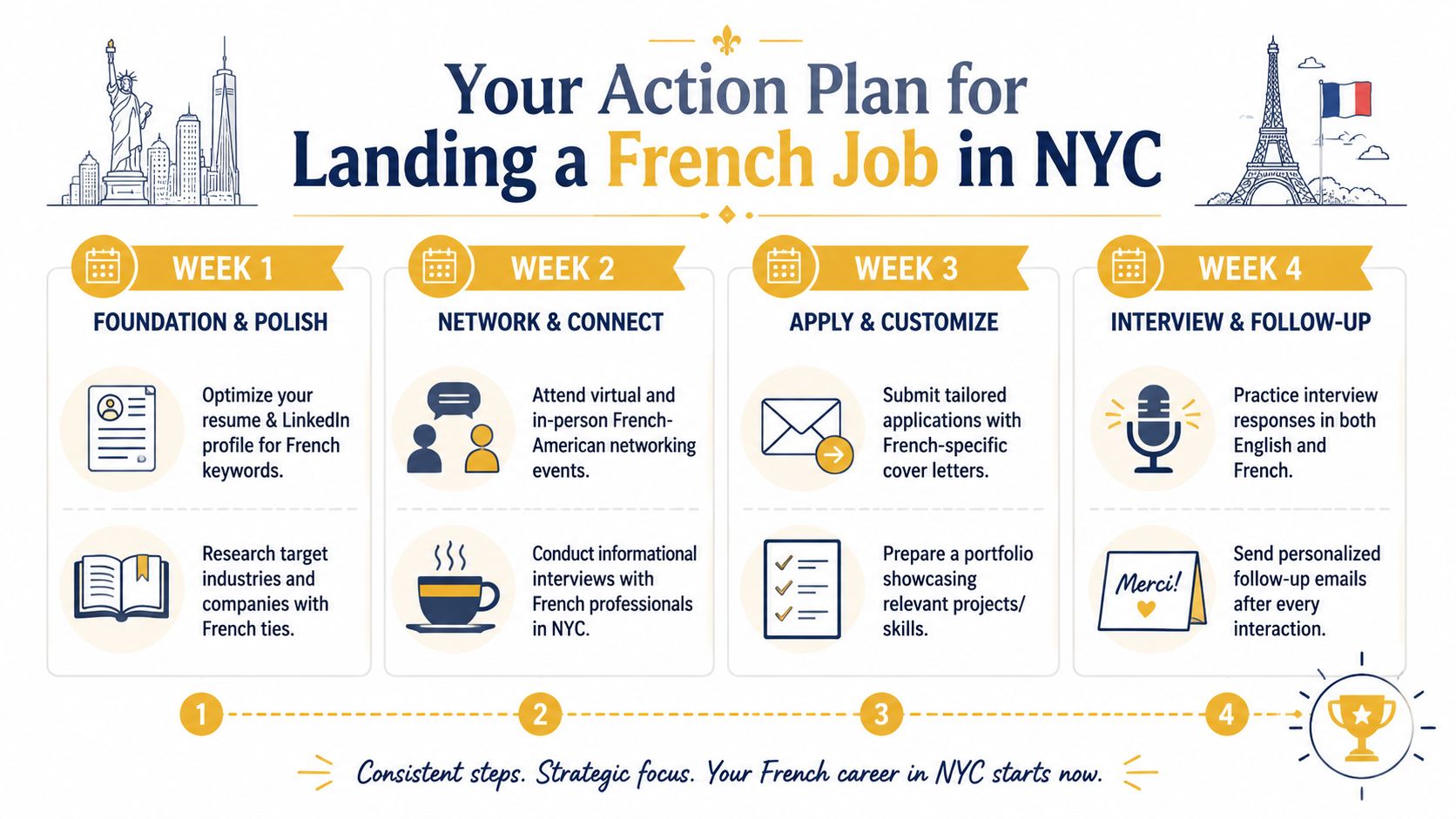
Your next 30 days
Week 1
Clean up your positioning. Rewrite your headline, resume summary, and LinkedIn About section so French is tied to a function. Choose one or two target sectors only.
Week 2
Build your target list. Pick employers, schools, staffing firms, and organizations where French is central to trust or delivery. Start sending short networking messages.
A quick refresher on interview-style French can help at this stage, especially if you're also considering formal credentials. If certification is part of your plan, DELF B2 exam preparation support is one option to explore.
Here's a useful video to keep your momentum practical, not theoretical.
Week 3
Apply selectively. Customize only for roles where fluent French is clearly required or strongly implied. Don't burn hours on weak-fit postings.
Week 4
Practice interviews in English and French. Prepare concise answers for why your French matters in the role, not just how long you've studied it. Follow up after every conversation.
The standard I want you to use
Ask these questions before every application:
- Does this role require French, or is it filler?
- Can I explain in one sentence how my fluency helps this employer?
- Does my resume prove that, fast?
- Have I tried to connect with someone around the role or organization?
If you can't answer yes to most of those, keep moving.
The strongest job searches in NYC don't come from applying everywhere. They come from repeating a sharp message in the right rooms.
If you're deciding whether to invest in stronger professional French, conversation practice, or exam prep before your next round of applications, compare your options carefully and choose the one that matches the sector you're targeting. For some candidates, that means business-focused coaching. For others, it means DELF or DALF preparation. And for others, it means polishing spoken confidence before interviews.