You don't need French to impress anyone at a dinner party. You need it when a client in Montréal goes quiet after your too-casual email, when a supplier in West Africa switches to French on a call, or when your company asks who can lead the next cross-border project and your name doesn't come up.
I've coached enough professionals to know the pattern. Smart people stall not because they lack ambition, but because they treat language like an academic hobby instead of a business tool. That's the mistake. In french language business, the goal isn't fluency for its own sake. The goal is getting through meetings cleanly, writing credible emails, handling pressure without sounding blunt, and being trusted in rooms where English alone isn't enough.
French is commercially relevant for a simple reason. It's spoken by more than 300 million people across five continents, and French-speaking countries account for about 20% of global trade in goods, according to Babbel for Business on the benefits of learning French for business. If your work touches Europe, North America, or Africa, that's not a cultural footnote. That's market access.
Table of Contents
- Opening Doors with the Right Language
- What Business French Really Means
- The Four Core Skills for Professional Communication
- Comparing Your French Training Options
- How a Custom Program Accelerates Your Career
- Your 3-Month Roadmap to Business French Confidence
Opening Doors with the Right Language
You're in a client meeting in Paris. The first five minutes go fine. You introduce yourself, exchange pleasantries, and follow the slide deck. Then the conversation shifts. A stakeholder raises a concern about timing. Someone else adds a side comment about budget risk. The room starts speaking faster, interrupting more, and testing your position. If your French stops at small talk, you stop influencing the outcome.
I have seen this with senior professionals who were excellent at their jobs. Their expertise was never the problem. Their problem was losing control once the discussion became commercial, political, or operational. In french language business, that is the difference between being present and being useful.

Treat French as a business tool. That mindset changes how you learn and how fast you see results. You do not need broad fluency to get a return. You need enough French to protect trust, move work forward, and handle the moments that decide whether people see you as credible.
Where professionals usually lose value
The loss is rarely dramatic. It shows up in routine business moments that carry real cost.
- Client confidence weakens: You catch the topic but miss the underlying concern behind it.
- Decisions slow down: Colleagues have to repeat, summarize, or switch languages for you.
- Influence shrinks: You stop contributing when the discussion becomes less scripted.
- Career options narrow: Regional roles go to the person who can operate directly in both languages.
Here is the rule I give clients. Start with the French that affects revenue, delivery, and reputation in your actual role.
For a sales director, that means learning how to run a demo, answer objections, and write follow-up emails that move the deal forward. For an operations manager, it means handling delays, clarifying responsibilities, and pushing for deadlines without sounding careless or aggressive. For a consultant, it means framing recommendations, asking sharper questions, and defending a point under pressure. General grammar drills do not solve those problems fast enough.
If you want a broader view of why this pays off professionally, this guide on how French improves business opportunities lays out the business case clearly.
The right goal
Set a performance goal, not a vague language goal.
Aim to do four things well:
- Write a professional email that sounds clear and credible
- Follow a meeting without getting lost when people go off script
- Speak up at the right moment with language that fits the room
- Explain your work, your constraints, and your recommendations without hesitation
That standard changes careers because it changes perception. In business, nobody rewards you for sounding academic. They reward you for making communication faster, safer, and easier to trust.
What Business French Really Means
Business French is often overcomplicated. It's not a separate language. It's standard French used with precision, formality, and cultural control.
If conversational French is knowing how to cook dinner, Business French is running a professional kitchen. The ingredients are familiar. The difference is timing, consistency, expectations, and mistakes that cost something.
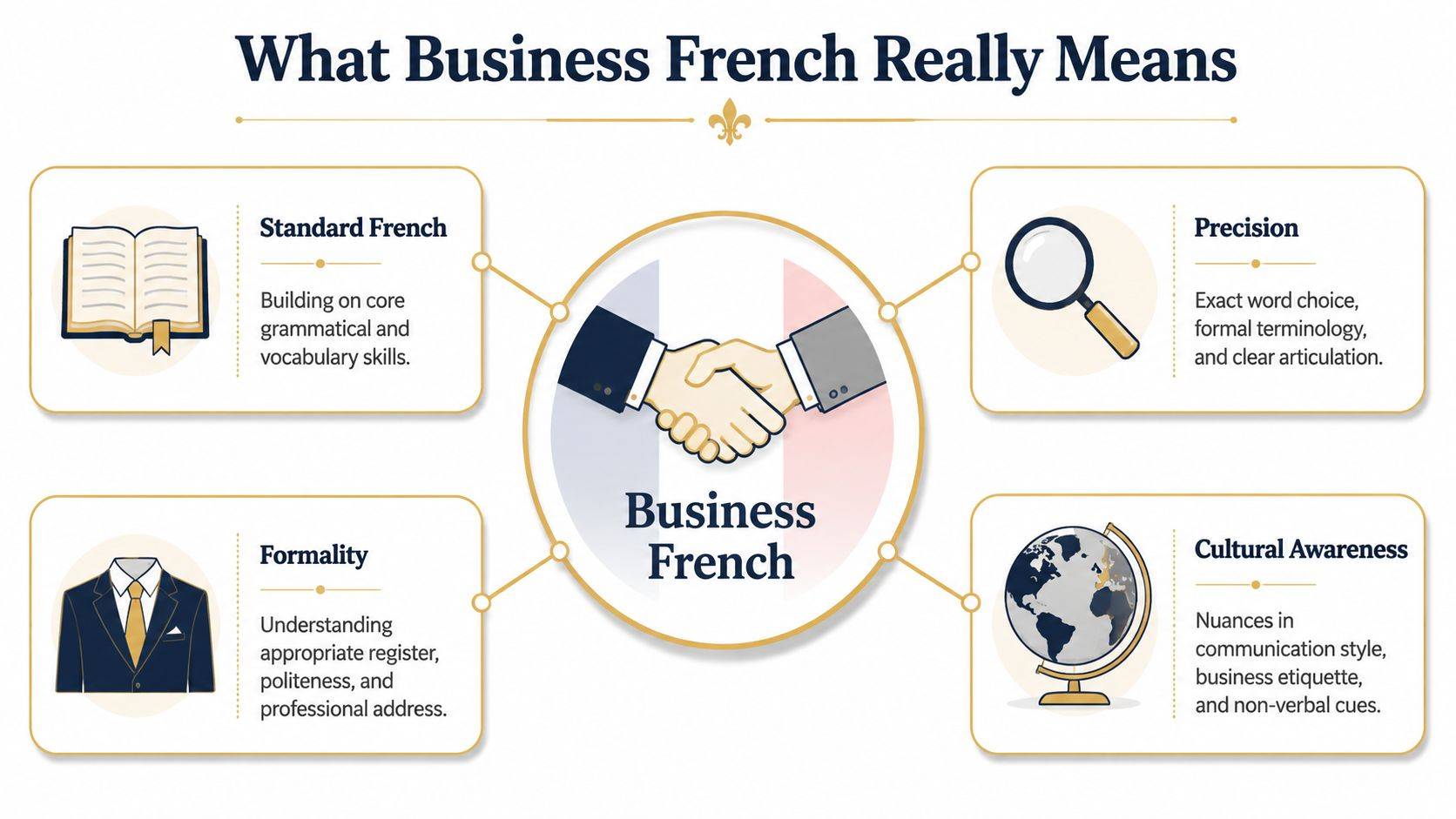
It is not separate French
Here's what professionals actually need to control:
- Register: You need to know when to use formal language and when not to.
- Structure: Business messages in French often rely on predictable, polished phrasing.
- Vocabulary: Your field has its own terms, and using the wrong one makes you sound unprepared.
- Cultural timing: Directness, interruption, agreement, and disagreement all land differently.
A casual speaker might say something understandable. A business user says something appropriate.
For example, many learners can ask for a document. Fewer can do it in a way that sounds efficient rather than pushy. That difference is where careers move. In my experience, this is why generic apps frustrate serious professionals. They teach broad language recognition, not role performance. If your focus is meetings, reporting, client care, or executive communication, targeted French for business training makes more sense than random vocabulary drills.
The standard for business French isn't "Can people understand me?" It's "Do I sound reliable enough to work with?"
Why institutions still matter
French also carries institutional weight that many professionals underestimate. It remains one of the principal languages used in international diplomacy and multilateral organizations. Its usage in Africa rose by 17% between 2010 and 2014, according to London Translations on the importance of French as a business language.
That matters in sectors where contracts, procurement, public-private partnerships, development work, logistics, and cross-border compliance all intersect. Even if your company isn't "French," your stakeholders may be. That's common in international organizations, NGOs, government-facing work, aviation, shipping, consulting, and finance.
A useful way to think about Business French is this short checklist:
| Element | Conversational French | Business French |
|---|---|---|
| Tone | Informal, flexible | Deliberate, polished |
| Goal | Social connection | Clarity, trust, action |
| Vocabulary | Everyday words | Job-specific terminology |
| Errors | Often tolerated | Can reduce credibility |
If you want ROI, train the version of French that your work demands. Anything else is intellectually pleasant and commercially weak.
The Four Core Skills for Professional Communication
Fluency is a fuzzy goal. Professional communication is measurable. In french language business, I focus on four skills first: email, meetings, negotiations, and presentations. If those work, your French starts producing value.
A key point from workplace practice is that politeness and register control are functional performance variables. Business communication typically uses formal address, vous, and structured phrases. Errors in register can affect credibility in emails, meetings, and negotiations, as explained by italki's guide to French for business.
Email that sounds credible
Most weak business emails in French fail for one reason. They sound translated.
Before
Salut, je veux le document aujourd'hui.
Understandable? Yes. Professional? No.
After
Bonjour, pourriez-vous me faire parvenir le document aujourd'hui, s'il vous plaît ?
The second version does three things right. It uses formal address, softens the request without weakening it, and sounds like someone who works in a professional environment.
Use these patterns often:
- Opening with respect: Bonjour Madame, Bonjour Monsieur, Bonjour [Name]
- Requesting clearly: Pourriez-vous…, Serait-il possible de…
- Closing properly: Bien cordialement, Cordialement
Meetings without awkwardness
Meetings expose weak learners fast because speed goes up and politeness matters more.
Before
Je ne suis pas d'accord.
That can sound abrupt.
After
Je comprends votre point de vue. En revanche, j'aimerais proposer une autre approche.
Now you're disagreeing without creating friction.
Useful phrases include:
- Entering the discussion: Si je peux me permettre…
- Clarifying: Si j'ai bien compris…
- Interrupting politely: Excusez-moi de vous interrompre, mais…
If pronunciation is holding you back, work on it early. People forgive accent. They don't forgive confusion. This practical guide to French pronunciation for English speakers is a good place to tighten the sounds that most often derail professional clarity.
Negotiations that stay respectful
Negotiation French isn't about aggression. It's about keeping options open.
Before
Ce prix est trop élevé.
Direct, but clumsy.
After
Ce point mérite peut-être d'être revu. Y a-t-il une marge de discussion sur les conditions ?
That phrasing keeps the relationship intact while signaling a limit.
Strong negotiation French sounds calm, controlled, and specific. It doesn't sound dramatic.
A few expressions I like clients to master:
- Pourrions-nous envisager…
- Dans ces conditions, il serait difficile de…
- Nous aurions besoin de davantage de visibilité sur…
Presentations with structure
Presentations in French reward structure more than flair. That's good news for learners.
Before
Aujourd'hui je parle du projet.
After
Je vais vous présenter les principaux objectifs du projet, puis les prochaines étapes, avant de répondre à vos questions.
That opening gives your audience a roadmap. It also buys you thinking time.
Use a basic sequence:
- Opening: Je vais vous présenter…
- Transitioning: Passons maintenant à…, J'aimerais aborder…
- Closing: Je vous remercie de votre attention. Je suis à votre disposition pour vos questions.
You don't need hundreds of phrases. You need a dependable core set that you can deliver cleanly under pressure.
Comparing Your French Training Options
Professionals waste a lot of time choosing the cheapest language method and then acting surprised when it produces cheap results. If your goal is casual exposure, apps are fine. If your goal is workplace performance, you need to judge training the way you'd judge any business investment.
Criteria are simple: speed to practical use, relevance to your role, accountability, and whether the method helps you perform under pressure.
Business French Training Methods Compared
| Feature | Self-Study (Apps/Books) | Group Classes | Customized Tutoring (Elite French Tutoring) |
|---|---|---|---|
| Speed to practical application | Slow if you need business use quickly | Moderate | Fastest for role-specific use |
| Industry-specific vocabulary | Limited | Usually broad, not tailored | Built around your sector and tasks |
| Speaking time | Low | Shared across the group | High |
| Accountability | Low | Moderate | High |
| Flexibility | High | Fixed schedule | Usually flexible |
| Best fit | Casual learners | Learners who want structure | Professionals with clear work goals |
Self-study works for disciplined learners who need passive exposure and don't mind slow transfer to the workplace. The weakness is obvious. No one corrects your tone in an email. No one tells you that your meeting phrase sounds too blunt. No one rehearses your procurement call before it happens.
Group classes give you structure, and that matters. But they almost always move at the speed of the room. That's frustrating if you're a senior professional who needs French for investor updates, legal coordination, HR conversations, or client retention. You're paying for a shared curriculum when your work problem is specific.
What I recommend for busy professionals
If you need French for actual business outcomes, choose the method that matches the cost of getting it wrong.
- Choose self-study if you want a low-cost starting point and your timeline is loose.
- Choose group classes if you learn well with routine and don't need much customization.
- Choose private customized training if your role, market, or promotion path depends on business communication.
Role-specific coaching holds a real edge. One option in that category is corporate French language classes, which are designed around meetings, presentations, and workplace communication rather than generic language progression.
My opinion is blunt. If you're a manager, founder, consultant, attorney, executive assistant, diplomat, or client-facing specialist, generic learning is usually a false economy. You're not buying entertainment. You're buying competence.
How a Custom Program Accelerates Your Career
The fastest progress I've seen never came from people studying "French" in the abstract. It came from people studying the language of their job.
Sarah is a good example. She was a project manager at a tech company and had to work with colleagues in Lyon after an acquisition. She didn't need to debate literature or discuss vacation plans. She needed to lead updates, explain delays, discuss product priorities, and handle friction without sounding abrupt.

Sarah's turning point
Her first instinct was the same one I hear all the time. She thought she should "improve overall fluency" first. I pushed back. That would have wasted weeks.
Instead, we built everything around her actual work:
- Meeting language: updates, blockers, dependencies, deadlines
- People management: feedback, delegation, check-ins
- Documentation: status summaries, follow-up emails, action items
- Pressure moments: disagreeing politely, asking for clarification, regaining control
We used her real project material. Roadmaps, talking points, status notes, recurring phrases from her calendar. That changed the game because she wasn't memorizing detached vocabulary. She was rehearsing tomorrow's work.
Custom Business French works because adults remember language they can use immediately.
Within a short stretch of focused work, she stopped freezing in bilingual meetings. She still wasn't "fluent" by the romantic definition people love to throw around. She was effective. In business, that's the threshold that matters first.
Why customization works
This approach lines up with what professional guidance emphasizes. Business French is most effective when training is role-specific, with focus on the actual language a team needs and the industry vocabulary that transfers directly to workplace performance, as described by Babbel for Business in its guidance on learning Business French.
That matters because the job itself decides the curriculum.
A lawyer needs different French from a luxury retail manager. A parent relocating for a diplomatic posting needs different French from a startup founder pitching in Québec. A procurement lead needs conditional language, supplier coordination, and tact. A physician needs clarity, not broad social vocabulary.
When a program is built properly, every lesson answers one question: what conversation are you paid to handle?
That's how language starts affecting promotions, mobility, and confidence. Not because you "know French." Because you can do your job in more rooms than before.
Your 3-Month Roadmap to Business French Confidence
Most professionals don't need a perfect long-term language plan. They need a short, disciplined runway that gets them functional fast. A strong three-month plan does that, especially when your role needs French alongside English rather than instead of it.
Le Monde reports that in France, more jobs now require English, which means business language demand is increasingly bilingual. The better question isn't just whether to learn French, but how much French you need alongside English, and in which functions, as discussed in Le Monde's reporting on English in French workplaces.
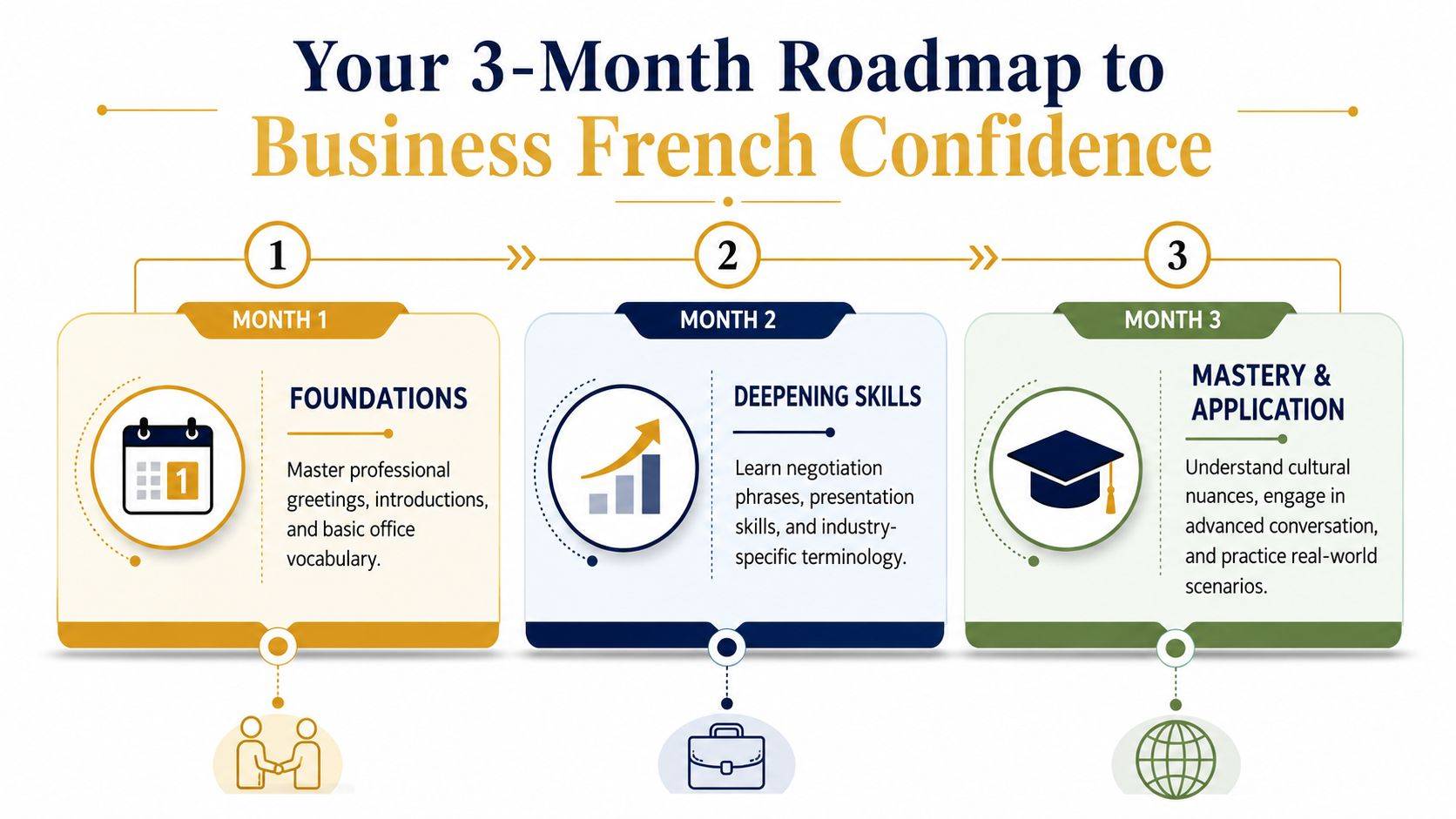
Month 1 foundations
Build the professional base first. Not verbs in isolation. Not trivia.
Focus on:
- Formal greetings and introductions
- Email openings and closings
- Core office vocabulary
- Listening to slow, clear professional French
At this stage, I want clients hearing and using polite structures every week. You should be able to introduce yourself, describe your role, request basic information, and follow the shape of a simple meeting.
Month 2 application
This month is where french language business becomes real. Start practicing scenarios tied to your role.
Use your own materials if possible:
- Write follow-up emails based on actual work situations
- Role-play recurring meetings
- Build a glossary of your industry terms
- Practice short spoken updates
The shift here is from recognition to production. If you can say it only when reading, you don't own it yet.
A quick visual helps many learners stay disciplined:
Month 3 integration
By the third month, stop treating French as a lesson subject. Start treating it as part of your workflow.
That means:
- Listening to business news or podcasts in your field
- Reviewing bilingual documents
- Practicing live conversation with correction
- Rehearsing high-stakes situations before they happen
If your French study doesn't touch your calendar, inbox, or meetings, it probably won't change your work.
You don't need to master everything in three months. You need to become useful, credible, and less dependent on English in the situations that matter most. That's a realistic benchmark.
If you're comparing lesson formats or thinking about a more personalized plan, it makes sense to book a brief consultation and map your exact needs before committing to a course. That's especially true if you're balancing client-facing French with an English-heavy workplace.
French in business isn't about sounding impressive. It's about being trusted with more responsibility.
If your work touches French-speaking clients, teams, or markets, stop waiting for the perfect time to start. Build the language around your job, your sector, and your actual conversations. That's where the ROI is.