
You're probably doing what most Denver learners do first. You search for French classes, open six tabs, compare a nonprofit program, a college course catalog, a tutor profile, an app, and an online school, then realize none of them are answering the specific question you have.
That question isn't “Where can I study French in Denver?” It's “Which format will work for my goal, my schedule, and my budget?”
I've seen adult learners waste months in the wrong setup. A business traveler joins a casual conversation group and gets frustrated. A parent pays for private lessons when the child really needed a richer peer environment. An exam student signs up for a general class and never gets enough targeted correction. The problem usually isn't motivation. It's a mismatch between the student and the learning model.
Denver does have a real French-learning ecosystem, but that's only helpful if you know how to sort the options. If you're weighing local classes, private instruction, or online lessons, this guide will help you make a practical choice. If you want an adult-focused framework for vetting tutors, this guide on how to find the perfect French tutor for adult learners is also useful before you start booking trials.
Table of Contents
Starting Your Search for French Classes in Denver
Those looking for French language classes in Denver aren't starting from curiosity alone. They've got a reason. A trip is coming up. Their child needs support. A new role requires French-speaking meetings. An exam date is hanging over them.
That urgency is why bad fit matters so much.
I've worked with students who spent weeks trying to compare options by brand name alone, as if choosing the “right school” mattered more than choosing the right format. It rarely does. What matters first is whether you need structure, flexibility, personal correction, peer energy, or a formal curriculum. Once you know that, the Denver market becomes much easier to read.
The real problem is usually mismatch
A lot of search results flatten everything into one category. Group classes, immersion schools, college courses, and private tutoring all get presented like they solve the same problem. They don't.
A weekly evening class can be great for a learner who wants accountability and community. It's a poor fit for someone who needs presentation practice for a French-speaking client call. A one-on-one tutor can be ideal for DELF prep or pronunciation work, but it may be more than a casual learner wants. Online lessons can remove commuting friction, but only if the teacher knows how to keep the lesson interactive instead of screen-heavy and passive.
Practical rule: Don't choose based on the label “French class.” Choose based on the kind of repetition and feedback your goal requires.
Denver gives you real options
Denver isn't a city with only one outlet for French learners. There are community-based programs, academic pathways, tutors, and flexible remote options. That's good news, but it also means you need a filter.
Here's the filter I use with students:
Your goal: travel, work, school support, exam prep, or long-term fluency
Your schedule: fixed weekly availability or irregular calendar
Your learning style: you like group energy, or you need private correction
Your tolerance for slow pace: some people enjoy steady progression, others need targeted acceleration
Once those four pieces are clear, your short list gets much smaller and much better.
Comparing Denver French Learning Models
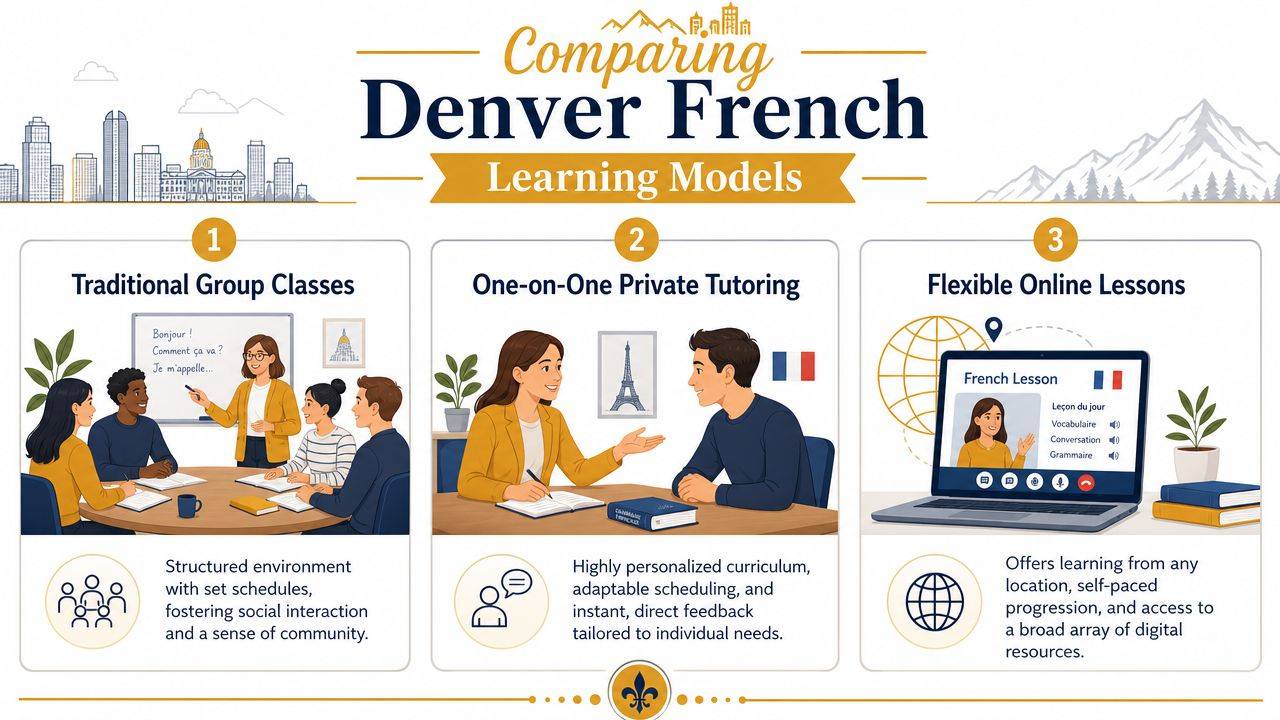
If you want to make a smart decision quickly, compare learning models, not just providers. In Denver, most learners end up choosing between three paths: traditional group classes, private tutoring, and online lessons.
Why Denver has more than one serious path
Denver has a durable French-learning base. The Alliance Française de Denver says it is “one of the oldest non-profit organizations in the Denver-Metro area” and the only wholly French language, culture, and resource center in Colorado, serving more than 1,500 members. That tells you something important. French study here isn't a fringe activity. It has community depth, recurring demand, and multiple entry points.
That depth helps students, but it can also hide trade-offs. A strong institution may offer culture and continuity, while a private teacher may offer speed and precision. A flexible online program may remove travel time but ask more of your self-discipline. If you're considering a more immersive path, this overview of French immersion programs can help you compare expectations.
French class models in Denver at a glance
| Feature | Group Classes | Private Tutoring | Online Lessons (Elite Model) |
|---|---|---|---|
| Best for | Learners who like structure and peer interaction | Learners with specific goals or uneven skill profiles | Busy adults, families, and professionals who need flexibility |
| Schedule | Fixed | Usually flexible | Highly flexible |
| Pace | Set by the group | Set by the student and tutor | Set by the student and tutor |
| Personalization | Limited | High | High |
| Speaking time | Shared with classmates | Concentrated | Concentrated if taught well |
| Accountability | Strong if you like routines | Strong if lessons are consistent | Strong when there's a clear plan |
| Social element | High | Low | Moderate, depends on format |
| Typical fit | Casual learners, community-focused learners | Exam prep, business French, school support | Irregular schedules, remote learners, goal-driven adults |
| Cost shape | Usually lower per session, less customized | Higher per session, targeted value | Varies, but often chosen for convenience and personalization |
Who usually does well in each model
Group classes work best for learners who want a recurring appointment and don't mind moving at a shared pace. They're often a good entry point for adults who need momentum more than customization.
Private tutoring fits students whose needs are narrow, urgent, or uneven. That includes learners who read well but can't speak, kids who need school-aligned support, and professionals who need role-play for real conversations rather than broad exposure.
Online lessons are often dismissed too quickly. In practice, they're one of the strongest options for learners with demanding schedules, provided the lessons are interactive and not just workbook correction on a screen.
If your calendar changes every week, a rigid class time can become the main reason you stop learning, not the main reason you improve.
A simple test helps. Ask yourself which frustration would bother you more: moving too slowly with a group, paying for personalization you may not need, or managing your attention in an online setting. Your answer usually points to the right model.
Matching Your French Goal to the Right Class
Your goal should drive the format. That's where many people get stuck. They shop by proximity or price first, then discover later that the class wasn't built for what they needed.

Denver supports serious French study across age ranges. The French American School of Denver profile describes a French-immersion model designed to develop bilingual, bi-literate learners, and Denver's broader ecosystem includes study that continues into university-level coursework. That matters because families and adult learners aren't choosing in a vacuum. They're choosing within a city where French can be pursued as enrichment, academic development, or professional skill-building.
For parents choosing enrichment or support
For younger learners, the first question isn't “private or group?” It's “Does my child need exposure, support, or acceleration?”
If the goal is enrichment, group-based learning or immersion-adjacent experiences often work well because children benefit from repetition, songs, stories, and social use of the language. If the goal is support for a bilingual or school curriculum, private lessons usually work better because the tutor can align vocabulary, reading, and oral work to the child's exact classroom demands.
A sample lesson focus for a child might include:
Vocabulary through context: picture books, routines, colors, food, or school topics
Oral confidence: short question-and-answer practice instead of grammar lectures
Retention: songs, games, and recurring phrases that become automatic
Parents often overvalue worksheets. Kids usually progress faster when the lesson is built around speaking, listening, and recall.
For professionals who need usable French fast
Busy adults need a different approach. If you need French for meetings, travel, relocation, or client relationships, your lessons should look like your real life. A professional preparing for calls with French colleagues should spend time on introductions, clarification phrases, politeness levels, and industry vocabulary, not just chapter-by-chapter textbook sequencing.
That's why one-on-one or highly customized online lessons tend to outperform generic classes for this group. A practical resource for this path is French for business, especially if your goal is workplace communication rather than broad academic study.
A sample business-focused lesson might include:
opening a meeting politely
summarizing a project update
asking someone to repeat or clarify
handling small talk before the agenda starts
Adults improve faster when the lesson targets the conversations they're actually going to have next week.
For DELF and academic learners
Exam students need precision. They usually benefit from private tutoring or a very structured course with correction built in. General conversation classes can help with fluency, but they won't automatically prepare you for timed writing, listening tasks, or oral exam expectations.
Good DELF support includes:
Task familiarity so the exam format doesn't become the hidden problem
Targeted feedback on writing and speaking
Weak-skill diagnosis so you don't spend all your time practicing what already feels comfortable
Academic learners at the high school or university level fall into a similar category. If grades, essays, or presentations matter, choose a model that gives detailed correction, not just exposure.
Key Questions to Ask Before You Enroll
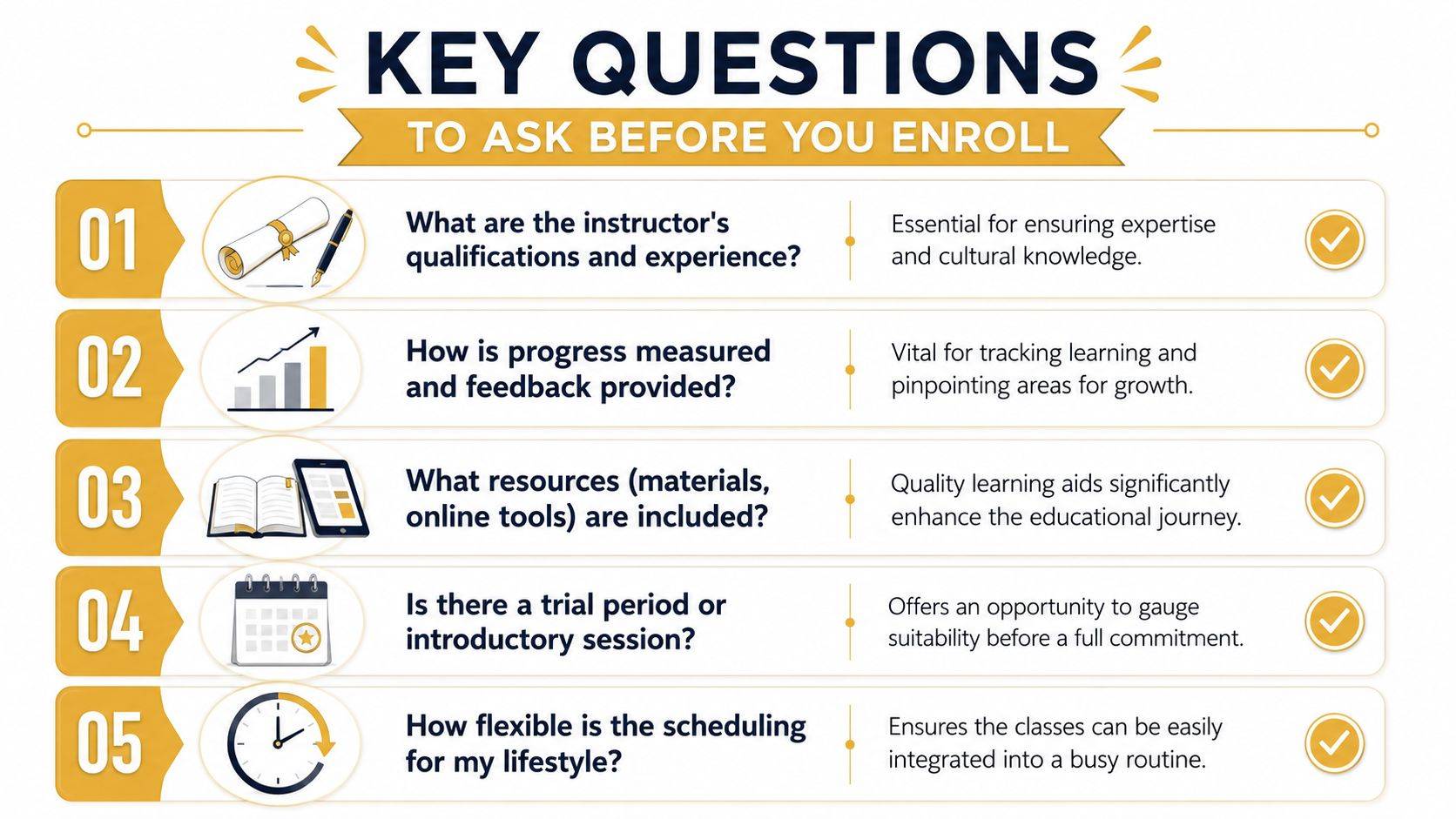
Most programs look good on a landing page. The useful differences come out when you ask sharper questions.
One of the clearest markers of a strong program is whether it develops more than passive knowledge. The Community College of Denver French course sequence explicitly builds interpretive, interpersonal, and presentational communication, with continued work in listening, speaking, reading, and writing. That's the right general direction. Students need repeated output, not just recognition.
Questions that reveal the teaching method
Ask these early, even if the website feels polished.
How much of the lesson is spent speaking French out loud? If the answer is vague, expect limited speaking gains.
How do you correct mistakes? Good correction is selective and timely. Constant interruption shuts people down. No correction leaves fossilized errors in place.
What does a beginner lesson look like? You want concrete examples, not broad promises.
Do you teach grammar in isolation or through communication? Grammar matters, but students retain it better when they use it in speaking and writing.
A program doesn't need to be purely conversational. It does need to move beyond passive intake.
A student who only recognizes French on paper often feels “better” for a while, then freezes the first time someone speaks back.
Questions that protect your time and budget
Price matters, but not by itself. A cheaper option that doesn't fit your schedule or your goal can cost more in lost momentum.
Ask:
What happens if my schedule changes often?
Is there an introductory session or consultation?
How is progress tracked over time?
Are materials included, or will I need to buy separate books and tools?
Who is this class not a good fit for?
That last question is one of my favorites. Honest instructors answer it clearly.
Here's what strong answers usually sound like:
a clear explanation of lesson flow
examples of student tasks
realistic expectations about practice between sessions
a straightforward policy on cancellations, pacing, and feedback
If you're comparing several options for French language classes in Denver, take notes during each inquiry call. Marketing language starts to blur very quickly. Specific answers don't.
A Denver Professional's Success Story
Anna came to us after her company changed ownership and her new leadership team included French speakers. She didn't need literature, academic grammar, or a casual hobby class. She needed to participate in meetings without feeling lost, ask follow-up questions politely, and stop panicking when someone switched from English into French.
Her first instinct was to look at local group classes. The problem wasn't quality. It was fit. The schedules were hard to match with her work travel, and the curriculum was too broad for what she needed right away.
What changed for Anna
We narrowed her target. Instead of “learn French,” the goal became much more practical: survive introductions, understand recurring meeting phrases, manage small talk, and speak with enough confidence to stay in the room.
Her lessons focused on:
recurring work situations
listening for key phrases rather than understanding every word
short speaking drills tied to her own industry context
pronunciation support on names, greetings, and common meeting language
She also needed a format she could maintain. That made consistency possible.
For readers comparing real-world outcomes, this corporate French classes success story shows the same pattern I see often. Adults improve when the lesson mirrors the pressure points of their work life.
Why her setup worked
Anna did not need a beautiful curriculum map. She needed a usable one.
What worked was the combination of targeted speaking practice, direct correction, and scheduling that didn't collapse every time work changed. Her confidence improved because the lessons repeatedly rehearsed situations she faced. That kind of specificity is hard to replicate in a broad group class.
By the time her meetings became more regular, French no longer felt like a wall of sound. It felt manageable. That's a big turning point for adult learners. Once they can track the structure of an interaction, progress stops feeling abstract.
The Elite French Tutoring Advantage for Denver Learners
Denver learners often face one practical tension more than any other. They want lessons that respect both their calendar and their goal.
A consumer pricing breakdown for Denver-area French learning reported lessons at roughly $60 to $75 per hour plus memberships in some cases, while also highlighting the unresolved question many adults still have: what's the actual balance between cost, convenience, and progress in a full learning path? That summary appears in this Denver French pricing discussion. In practice, learners don't just compare hourly rates. They compare friction. Commuting friction. scheduling friction. pacing friction. generic-content friction.
Where customized tutoring fits
For the student with a stable weekly routine and broad interest in the language, a group class can still make sense. For the learner with a narrow goal or uneven availability, a customized model usually makes more sense because it removes wasted lesson time.
That's where Elite French Tutoring fits as one option in the market. The model is private and customized, with online delivery available for learners who need scheduling flexibility or location independence.
The value of that setup isn't “online” by itself. It's what online makes possible:
lessons built around your exact use case
easier continuity when travel or family logistics change
focused speaking time instead of waiting for turns
content that can shift as your goal changes
What a tailored program solves
A parent may need curriculum-aligned support for a child who's falling behind in French reading. A professional may need role-play for presentations and client dinners. A DELF candidate may need writing correction and oral mock exams. Those are different problems, and a single broad class rarely solves all of them well.
What I like about the customized approach is simple. It reduces drift. Students stop spending energy on material that isn't relevant, and that usually improves consistency. If you're shopping for French language classes in Denver with a commercial mindset, that matters more than glossy branding. You're not buying “access to French.” You're buying a learning process that you'll sustain.
If you're weighing options right now, a short consultation or trial with your top choice is usually the cleanest next step.
Your Simple Enrollment Checklist
Most people don't need more options. They need a cleaner decision.
A practical four-step decision process
Clarify your why
Write one sentence, not five. “I need French for client meetings.” “My child needs support with school French.” “I'm preparing for DELF.” If your goal is fuzzy, your class choice will be fuzzy too.Audit your real schedule
Don't choose based on your ideal week. Choose based on your actual one. If your evenings change constantly, fixed classes may become hard to sustain. If you thrive on routine, a recurring group slot might help.Use the diagnostic questions
Ask about speaking time, correction, lesson structure, progress tracking, materials, and flexibility. The answers will tell you more than the branding will.Book one low-pressure first conversation
A consultation, intro lesson, or placement call should leave you with clarity. You should know whether the teacher understood your goal, whether the format fits your life, and what the first phase of study would look like.
A final gut check helps. Ask yourself, “Can I realistically stay consistent with this for the next several months?” That question filters out a lot of bad decisions.
The best choice usually isn't the cheapest or the most popular. It's the one that makes consistent, focused practice easiest for you.
If you're comparing French lesson options and want a clearer sense of which format fits your goals, the simplest next step is to book a short introductory conversation with a provider that can assess your level, schedule, and target use of French before you commit.