

You're sitting at the kitchen table with a deadline that won't move. Maybe it's a Paris relocation, a DELF date, a Lycée Français placement test, or a job that suddenly expects you to speak before you feel ready. That's when generic French advice becomes useless, because the core question isn't whether you should study French, it's whether intensive French lessons fit your timeline, your goal, and the way you learn.
I've placed adults into the wrong format before, and I've seen what happens. A busy professional gets trapped in a schedule that's too light, momentum dies, and six weeks later they're still “working on it.” Another learner crams into a format that's too aggressive, then burns out before the progress turns into confidence. The right plan is not the one with the loudest marketing. It's the one that matches your calendar and produces measurable movement.
Table of Contents
When an Intensive French Plan Is the Right Move
The wrong French format wastes time in the most expensive way possible, by letting the deadline stay real while your progress stays abstract. I've seen that with relocation cases, exam candidates, and parents trying to line up support with school admissions. If your French has to function on a schedule, format choice matters more than how motivated you feel on day one.
A true intensive plan makes sense when the goal is tied to a hard outcome, not a vague wish. That might be a work assignment, a family move, a certification target, or a school interview. In those situations, a slow weekly rhythm looks safe but usually delivers too little contact time to build confidence fast enough. A concentrated format gives you repeated exposure, correction, and speaking reps while the target is still close.
Practical rule: if your deadline is fixed, build the French plan backward from the date, not forward from your current comfort level.
The benchmark matters because it separates real intensity from marketing language. A widely used baseline for intensive French lessons is 15 to 25 hours of instruction per week, versus about 3 to 4 hours in a typical non-intensive format, and once homework and independent practice are included, intensive study is often framed as roughly 25 to 30 total hours per week in this overview of intensive French courses. That gap is what tells you whether a program can actually move you toward a deadline, or whether it only sounds serious on paper.
If you are a corporate client, a parent coordinating school support, or an adult learner with a travel or exam deadline, use one simple filter. If you need momentum in weeks, not months, intensive belongs on your shortlist. If your goal is maintenance, light conversation, or long-term comfort without urgency, a lower-intensity cadence is usually the smarter buy. The reasons adults start French vary, but the format decision still comes down to timing, pressure, and outcome, which is why Elite French Tutoring's overview of why people learn French fits naturally here.
What Intensive French Lessons Actually Mean
A serious intensive French plan is not just more class time. It is compressed contact time, tighter correction, and enough repetition for the language to stop feeling abstract. If a provider cannot show the weekly hours, the practice rhythm, and the correction cycle, they are selling volume without structure.
Measuring intensity by weekly hours
Weekly contact hours are the cleanest benchmark. A properly intensive program sits around 15 to 25 hours of instruction per week, while a standard non-intensive format is closer to 3 to 4 hours. Many programs also frame the full weekly load, homework included, as roughly 25 to 30 total hours. That gap is what separates serious progress from a course that only looks demanding on a sales page.
Use that benchmark to check a provider's claim. Ask for the timetable, the amount of guided instruction, and the amount of work expected between sessions. If the answer stays vague, the program is not truly intensive, no matter what label it uses.
The label itself changes from school to school. Some call it immersion, others say super-intensive, and others use accelerated course. I do not care about the wording. I care about whether the weekly structure gives you enough speaking, enough correction, and enough repetition to move your French forward.
What makes it properly intensive
A proper intensive course has three parts. The schedule is compressed into a short window. Students are speaking, listening, reading, and writing repeatedly within the same week. The instructor corrects fast enough that mistakes do not harden into habits.
The fastest programs increase the density of feedback. That matters more than glossy branding or a dramatic course name. A learner who gets corrected quickly, then uses the same language again the next day, improves faster than someone who gets a large amount of loosely guided exposure.
Class structure tells you a lot. A provider with a loose self-paced model is not the same thing as a program with fixed blocks, assigned work, and a clear progression. If you want to see how a serious lesson arc is usually organized, compare the pace and structure against Elite French Tutoring's class structure page.
Ask one blunt question before you pay. How many hours per week are guided, and what happens between those sessions? If a provider cannot answer that clearly, it is not a true intensive.
The Four Real Formats and When Each One Wins
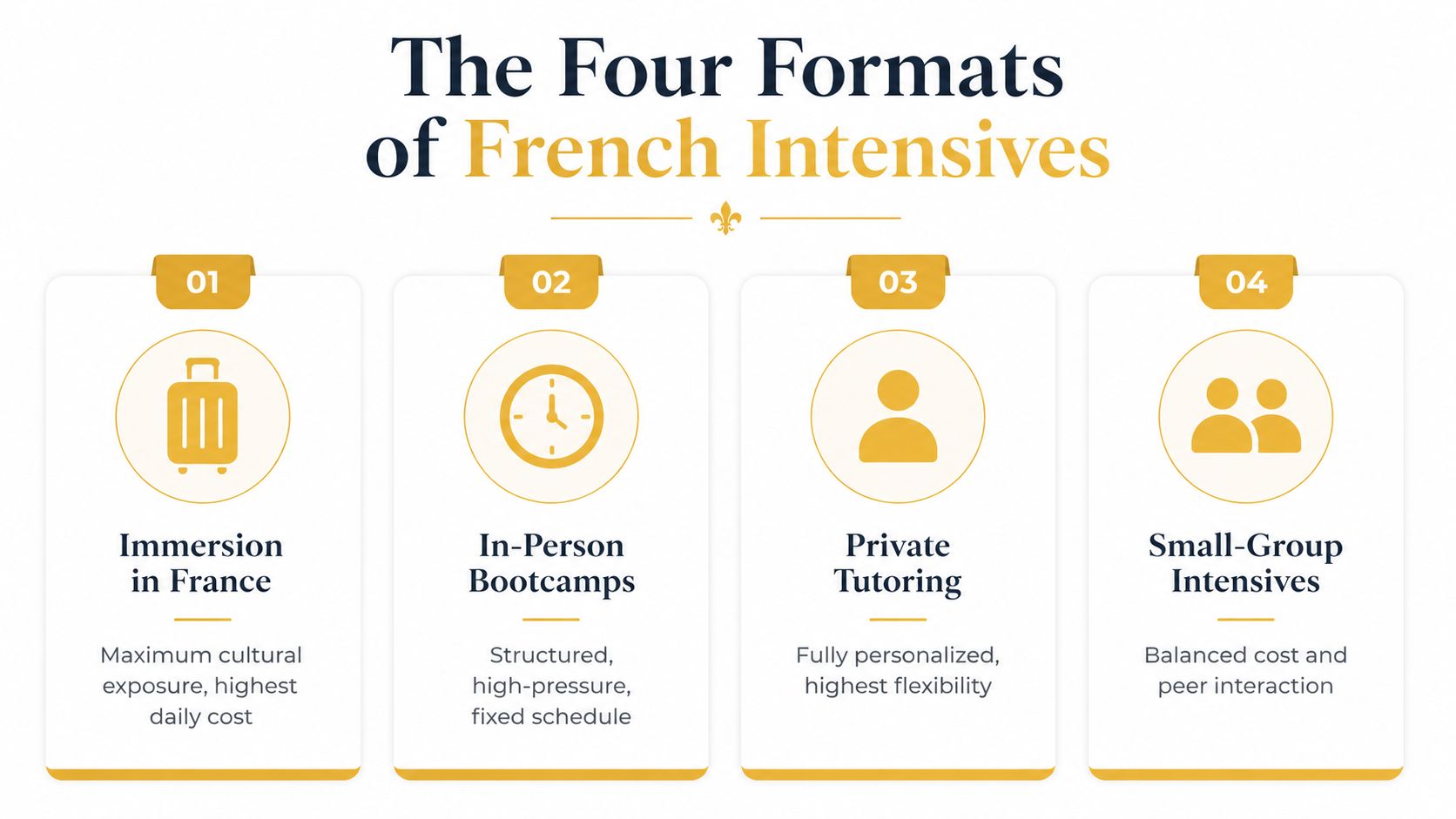
There are four formats that show up again and again, and they do not solve the same problem. I've seen people pick the wrong one because they chased the most dramatic word on the page instead of the fit for their actual week. That's how you end up paying for intensity you can't sustain.
Immersion in France
Immersion works when the learner can travel and wants maximal exposure. It's the strongest choice for people who need culture, daily language contact, and the pressure of living inside French. It's also the least forgiving option for someone who needs flexibility, controlled pacing, or a specific focus on exams or workplace language. If the goal is to live in French quickly, immersion belongs on the list. If the goal is to prepare efficiently while juggling a job, it may be the wrong tool.
In-person bootcamps
Bootcamps are for learners who want structure and don't want to negotiate with their calendar every day. They suit exam candidates and adults who perform well under time pressure. The downside is obvious, the schedule is fixed, so if your workweek is chaotic, the format can collapse under real life. The model is strong, but only for learners who can show up consistently.
Private tutoring and small groups
Private tutoring wins on flexibility and precision. It's the cleanest option for professionals, families with curriculum-aligned needs, and remote learners who need continuity without travel. Small-group intensives sit in the middle, with shared momentum and peer interaction without losing all personalization. If you want to compare those paths in more depth, this immersion program page is useful because it shows how a concentrated format is framed for different learners.
| Format | Typical Weekly Hours | Cost Range (USD) | Best For | Watch Out For |
|---|---|---|---|---|
| Immersion in France | High, often full schedule | Varies widely | Fast cultural adaptation and full exposure | Travel logistics and lower flexibility |
| In-Person Bootcamps | Fixed, concentrated blocks | Varies widely | Exam prep and short deadlines | Hard schedules that leave little room for absences |
| Private Tutoring | Fully customizable | Varies widely | Busy adults, executives, family goals | Needs discipline and clear goals |
| Small-Group Intensives | Structured and shared | Varies widely | Balanced cost and accountability | Pace may not match every learner exactly |
The right choice comes down to your week, not your ego. If you need high control, choose tutoring. If you need community and structure, choose a group. If you can travel and want full immersion, take immersion seriously. If you like a pressurized sprint and can protect the calendar, bootcamp can work.
Real Schedules and What You Can Realistically Achieve
Hours matter, but only if you translate them into a realistic calendar. I don't care how polished a brochure looks if the schedule doesn't line up with what a human being can absorb. Progress follows contact time, repetition, and follow-through, not optimism.
A short sprint and a deeper push
A two-week sprint works when the goal is immediate survival language, orientation, or a quick confidence boost before travel. It can sharpen listening, speaking patterns, and basic transactional French, but it won't turn a beginner into a comfortable conversationalist. A six-week deep dive is more serious. That's where you can build routine, start speaking with less hesitation, and move from “I know the material” to “I can use it.”
The data point that matters most here is clear. Multiple intensive-program guides report that about 60 hours can bring a true zero-beginner to CEFR A1, while 80 to 100 hours is a common estimate for reaching A2 conversational ability, and one school notes roughly 10 weeks to move from one level to the next in a 20-lesson syllabus in this program guide. That's the kind of benchmark I trust when I'm planning for adults.
What the week should look like
A sane intensive week usually mixes morning grammar, mid-day speaking, and later review. You need time for oral production, not just passive exposure, because output is where gaps show up fast. The point is not to accumulate class time for its own sake. It's to create enough repetitions that correct forms start to feel natural.
My rule for adults: if a schedule doesn't include repeated speaking with correction, it's not intensive enough to justify the label.
Here's the blunt takeaway. A shorter sprint can get you started, but it should be judged by whether it creates momentum. A six-week plan can create real competence if the hours are high enough and the homework is serious. A rolling weekly plan works best when continuity matters more than speed.
A Real Student Story From Zero to DELF Ready
One of the cleanest examples I've seen was a professional who needed French for an upcoming relocation and had no time for a slow build. She was a genuine beginner, nervous on the first call, and very clear about one thing. She didn't want a vague “eventually” plan. She wanted usable French by the time the move happened.
We chose a format that fit her schedule and her pressure level, then built the week around workplace language, short speaking tasks, and constant correction. The sessions were tight, and the homework wasn't decorative. She had to review vocabulary, record herself, and come back ready to use the language, not just recognize it. That's the difference between pretending to study and moving forward.
Her progress was tracked against a concrete exam path, not a feel-good checklist. The work connected directly to a DELF-style goal, and the structure mattered as much as the content. If you want a parallel example of how a candidate can be guided through a focused prep path, this DELF preparation story shows the same principle in action.
What made the result possible was not magic. It was the match between deadline, format, and feedback. She didn't need a loose conversation club. She needed a program that closed gaps fast and kept pressure on the exact skills her move required. That's the template I use with adults every time.
What a Strong Intensive Curriculum Looks Like
A strong intensive curriculum is easy to recognize because it has a weekly arc. Weak programs hide behind vibes. Strong ones show you what happens each day, how skills build, and where corrections happen. If the provider can't explain that, walk away.
What a real week includes
A serious week for an intermediate learner should not feel random. It needs grammar consolidation early in the week, production drills in the middle, and a check point at the end. The content should keep returning to real scenarios, not abstract textbook sentences. A café negotiation, a vendor phone call, and a workplace update are better than sterile exercises because they force the learner to use language under pressure.
The best programs also make homework matter. That's where timed writing, shadowing, self-recording, and structured correction come in. Those activities reveal whether the learner can produce the language without a prompt in front of them. A curriculum that ignores homework is leaving progress on the table.
The CCFS–Sorbonne intensive French program is a strong benchmark because it combines 20 hours of class with 10 to 15 hours of personal work per week, for a total of 30 to 35 hours weekly, and reports success rates above 85% for DELF B2 and 75% for DALF C1 in its program description. That doesn't mean every learner will hit the same result, but it does show what a structured intensive model looks like when the weekly load and outcomes are taken seriously.
What to ask before you buy
If a provider can't tell you how they close gaps, you're buying a logo, not a course. Ask for the weekly sequence, the type of feedback, and the way they track progress. A good curriculum gives you a reason for every hour.
Show me the week, not the slogan.
If the provider's answer is vague, the intensity is probably fake. If the answer is specific, you're at least looking at a real program.
How to Choose the Right Intensive Program for You
The right choice comes from four questions, and they're not complicated. How much time do you have each week? What outcome do you need, a CEFR move, exam readiness, workplace use, or travel confidence? How much correction do you expect? And what happens after the intensive window ends?
That last question matters more than most admit. I've seen adults finish a burst of strong study and then lose half their confidence because they had no continuity plan. The solution is not always more hours. Sometimes it's a transition from sprint to maintenance, from high-pressure practice to a sustainable weekly rhythm. Matching the format to the after-plan is how you avoid the “I learned it and lost it” spiral.
The schedule itself should fit your life. Intensive programs are commonly structured around about 20 lessons per week in fixed morning blocks, while adult language centers also offer morning, afternoon, evening, weekday, Saturday, in-person, and online scheduling, making format flexibility a major decision factor as noted by CIA France. That flexibility is not a luxury. For many adults, it's the difference between a program that works and one that fails on week two.
If you want a custom path, Elite French Tutoring offers private French lessons with a free 20-minute consultation, which is the right kind of starting point when you need the format built around your deadline rather than the other way around. That's one option among several, but the point is the same. Choose the program that matches your schedule, outcome, and feedback needs, not the one that sounds the most intense.
Pricing Prep and Your Next Step
Before you speak to any provider, get three things ready. A clear deadline. A rough level estimate. And a short statement of what success looks like in real life. If you can't define the target, you can't buy the right program.
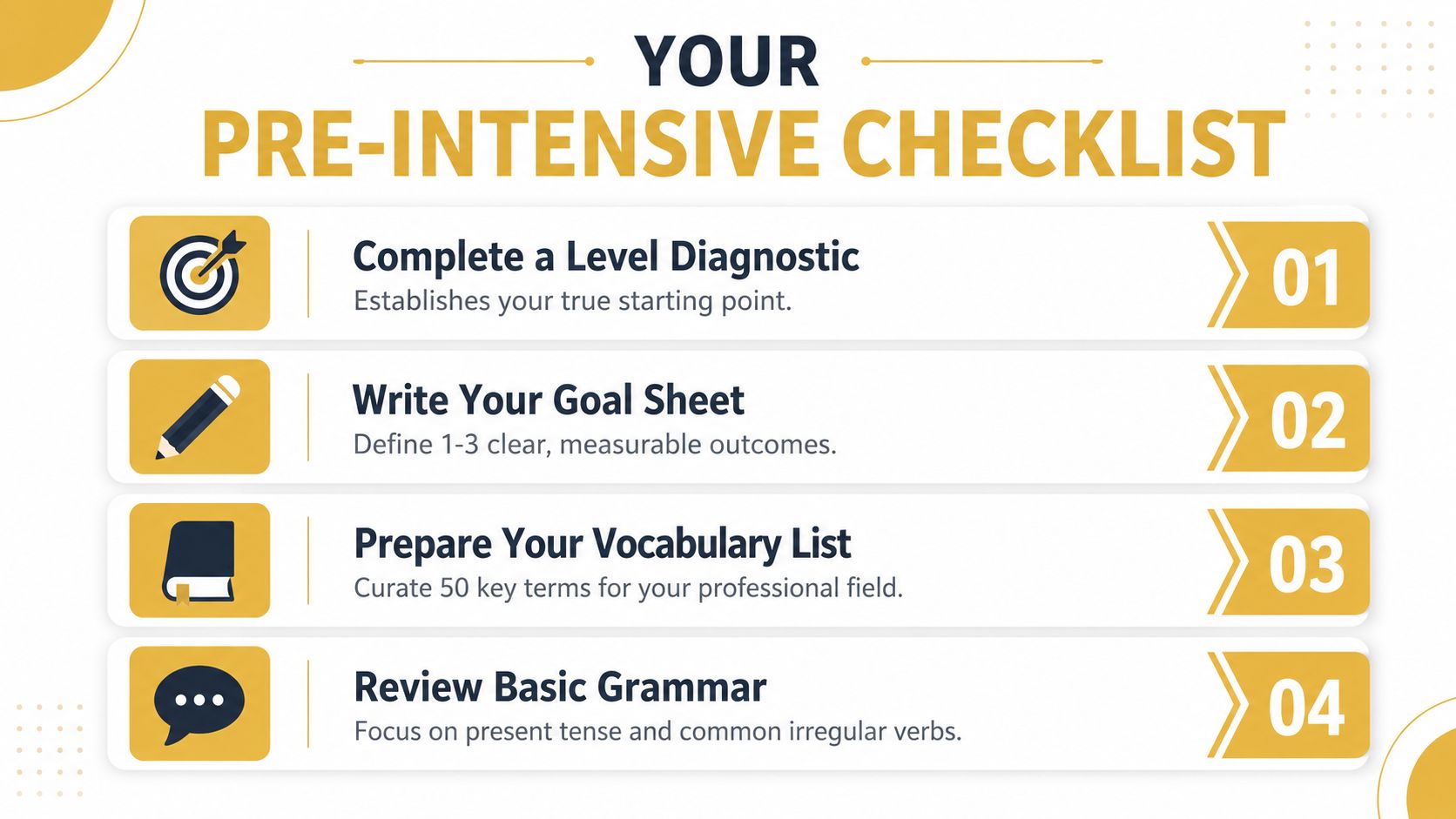
What to prepare before a consultation
Complete a level diagnostic. Know where you stand, not where you hope you stand.
Write a goal sheet. Keep it to 1 to 3 clear outcomes so the program stays focused.
Prepare a vocabulary list. Pull together the terms that matter in your field, school system, or relocation context.
Review basic grammar. Refresh present tense and common irregular verbs so the first week doesn't get wasted on basics you can handle before class starts.
You don't need perfect preparation. You need enough clarity to make the first week productive. That's where the money goes farthest. When adults come in ready, I can spend the live time on speaking, correction, and targeted gaps instead of guessing what they need.
If you're comparing options today, make the decision on fit, not hype. Choose the schedule you can protect, the outcome you can measure, and the format you can sustain. Then book a consultation or line up two or three programs side by side and compare them against the same criteria. That's the cleanest way to buy intensive French lessons without wasting a month on the wrong fit.