
You already know the problem. The email needs to sound polished, the client call needs to sound calm, and the negotiation line that worked in English lands awkwardly in French. At that point, a general class is a bad buy. You need a business French course online that trains the exact moves your job demands, not a broad language program that leaves you stuck when the meeting starts.
The right course is the one that matches your role, your schedule, and your output. If you need to write sharper emails, you need writing drills. If you need to hold your own on video calls, you need live speaking practice. If you need to pass a certification or prove readiness for a French-speaking office, you need a provider that measures progress instead of selling motivation.
Table of Contents
Why Most Business French Searches End in the Wrong Course
The usual failure starts with a vague search. Someone types business French course online, lands on a polished page, and buys the first program that sounds professional enough. Then the real work shows up, a supplier email, a team meeting, a presentation to the Paris office, and the course they chose doesn't touch any of it.
That mismatch happens because people shop for French fluency, not French performance. Those are not the same purchase. A strong provider should help you do one of three things fast, write better messages, speak with more authority in meetings, or handle role-specific conversations without freezing.
Buy for the job you need to do
If your day is mostly email and documents, a conversation-heavy class is a waste. If you're in sales or client management, broad vocabulary drills won't save you when you need to persuade, soften a refusal, or negotiate terms. If you're heading into a French-speaking office, you need a format that makes speaking feel routine, not heroic.
Practical rule: never choose a course until you can name the exact workplace moments it has to improve.
The buyer mistake is treating every program as if it serves the same goal. It doesn't. A semester course, a short cohort class, a corporate platform, and private tutoring solve different problems, which is why the decision has to start with the task, not the brand name.
The other common mistake is assuming the “best” course is the most general one. It isn't. In business French, specificity wins. The course that rehearses your next board update, your next hiring interview, or your next vendor call is the one that pays off.
What Business French Actually Teaches You
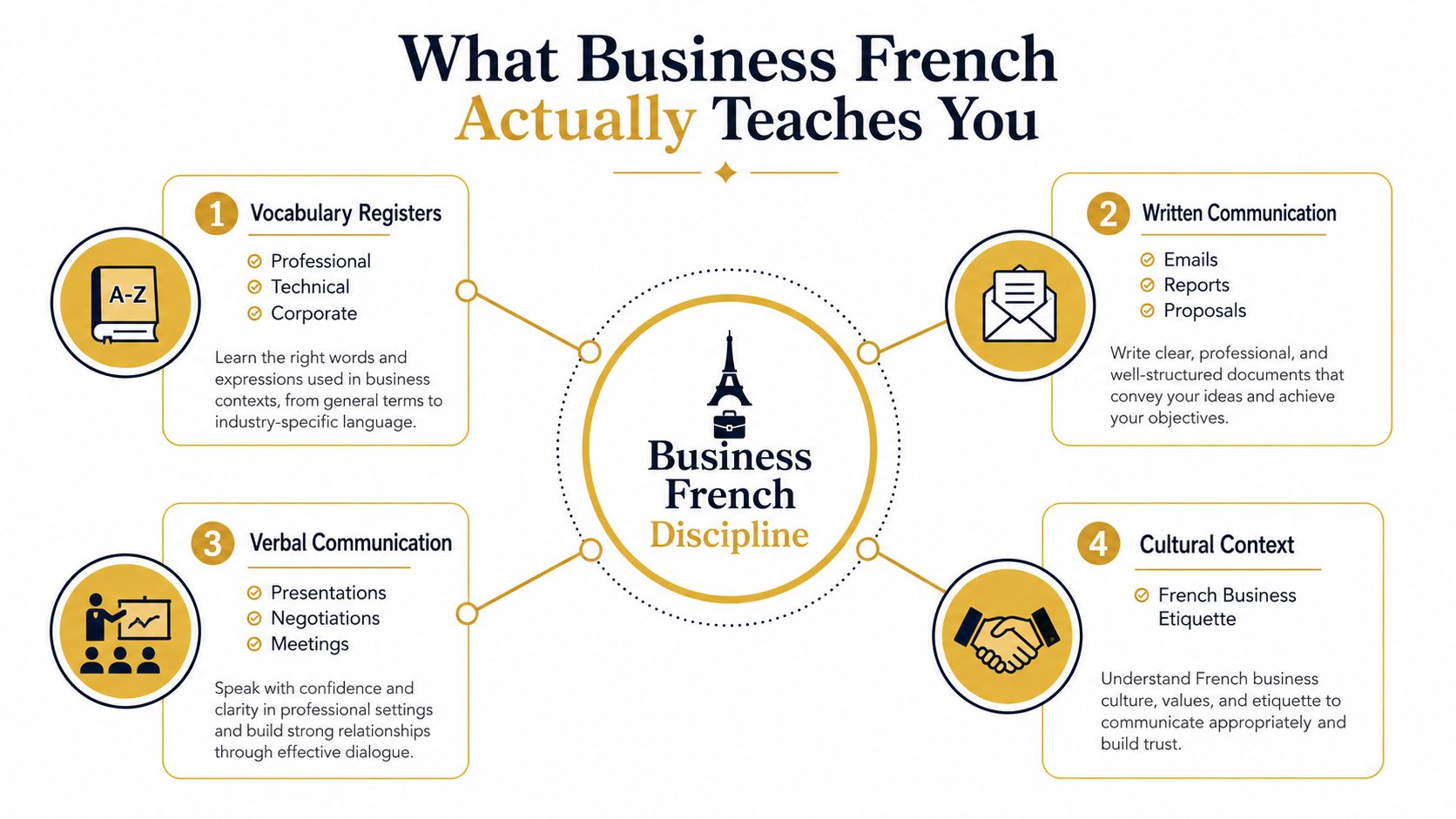
Business French is a workplace communication system, not general French with a formal wardrobe. The vocabulary shifts, the tone shifts, and the social rules shift. A strong course shows you how to handle professional situations where the wrong phrase can sound vague, too direct, or out of place.
The language shifts by channel
A client email needs controlled wording. A video call needs quick comprehension and clean turn-taking. A negotiation needs precision, because the other side listens for commitment, not just understanding. Strong online programs build around meetings, presentations, negotiations, email writing, and etiquette, not broad general French.
Buyers should also look at how a provider defines its training. Busuu's business French course guidance pushes learners to assess level, define format, and check sector vocabulary and framework fit, which is the right way to buy a course instead of browsing by brand name. It also points buyers toward recognized levels like CEFR and exam pathways such as DELF/DALF when certification matters. You can read that positioning in Busuu's own business French course guidance.
Vocabulary alone is not enough
The stronger programs do not dump random industry terms on you. They start with the words you will repeat in your role, then add the terminology that belongs to your field. GoFLUENT makes the same case in its own business-French approach, putting the most common words first and then extending into sector-specific language, which is the right order for busy professionals. Their reasoning is simple. Use the high-frequency set first, then expand into your domain through the business French approach they outline.
That is why business French matters once you already have a base. Many structured programs target B1 and above, because intermediate speakers can already follow basic conversation and are ready for professional precision. Live-French explicitly recommends B1 for business French, and Sorbonne's semester course requires B1 plus prior business French and phonetics hours for admission, which sets the entry bar clearly. The Sorbonne requirement is listed on the semester business French course page. For professionals who need role-specific speaking and writing practice rather than broad study, Elite French Tutoring's French for Business is built around that exact need.
A course that ignores your starting level wastes time. A course that starts where you are gets you to the workplace faster.
The Four Formats of an Online Business French Course
| Format | Best For | Typical Hours | Price Range | Personalization |
|---|---|---|---|---|
| Short cohort course | Fast skill refresh, limited budget, clear schedule | About 20 hours in the Dawson College model | Not stated in the verified data | Moderate |
| University semester program | Learners who want a formal academic structure | Longer-term, semester-based | Not stated in the verified data | Moderate to high |
| Corporate training platform | Teams, departments, and internal rollout | Modular, varies by provider | Not stated in the verified data | High for teams, lower for individuals |
| One-to-one private tutoring | Executives, relocating professionals, role-specific goals | Flexible, set by need | Not stated in the verified data | Very high |
The market splits into four formats, and each one serves a different decision. Buyers usually waste money when they choose a structure that does not match the work they need to do in French.
Short cohort courses
A short cohort course is the practical choice for professionals who need a quick reset and a clear calendar. Dawson College's winter 2026 Business French course fits that model. It is delivered online through Microsoft Teams, runs 20 total hours, and limits enrollment to 20 learners. That is a tight format, short, scheduled, and built for speaking practice in a small group. The course page is here: Dawson College's online Business French offering.
Use this format when you need focused exposure and the discipline of a set schedule. It makes sense for professionals who want guided practice without a long commitment, especially if they are testing whether business French is worth a bigger investment.
University semester programs
A semester program fits learners who want formal progression and an academic frame. Sorbonne's business French course is a clear example, because it sets a B1 prerequisite and expects learners who already handle intermediate French. That excludes beginners, and it should. A semester model works best for people who can already function in French and now need more precise workplace language, not for someone starting from zero.
If you want a steadier path and do not mind a slower pace, this format gives you structure. The trade-off is obvious. You get depth and academic credibility, but you give up speed and flexibility.
Corporate platforms and private tutoring
Corporate platforms are built for rollout across a team or department. They usually work best when an employer wants common language standards, shared practice, and tracking across multiple learners. That makes them a strong fit for companies with recurring French-language needs, especially if the goal is consistency rather than individual tailoring.
Private tutoring sits at the other end of the market. It is the sharpest option for executives, relocation cases, and professionals with narrow targets such as client calls, negotiations, or presentations. If your role demands specific speaking patterns and written outputs, one-to-one instruction gives you the fastest route to that outcome. For readers comparing formats against provider quality, best online French lessons is a useful starting point. The question is simple. Do you need a course built for a group, or do you need instruction built around your job?
Inside the Curriculum of a Strong Business French Course
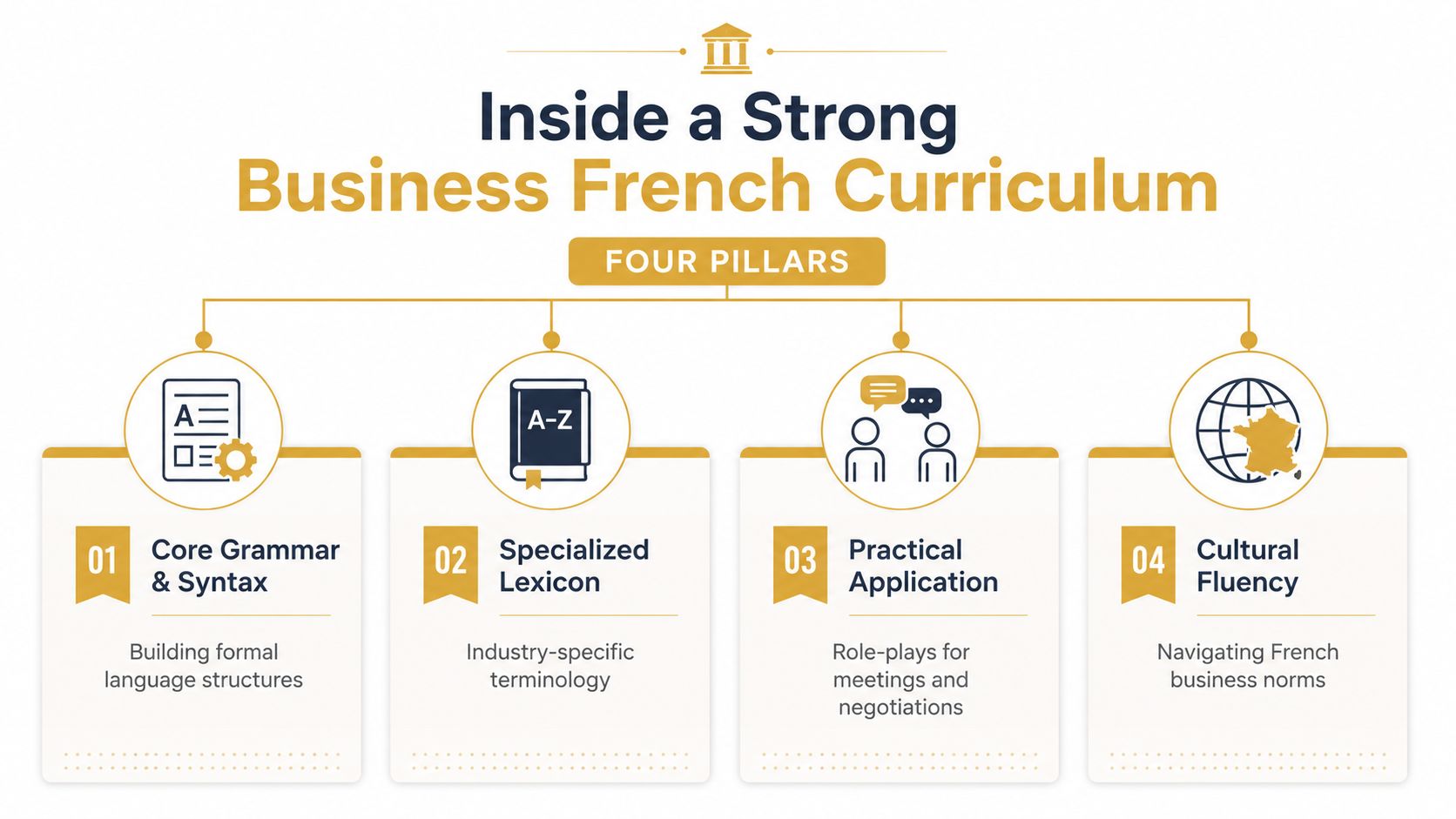
A strong course is built around four things, not forty. If a provider can't show you these pillars clearly, keep looking.
Core grammar and syntax
You don't need advanced literary French to run a meeting. You do need sentence control. That means clean tense use, proper register, and the ability to soften requests without sounding weak. In practical terms, this is the difference between sending a blunt note and sending a message that gets action without friction.
Specialized lexicon
Strong courses separate themselves from generic ones. They teach the professional words you'll reuse, then add the terminology your industry depends on. A finance director, an operations manager, and a marketing lead do not need the same vocabulary bank, even if they all work in French.
Practical application
The best courses rehearse the tasks, not just the words. A learner should practice opening a meeting, explaining an issue, interrupting politely, asking for clarification, and closing with next steps. For written work, the same logic applies to reports, proposals, and follow-up emails.
Cultural fluency
French business etiquette still matters. Tone, turn-taking, and formality can shape how your message is received. A good instructor won't just fix grammar, they'll flag where your message sounds too casual, too direct, or too translated.
The curriculum should feel like work, not school. If it doesn't touch meetings, emails, presentations, and etiquette, it's not a real business French course online. It's general French with a business label.
The internal structure matters enough that I always tell clients to look at French business writing support if emails and reports are a priority. Writing is often where professionals feel the most immediate pressure, and it's also where targeted coaching pays off fast.
How to Evaluate Any Business French Provider Before You Pay
A provider page should answer four questions before you hand over money. If it doesn't, the offer isn't ready for a serious buyer.
Does it start with a real language evaluation
Ask whether they assess your level before placing you. If they guess, walk away. A proper placement test prevents the classic mistake of joining a class that's too easy or too hard.
Does it connect to recognized outcomes
If certification matters, check whether the provider references the CEFR or formal exams like DELF/DALF. Busuu's guidance does this for business French, and that matters because it gives you a measurable benchmark instead of a vague promise.
Is the vocabulary tied to your sector
This is essential if your work has specialized language. A healthcare manager, a lawyer, and a sales director do not need the same course content. If the provider can't explain how it adapts materials to your field, it's too generic for business use.
Does the format fit your calendar
Schedule fit is not a luxury. If the class time makes you miss calls, the course will fail in practice even if it looks good on paper. That's why modular delivery and short time blocks matter so much for professionals with packed weeks.
Red flag: any course that sells confidence first and structure second is asking you to trust marketing instead of a learning plan.
If you want a cleaner benchmark for how a serious provider structures sessions, compare it against a clear French class structure. The best operations don't hide the sequence, they make it easy to understand how intake, instruction, and progress tracking fit together.
One more thing, if a provider offers an evaluation up front, that's a strong sign. A free consultation, such as Elite French Tutoring's 20-minute evaluation, usually means they're thinking about fit before enrollment, not just filling seats.
What Real Progress Looks Like Inside a Business French Program
A mid-career manager came to us before relocating from New York to a French-speaking office. He started at B1, handled everyday French, and needed something sharper, enough to lead meetings, write professional follow-ups, and deliver a client presentation without sounding hesitant. His target was not abstract fluency, it was workplace performance at a B2-equivalent level.
The first step was a consultation, then a curriculum built around his role. We focused on client updates, project summaries, meeting language, and the vocabulary he used every week with regional teams. The rhythm was simple, one live session for speaking, one writing drill for email tone, then targeted correction on the phrases he needed.
What changed was not just confidence. He stopped translating sentence by sentence during calls, and his written updates became shorter, clearer, and more credible. His manager later asked him to present to a French-speaking client group, and he delivered it in French.
The measurable outcome was concrete. He earned a promotion tied to expanded regional responsibilities, because his French stopped being a barrier and started functioning like part of his job. That's the standard I use when I judge a business French course, does it change what the learner can do on Monday morning?
Real progress in business French is when the learner stops preparing for French and starts using French to do the job.
That same logic is why French for business support has to stay tied to the learner's actual tasks, not generic classroom topics. If your job changes, the language plan should change with it.
Comparing Providers Side by Side on What Actually Matters
The cleanest comparison is not “which provider is most famous.” It's which one fits your target use case, your time horizon, and your tolerance for structure.
| Provider type | Personalization | Certification alignment | Sector vocabulary | Scheduling flexibility | Pricing transparency |
|---|---|---|---|---|---|
| Short cohort course | Moderate | Usually limited unless stated | Moderate | Moderate | Often clear, as in the Dawson College example |
| University semester program | Moderate to high | Stronger when tied to formal study | Moderate | Low to moderate | Often less transparent until you enquire |
| Corporate training platform | High for teams | Varies by provider | High | High for teams, but fixed internally | Varies |
| Private one-to-one tutoring | Very high | Can be aligned to CEFR or exam goals | Very high | Very high | Depends on provider |
Sorbonne's semester course is useful for a buyer who already knows they're B1 and wants a more academic pathway. CERAN is a better reference point for modular delivery because it offers 10, 15, 20, or 40-hour options, which suits professionals who need a course to bend around their calendar rather than the other way around. Those are not interchangeable products, and buyers make fewer mistakes when they treat them as different categories.
I'd sort the choice like this. If you need a quick boost and a defined schedule, look at a short cohort course. If you need formal progression and already meet the entry threshold, consider a semester program. If you're buying for a team, use a corporate platform. If your job stakes are high and the language has to fit a specific role, private tutoring is the sharper bet.
For readers who want a direct professional path, Elite French Tutoring offers fully customized online French lessons with a free 20-minute consultation, which is the kind of intake that helps separate a general request from a real training plan. It's not the only option, but it is the kind of model that rewards buyers who know they need specificity.
Your Next Step Toward the Right Course
The decision comes down to four things, whether you're ready for the level, whether the format fits your schedule, whether the provider proves credibility, and whether the outcome matches your job. If your goal is a stronger client pitch, an internal promotion, or a DELF B2 pathway, the course has to be built around that outcome from day one.
Don't buy the first program that sounds polished. Shortlist two or three providers, compare their entry level, their format, their vocabulary focus, and their assessment process, then choose the one that looks built for your actual work. If you want a quick expert check before you commit, book a consultation and pressure-test your shortlist against your real role, your calendar, and your next business conversation.