You're probably here because you typed “French lessons Atlanta” into Google, opened five tabs, and got the same unhelpful mix every buyer gets. Tutor marketplaces. Group class calendars. A few polished school pages. Very little guidance on which option will fit your goal.
That's the problem. Many learners don't need “French lessons” in the abstract. They need the right format for a job change, a child's school support, an exam, or a fast push toward speaking confidence. I've worked with enough learners to say this clearly: the best French lesson in Atlanta isn't one specific provider. It's the format that matches your objective, schedule, and tolerance for wasted time.
If you're trying to decide whether private lessons, group classes, or online instruction make sense, start with buying logic, not marketing. Cost matters. So does pace, accountability, speaking time, and whether the teacher can shape lessons around you. If you're still unsure whether premium instruction pays off, this short guide on when a French tutor is worth the investment will help you think about value, not just price.
Table of Contents
So You Want to Learn French in Atlanta
Atlanta gives you plenty of choice. That sounds good until you realize choice creates noise. You can join a class, hire a private tutor, or sort through a huge stack of online profiles, and each path looks reasonable until you ask a harder question: reasonable for what?
French is also a real part of the city's linguistic presence, not some niche add-on. An estimated 31,115 Atlanta metro residents speak French at home, about 0.47% of the population, and French ranks among the top 10 home languages in the region according to this Atlanta language profile. That matters because it supports steady demand from families, professionals, and internationally connected households who need instruction, not just a hobby class.
Start with the outcome, not the format
I tell students to stop asking “Should I do online or in person?” first. Ask these instead:
What's the goal? Conversation, school support, professional communication, or exam prep.
How fast do you need progress? A relaxed pace and an urgent timeline require different structures.
Where do you usually fail? Scheduling, confidence, pronunciation, consistency, or feedback.
What kind of accountability do you need? Some learners do fine in a group. Others disappear without a fixed private plan.
Practical rule: If your goal is specific, your lesson format should be specific too.
The strongest buyers make one decision early. They choose for efficiency, not appearance. A lovely classroom and a long tutor list don't help if you need focused speaking practice, school-aligned support, or a teacher who can catch the same grammar mistake every week until it disappears.
Atlanta French Lesson Formats Compared
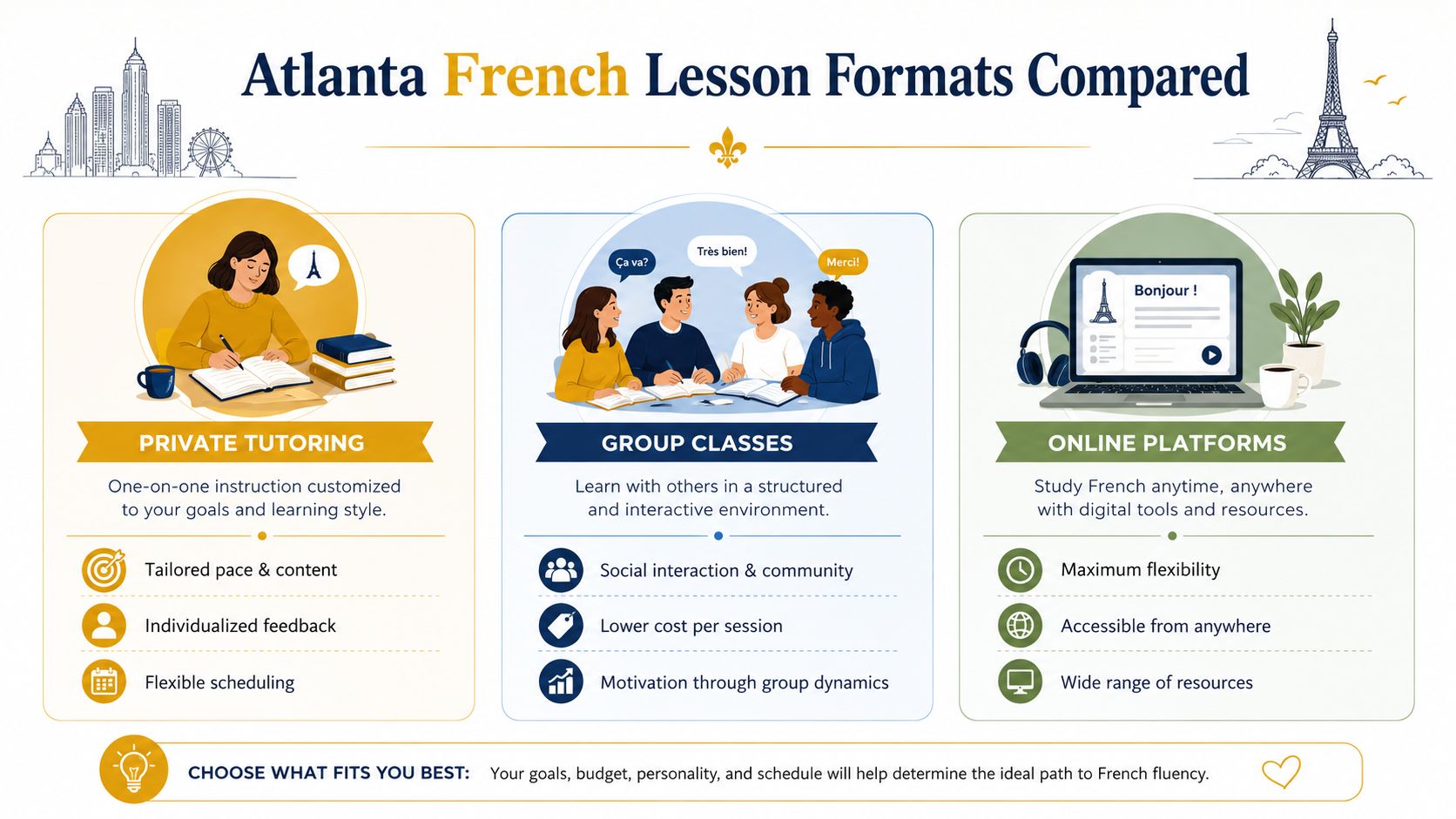
Private tutoring, group classes, and online platforms all work. They just don't work equally well for every person. If you shop for French lessons in Atlanta without understanding that trade-off, you'll pay for the wrong thing.
What you're actually buying
Private tutoring buys focus. The teacher adjusts pace, materials, correction style, and speaking tasks around one learner. That's why private lessons usually cost more.
Group classes buy structure at a lower per-person rate. In Atlanta, a tutor marketplace reports an average of about $30/hour with 181 teachers listed, while institute-style group French can run about $17.75/hour according to this Atlanta French marketplace page. Lower cost is attractive, but group learning always divides teacher attention.
Online platforms buy convenience and breadth. You get more scheduling flexibility and a wider pool of instructors. That's useful if your calendar is ugly or your needs are unusual. If you're comparing remote options, this guide to the top ways to learn French online is a solid next step.
French lesson formats in Atlanta at a glance
| Feature | Private Tutoring | Group Classes | Online Platforms |
|---|---|---|---|
| Best for | Targeted goals, fast progress, school support, exam prep | Budget-conscious learners, steady curriculum, social learning | Busy schedules, remote access, broader teacher choice |
| Cost pattern | Higher per hour | Lower per student | Varies widely |
| Personalization | High | Limited | Varies by teacher |
| Speaking time | Highest | Shared across the group | Often strong in 1 on 1 formats |
| Scheduling flexibility | Moderate to high | Fixed | High |
| Pace | Matched to the student | Set by the class | Varies |
| Accountability | Strong when well managed | Good if you attend consistently | Depends on the setup |
| Weak point | More expensive | Less individual correction | Quality varies a lot |
A few buying truths matter here.
Choose private tutoring if you need pronunciation correction, CEFR-aligned feedback, or fast movement.
Choose group classes if you want routine and don't mind moving at the class pace.
Choose online lessons if convenience is the bottleneck and you'll show up more consistently from home or office.
Group classes are often efficient for coverage. Private lessons are often efficient for change.
That difference matters. Plenty of learners confuse activity with progress. If you're attending regularly but not speaking much, not getting corrected, and not working on your exact weak spots, you're staying busy, not getting efficient. Before you pick a provider, decide which one factor matters most to you right now: lower cost, faster results, or easier scheduling.
Choosing Your Path Based on Your Goals
The right answer changes with the learner. I wouldn't send a corporate manager, a fourth grader, and a DELF candidate into the same format and pretend the choice is obvious.

One Atlanta provider says its French program uses 10 weekly group sessions, with smaller formats compressed into 7-week two-student classes or 5-week private lessons in its course structure overview. That's useful because it shows what many buyers miss: format duration reflects learning intensity. Shorter private cycles usually mean more concentrated effort. Longer group cycles usually mean steadier curriculum coverage.
For busy professionals
If you need French for work, I recommend private lessons first, usually online unless your attention is much better in person.
Professionals don't need generic chapter-by-chapter instruction. They need efficiency. That means role plays, presentation language, industry vocabulary, correction that gets straight to recurring errors, and scheduling that survives real life.
A group class can help if your goal is broad competence over time. It's a weak fit if you need to speak in meetings, write polished emails, or prepare for interviews. In that case, buy time with a teacher who can focus on your exact tasks.
For parents and K to 12 students
Parents should prioritize curriculum alignment and rapport, not flashy branding.
A child who needs support for school usually benefits most from a private tutor or a very small format. Why? Because the tutor can match school materials, reinforce teacher expectations, and slow down where the student is confused. Large classes don't catch subtle issues quickly enough. They also don't always build confidence in kids who hesitate to speak.
Look for a teacher who can balance structure with warmth. Children don't need endless “fun activities.” They need lessons that make them speak, remember, and feel safe making mistakes.
The best tutor for a child isn't always the most charismatic one. It's the one who can keep progress steady without burning the child out.
For DELF and DALF exam prep
Exam prep is where I get opinionated. Don't wing it with a general conversation tutor.
DELF and DALF students need someone who understands the exam's written and oral demands, can diagnose weak sections, and can work under a deadline. Private lessons are usually the strongest option because the teacher can target productive skills, timing, error patterns, and mock performance.
A small pair format can work if both students are close in level and deadline. Standard group classes are often too broad unless they are specifically exam-focused.
For adults who want conversation fast
If your goal is travel, family connection, or personal confidence, the best option depends on what has blocked you before.
If you've tried apps and still freeze when speaking, choose private conversation-centered lessons. You need live interaction, correction, and repetition. If you're motivated by social learning and can tolerate slower pacing, a small group may be enough.
If schedule friction is your biggest problem, online often wins. I'd rather see a student do consistent remote lessons than keep postponing a perfect in-person setup. The right format is the one you'll maintain.
Where to Find Top-Tier French Instructors in Atlanta
Atlanta has a real French-learning market. That's good news, but it also means you need filters. More choice doesn't automatically mean better decisions.
Established institutions
The strongest argument for established institutions is continuity. Alliance Française Atlanta says it has served the community since 1912, and it offers courses for individuals, groups, businesses, and nonprofit or governmental organizations, with class sizes ranging from 5 to 14 students on its about page. If you value cultural connection, a formal class environment, and a long-running local presence, that type of institution can be a strong fit.
The trade-off is customization. Institutional programs usually prioritize a shared curriculum and set calendar. That's useful for some learners, but limiting for people with sharp goals or unusual schedules.
Large marketplaces
Marketplaces are attractive because they give you range. You can compare teacher bios, availability, teaching styles, and price points without much friction.
That convenience has a downside. You still have to do the sorting. A fragmented market creates choice overload, and buyers often mistake a large teacher catalog for quality control. Some excellent instructors are on marketplaces. Some are not. The burden of evaluation falls on you.
Specialized tutoring services
Specialized tutoring services make the most sense when your goal is narrow and the cost of a poor fit is high. That includes school support, professional French, oral fluency work, and exam preparation.
One example is Elite French Tutoring, which offers customized private online lessons and begins with a free consultation to evaluate goals, level, and learning style. That kind of structure is useful if you don't want to guess your way through profiles and want a plan built around a specific outcome.
Here's how I'd frame the market:
Choose an institution if you want a traditional learning environment and community connection.
Choose a marketplace if you're comfortable screening teachers yourself.
Choose a specialist if the lesson must fit a defined objective and timeline.
None of these categories is automatically right. But one of them is usually more efficient for your actual need.
From Zero to Confident A Student Success Story
Sarah came to us from Buckhead with a problem I see all the time. She didn't need “general French.” She needed French that would help her operate more confidently in a professional setting.
She was a marketing executive. Her company had more interaction with French-speaking partners, and she wanted to position herself for a bigger role. She'd already tried apps, self-study, and scattered online materials. None of that resolved the central difficulty. She could recognize vocabulary, but she couldn't speak with composure under pressure.

What changed for Sarah
Her lessons stopped being broad and started being useful. We built sessions around the language she needed: introductions, polished explanations, meeting phrases, clarification strategies, and vocabulary tied to marketing and client communication.
A few things shifted quickly:
She stopped translating everything first. We trained short, usable speaking patterns instead of chasing perfect sentences.
She got corrected on the same recurring mistakes. That mattered more than learning endless new content.
She practiced pressure moments. Presenting, answering follow-up questions, and recovering when she got stuck.
The biggest breakthrough wasn't grammar. It was control. Once she knew how to steer a conversation, ask for clarification naturally, and recover after an error, her confidence rose fast.
“I'm not trying to sound like a textbook anymore. I'm trying to communicate well.”
That mindset changed everything. By the end of her program, she was speaking more directly, handling work-related exchanges with much less hesitation, and showing up differently in professional conversations.
If you like seeing how customized instruction changes the trajectory, this story about how Emma went from zero to fluent with a structured French program is worth reading too.
Key Questions to Ask Any French Tutor or School
Most buyers ask the easy questions first. How much does it cost? What times are available? Those matter, but they won't tell you whether the instruction is any good.
The shortlist questions that matter
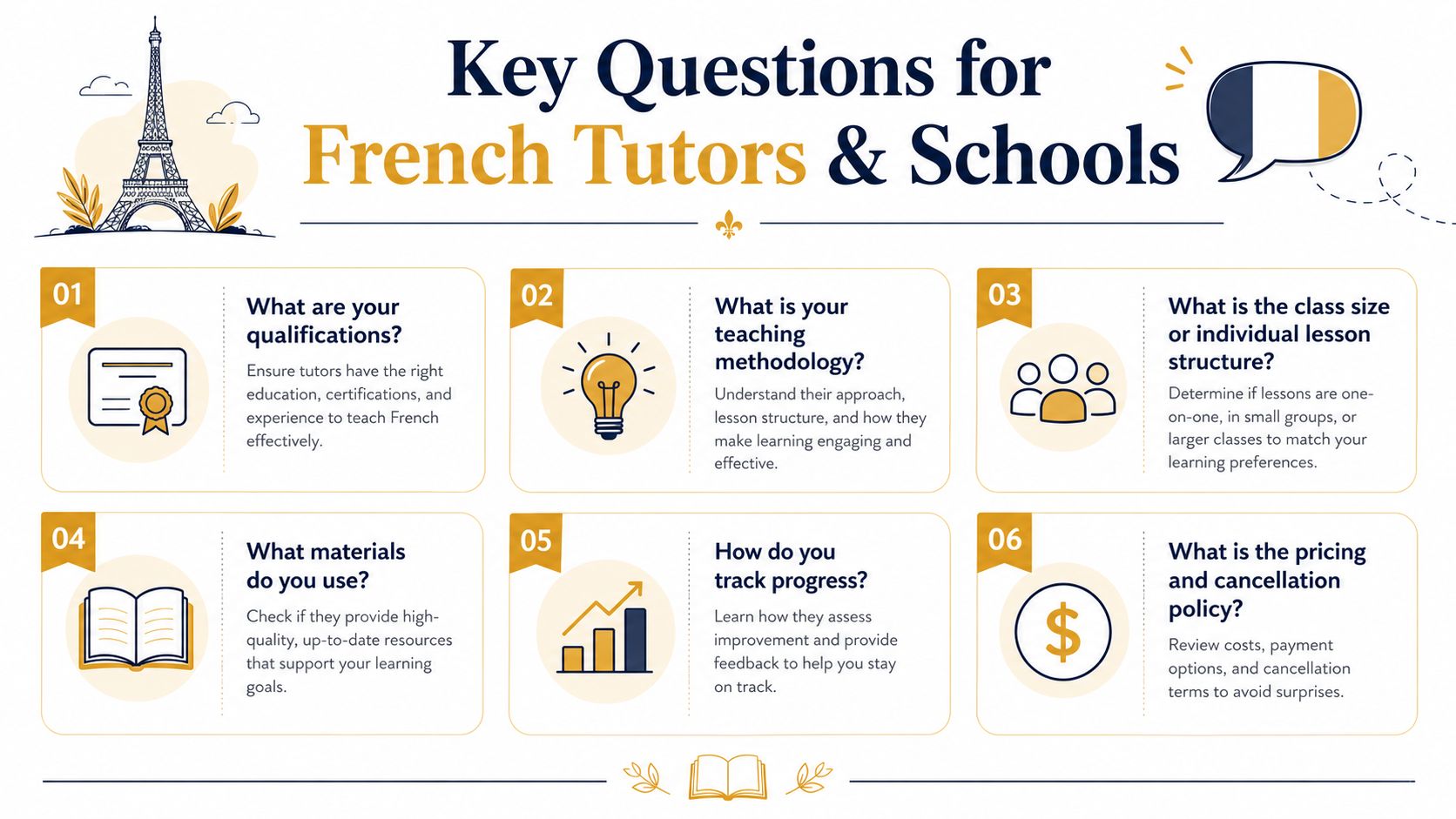
Use this checklist before you commit.
What kind of learners do you usually teach? A tutor who works mostly with children isn't automatically right for a corporate learner, and the reverse is also true.
How do you assess my current level? If there's no placement process, expect a lot of guesswork. A proper French placement test helps prevent mismatched materials and wasted early lessons.
How do you structure lessons? Ask what happens in a typical session. You want more than “we follow a book.”
How do you correct mistakes? Some teachers barely interrupt. Others overcorrect and kill confidence. Good instruction balances fluency and accuracy.
What materials do you use? Strong tutors adapt materials to the learner instead of relying on one static track for everyone.
How do you measure progress? Ask what improvement looks like in practice. Better speaking control, stronger listening, cleaner writing, more accurate grammar, and more confident participation are all legitimate markers.
What happens between lessons? Momentum matters. Homework, review notes, audio work, or targeted practice often separate steady progress from random exposure.
What is your cancellation and scheduling policy? If the policy creates constant friction, the program won't last.
What good answers sound like
You don't need slick sales language. You need clarity.
A good tutor should be able to explain who they teach well, how they build a lesson, how they track progress, and what a reasonable next step looks like. If the answers are vague, assume the instruction will be vague too.
Ask one hard question early: “How would you teach someone with my exact goal?”
If they can't answer clearly, keep looking.
The right provider won't be annoyed by good questions. They'll welcome them.
FAQs About French Lessons in Atlanta
Are online French lessons as effective as in-person lessons?
They can be, and often are, if the teacher is skilled and the student shows up consistently. Online works especially well for adults with demanding schedules, professionals who need convenience, and learners who want access to a broader pool of instructors. In-person still has an edge for some children, some beginners, and anyone who focuses better face to face.
Is private tutoring worth the higher cost?
Usually yes, if your goal is specific and your time matters. Private lessons remove the biggest source of waste in language learning: generic pacing. If you need school support, speaking confidence, professional French, or exam prep, focused instruction often gives better value than a cheaper format that moves too slowly or too broadly.
How do I choose a tutor in a crowded market?
Use a framework. The Atlanta market is fragmented, with online platforms like iTalki offering 79+ French teachers for Atlanta-area learners according to its Atlanta teacher listings. Large marketplaces can be useful, but they also create noise. Filter by your goal, preferred format, correction style, and scheduling reality, not just profile polish.
How long will it take to become conversational?
That depends on your starting point, consistency, and what you mean by “conversational.” Some learners mean travel survival. Others mean confident, sustained discussion. The timeline changes a lot based on lesson quality and how much live speaking you do. If you want faster progress, prioritize regular speaking practice, targeted correction, and a format you'll maintain.
If you're comparing French lessons in Atlanta and want a recommendation that fits your goal rather than a generic list, book a free consultation with Elite French Tutoring. A short planning conversation is often enough to tell whether you need private online lessons, in-person support, or a different structure altogether.