Skip to content

You're probably here because your search history now looks like this: French classes Los Angeles, private French tutor near me, online French lessons, DELF prep LA, French tutor for Lycée Français. That usually means one thing. You want to learn French, but the local market is messy, scattered, and hard to judge from polished websites alone.
I see this constantly with new students in Los Angeles. One person wants business French before a relocation conversation. Another wants travel confidence before a long-planned trip. A parent needs help for a child who's already in a bilingual school and falling behind on class-specific material. All three are looking for french lessons in Los Angeles, but they should not buy the same type of program.
The good news is that you don't need more options. You need the right filter.
Table of Contents
Finding Your French Path in the City of Angels
A lot of Angelenos start the same way. They picture themselves speaking smoothly in a meeting, ordering confidently on a trip, or helping a child keep pace in a French-speaking classroom. Then reality hits. Los Angeles is huge, traffic is real, schedules are uneven, and every provider seems to promise “conversation,” “immersion,” and “results.”

What matters most is fit. I've seen students waste months in the wrong format because the class sounded appealing. A motivated professional signs up for a cheerful group course but needs negotiation vocabulary. A parent books a general tutor when the child needs support tied to a specific school sequence. An adult beginner picks a cheap app-based solution and then realizes nobody is correcting pronunciation.
Los Angeles has a distinctive demand pattern too. In the city, 52.3% of the French-speaking audience falls into the 25–34 age group, which shows how often French here is tied to career plans and global mobility rather than only heritage learning or childhood exposure (French speakers in Los Angeles audience data).
Practical rule: Don't ask, “What's the best French class in LA?” Ask, “What lesson format matches the reason I need French?”
That question changes everything.
Some students need speed and accountability. Others need flexibility because work hours move every week. Some need an instructor who can handle school materials, ministry-aligned expectations, or exam prep without improvising. The best choice isn't the flashiest website or the lowest hourly rate. It's the option that solves the exact problem sitting in front of you right now.
First Things First Define Your French Learning Goal
The biggest buying mistake I see is simple. People shop for format before they define outcome.
If you don't know whether you need French for work, travel, exams, or school support, every option looks plausible. That's how students end up in programs that feel active but don't move them toward anything concrete. Busy adults especially lose time this way because they mistake “speaking practice” for targeted progress.
Four common goals that need different lesson types
If your goal is career and professional communication, you need controlled speaking practice, role-play, corrective feedback, and industry vocabulary. General conversation classes often feel pleasant, but they rarely target meetings, presentations, relocation interviews, or networking exchanges.
If your goal is travel confidence, you don't need a grammar-heavy program first. You need practical speaking patterns, listening repetition, and survival vocabulary you'll use. A strong tutor will prioritize high-frequency situations over abstract textbook sequencing.
If your goal is DELF or DALF preparation, you need structure. Not vibes. Exam prep works best when lessons map to the test format, timing, and output expectations. A casual conversation group usually won't do that well.
If your goal is school support for a child, the issue is often narrower and more urgent than parents expect. Many LA providers focus on general conversation, but families at bilingual schools often need curriculum-aligned support for grade levels like 6ème B, and that niche is frequently underserved despite being central to student success (French for bilingual 6ème B listing).
A quick self-diagnosis
Use this checklist before you book anything:
Professional need: Are you trying to speak more confidently in meetings, interviews, emails, or relocation settings?
Short-term trip: Do you need useful spoken French fast, without getting buried in theory?
Exam target: Do you need a teacher who understands DELF or DALF task expectations?
School alignment: Does your child need help with current classroom content rather than generic French practice?
The right teacher for a travel learner may be the wrong teacher for a bilingual middle-school student.
That's why I push students to get specific early. Once your goal is clear, you can reject a surprising number of options immediately. If a tutor can't explain how they'd teach your exact use case, keep looking.
Private Lessons Group Classes or Online Tutors
Los Angeles gives you three main buying paths. Private tutoring, group classes, and online lessons. None is automatically better. Each works well for a different kind of learner, budget, and schedule.
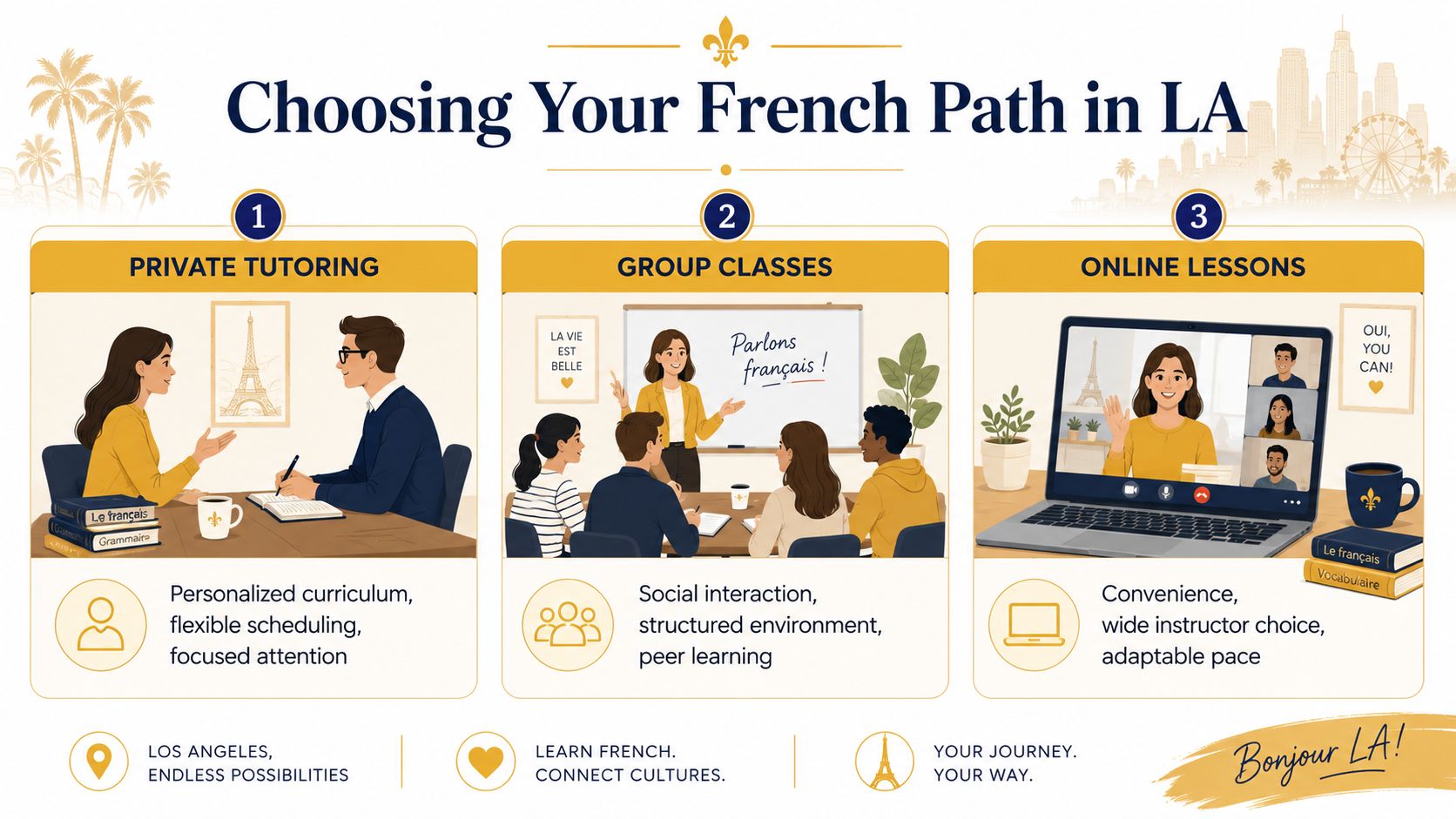
Comparing French lesson formats in Los Angeles
| Feature | Private Tutoring | Group Classes | Online Lessons |
|---|---|---|---|
| Personalization | Highest | Limited | High, if one-on-one |
| Scheduling | Flexible | Fixed | Usually most flexible |
| Best for | Specific goals, fast correction, school support, exam prep | Social learners, routine, lower-pressure entry | Busy professionals, remote learners, access to native speakers |
| Pace | Customized | Set by group | Customized or semi-customized |
| Accountability | Strong | Moderate | Depends on tutor and schedule |
| Travel time | Sometimes required | Usually required for in-person | None |
| Buying risk | Higher upfront spend | Lower individual commitment | Wide quality range |
Private tutoring works best when the goal is specific
Private lessons are usually the strongest option when the learner has a clear objective and limited time. This includes business French, interview prep, DELF or DALF, relocation, and school-aligned tutoring for children. You get direct correction, a customized plan, and no waiting for a class to catch up.
The downside is obvious. You'll usually pay more, and quality varies a lot from one tutor to another. Private only works if the teacher knows how to structure progression, not just chat for an hour.
Group classes are useful, but they have limits
Group courses help with rhythm. They're good for learners who want routine, don't need a highly customized curriculum, and enjoy learning with peers. For some beginners, that social pressure is motivating in a healthy way.
But group classes often frustrate students with narrow goals. A parent needing support for school assignments doesn't need a broad adult conversation syllabus. A lawyer preparing for French-speaking clients doesn't want twenty minutes spent on classmates' vacation vocabulary.
If your goal is broad, group can be efficient. If your goal is narrow, group can be expensive drift.
Online tutoring fixed one major LA problem
For many students, online lessons solve what geography and traffic make difficult in Los Angeles. They remove commute friction, open access to more instructors, and make it easier to keep momentum when workdays shift.
That matters more now because flexibility has become a real buying factor. Some learners specifically want native-speaker-led online options with adaptable scheduling rather than fixed-location classes. If that's your situation, it helps to compare programs built for remote delivery, not just traditional classes moved onto Zoom. A good starting point is this guide to best online French lessons.
What usually works best by learner type
Busy professionals: Private or online one-on-one
Budget-conscious beginners: Group class
Parents needing school support: Private tutoring
Exam-focused learners: Private tutoring or tightly structured online one-on-one
Remote learners with unpredictable schedules: Online tutoring
The wrong format creates drag. The right format makes consistency much easier.
How Much Do French Lessons Cost in Los Angeles
Price matters, but hourly price alone doesn't tell you much.
In Los Angeles, the average market rate for a private, expert-level French tutor is $40–$65 per hour, with the upper end generally tied to specialized skills like DELF/DALF prep and stronger records of helping students progress faster (Los Angeles French tutor rates on Wyzant). That range is useful because it gives you a real benchmark for expert private instruction in the city.
What you're paying for
A higher rate can reflect several things:
Specialization: Business French, exam prep, or school-specific support
Native-level command: Important when pronunciation and idiomatic use matter
Lesson design: A teacher with a plan usually gets further than one who improvises
Feedback quality: Good correction is hard work and worth paying for
Reliability: Consistent scheduling and preparation save students time
That doesn't mean the most expensive tutor is always the best fit. It means you should ask whether the higher fee buys structure, sharper correction, and stronger alignment with your goal.
The cheapest option can cost more in the long run
I've seen students bounce between low-cost options and spend more overall because nothing sticks. They buy a few sessions here, a package there, then restart from scratch with someone new. The actual problem wasn't motivation. It was poor matching.
If you're weighing price against results, this breakdown of whether a French tutor is worth the investment is a useful lens.
Where budget shoppers can compare the market
Los Angeles also has a very competitive marketplace. On Superprof alone, there are 649 private French teachers available around Los Angeles, 97% offer the first hour free, and the average lesson cost is $33/h (French lessons on Superprof Los Angeles). That tells you two things. First, there's no shortage of supply. Second, trial lessons and pricing comparisons are part of how students shop. For learners who want a more personalized experience, Elite French Tutoring offers private French lessons at $125 per hour, while Superprof remains a useful marketplace for comparing tutors and price points.
There's also a free benchmark worth knowing. The Los Angeles Public Library offers free one-to-one virtual French tutoring through Tutor.com daily from 11 a.m. to 11 p.m. for K–12 and adult learners with a library card (Tutor.com through the Los Angeles Public Library). Even if you want paid instruction, it's helpful to compare what a premium lesson gives you beyond basic access.
What to Expect in Your First French Lessons
Most adults worry about the same thing before lesson one. Will I have to speak immediately, and what if I freeze?
A good first lesson doesn't try to impress you with complexity. It should lower pressure, identify your level, and start building a pattern you can repeat weekly.
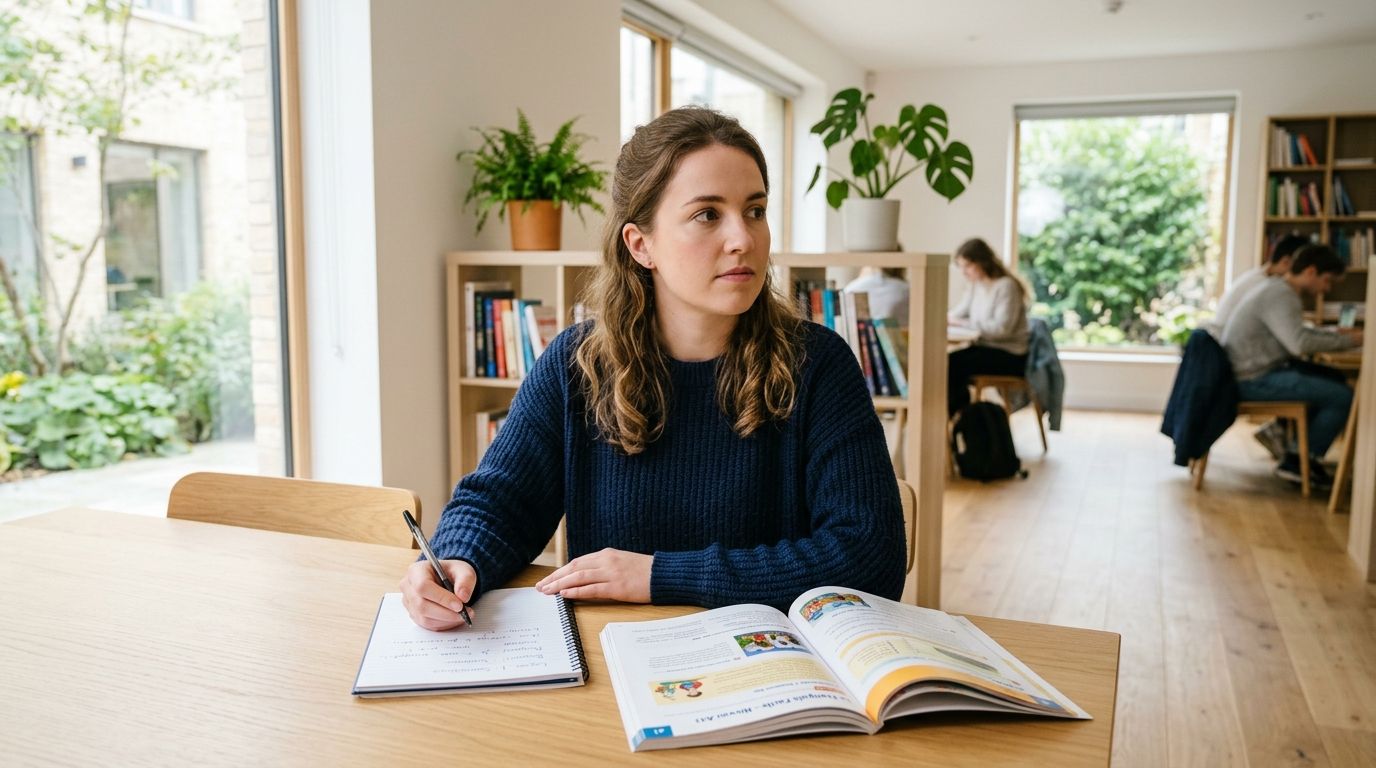
How a strong first lesson is structured
In stronger LA-based programs, teachers often use an 8-level CEFR-adapted curriculum, with lessons running 40 to 120 minutes depending on the format and learner needs. That structure helps students track progress more clearly, including gains like 200–300 new words per level (French classes in Los Angeles with CEFR-adapted structure).
In practice, a solid first session usually includes:
Level check: Not a stressful test. More like guided sampling of listening, speaking, and grammar control.
Goal sorting: What do you need first, what can wait, and what success looks like.
Live speaking: Even beginners should say something early. Short, manageable output is better than silent note-taking.
Correction style: You should feel how the teacher handles mistakes. Constant interruption isn't helpful, but zero correction isn't teaching.
Next-step plan: You should leave knowing what you'll work on next, not just how the hour felt.
A first lesson should feel focused and calm. If it feels random, the problem usually isn't you.
For students who like seeing how spoken French is introduced naturally, this short clip gives a sense of lesson tone and pacing:
A real student example
One student I worked with was a lawyer in Century City who needed conversational confidence for legal discussions connected to Quebec. She didn't need broad cultural enrichment first. She needed controlled fluency under pressure.
Her first lessons were narrow by design. We focused on introductions, clarification language, professional turn-taking, and how to ask for reformulation without losing authority. That worked better than jumping into dense grammar chapters because her immediate bottleneck was confidence in live interaction.
Within a few months, she stopped defaulting to English at the first sign of uncertainty. What's more, she could sustain professional conversation, ask precise follow-up questions, and recover smoothly when she didn't catch something the first time. That's the kind of progress I want students to look for. Not “I covered a lot,” but “I can now do something in French that I couldn't do before.”
Key Questions to Ask Before You Book a Lesson
By the time you're comparing actual providers, the hardest part isn't finding options. It's filtering them. With 649 private French teachers listed on one Los Angeles platform, targeted questions matter because they reveal whether a tutor can solve your problem or only market to it, as noted earlier in the Superprof marketplace data.
Ask questions that force specificity
Skip broad prompts like “How do you teach?” Most tutors can answer that smoothly. Ask questions that make them describe decisions.
Goal match: “How would you teach someone who needs French for business travel, exam prep, or school support?”
Correction style: “How do you balance speaking confidence with error correction?”
Curriculum: “Do you follow a structured path, or do you build from my materials and goals?”
Progress tracking: “How will I know I'm improving after the first few lessons?”
Scheduling reality: “What happens if my work schedule changes often?”
Student type: “Do you work more often with adults, children, exam candidates, or bilingual-school families?”
Watch how they answer
You're not just listening for the content. You're listening for precision. Strong teachers usually answer with examples, not slogans. They can explain how they'd adapt to a beginner versus an intermediate learner, or to a child at a bilingual school versus an adult preparing for travel.
A helpful companion piece is this guide on how to find the perfect French tutor for adult learners.
If a tutor can't describe the first few lessons clearly, they probably haven't thought deeply about your outcome.
That's often the difference between a pleasant lesson and a useful one.
Your Next Steps to Speaking French with Confidence
By this point, your decision should feel narrower. That's a good sign.
You don't need to compare every French program in the city. You need to match your goal to the right format, confirm the budget makes sense, and choose a teacher who can explain their method clearly. That's how people make progress in french lessons in Los Angeles. Not by finding a perfect program on paper, but by choosing one that fits real life well enough to sustain consistency.
A simple decision path
If you're still deciding, use this order:
Name the outcome first. Work, travel, exam, or school support.
Choose the format second. Private, group, or online.
Vet the teacher third. Ask specific questions and look for clear answers.
Test the fit quickly. A short consultation or trial tells you more than a polished sales page.
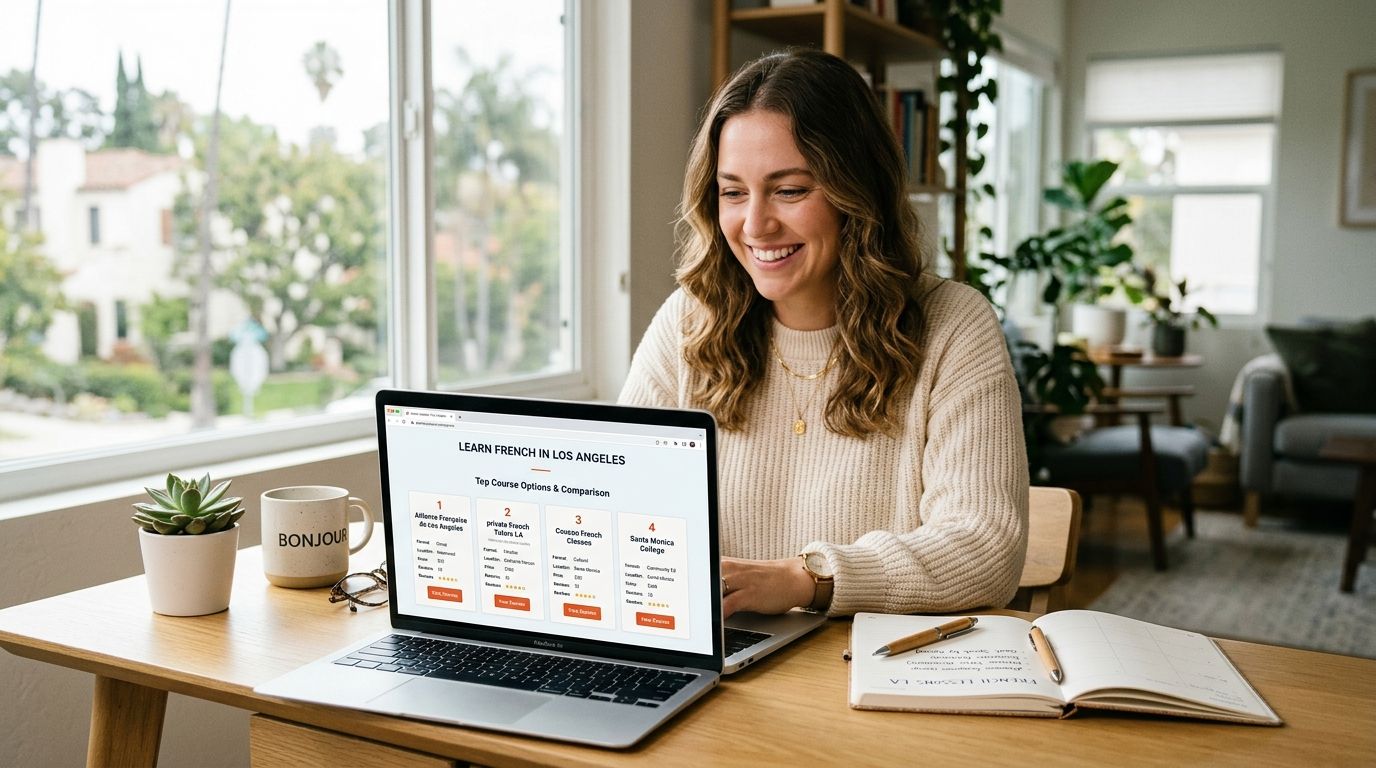
One thing I always tell new students is this: momentum matters more than intensity. The best plan is the one you'll keep. That usually means realistic scheduling, a teacher who knows your use case, and a lesson structure that doesn't waste time.
If you want a practical place to continue comparing options and building your plan, these French learning resources are a useful next stop.
If you'd like a more personalized read on your options, Elite French Tutoring offers a free 20-minute consultation to talk through your goals, current level, and the lesson format that fits best. It's a low-pressure way to see whether private online French lessons or a more targeted program makes sense for you before you commit.