Skip to content
You're probably here because you've already done the obvious things. You searched for French lessons in Nashville, opened a few tutor directories, glanced at a group class schedule, maybe downloaded an app, and still didn't feel any closer to a good decision.
That's normal. The hard part isn't finding a French class. It's finding the right format for the reason you need French in the first place. A parent trying to support a child in a bilingual program shouldn't shop the same way as a healthcare executive preparing for Francophone client meetings. An adult learning for travel doesn't need the same structure as a student preparing for DELF.
I've seen this play out again and again. People lose months by choosing based on convenience first and goal second. Then they switch providers, restart, and spend more than they would have if they had matched the lesson format correctly from day one.
Table of Contents
- Starting Your Search for French Lessons in Nashville
- Mapping Your Nashville French Learning Options
- A Comparison of Lesson Types In Person vs Online
- Finding a Tutor for Your Specific Goals
- What to Expect Pricing Scheduling and Progress
- Your Next Step Taking a French Lesson in Nashville
Starting Your Search for French Lessons in Nashville
Most Nashville families and professionals I speak with start in the same place. They want progress, but the options look scattered. One tutor seems affordable but too general. A group class sounds fun but may move too slowly. An app looks easy until it becomes clear that streaks aren't the same thing as speaking ability.

That confusion makes sense in a market where private tutoring has become much more common. Between 1997 and 2022, the number of in-person private tutoring centers in the U.S. more than tripled, with concentration in higher-income areas such as Brentwood near Nashville, according to Education Next's reporting on the tutoring boom. More people are paying for individualized help because generic instruction often leaves too many gaps.
What strong buyers do differently
The smartest buyers don't ask, “Who's the cheapest French tutor?” They ask better questions:
- What outcome matters most: conversation, school support, DELF prep, relocation, or business communication?
- What kind of accountability do I need: weekly structure, assignments, feedback, or flexible drop-in lessons?
- What will waste my time: a pleasant class with no correction, or a rigid program that doesn't fit real life?
Practical rule: Buy French lessons the way you'd hire a specialist. Match the provider to the problem.
If you're still sorting out whether private lessons are worth it, this guide on the advantages of taking French lessons is a useful next read before you compare specific Nashville options.
Mapping Your Nashville French Learning Options
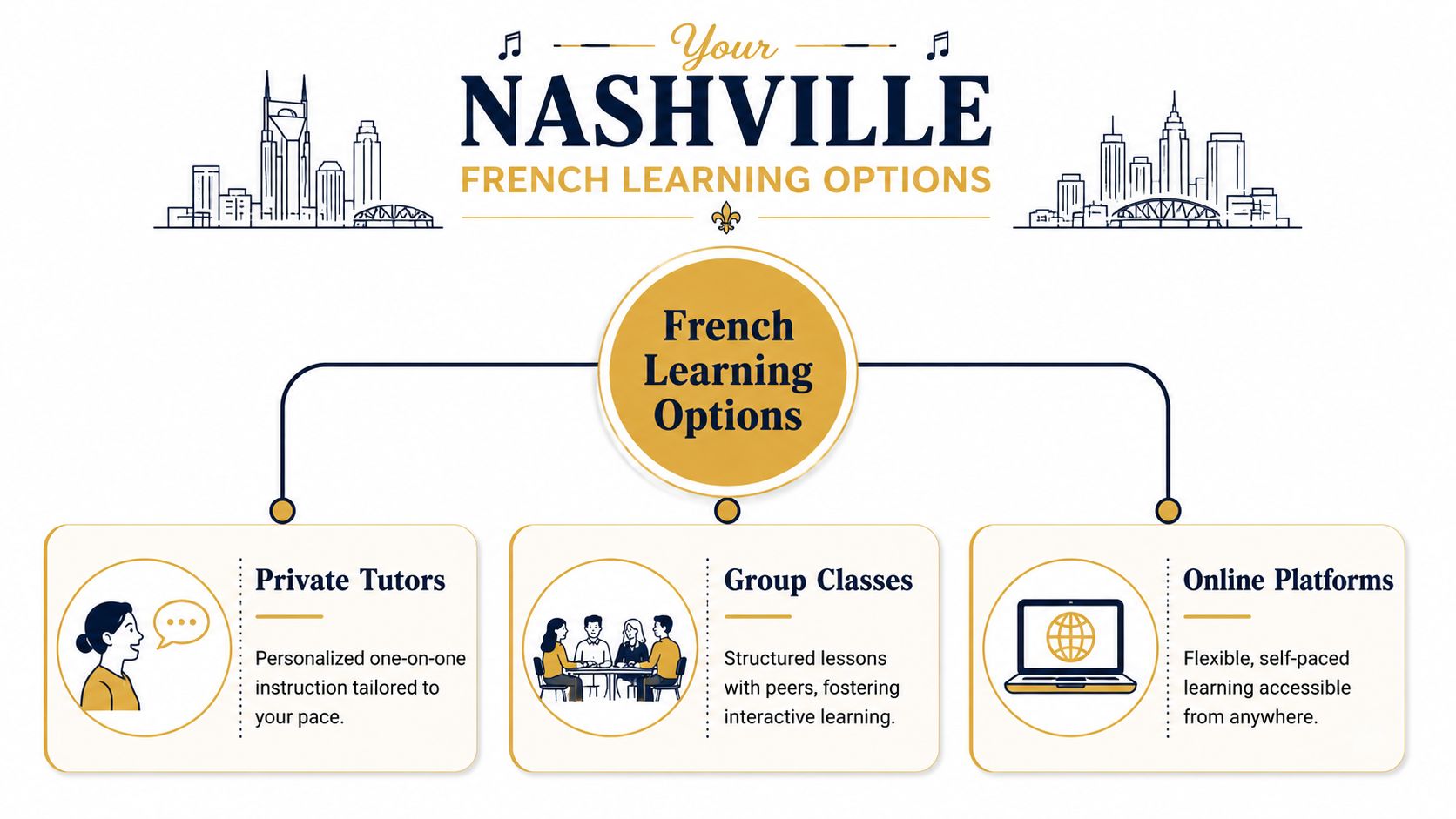
Nashville has three main paths for learning French. Each can work. Each also fails in predictable ways when the student chooses the wrong one.
Private tutoring
Private tutoring is the strongest fit when the goal is specific and time matters. That includes school support, exam preparation, confidence for travel, and professional communication. A good private tutor adjusts pace, materials, and correction style to the learner in front of them.
This format works best for students who need fast feedback. If a child is mixing verb forms, or an adult keeps making the same pronunciation mistake, a private tutor can stop and fix it immediately. That doesn't happen as consistently in a group environment.
The trade-off is simple. Private tutoring usually asks for a higher hourly investment, and quality varies a lot from one tutor to another.
Group classes
Group classes offer community, structure, and a lower-pressure social setting. For some adult beginners, that makes starting easier. Students hear other voices, practice turn-taking, and build routine around a weekly class.
Nashville has a real community option here. The Alliance Française de Nashville organizes cultural events, offers French classes and topical workshops, and funds two scholarships annually to support local learners. That matters because many adults don't just want language instruction. They want cultural connection too.
Group classes are often a better cultural experience than a precision tool.
The downside is alignment. A group class has to serve the group. If one student needs exam prep, another wants travel phrases, and a third is there for enrichment, nobody gets a fully personalized path.
Online platforms and apps
Apps and large online platforms appeal to busy people because they remove friction. You can log in after work, fit study into short windows, and keep a routine going from anywhere.
They're useful for vocabulary review, listening exposure, and light grammar reinforcement. I often see them work best as a supplement, not the core program.
They break down when the learner needs:
- Live correction
- Structured speaking practice
- Curriculum alignment
- A plan tied to a deadline
A quick way to narrow your choice
If you're deciding between these three paths, use this lens:
| Learning need | Best starting fit |
|---|---|
| Child with academic goals | Private tutoring |
| Adult seeking community and culture | Group classes |
| Busy learner needing light review | Online platform or app |
| Professional with a work deadline | Private tutoring |
| Casual beginner testing interest | Group class or app |
If you're comparing providers now, focus first on the environment where you're most likely to stay consistent. The best French lessons in Nashville aren't the most impressive on paper. They're the ones you'll attend and use.
A Comparison of Lesson Types In Person vs Online
Students often compare lesson options by price first. I understand why. But in language learning, the cheaper format can become the more expensive one if it slows progress or leaves important gaps untouched.
Here's the comparison I use most often when helping someone choose among local French lesson formats.
| Factor | Private Tutoring (e.g., Elite French Tutoring) | Group Classes (e.g., Alliance Française) | Online Apps/Platforms |
|---|---|---|---|
| Personalization | High. Lessons can match one goal, one pace, and one weakness pattern | Limited. Teacher has to balance the whole group | Low. Content is standardized |
| Scheduling flexibility | Usually high, especially with online options | Fixed schedule | Very high |
| Cost per hour | Higher upfront | Lower per session | Lowest entry cost |
| Speed of progress | Often fastest when the student attends consistently | Moderate, depends on group pace | Uneven, often slower for speaking |
| Real-time feedback | Immediate and targeted | Partial, shared across students | Minimal or automated |
| Best for | Exams, professional needs, curriculum support, accelerated progress | Social learning, cultural enrichment, beginner exposure | Review, habit-building, supplemental practice |
In person isn't always better
A lot of Nashville buyers still assume in-person automatically means stronger instruction. Sometimes it does. For children who need focus, some in-person settings help. For adults who are easily distracted online, face-to-face sessions can improve consistency.
But online private lessons often outperform in-person group classes when the student needs precision. The teacher can still hear pronunciation issues, correct grammar in real time, share documents, assign homework, and adapt each session. What matters isn't the room. It's the match between method and goal.
The hidden cost of low personalization
A lower hourly rate looks attractive until you calculate what happens when the course spends weeks on material the student already knows, or skips what they urgently need. That's common in mixed-level group settings and on broad online platforms.
The wrong format rarely fails in week one. It fails in month three, when motivation drops because the student still can't do the thing they started for.
This is especially true for high-stakes goals. If a child needs school-aligned support, or a professional needs role-specific speaking practice, generic lessons create drag. The student is busy, the need is real, and “good enough” instruction stops being good enough quickly.
What I recommend by buyer type
- Choose private tutoring if your goal has consequences. School performance, exam deadlines, work communication, and relocation all fit here.
- Choose group classes if your main objective is enjoyment, cultural connection, or building a routine without pressure.
- Choose apps or online platforms if you want inexpensive reinforcement between live lessons, not a complete substitute for them.
If you're leaning toward remote instruction, compare live options instead of assuming all online learning is passive. This roundup of the best online French lessons is a helpful place to benchmark what serious online instruction should include.
Finding a Tutor for Your Specific Goals
The best French tutor in Nashville is not a universal title. It changes with the student's target. That's where many directories fall short. They give you names, hourly rates, and broad labels, but they don't help you separate a conversational tutor from someone who can support a bilingual student or a corporate learner.
For children in bilingual or academically demanding settings
This is the biggest gap I see in Nashville. The Cultured Kids Club Nashville page reflects a market where children can find general French exposure, but there's still a clear lack of curriculum-aligned, DELF/DALF-focused private tutoring for students in bilingual school settings. For families, that gap matters because general enrichment and academic support are not the same service.
Parents should ask very direct questions before hiring a tutor:
- Can you align with my child's school materials: not just teach general French?
- Do you prepare students for DELF or DALF-style tasks: speaking, listening, reading, and writing under structure?
- How do you track correction patterns: verb agreement, dictation, reading fluency, written expression?
- What happens between lessons: worksheets, reading practice, audio review, or nothing?
A tutor who mainly teaches casual adults may be excellent at conversation and still be a poor fit for a child in a formal academic track.
A child who says “I like my tutor” is off to a good start. A child whose tutor can explain exactly what skill is being built is in much better hands.
For professionals who need business French
Business French is another area where many local listings stay vague. “French tutoring” is not the same as professional communication coaching. A software leader, healthcare manager, recruiter, or executive assistant may need meeting language, email phrasing, introductions, travel etiquette, and role-play practice for specific work scenarios.
When you interview a tutor for business use, ask for examples of lesson content. If the answer stays abstract, keep looking.
What a strong business French tutor should be able to do:
- Build role-specific vocabulary: not random business buzzwords
- Run speaking drills around your actual job: meetings, presentations, onboarding calls, client hospitality
- Correct tone and register: formal vs conversational French matters at work
- Use practical materials: agendas, emails, scripts, summaries, and mock conversations
For adults learning for travel conversation or personal goals
This group often overbuys. Not every learner needs an intensive academic tutor. If your main aim is to feel comfortable in France, Quebec, or another Francophone setting, the right tutor should prioritize speaking confidence, listening tolerance, and useful routines.
Look for a tutor who teaches in usable chunks:
- ordering and social basics
- asking follow-up questions
- understanding common replies
- recovering when you miss something
That sequence works better than memorizing long lists of isolated vocabulary.
If you want a sharper framework for evaluating tutors as an adult learner, this guide on how to find the perfect French tutor is a practical next step.
What to Expect Pricing Scheduling and Progress
Buyers usually ask the same three questions. What will this cost, how often should I meet, and how fast will I improve? The honest answer is that all three depend on the level of customization and the seriousness of the goal.
What the Nashville market looks like
As of June 2026, Care.com's Nashville French tutor listings show 15 French tutors with an average posted rate of $21.00/hr. That tells you two things. First, there is real competition in the market. Second, hourly price alone won't tell you whether the lesson is structured, specialized, or goal-driven.
A low posted rate can make sense for homework help, casual conversation, or beginner support. It tells you much less about whether the tutor can handle academic alignment, formal exam prep, or workplace communication.
A real student success story
One recent adult learner came to us after trying a directory-based tutor and an app at the same time. She was a Nashville-based professional preparing for increased contact with French-speaking colleagues. Her first setup gave her vocabulary, but not confidence. She could recognize terms on a screen and still froze in live conversation.
After switching to structured private coaching, her work changed in visible ways. She stopped scripting every sentence before meetings, handled greetings and follow-up questions more naturally, and began participating instead of listening.
“I didn't need more words. I needed practice using the right words under pressure.”
That's a common turning point. Many students don't need more content. They need a lesson structure that turns passive knowledge into usable language.
Scheduling that actually works
The ideal schedule is the one a student can maintain. I'd rather see someone commit to steady lessons they can keep than choose an ambitious plan they abandon after a few weeks.
A few patterns tend to work well:
- For school support: one regular weekly session, plus short review between lessons
- For professionals: one core lesson each week with focused speaking practice and targeted prep before key meetings or travel
- For motivated adults: consistent weekly lessons plus independent listening or reading on non-lesson days
One caution: If your lessons are irregular and there's no plan between sessions, progress becomes hard to feel even when the tutor is capable.
If you want a model for what steady progress looks like on paper, this structured French study plan gives a useful reference point before you commit.
Your Next Step Taking a French Lesson in Nashville
By now, the pattern should be clear. The right French lessons in Nashville depend less on the city and more on the fit between your goal and the teaching format.
If you're a parent, look past “fun French exposure” and ask whether a tutor can support school expectations and formal proficiency goals. If you're a professional, don't settle for a general tutor if your real need is workplace communication. That gap matters in Nashville because business French for corporate professionals remains under-addressed locally, even as Superprof's Nashville French lesson market overview points to rising demand tied to sectors such as tech and healthcare, alongside a 4.2% GDP growth in 2025 connected to tech expansion.
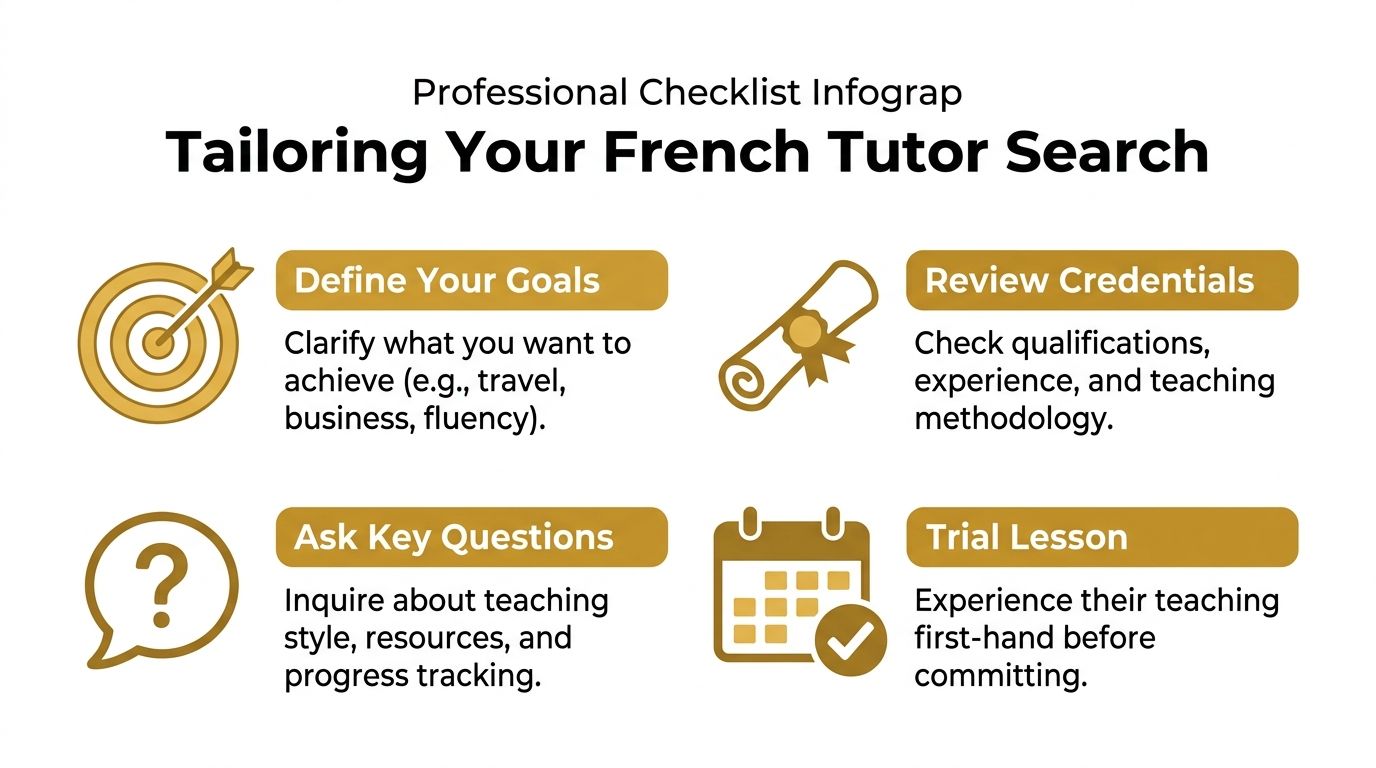
A good buying decision usually comes down to this short checklist:
- Match the lesson format to the stakes
- Check whether the tutor has experience with your exact use case
- Prioritize feedback and consistency over convenience alone
- Avoid paying for broad instruction when you need targeted results
You don't need to commit blindly. The next sensible move is to compare your options against your actual objective, then speak with a provider who can map out a realistic plan.
If you want a personalized recommendation, a free consultation with Elite French Tutoring is a low-pressure way to sort through lesson options, compare formats, and see what kind of program fits your schedule and goal best.