Skip to content
You've probably already done the obvious things. You searched for French lessons in Palo Alto, skimmed tutor marketplaces, maybe asked another parent at school pickup, and still ended up with the same problem. Plenty of options say “French tutoring,” but very few are built for your specific needs.
That gap matters more in Palo Alto than almost anywhere else. The parent trying to support a child in a bilingual program doesn't need generic conversation practice. The product leader relocating to Paris doesn't need a cheerful beginner class built around ordering croissants. You need a tutor or program that matches the stakes.
I've seen people waste months choosing the wrong format first and the wrong teacher second. The smarter move is the reverse. Start with the outcome, then choose the lesson type, then vet the instructor hard. That's how you make French lessons in Palo Alto worth the investment.
Table of Contents
Finding the Right French Tutor in Palo Alto Is a Challenge
A parent I spoke with recently had done everything “right.” She had a child in a French-speaking school environment, knew extra support was needed, and had already contacted several local tutors. Every reply sounded similar. Lots of enthusiasm, plenty of availability questions, almost nothing about curriculum alignment, writing support, or how to handle grammar taught in a bilingual setting.
I hear the same thing from professionals. They don't want hobby-level French. They want to lead meetings, manage relocation, or prepare for formal certification without wasting time on lessons that drift. Yet many local listings are broad by design. They're trying to appeal to everyone, so they end up serving no one especially well.
That's the core problem with French lessons in Palo Alto. The market looks full when you first search, but once you filter for actual fit, it gets thin fast.
The right tutor isn't just someone who speaks French well. It's someone who can teach your exact use case without improvising their method from week to week.
The strongest buyers make decisions differently. They don't start with “Who's cheapest?” or “Who's nearby?” They start with “What problem am I solving by this semester, this quarter, or this move?”
If your child needs school-aligned support, your checklist should look completely different from a founder preparing for a move to Montreal or Paris. If you're aiming for DELF or DALF, you need structure, correction, and exam logic. If you're trying to recover confidence after years away from the language, you need momentum and consistency more than a flashy resume.
That's how I'd approach this market. Strip away the generic listings. Define the pressure point first. Then judge every option against that one requirement.
First Define Your Why and Match It to a Lesson Type
Many learners are too vague at the start. “I want to learn French” sounds fine, but it produces bad buying decisions. A clear goal leads to a useful program. A fuzzy goal leads to a pleasant but expensive routine.
French remains a strong investment category. Preply's global language learning report notes that French is the third most learned language globally, accounting for 8% of all global learners, and in North America it represents 9% of the most learned languages. That popularity is tied to career advancement, diplomatic relocation, and bilingual education, especially for families connected to institutions like Lycée Français.
Start with the outcome, not the tutor bio
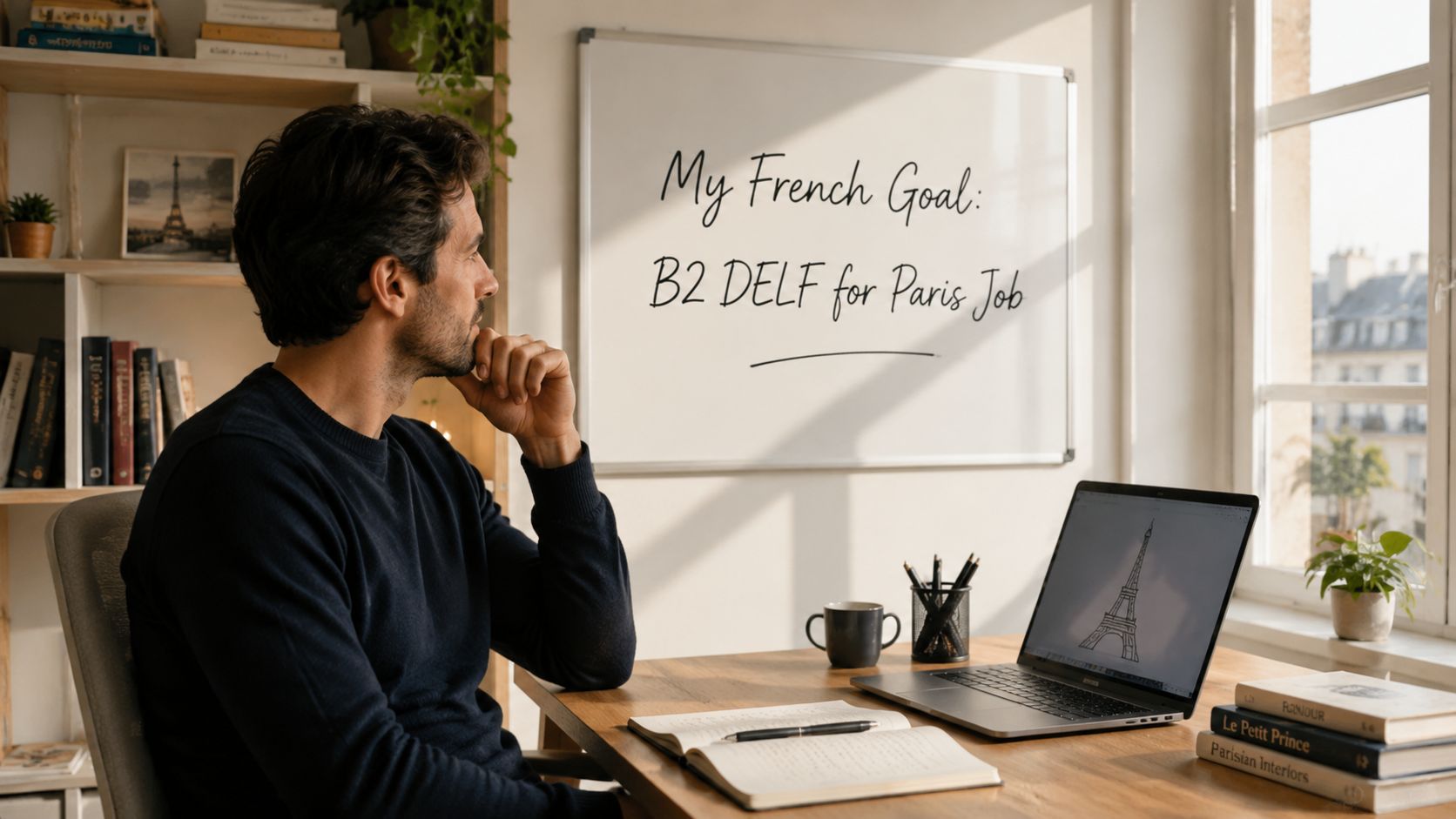
I tell clients to write their goal in one sentence, and it has to be concrete. Not “improve my French.” Something like:
For school support: “My child needs help keeping up with French reading and grammar at a bilingual school.”
For career use: “I need professional French for meetings, presentations, and workplace communication.”
For certification: “I need structured preparation for DELF or DALF.”
For relocation or family life: “I need practical speaking confidence for daily life in a French-speaking environment.”
That sentence changes everything. It tells you what kind of teacher to look for, what lesson structure you need, and what success should look like after a few months.
If your goal is flexible access and regular speaking practice, an online French tutor can be the best fit. If your goal is school support or business communication, flexibility alone isn't enough. You need specialization.
Match the goal to the teaching format
Here's the simple version.
A child in a bilingual program often needs correction, pacing, and reinforcement tied to what happens in class that week. An adult preparing for a relocation may need listening, speaking, and role-play around real situations. An exam candidate needs a teacher who can spot recurring errors and build around CEFR expectations.
Use this matching logic:
Choose private lessons if the goal is high stakes, time-sensitive, or specific.
Choose group classes if motivation and routine matter more than tailoring.
Choose online lessons if scheduling flexibility is the main obstacle.
Choose a specialist if the goal involves school alignment, business French, or exam prep.
A lot of frustration disappears once you stop treating all French lessons as interchangeable.
Here's a useful reminder before you compare providers in detail:
Practical rule: If you can't describe the exact result you want, don't book a package yet.
Comparing French Lesson Formats in Palo Alto
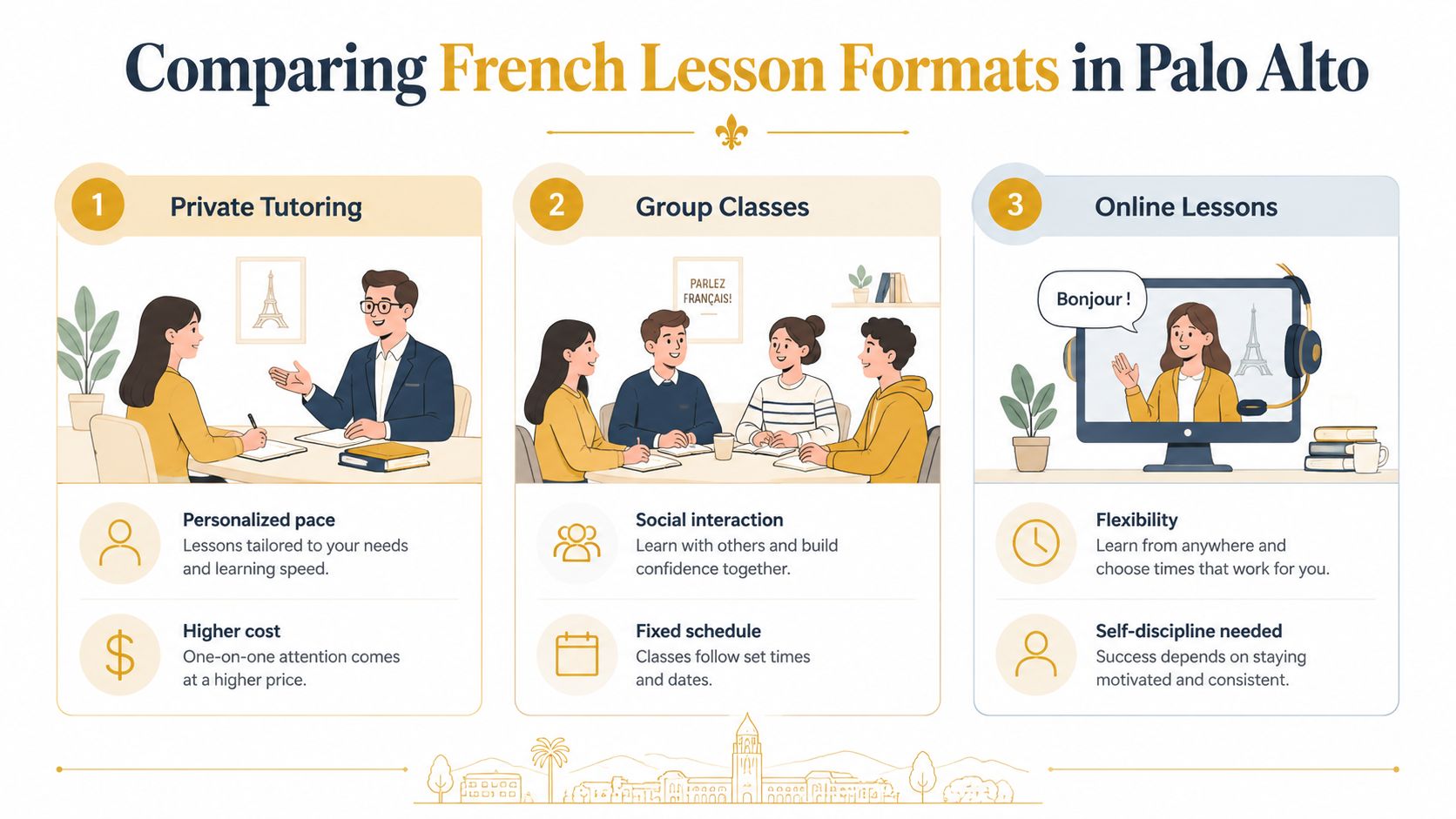
Once your goal is clear, the next decision is format. Many Palo Alto families and professionals waste time here. They choose the format that seems easiest to book, not the one most likely to work.
The right answer depends on urgency, schedule, and how personalized the instruction needs to be.
French Lesson Formats Compared for Palo Alto Learners
| Feature | Private Tutoring (e.g., Elite French Tutoring) | Group Classes | Online-Only Platforms |
|---|---|---|---|
| Personalization | High. Lessons can target one learner's exact goals | Limited. Teacher must serve the whole group | Varies widely by platform and tutor |
| Scheduling | Usually flexible | Fixed schedule | Often very flexible |
| Best for | Business French, DELF/DALF, school-specific support | Beginners, casual learners, social learning | Busy adults, remote learners, access to wider tutor pool |
| Feedback quality | Direct and continuous | Less individual correction | Can be strong, but depends on tutor and setup |
| Pace | Adjustable every session | Set by group average | Adjustable in private sessions |
| Accountability | Strong when tutor tracks progress closely | Moderate | Depends heavily on learner discipline |
| Fit for Palo Alto families | Strong if child needs tailored school support | Weak if curriculum alignment matters | Strong if the tutor understands the school context |
| Fit for professionals | Strong for role-play and presentation work | Usually too general | Strong if lessons are customized for workplace language |
One-on-one instruction has a clear advantage when the goal isn't generic. Language Trainers' Palo Alto French page states that programs using immersive, real-life dialogues and CEFR-aligned curriculum show measurable improvement in pronunciation and confidence, with stronger results tied to consistent scheduling and premium materials.
Which format works best for busy Palo Alto schedules
Group classes have a role. I recommend them for adults who want structure and social energy, especially at the beginner stage. But they're not ideal for someone under pressure. If your child is already behind in written French or your company move is on a deadline, group pacing becomes a problem fast.
Private tutoring is the strongest format when every lesson needs a job. One session can focus on oral fluency, the next on written corrections, the next on exam production tasks or presentation rehearsal. That kind of precision is hard to replicate elsewhere.
Online learning deserves more credit than many buyers give it. For Palo Alto families juggling school schedules, commuting, and travel, online lessons often beat in-person lessons because they happen consistently. A great online specialist is usually more valuable than a convenient local generalist. If you're comparing Bay Area options, it's worth seeing how strong programs are structured in nearby markets such as French lessons in San Francisco, because the same decision logic applies.
Use this quick filter before you choose:
Pick private tutoring when mistakes need immediate correction and the goal is specific.
Pick group classes when cost sharing and social accountability matter most.
Pick online private lessons when your calendar is unpredictable but your goal is still serious.
Avoid broad “all-level” marketing if your needs involve bilingual school support or professional communication.
If the lesson format can't adapt, your tutor ends up teaching the format instead of teaching you.
How to Vet a French Tutor Like an Expert
A polished profile tells you almost nothing. I care much more about how a tutor thinks than how they advertise. The market for language learning is large because people are willing to pay for instruction that works. GM Insights reports that the global language learning market was valued at USD 85.1 billion in 2025 and is projected to expand at a CAGR of 22.9% from 2026 to 2035, driven heavily by digital adoption and personalized tutoring services. Buyers aren't spending for access alone. They're paying for fit.
That means your screening questions need to go past surface credentials.
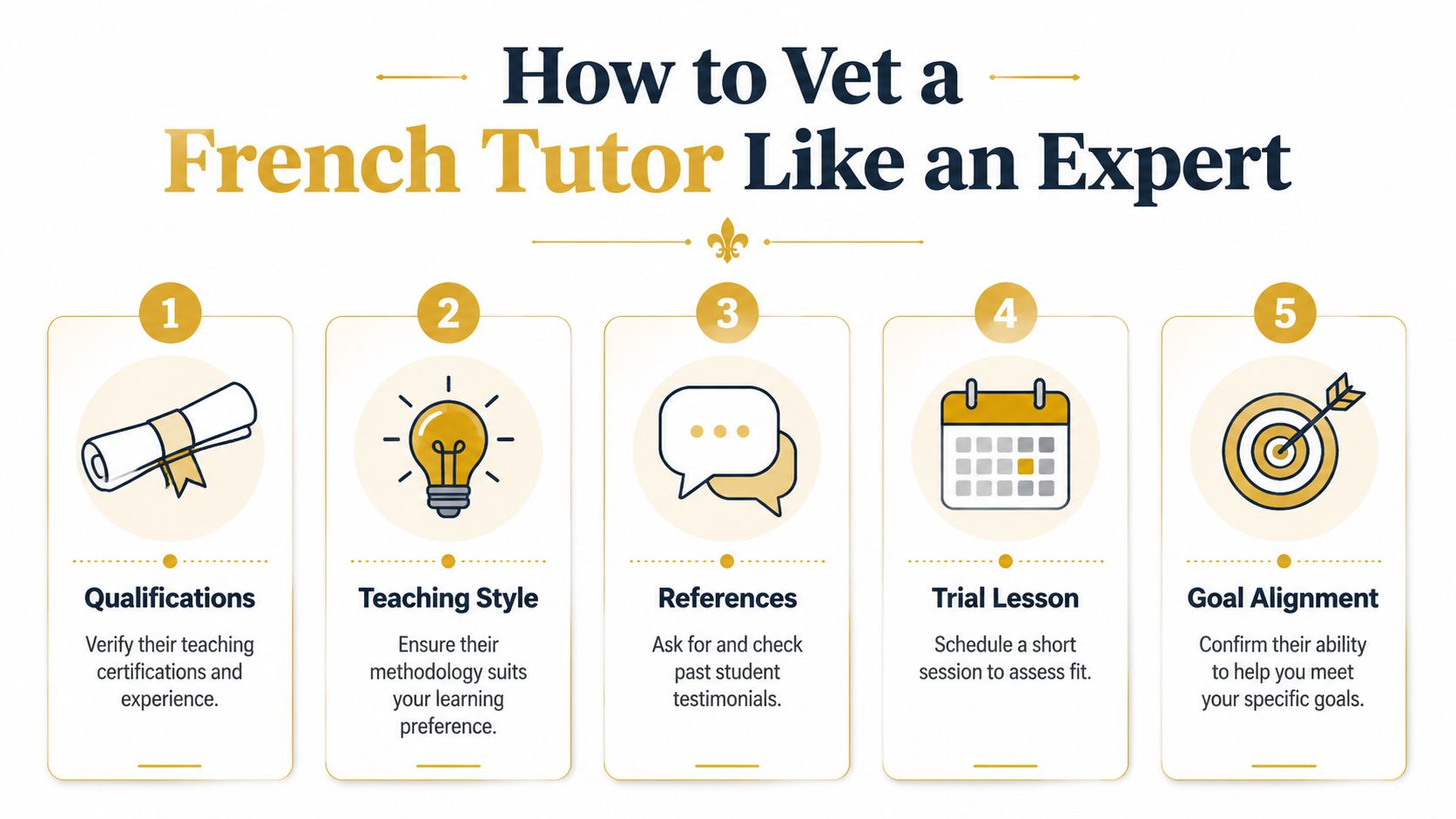
The questions that expose real expertise
Ask direct questions that force the tutor to show method, not charm.
For adults with a practical goal: “How would you structure my first month if I need French for work or relocation?”
For parents: “How would you support a child who needs help with school-specific grammar, reading, or writing?”
For exam candidates: “How do you correct writing and speaking for DELF or DALF preparation?”
For anyone serious about progress: “How do you track improvement between sessions?”
For plateaued learners: “What do you change when a student understands grammar but still can't speak fluidly?”
Weak tutors answer with generalities. Strong tutors answer with sequence. They'll talk about diagnostics, correction habits, homework design, role-play, listening work, feedback loops, and how they adapt when something isn't landing.
I also recommend asking:
What happens in a trial lesson?
How do you handle homework for busy students?
How do you build confidence without letting errors fossilize?
What materials do you use, and why those materials?
If you want a sharper checklist before booking, this guide on how to find the perfect French tutor for adult learners is a useful benchmark.
Student Success Story From Hesitant to Confident
A real success story doesn't need inflated numbers. It needs a clear before and after.
One adult learner came in with classic Palo Alto constraints. Smart, busy, motivated, and completely stuck. She had studied French before, understood more than she could say, and had lost confidence speaking aloud. What changed was not more content. It was better targeting. Once she found a tutor who corrected actively, used real dialogue, and tied each session to a clear speaking objective, she stopped freezing and started responding with much more ease in professional and social settings.
Here's the buying lesson. Progress came from fit, not from “more hours” in the abstract.
| Student Success Story: From Hesitant to Confident | Details |
|---|---|
| Starting point | Prior exposure to French but low speaking confidence |
| Main obstacle | Could understand more than she could produce in conversation |
| Better tutoring match | Active correction, real-life dialogue, focused speaking goals |
| What improved | Confidence, consistency, and practical spoken use |
| Why it worked | The tutor's method matched the learner's actual problem |
A good tutor should be able to describe how they've solved your type of problem before, even if the details vary from student to student.
Understanding Palo Alto Pricing and Trial Lessons
Let's talk about money the way buyers should. Price matters, but price without context is noise.
What the local rate does and doesn't tell you
Superprof's Palo Alto French tutor listings show an average hourly rate of $32, with 97% of tutors offering the first lesson for free, and only 10 private instructors currently available in the area. That tells me two things immediately. Supply is limited, and the headline rate won't tell you much about quality.
A low rate can be perfectly fine for casual conversation practice. It may be a poor fit for a child in a bilingual school who needs structured writing support. It may also be a poor fit for a professional who needs polished French for meetings, presentations, and workplace nuance.
The question to ask isn't “What's the hourly number?” It's “What problem does this rate solve?” If the tutor can't define that clearly, the price is irrelevant.
How to use a free trial lesson well
Learners frequently squander trial lessons. They often treat them like chemistry checks. Chemistry matters, but it shouldn't be the only filter.
Use the first lesson to evaluate these points:
Lesson control: Does the tutor lead confidently, or do they drift?
Correction style: Do they catch meaningful errors and explain them well?
Specificity: Can they connect today's lesson to your actual goal?
Planning: Do they propose a real path, not just “we'll see how it goes”?
Momentum: Do you leave knowing what happens next?
A free lesson is not a free sample. It's an audition.
For parents, I'd also watch whether the tutor can work with school materials without becoming reactive and chaotic. For adults, I'd pay attention to whether the tutor pushes you into useful output instead of letting you hide in passive comprehension.
If you're comparing French lessons in Palo Alto, judge value by fit, consistency, and teaching precision. Not by who had the nicest profile photo.
The Elite Advantage for Palo Alto's Specific Needs
The biggest holes in the local market are easy to spot once you've looked closely. General beginner instruction exists. Casual conversation support exists. What's harder to find is targeted help for two high-stakes groups: professionals who need business French, and families who need curriculum-aligned K-12 support.
Where general local options fall short
The beginner path is covered in several local settings, but that's not the same as specialization. Palo Alto Adult School's French beginner offering reflects the broader local pattern, and the market still leaves a clear gap for advanced professional communication and school-specific support. That's exactly where generic tutoring stops being enough.
If you need help aligned to a bilingual school's pacing, you want a tutor who can work from your child's actual assignments, reading level, grammar expectations, and writing demands. If you need French for work, you want someone who can rehearse meetings, email tone, professional vocabulary, and spoken nuance. Those are different products, even if both are called “French lessons.” Elite French Tutoring is designed for learners who need more than generic conversation practice, with private support tailored to school, professional, and exam-focused goals.
Who should choose a specialized program
I'd strongly recommend a specialist if any of these apply:
Your child attends a bilingual or French-language program and needs support tied to schoolwork.
You need French for work, especially presentations, meetings, relocation, or executive communication.
You're preparing for DELF or DALF and need CEFR-aware correction.
You've already tried general tutoring and progress felt slow or unfocused.
That's the gap a specialized provider should fill. For families and professionals who want a more customized option, business French tutoring is one of the clearest examples of a service built around an actual use case instead of a generic language promise.
If you're comparing French lessons in Palo Alto, don't settle for the first tutor with availability. Match the lesson type to your goal, ask better questions in the trial, and choose specialization when the outcome is important. If you want a custom option for your child, your team, or your own professional goals, booking a quiet consultation with Elite French Tutoring is a smart next step.