Skip to content

You've probably already done the frustrating part. You searched for private French classes in Montreal, opened ten tabs, and ended up comparing a free francisation program, a university semester course, a tutor marketplace profile, and a school that looks polished but doesn't say who it's best for.
That confusion is normal. In Montreal, the problem usually isn't lack of options. It's choosing the right option before you spend money, lock yourself into a schedule, or lose momentum. I've seen smart professionals, parents, and exam candidates waste weeks because they started by shopping for prices instead of defining the job their tutor needed to do.
A good private French program should fit your goal, your schedule, and the kind of accountability you need. That's the filter that cuts through the noise.
Table of Contents
Finding the Right Private French Classes in Montreal
Individuals don't start this search because it sounds fun. They start because work is shifting, a move to Quebec is getting real, a child needs support in a bilingual school, or an exam date is getting close. The urgency changes everything.
That's also why generic “best French schools in Montreal” lists usually don't help much. They flatten very different buyers into one category. A parent looking for curriculum-aligned support for a child does not need the same thing as a professional preparing for TEF or TCF.
The local market is busy, and demand is real. Since 2021, Montreal has seen a 27% increase in enrollment for French classes, driven by immigration policy and TEF/TCF requirements, according to this Montreal French classes market overview. That same overview notes a wide range of options, from community classes to premium private tutoring.
Practical rule: Don't start with “Who's available?” Start with “What problem am I hiring this tutor to solve?”
That shift sounds small, but it changes the whole search. Once you know the job, you can judge whether you need structure, flexibility, exam precision, business language, or school support.
A useful way to think about private French classes in Montreal is to sort options into three buckets:
Goal-driven programs: Best when you need a clear outcome such as exam prep, professional relocation, or academic support.
Flexible tutoring: Best when your schedule changes often and you need lessons to bend around work or family life.
Institutional courses: Best when you prefer fixed systems, established curricula, and formal administration.
If you're still deciding whether French deserves a serious investment, these practical reasons people choose to learn it often mirror what I hear from adults and families making this decision.
The rest comes down to fit. Not prestige. Not the prettiest website. Fit.
First Define Your French Learning Goals

Buying the wrong type of French help usually happens before you ever speak to a tutor. It happens when the goal stays vague. “I want to improve my French” sounds reasonable, but it's too broad to guide a good purchase.
Choose the outcome before the tutor
Start with the question that matters most. What needs to be different in your life after these lessons?
If your answer is I need to pass TEF, TCF, DELF, or DALF, you're not shopping for casual conversation practice. You need a tutor or institution that works with structured correction, speaking tasks, writing feedback, and test-format familiarity.
If your answer is I need French for work, your tutor should be able to simulate meetings, presentations, negotiations, email phrasing, and industry-specific conversations. In Montreal, that business niche exists. Language schools including ILSC offer executive business French in private classes with teachers who are experienced business professionals, as described on ILSC's executive business French program page.
If your answer is my child needs support in a bilingual or French school, the target is different again. You need someone who can align with school expectations, homework style, oral production, grammar sequencing, and confidence-building. Many adult-focused programs aren't built for that.
If your answer is I want to function comfortably in Montreal day to day, the ideal tutor needs to build listening confidence, spontaneous speaking, repair strategies when you get stuck, and routine vocabulary for real life.
The tutor profile that matches each goal
Here's the framework I use with students and families.
Exam candidate: Choose a tutor with a structured plan, correction habits, and comfort assigning targeted practice. You want precision, not just friendly conversation.
Executive or working professional: Choose someone who can role-play real workplace situations. Business French is a different service from general tutoring.
Parent hiring for a child or teen: Choose for patience, school alignment, and age-appropriate pacing. A strong adult instructor isn't automatically the right fit for younger learners.
Relocation or daily-life learner: Choose for consistency and communication confidence. The best tutor here is often someone who can keep you speaking regularly without making lessons feel academic.
The right tutor is rarely the most impressive on paper. It's the one whose teaching style matches your pressure point.
A second filter helps. Decide whether your goal is short-term performance or long-term fluency. Some learners need a result on a deadline. Others need sustainable growth over many months. Those are different buying decisions.
If you need help identifying your current level before booking lessons, a practical refresher on how CEFR levels shape French learning goals can help you describe what you need when you speak with a tutor or school.
Where to Find and How to Vet Your French Tutor
Montreal gives you several valid ways to buy French instruction. None is automatically best. Each comes with a trade-off in screening, flexibility, and how much decision-making you need to do yourself.
The four main places people shop
Language schools appeal to people who want structure. Names such as Alliance Française de Montréal and university-affiliated programs usually feel more formal. You're paying for administration, materials, and a clearer system.
Independent tutors on marketplaces offer range. You can find budget options, specialists, conversation tutors, and people with very different backgrounds. That variety is useful, but you have to do much more vetting.
Private tutoring companies usually sit in the middle between an institution and a freelancer. The better ones pre-screen instructors and match students more intentionally.
University and academic programs can work well for learners who want an educational environment, longer timelines, and a recognized curriculum. They tend to suit learners who can live with fixed schedules.
In the Montreal area, the average hourly rate for private French tutoring is $29, with rates ranging from $15 to $40 depending on tutor experience and specialization, according to Superprof's local tutoring market page. That same page notes that certified instructors at institutions often use a pre-registration consultation to assess fit.
Comparison of French Tutor Sources in Montreal
| Tutor Source | Typical Cost | Vetting Process | Customization Level | Best For |
|---|---|---|---|---|
| Language schools | Higher and often package-based | Usually formal and standardized | Moderate to high | Learners who want structure and administration |
| Independent marketplaces | Wide range, from budget to premium | Mostly self-directed by the buyer | Varies widely | Price-sensitive learners comfortable screening tutors |
| Private tutoring companies | Usually mid to premium | Often curated before matching | High | Busy adults, families, and goal-based learners |
| University programs | Semester-based pricing | Institutional admissions and placement | Moderate | Learners who prefer academic structure |
Many buyers get distracted by credentials alone. Credentials matter, but they don't answer the main question. Can this person help with your exact use case?
What to ask before you book
A short vetting conversation should tell you more than a polished profile ever will.
Ask about goal-specific experience: “Have you worked with learners preparing for my exam, job context, or school setting?”
Ask how they correct mistakes: If the answer is vague, expect vague progress.
Ask what happens between lessons: Good tutors think beyond live class time.
Ask how they assess level: Strong teachers don't guess. They diagnose.
Ask how they adapt when a student stalls: Every learner hits plateaus.
A common mistake is choosing a native speaker and assuming that's enough. It isn't. Native fluency can help, but teaching skill is separate. Some outstanding tutors are excellent because they explain clearly, sequence lessons well, and correct without overwhelming the student.
A tutor should be able to describe a lesson, not just promise results.
If you're comparing profiles and offers, this guide on how adult learners can identify the right French tutor is a useful companion when you're narrowing the list.
Comparing Lesson Formats and Pricing Models
A Montreal professional books a polished private course, pays a premium, and still misses half the lessons because the format fights their real life. We see this all the time. The teacher may be good, but the setup is wrong for the goal, schedule, or attention style.
Start with fit, then compare price.
Which format works for which learner
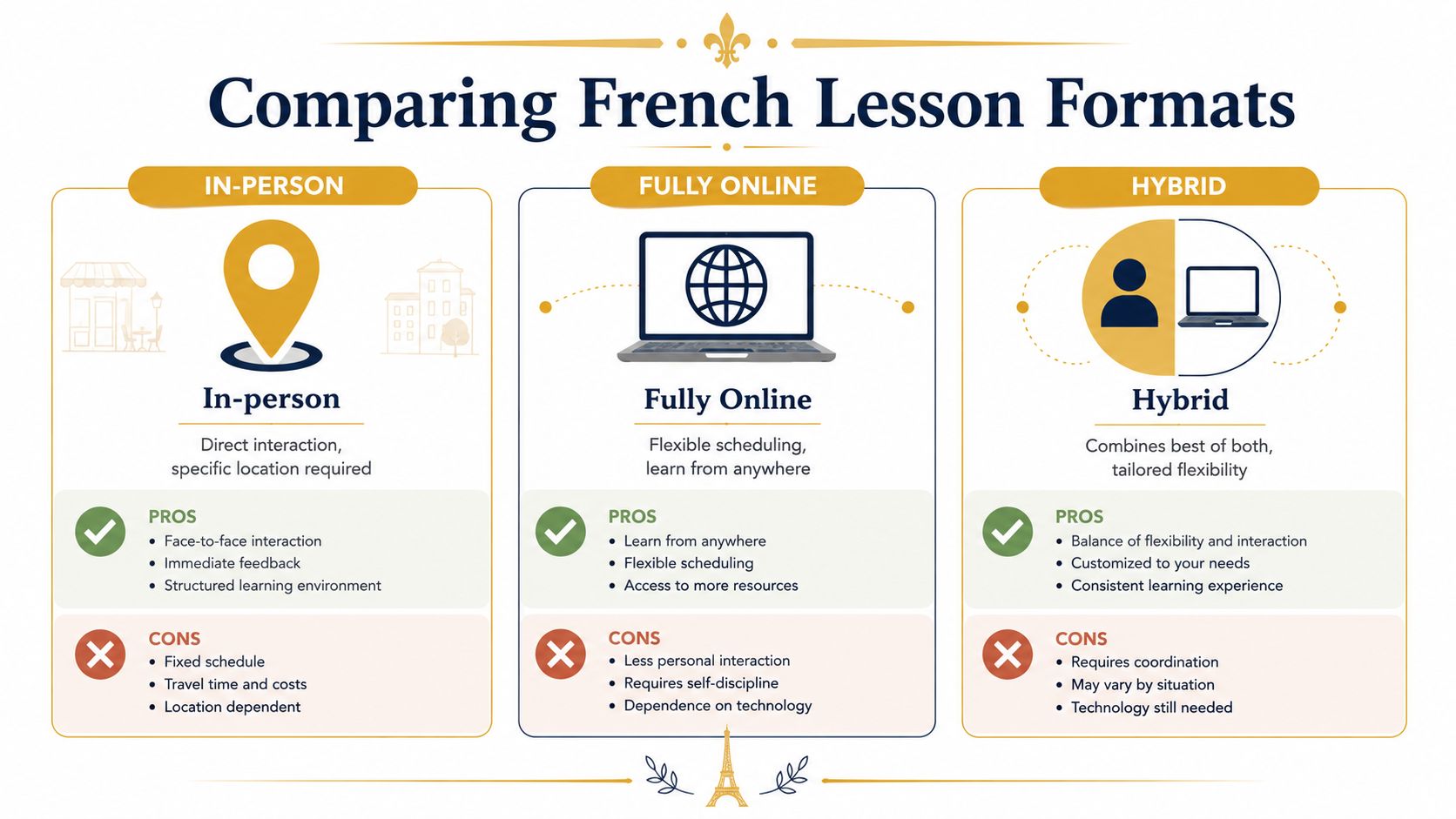
In-person lessons suit learners who need structure outside the home. They also tend to work well for children, teens, and adults who focus better in a dedicated learning space. If your main problem is follow-through, the commute can help because it creates a routine you are less likely to ignore.
There is a trade-off. In-person usually means less scheduling flexibility, more transit time, and fewer workable slots if your calendar changes often.
Fully online lessons fit busy adults who need lessons to happen consistently, not ideally. For exam prep, business French, or maintenance work after a long day, online often wins because it removes friction. Students can log in from downtown, the South Shore, or a hotel room and keep the week intact.
Online is not automatically better. Learners who get distracted easily, avoid speaking on camera, or treat home as a place to multitask may need more structure than Zoom gives them.
Hybrid lessons work best for a narrow but real group. These are learners who want occasional face-to-face sessions for assessment, pronunciation, or motivation, but need online lessons to keep momentum between meetings. It can be a strong option if the provider keeps one teacher, one plan, and a clear rhythm.
If the hybrid setup feels improvised, progress usually gets patchy.
A simple way to choose:
Pick in-person if routine, focus, and accountability matter more than convenience.
Pick online if your schedule changes and consistency is your biggest risk.
Pick hybrid if you want flexibility but still benefit from periodic in-room coaching.
How pricing is packaged in Montreal
Montreal providers rarely price private French the same way, so quick comparisons are misleading. One tutor quotes an hourly rate. A school sells a block of lessons. A university-style program builds private support into a larger term structure. Until you convert each option into the same unit, you cannot tell what is expensive.
Compare cost per usable hour, not sticker price. A premium provider like Elite French Tutoring may charge 125 per hour, but for learners who need tailored support, that price can deliver better long-term value than a cheaper generic option.
We advise students to compare four things side by side: total cost, number of teaching hours, cancellation terms, and how personalized the plan is.
The details change the value fast:
Billing unit: per hour, 5 to 10 lesson package, monthly plan, or full course
Materials: included resources versus required textbook purchases
Cancellation policy: flexible rescheduling versus lost lessons
Teacher continuity: one instructor throughout versus rotating staff
Goal alignment: general conversation practice versus targeted exam, workplace, or school support
Support between lessons: homework review, voice notes, corrections, or no follow-up at all
Buying tip: Compare cost per usable hour, not sticker price. A cheaper package loses value fast if rescheduling is hard or the lessons stay generic.
The right choice depends on individual factors. Someone preparing for TEFAQ may get better value from a specialist charging more per hour than from a lower-cost general tutor. A child who needs weekly support may do better with a stable local routine than with the cheapest online option. A manager with irregular travel may need flexible online scheduling or the plan will collapse by week three.
We have also seen buyers overpay for prestige. A recognized institution can be a good fit, but brand alone does not guarantee the right pace, teacher match, or correction style for your use case.
A real example of format beating intensity
One client in a senior international role had enough motivation and enough budget. What they lacked was a format they could sustain. Their meetings shifted constantly, travel interrupted fixed bookings, and each missed lesson broke momentum.
Once the lessons moved online with a schedule that could flex week to week, attendance stabilized. Progress followed because the format matched the reality of the job. The curriculum did not become more complicated. The plan became usable.
If your week is unpredictable, reviewing online French lesson options for busy adults and professionals will often help more than comparing local listings on price alone.
Your Consultation and Trial Lesson Checklist
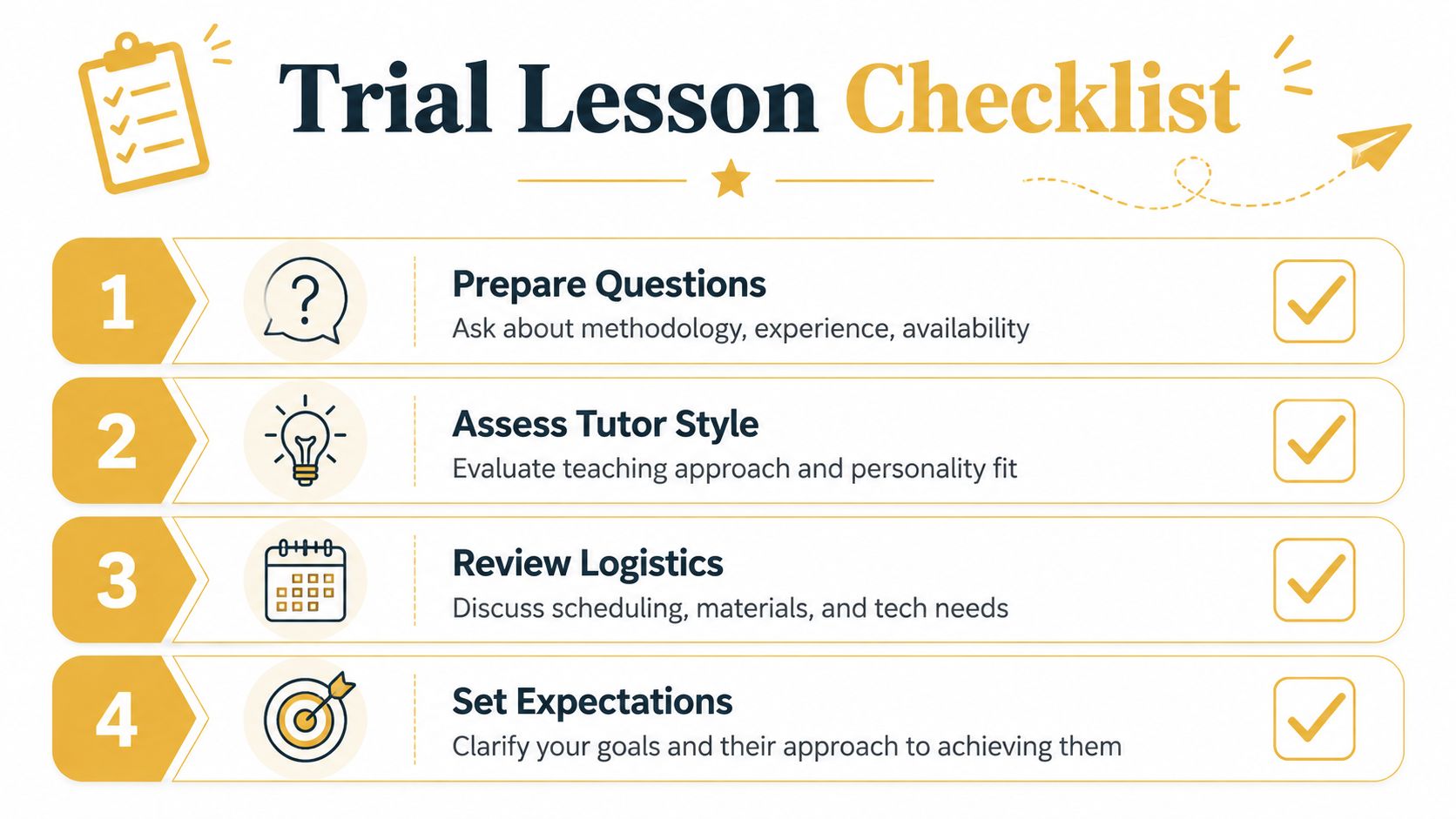
A consultation is not just for the tutor to qualify you. It's for you to qualify them.
That matters even more if your goal is specific. One-on-one instruction has been shown to produce higher production scores and a 100% exam success rate for intermediate learners compared with group settings that lack individualized correction, as reported in The Link's discussion of French learning timelines and private instruction. If you're paying for private help, you should make sure you're getting the benefits of personalization.
Questions that reveal how a tutor actually teaches
Skip generic questions such as “What's your method?” They invite generic answers.
Ask these instead:
“How would you handle it if I keep making the same grammar mistake in conversation?”
This shows whether the tutor can correct in real time without killing confidence.“What would the first month look like for someone with my goal?”
Good teachers can map early priorities clearly.“How do you balance speaking practice with correction?”
You want a tutor who can do both, not one at the expense of the other.“What kind of homework or between-session practice do you usually assign?”
Strong progress rarely comes from live lessons alone.“How do you adapt lessons if I'm improving in one area but stuck in another?”
This reveals whether they teach responsively or follow a rigid script.“What do you need from me for this to work?”
The best tutors will answer truthfully and set expectations.
What to watch during the trial lesson
The trial lesson should give you evidence, not just a pleasant feeling.
Look for signals in real time:
The tutor makes you speak early.
If most of the lesson is the tutor explaining things, that's a warning sign.Corrections are clear and usable.
You should understand what changed and why.The pacing feels intentional.
A good tutor doesn't rush, but they also don't drift.You feel safe making mistakes.
Anxiety shuts down production. Strong teachers lower the pressure without lowering standards.The next step is concrete.
By the end, you should know what the plan would be if you continue.
If you leave a trial lesson thinking, “That was nice,” but you still can't tell how the tutor would move you forward, keep looking.
A great private lesson usually feels specific. The tutor notices your pronunciation pattern, your hesitations, your grammar gaps, or your listening bottleneck. They don't offer one-size-fits-all encouragement.
Enrolling and Setting Yourself Up for Success

Enrolling isn't the finish line. It's the point where the significant return on your investment starts.
The strongest students treat private French classes in Montreal as a working partnership. They don't hand over responsibility and hope for magic. They show up consistently, communicate when something isn't clicking, and use the small exercises between lessons that keep the language active.
What strong students do differently
They protect lesson time. That sounds obvious, but it's one of the clearest separators between students who progress steadily and students who stall.
They also tell the tutor the truth. If homework is too much, if the pace is too fast, if you need more speaking and less grammar explanation, say so early. A good tutor can adapt. They can't adapt to silence.
Keep your schedule realistic: It's better to maintain a rhythm you can keep than to overbook and start canceling.
Use between-lesson practice: Short review, audio repetition, and targeted exercises keep momentum alive.
Track what still breaks down: Note the moments where you freeze, guess, or avoid speaking.
Ask for adjustment quickly: Don't wait a month to mention that the format isn't working.
How to make your investment pay off
Private instruction works best when expectations are shared. You should know what success looks like, how progress will be noticed, and what your tutor expects from you outside class.
This is also where flexibility matters. Some learners need steady conversational growth. Others need rapid support for professional or academic deadlines. A strong program makes those priorities visible from the start instead of pretending every learner follows the same path.
If you're ready to compare options more seriously, a low-pressure next step is to review a provider's lesson format and speak with someone who can match the program to your goal. If you want that kind of personalized conversation, Elite French Tutoring's free consultation is a practical place to start.
The right choice isn't the cheapest tutor or the biggest school. It's the program that matches your reason for learning, your schedule, and the way you make progress. That's how private French classes in Montreal stop feeling confusing and start feeling useful.