Skip to content
You're probably in one of two situations right now. Either your child needs real French support and the public-school option doesn't fit your address, schedule, or expectations. Or you're an adult who wants French for work, relocation, or certification, and you've already realized that apps and casual meetup chatter won't get you there.
That's the core New Orleans language problem. The city looks saturated with French culture, but finding French lessons in New Orleans that align with your goal takes more digging than it should. I've watched parents waste months in the wrong format, and I've watched professionals stay stuck in beginner-level conversation because nobody pushed them past “tourist French.”
You need a program that fits your reason for learning, not a generic class description.
Table of Contents
Finding French Lessons in the Heart of New Orleans
You can live in New Orleans for years, hear French names on street signs, see it in restaurants and cultural spaces, and still have no clear answer when you ask, “Where do I learn this well?”
That disconnect is real. I hear it from transplants, parents, Tulane-affiliated families, and professionals who assumed the city would make French easy to access. Instead, they find scattered tutor profiles, group classes that may or may not fit their level, and public options that don't serve everyone.

The bigger picture helps. In Louisiana, French speakers fell from around 30% of the population in the 1960s to under 3% by 2010, but a revitalization effort that includes 30 immersion schools is building a new generation of Francophones, according to Louisiana French language background data. That matters because your search for French lessons in New Orleans isn't random. You're stepping into a city where language learning is becoming active again, not just nostalgic.
Why this search feels harder than it should
Many learners don't fail because they lack motivation. They fail because the local market is mixed together in one pile:
School support and adult conversation get marketed the same way.
Business French and hobby learning often sit under the same course title.
Native fluency, exam prep, and homework help are treated like interchangeable services when they aren't.
If your goal is specific, your program has to be specific too.
That's why I always tell people to stop searching only by price or proximity. Start with outcome. If you need help sorting the adult side of that decision, this guide on how to find the perfect French tutor for adult learners is a useful filter.
What I'd do first
Before you contact anyone, decide which of these sounds like you:
A parent who needs curriculum-aligned support
A professional who needs serious spoken and written French
An adult learner who wants structure and accountability
A casual learner who mainly wants social exposure
Those are not the same buyer. If you shop like they are, you'll end up in the wrong room. If you want a personalized path, Elite French Tutoring can match lessons to your level, schedule, and goal.
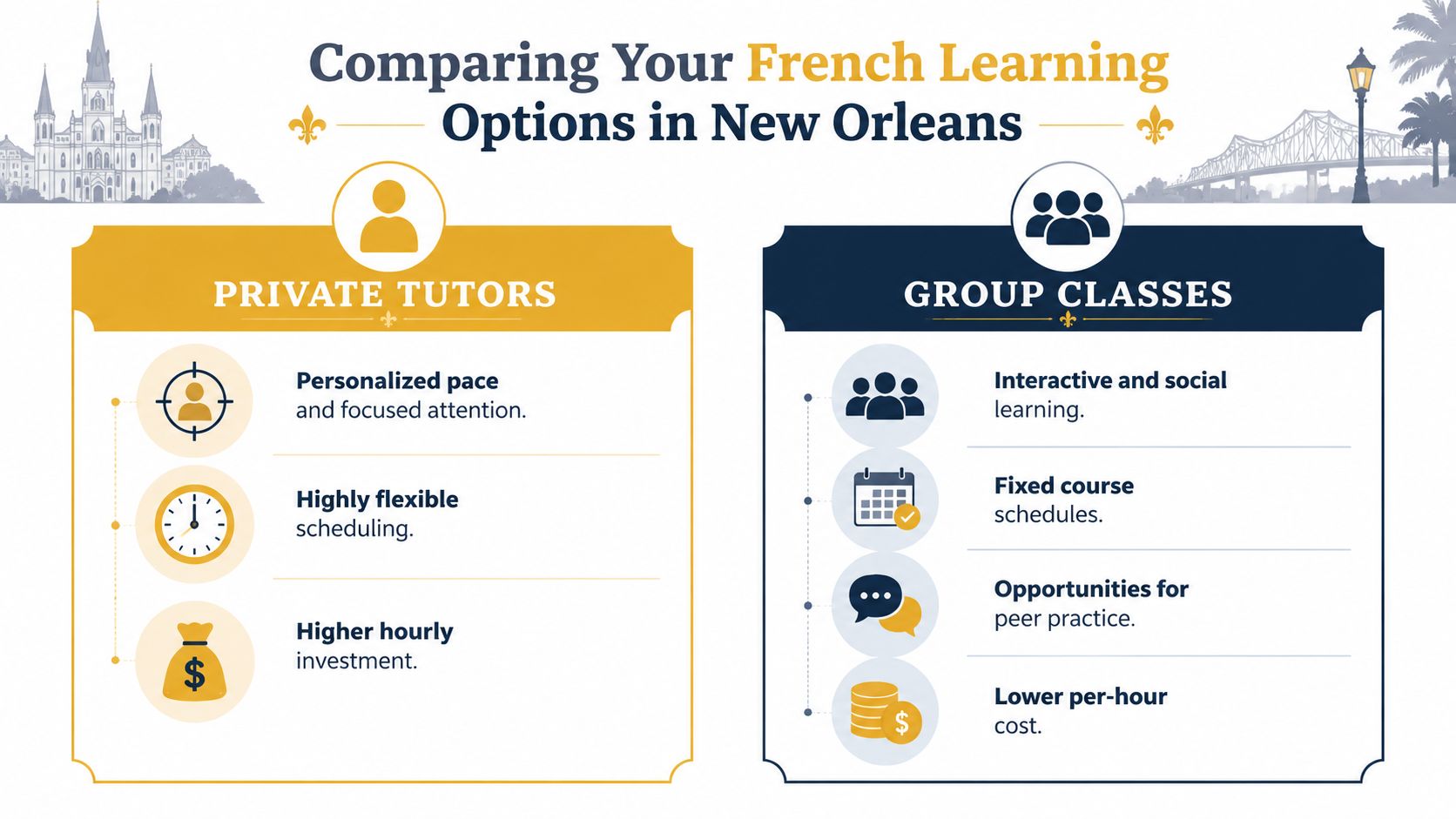
Comparing Your Learning Options Private Tutors vs Group Classes
Those asking about French lessons in New Orleans don't need more options. They need fewer, better ones.
The local market breaks into four lanes: private tutors, group classes, community meetups, and apps. Each can work. Each can also waste your time if you use it for the wrong purpose.
Choosing Your French Learning Path in New Orleans
| Learning Format | Best For | Average Cost (Per Hour) | Pros | Cons |
|---|---|---|---|---|
| Private tutors | Parents needing school support, professionals, exam prep students | Varies by tutor and platform | Personalized pace, direct feedback, flexible scheduling | Quality varies a lot, you must vet carefully |
| Group classes | Adults who want structure and cultural context | Usually course-based rather than simple hourly pricing | Clear progression, peer interaction, outside accountability | Fixed schedule, less individualized attention |
| Community meetups | Casual learners who want exposure | Often free or low-cost | Social practice, low pressure | Limited correction, uneven attendance, not goal-driven |
| Apps and self-study | Beginners building habits | Subscription-based | Convenient, easy to start, useful for review | Weak for speaking, correction, and real conversation |
When private tutoring is the best buy
Private tutoring wins when the goal is precise.
If your child needs help with reading, dictation, oral participation, or class-specific vocabulary, a general adult class won't solve that. If you're an attorney, executive, medical professional, or diplomat, you also need targeted language, not broad exposure. A strong private tutor can build lessons around school material, presentation practice, meeting simulations, or DELF/DALF preparation.
That's also why I don't recommend judging tutors by profile charm alone. Ask what they correct, how they structure sessions, whether they assign between-lesson work, and whether they can adapt to your exact context. If you're weighing private instruction seriously, this breakdown of the advantages when you take French lessons is worth reviewing.
Practical rule: If your progress depends on correction, accountability, or a custom target, choose private lessons before you choose convenience.
When group classes make sense
Group classes work best for adults who want rhythm, social energy, and a built-in curriculum. They're often a smart choice for learners who need external structure just to stay consistent.
The strongest local institutional option is the Alliance Française de la Nouvelle-Orléans, which offers structured classes with an emphasis on francophone cultural immersion, as outlined on the Alliance Française de la Nouvelle-Orléans website. That makes it a good fit for people who want more than grammar drills. If culture is part of your motivation, that setting can keep you engaged.
Still, group classes have a ceiling. If one student dominates speaking time, if the pace is wrong, or if your needs are narrower than the syllabus, your progress slows.
What I tell different buyers
Here's my direct take:
For K to 12 support: choose a private tutor first.
For business French: choose a private tutor first.
For DELF or DALF prep: choose a private tutor or a very specialized small program.
For casual adult enrichment: a group class can be a great buy.
For pure conversation practice: a meetup can supplement, but it shouldn't be your main plan.
For total beginners on a tight budget: apps are fine to start, but don't stay there too long.
A lot of people try to save money by starting with the least personalized option. Then they pay again when they realize it didn't fit. That isn't frugal. It's expensive in slow motion.
How to Budget for French Lessons in New Orleans
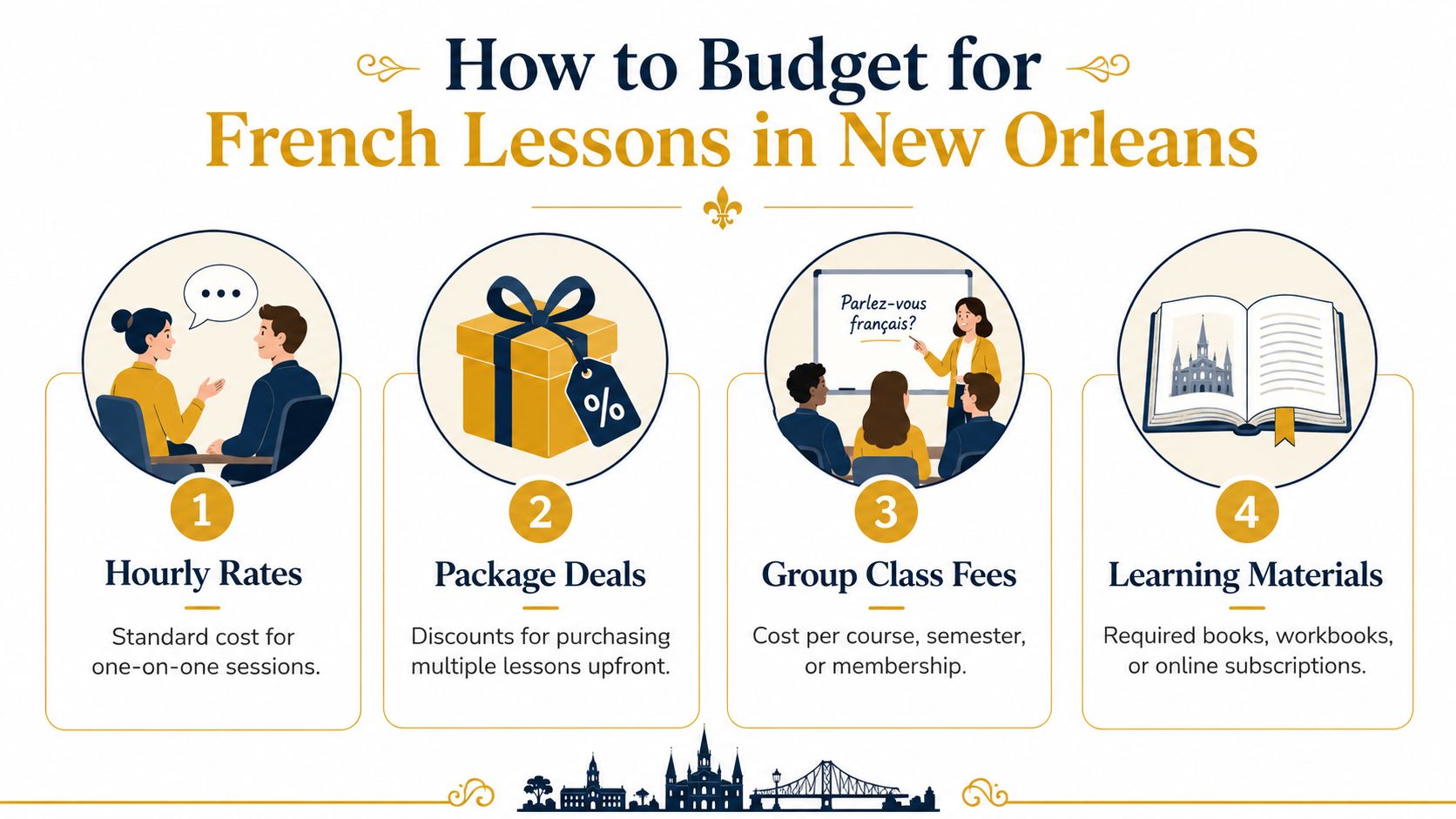
People often ask me what French lessons in New Orleans should cost. The better question is what you're buying.
A conversation partner, a homework helper, a classroom teacher, and a specialized private instructor may all advertise “French lessons.” Those are not the same service, and the hourly rates reflect that.
What the local market looks like
On Superprof, the average market price for private French lessons in New Orleans is $26 per hour, with 58 tutors available, according to Superprof's New Orleans French tutor listings. That gives you a useful baseline, not a guarantee of quality.
On Care.com, 14 verified French tutors in New Orleans were listed with an average posted rate of $17/hr as of April 2025, based on Care.com's New Orleans French tutor marketplace. That tells me the low end of the market is active, but fragmented.
Why cheap lessons sometimes cost more
I'm not against lower-cost tutoring. I am against paying for the wrong thing.
A lower rate can still be a good deal if you need:
Basic homework support
Beginner conversation exposure
Flexible scheduling with modest expectations
But rates alone won't tell you whether the tutor can handle:
Pronunciation correction
Writing feedback
Business scenarios
Exam strategy
Curriculum alignment for schools
If your need is specialized, you should expect to screen more carefully. The rate only matters after the fit is right.
A cheap lesson that doesn't move you forward is overpriced.
How I'd budget smartly
Don't build your budget around one hourly number. Build it around momentum.
Use this quick filter:
Start with your target
A child in immersion school, an adult relocating, and a traveler preparing for a short trip shouldn't shop the same way.Decide whether consistency matters more than bargain hunting
In language learning, a tutor you can reliably keep seeing beats a slightly cheaper option who cancels, drifts, or lacks structure.Ask what happens between lessons
Good programs usually include direction between sessions, whether that's targeted review, speaking practice, writing assignments, or curated materials.Treat trial lessons as diagnostics
A first meeting should show you how the teacher listens, corrects, and organizes the hour.
For a broader look at how private French programs are positioned in another U.S. market, compare this page on French lessons in Miami. It's a useful reminder that local averages matter, but goals matter more.
Finding the Right Program for Your Specific Goals
Most buyers commonly make this mistake. They choose a format before they define the mission.
I'd split the New Orleans market into two high-priority groups: parents seeking school support and adults needing professional-level French. Those are the people most likely to waste time in a generic program.
For parents who need more than a general tutor
A lot of families are trying to solve a practical problem, not a cultural one. Their child needs help with reading comprehension, speaking confidence, dictation, homework, or staying on track in a bilingual or French-heavy environment.
The complication is that public options don't serve every family equally. Louisiana's free public Lycée Français program has strict eligibility and has faced instability, which has created a real need for customized tutoring for children whose needs or schedules require a more personalized setup, as discussed in this report on Lycee Francais instability and access concerns.
That means parents should stop asking, “Who teaches kids?” and start asking sharper questions.
Ask these instead:
Can you align with my child's school materials?
Do you teach reading and writing, or mostly conversation?
How do you handle children who resist speaking French?
Will you communicate progress clearly to parents?
Can you adapt if my child is advanced in one area and weak in another?
A tutor who mainly works with adults may not be your answer, even if their French is excellent. Kids need pacing, patience, and lesson design that matches their school reality.
Parents should buy for fit, not prestige. The right tutor for a child is the one who can connect classroom demands to the child in front of them.
For professionals who need business-level French
Here's the gap I see constantly. New Orleans has plenty of people offering beginner French, cultural classes, or casual conversation. That's not the same as business French.
A major unaddressed need in the city is native-level, business-focused French instruction that goes beyond tourist basics, especially for adult learners who need professional communication skills or DELF/DALF preparation for career advancement, according to this discussion of local adult learner needs in New Orleans.
If your work involves clients, partners, relocation, diplomacy, education, shipping, hospitality, or international operations, you need a different standard.
Look for instructors who can do at least some of the following:
Role-play meetings instead of just teaching present-tense verbs
Correct register and tone so you don't sound too casual
Build vocabulary by industry
Train listening under pressure
Prepare you for writing emails, summaries, and professional introductions
Handle certification prep if an exam is part of your plan
The wrong fit is obvious once you know what to look for
You're likely in the wrong program if:
the lessons feel pleasant but vague,
you never get corrected in a meaningful way,
everything stays at the level of travel phrases,
your child's school struggles aren't showing up in lessons,
your tutor can't explain a plan for progress.
The right program usually feels narrower at first. That's a good sign. Specific instruction is what gets results.
A Student's Journey to Professional Fluency
I've seen this pattern enough times that the details barely change. I'll call him David.
David worked in a role connected to international trade around New Orleans. He wasn't a beginner. He could introduce himself, handle basic pleasantries, and follow simple written French. But whenever meetings shifted pace with native speakers, he froze. He missed nuance, reached for English too quickly, and sounded less senior than he was.

Where group learning stopped helping
He had tried group classes. They weren't bad. They just weren't built for him.
The class spent time on broad grammar review and general conversation. David needed meeting language, interruption strategies, formal phrasing, and the ability to recover when he didn't catch a fast response. Apps didn't help either. They gave him repetition, not negotiation.
So he switched to one-on-one instruction built around his actual work. Every lesson had a job to do.
He practiced:
handling introductions with authority,
summarizing proposals,
asking for clarification without losing face,
shifting between formal and neutral register,
responding in real time to objections and follow-up questions.
He didn't need more French content. He needed pressure-tested French for his real environment.
What changed
The turning point came when lessons stopped being academic and started sounding like his calendar. Instead of generic dialogues, he rehearsed the kinds of conversations he had to survive.
A few months later, he wasn't speaking perfect French. That wasn't the point. He was speaking usable, credible French in the room that mattered.
For another example of how targeted instruction can change the pace of learning, this story about going from zero to fluent with a customized approach captures the same principle well.
David's result wasn't magic. He found a format that matched the stakes. That's what most successful students do sooner or later.
Your Next Steps to Speaking French with Confidence
If you've read this far, you probably don't need motivation. You need a decision.
The mistake I'd avoid is waiting for the perfect option to appear. In New Orleans, the better move is to get clear about your use case, then choose the format that matches it.
A simple decision checklist
Use this before you book anything:
Define your primary reason
Is this for your child's school support, business communication, exam prep, relocation, or personal enrichment? If the reason is fuzzy, the program will be fuzzy too.Choose format second
Private tutoring is usually the strongest option for children, professionals, and exam-focused learners. Group classes can work well for adults who want structure and cultural immersion.Interview the instructor, don't just read the listing
Ask how they correct mistakes, what materials they use, how they track progress, and what a normal lesson looks like.Test for relevance fast
If your child's curriculum never appears in the lesson, or your business goals never shape the content, move on.
One warning for parents
Parents often lose time trying to force a public or semi-public option to work when the fit just isn't there. The local K to 12 educational environment can be confusing, and when a school option has access limits or instability, personalized tutoring becomes less of a luxury and more of a practical solution. That's especially true when your child needs support tied to a real schedule, a real teacher, and real assignments.
My blunt recommendation
For French lessons in New Orleans, buy the narrowest solution that fits your actual goal.
If you're a parent, favor curriculum-aware private support over generic enrichment. If you're a professional, don't settle for tourist-level instruction when your career needs precision. If you're an adult learner who mainly wants enjoyment and consistency, a strong group class may be enough.
The fastest path usually isn't the cheapest or the most popular. It's the one that matches your life from the first lesson.
Take a little time to compare options, then book a trial with the program that best fits your situation. If you want personalized guidance before committing, schedule a free 20-minute consultation with Elite French Tutoring to talk through your goals, level, and the kind of instruction that will work for you.