

You're probably here because your search for French lessons in Salt Lake City got messy fast. One option looks affordable but rigid. Another sounds polished but doesn't tell you how lessons work. A third seems fine until you realize it's built for complete beginners, and you studied French years ago, forgot half of it, and don't want to start from zero.
That's the key buying decision. Not “Where can I take French?” but “What kind of program will fit my goal, my schedule, and my current level?”
In Salt Lake City, that question makes sense in a multilingual environment. The city reports that 23.6% of residents age 5 and older speak a language other than English, and 7.9% report not speaking English “very well,” according to Salt Lake City language-access data. Language learning isn't niche here. It's part of how people manage work, school, travel, and relocation.
I've found that most students don't need a longer list of providers. They need a sharper way to choose. If you want help thinking through what kind of tutor or program fits your situation, this guide on how to find the perfect French tutor for adult learners is a useful companion to what follows.
Table of Contents
- Finding Your Perfect French Lesson in Salt Lake City
- Who Are You as a French Learner
- Comparing French Lesson Formats in SLC
- What to Expect from Your French Program
- Understanding French Lesson Pricing and Value
- Your Next Steps to Speaking French Confidently
Finding Your Perfect French Lesson in Salt Lake City
Those shopping for French lessons in Salt Lake City often think they're choosing between teachers. They're not. They're choosing between lesson architectures.
A traveler with a departure date needs something very different from a parent looking for school support. A lawyer preparing for francophone clients won't benefit from the same format as an adult who took French through college and now freezes during basic conversation. If you buy the wrong format, even a good teacher can feel like a poor fit.
That's why I usually start with a diagnosis. What do you need to do in French that you can't do comfortably right now? Hold conversation at dinner. Speak in meetings. Support homework. Prepare for an exam. Rebuild confidence after a long gap. Those are different jobs, and each one needs a different lesson design.
Start with the friction point
If you're unsure where to begin, identify the moment that pushed you to search.
- Upcoming travel: You need fast, practical speaking and listening, not a semester-style grammar crawl.
- Professional use: You need vocabulary, role-play, correction, and scheduling flexibility.
- School support: You need curriculum alignment and consistent accountability.
- Rustiness: You need retrieval practice, confidence rebuilding, and guided speaking that doesn't feel punitive.
Practical rule: Don't buy lessons based on provider branding alone. Buy based on whether the format matches the exact speaking problem you need to solve.
What usually goes wrong
Students often choose by convenience first. They pick the cheapest hourly option, the nearest class, or the provider with the easiest signup page. That can work for casual exposure. It usually fails when the learner wants real spoken progress.
The strongest buying decision is simpler than it looks. Match your goal, your schedule, and your tolerance for structure. Once those three line up, the right French lessons in Salt Lake City become much easier to spot.
Who Are You as a French Learner
The phrase “best French lesson” is misleading. A strong match depends on who you are, what kind of pressure you're under, and whether you need rebuilding, acceleration, or maintenance.

Audience data for French speakers in Salt Lake City show a notably young profile. 40.5% are ages 25–34, while 9.6% are 55+, 4.6% are 35–44, and 2.1% are 45–54, based on Start.io audience data for French speakers in Salt Lake City. In practical terms, demand skews toward working-age adults, which helps explain why flexible private instruction gets so much attention.
The working professional with limited time
This learner usually isn't looking for enrichment. They're buying efficiency.
They may need French for a role, a relocation path, a multinational team, or because they don't want to sound unprepared in front of colleagues or clients. Their real problem isn't motivation. It's fragmentation. They have time in small blocks, and they need every lesson minute to count.
For this profile, the right fit usually includes:
- Flexible scheduling: Missed momentum hurts busy adults more than a hard assignment does.
- Targeted speaking tasks: Meetings, introductions, client calls, travel scenarios.
- Tight correction loops: Immediate feedback on pronunciation, phrasing, and recurring errors.
A broad group class can feel reassuring at first. But if your use case is specific, broad can become slow.
The rusty speaker who needs reactivation
This is one of the most common profiles, and it's badly underserved. The learner already studied French. Maybe they even did well. Then life happened. Now they can read more than they can say, understand more than they can produce, and feel embarrassed that so much slipped away.
That learner does not need to be treated like a blank slate.
What works better is a program built around recovery:
- Retrieval before new input
- Conversation with support, not pressure
- Deliberate review of high-frequency structures
- Short speaking tasks that rebuild automaticity
A local community thread connected to Salt Lake City French learning points to this exact need. Adults who previously completed substantial coursework still look for ways to practice and regain confidence, especially in low-pressure speaking settings. That's a buying signal many programs miss because they market to beginners first.
If you studied French years ago, your problem usually isn't ignorance. It's access. The language is still in there, but you need a method that pulls it back into active use.
The parent, student, or exam-focused learner
This group needs structure more than variety.
Parents shopping for a child often benefit from a tutor who can align with school materials, upcoming assessments, and teacher expectations. Students preparing for proficiency milestones need targeted correction and repetition, not endless casual conversation. Exam-focused learners need a tutor who can build accuracy under time pressure.
These learners should ask harder questions before booking:
- Will lessons follow school or exam objectives?
- How is homework assigned and reviewed?
- How does the tutor handle speaking, writing, and error correction?
- Is the pacing stable enough to build momentum over time?
Not every tutor is built for all three profiles. That's normal. What matters is identifying your category before you compare offers.
Comparing French Lesson Formats in SLC
Once you know your learner type, the next decision is format. In Salt Lake City, most buyers end up comparing three paths: private tutoring, group classes, and online marketplaces.

Regional providers in the Salt Lake City market report both private sessions and online classes, and the local noncredit conversation model emphasizes speaking and listening development. The practical takeaway is that private or semi-private instruction with asynchronous reinforcement is often the most technically relevant setup for oral progress, because speaking improves through frequent retrieval under conversational pressure rather than passive exposure alone, as reflected in local French class and conversation offerings in Utah.
What each format is actually good at
Private tutoring is strongest when the learner has a clear goal and limited time. Every minute can be directed toward weak spots, pronunciation patterns, speaking confidence, or a specific target like travel, work, or exam preparation.
Group classes can be enjoyable and motivating, especially for learners who benefit from routine and peer energy. But they move at a shared pace. That means some learners feel held back, while others feel rushed.
Online marketplaces offer reach and flexibility. You can compare many tutors quickly, and some learners find excellent matches there. The trade-off is inconsistency. Curriculum design, accountability, and long-term progression vary widely from one tutor to another.
French Lesson Formats Compared
| Feature | Private Tutoring (Elite) | Group Classes | Online Marketplaces |
|---|---|---|---|
| Personalization | High. Lessons can target your exact gaps and goals | Moderate to low. Content must serve the group | Varies widely by tutor |
| Scheduling | Flexible, often easiest for busy adults | Fixed calendar | Usually flexible |
| Pace | Adapts to your progress | Set by class rhythm | Varies widely |
| Speaking time | Highest per learner | Shared among participants | Depends on tutor style |
| Curriculum depth | Can be highly structured | Usually structured but generalized | Often uneven |
| Accountability | Strong when homework and feedback are built in | Moderate | Inconsistent |
| Best fit | Professionals, rusty speakers, exam prep, school support | Casual learners, social learners, routine seekers | Price-sensitive or exploratory buyers |
| Main trade-off | Higher investment per hour | Less individual attention | Less quality control |
If you're also comparing remote options beyond local providers, this guide to best online French lessons is a helpful way to evaluate what “online” means in practice.
When private lessons make the most sense
Private tutoring isn't automatically the right choice. It becomes the right choice when delay is costly.
That's especially true if you:
- Need speaking results on a timeline
- Have a narrow use case
- Feel rusty and want guided reactivation
- Need school-aligned or exam-aligned support
- Can't commit to a fixed group schedule
One factual option in this space is Elite French Tutoring, which offers customized private French tutoring and online classes with a consultation-based starting point. That model fits learners who want a personalized plan rather than an off-the-shelf course.
The mistake I see most often is buying a format because it looks easier to start. The better question is whether it will still feel right after the first few weeks, when motivation drops and only fit keeps you moving.
What to Expect from Your French Program
A good French program shouldn't feel mysterious once you've enrolled. You should know how lessons are structured, how progress is reinforced between sessions, and what kind of change you're trying to create.
A realistic student story
One Salt Lake City adult I've worked with fits the classic rusty-speaker profile. She had studied French seriously years earlier, then stopped using it. When she came back, her comprehension was better than her confidence. She could recognize a lot, but speaking felt halting, and she defaulted to English the moment she got nervous.
Her goal was practical. She wanted to hold real conversation again without feeling exposed.
What helped wasn't “more content.” It was better sequencing. We reduced passive review, increased guided recall, and used repeated speaking tasks with correction built in. Early sessions focused on reactivating familiar language, not burying her in new material. Once that access came back, fluency improved much faster.
A strong program doesn't treat hesitation as failure. It treats hesitation as information about what the learner needs to retrieve, practice, and automate.
What a strong lesson should include
High-quality French lessons in Salt Lake City can look different on the surface, but the effective ones usually share a few features.
Clear separation between input and output
Learners need both. Input includes grammar explanations, vocabulary, model dialogues, and listening support. Output includes conversation, timed speaking, paraphrasing, and response drills.
If a lesson stays in input mode too long, students feel “busy” but don't become usable speakers. If it jumps into output too quickly without support, students get frustrated.
A repeatable lesson rhythm
Most strong private lessons use a recognizable pattern, even if the content changes. For example:
- Short warm-up: Natural conversation to reactivate recent language
- Focused review: Correction and retrieval from prior work
- New target: One concept, pattern, or communicative function
- Applied speaking: Use the new material in realistic scenarios
That rhythm matters because students learn faster when lessons don't feel random.
Reinforcement between sessions
Homework doesn't need to be heavy. It does need to be useful.
The best between-session work is usually short and specific. Vocabulary review, voice-note practice, a targeted listening clip, a written response, or a correction sheet can all work. The point is to keep contact with the language alive between meetings.
If you want a closer look at how that kind of structure works in practice, this overview of French tutoring methodology shows what a more deliberate approach should include.
Understanding French Lesson Pricing and Value
Price shopping is normal. But in French tutoring, hourly price can be one of the least useful numbers if you don't ask what that hour buys.
A local option in the Salt Lake City market lists adult French Zoom instruction at $215 for 15 hours, which works out to about $14.33 per hour, with either 1.5-hour weekly or 1-hour twice-weekly scheduling formats, according to the Alliance Française de Salt Lake City class listings. That's a real benchmark. It's also only one piece of the decision.
Low hourly cost can be expensive in practice
A lower per-hour rate can still produce poor value if the format is wrong for your goal.
If you need individualized speaking correction, but you buy a general group class, you may save money per hour while spending more total time circling around the same problems. If your schedule is unpredictable, a rigid class can create inconsistency. And inconsistency is expensive because it kills momentum.
Frequency matters too. Two shorter weekly touchpoints often work better than a single longer weekly session because spacing supports retention and makes spoken language easier to retrieve. Buyers who focus only on the sticker price often miss that.
How to judge value before you enroll
Ask what happens around the lesson, not just during it.
- Is the program customized or generic?
- Will you receive corrections and feedback?
- Is there homework or reinforcement between sessions?
- Does the schedule support consistency?
- Is the tutor experienced with your exact type of goal?
Those questions get you closer to the metric, which is cost to progress.
Buying advice: Don't compare French lessons as if they're interchangeable commodities. Compare them by how efficiently they move you toward your specific goal.
If you're weighing whether private tutoring makes financial sense, this article on whether a French tutor is worth the investment lays out the trade-off clearly.
Your Next Steps to Speaking French Confidently
Once you've narrowed the format, the final decision comes down to fit. A tutor can look good on paper and still be wrong for your pace, personality, or goal. That's why the conversation before you book matters so much.
Questions worth asking before you book
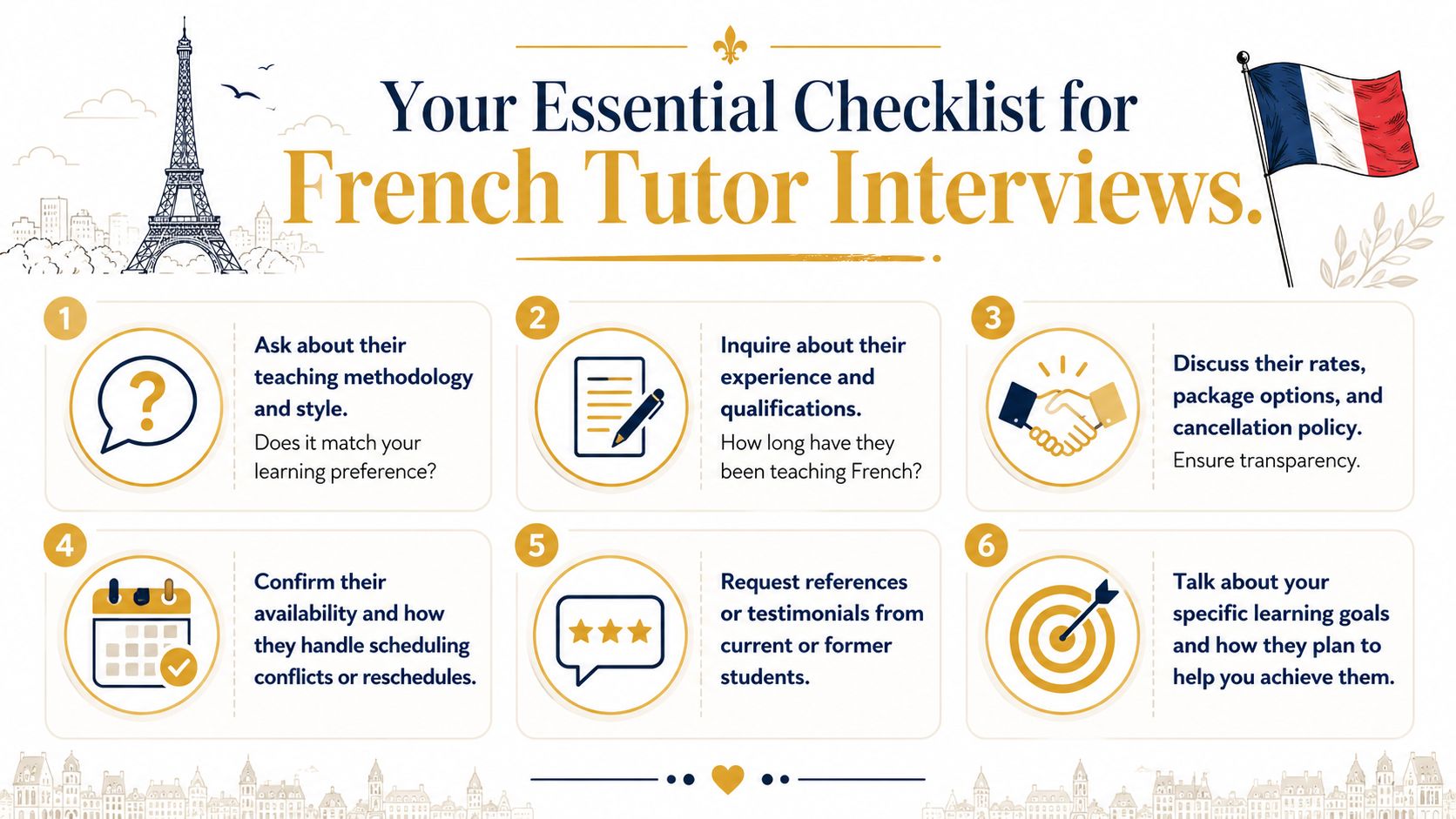
Use the first call or trial lesson to test for substance.
How do you tailor lessons for someone with my goal?
Listen for specifics. Travel French, school support, rusty-speaker recovery, and exam prep should not sound like the same plan.What does a normal lesson look like?
A good tutor should be able to describe the flow clearly.How do you handle correction?
Some learners want immediate interruption. Others do better with notes and delayed feedback.What happens between lessons?
If the answer is “nothing,” progress may be slower than you want.How do you measure progress?
You're looking for evidence of intentional tracking, even if it's informal.Have you worked with learners like me before?
This matters more than broad claims about teaching everyone.
A smart next move
You don't need to commit to a long program to make a smart decision. You need one honest conversation with the right questions.
If you're comparing French lessons in Salt Lake City and want a clearer sense of what would fit your level, schedule, and goals, booking a short consultation is a sensible next step. It gives you a chance to test the methodology, ask about pacing, and see whether the tutor understands the kind of learner you are.
The right program should leave you feeling clear, not pressured.
If you want to explore a customized option, you can book a free consultation with Elite French Tutoring and talk through your goals before deciding on lessons.