
You're probably doing what most San Diego learners do first. You search for French lessons, open six tabs, compare a cultural institute, a university extension program, a private tutor, an app, and maybe a cheap group class, then realize none of them are addressing the central question: which option best suits your goal?
That's the only question that matters. If you want travel French, you don't need the same setup as a parent trying to support a child in bilingual school. If you need DELF or DALF prep, a casual conversation class won't cut it. If you're a professional who needs French for meetings or presentations, fixed group pacing is usually the wrong buy.
I've looked closely at the local market, and San Diego gives you real choices. It's not a city with one scattered option. It has a documented French-learning ecosystem that includes providers such as Alliance Française de San Diego, which offers classes and serves as a certified exam center for DELF, DALF, and TCF. The same local ecosystem also connects to university-style study, and San Diego City College notes that French is spoken by nearly 300 million people worldwide through that broader local education environment. That matters because serious learners in San Diego can move from conversation practice to formal credentials instead of treating French as a hobby with no structure.
Table of Contents
- Finding Your Path to French Fluency in San Diego
- Comparing Your Main French Lesson Options
- How to Choose the Right French Program for You
- Targeted Tutoring for DELF Exams and School Curricula
- A Student Success Story From Tech Startup to Paris Pitch
- Your First Month A Sample French Learning Plan
- Frequently Asked Questions About San Diego French Lessons
Finding Your Path to French Fluency in San Diego
Many find that they don't need more options. They need a better filter.
I've seen the same mistake over and over. A learner picks the most visible program instead of the most relevant one. Then a few weeks later they're frustrated, not because French is too hard, but because the format was wrong from the start.
Start with your real goal
San Diego learners usually fall into one of a few clear groups:
- Travel learners who want practical speaking and listening
- Professionals who need polished conversation, meetings, or business vocabulary
- Parents looking for support that matches a child's bilingual or immersion program
- Exam candidates who need DELF, DALF, or TCF-focused preparation
Those are different buying decisions. They should lead to different lesson formats, different teachers, and different expectations.
Practical rule: Don't shop for “French classes.” Shop for the shortest path to your specific result.
A parent whose child needs help with reading and writing from a French school curriculum should not buy the same product as an adult who wants café French before a trip. A startup founder preparing for Francophone clients needs targeted speaking practice, not broad beginner content.
San Diego has enough depth to choose well
One reason this search gets confusing is that San Diego's French market is broad enough to look crowded. That's good news. You can find community-based classes, continuing studies coursework, exam infrastructure, and private instruction in one metro area.
That means you can be selective.
Here's the standard I recommend. Choose the provider that can answer these questions clearly:
- Can you teach for my exact goal?
- Can lessons fit my schedule consistently?
- Can you personalize materials or are you locked into one track?
- Will I get feedback on speaking, not just exposure to French?
If the answer to any of those is weak, keep looking. San Diego has enough depth that you don't need to settle for a vague fit.
Comparing Your Main French Lesson Options
You can live in North Park, work in Sorrento Valley, and still never make progress in French if you pick the wrong format. I see that constantly in San Diego. People blame motivation, but the actual problem is usually lesson design.
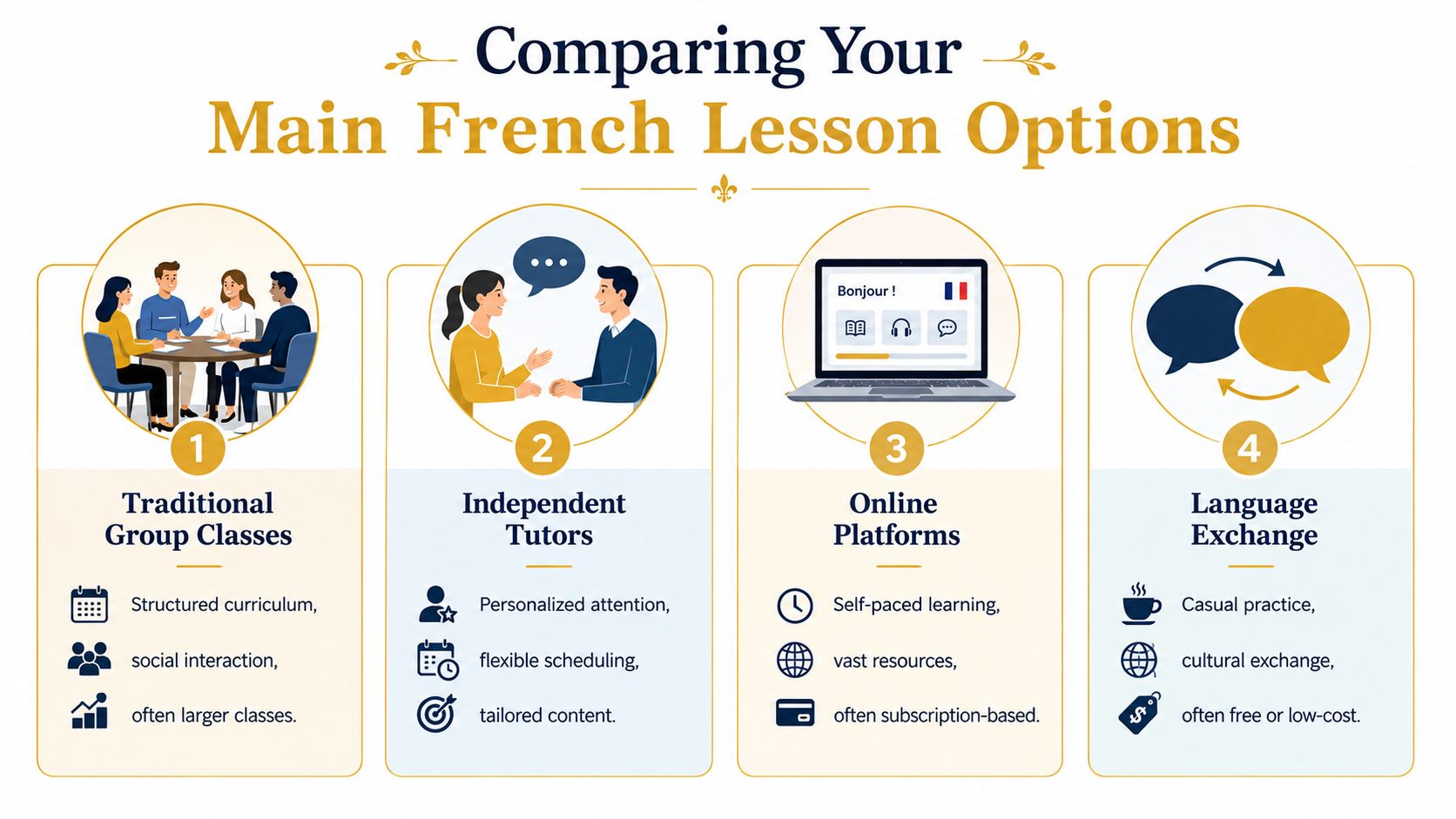
The right question is simple: what are you buying with each option?
French lesson formats in San Diego at a glance
| Format | Best For | Typical Cost | Flexibility | Personalization |
|---|---|---|---|---|
| Traditional group classes | Adults who want routine, classroom structure, and peer interaction | Usually lower per session than private lessons | Low to medium | Low |
| Independent local tutors | Learners with a specific goal, families, professionals, students | Usually higher per session, but more targeted | High | High |
| Online private tutoring programs | Busy adults, remote learners, exam candidates, niche goals | Varies by provider | High | High |
| Hybrid models | Learners who want teacher guidance plus self-study between sessions | Varies by provider | Medium to high | Medium to high |
What each option is really worth
Traditional group classes give you structure and repetition. That helps if you are a casual learner who wants a weekly routine and enjoys learning with other adults. For travel French or general beginner practice, that can be enough.
I would not choose a group class for a narrow goal.
If you need DELF preparation, presentation practice for work, or support tied to a child's bilingual program, group classes usually waste time. The teacher has to serve the room, not your deadline. Your speaking time drops fast once six to twelve people share the hour.
Independent local tutors give you precision. This is usually the strongest option for families, professionals, and students with a clear target. A good tutor can spend the full lesson on oral correction, school writing support, pronunciation, or role-play for real situations, from a parent-teacher meeting to a client pitch.
That matters in San Diego because learner goals here are rarely generic. I see three patterns again and again. Parents want French support that matches school expectations. Professionals want efficient speaking practice they can fit around work. Exam candidates need targeted correction, not broad conversation.
Online private tutoring programs give you consistency. In a city where commute time can kill follow-through, online lessons often beat in-person options on actual attendance. That makes them a smart choice for busy adults and for learners who need specialized instruction that may not be available close to home. If you are comparing remote options, this guide to online French lesson formats and providers is a useful starting point.
Online does not mean lower quality. Poorly designed lessons are the problem, not the screen.
Hybrid models give you a middle ground. You meet with a teacher, then keep working between sessions with assigned drills, speaking tasks, reading, or writing. I like this format for disciplined adults who want to control cost without giving up feedback. I also like it for intermediate learners who already have some momentum and need correction more than constant hand-holding.
My recommendation by goal
Choose group classes if your goal is general fluency over time and you want community to keep you engaged.
Choose private tutoring if you need fast progress, a specialized plan, or support tied to school, work, or an exam.
Choose online private lessons if your schedule changes week to week or you want the widest choice of teacher fit.
Choose hybrid learning if you will do the independent work and want better value over several months.
My opinion is straightforward. The more specific your goal, the less sense a generic class makes. In San Diego, the best value is rarely the cheapest format. It is the format that gets you speaking, corrected, and progressing toward your exact result.
How to Choose the Right French Program for You
You live in San Diego, you finally commit to French, and two weeks later you are stuck between a cheap group class in Mission Valley, a private tutor on Zoom, and a polished program that looks great but tells you almost nothing about how it teaches. I see this all the time. The right choice depends on your goal, your timeline, and how much correction you require.
I choose programs by value, not branding. Value means the format and teacher fit your specific outcome, whether that is conversational confidence, school support, or exam performance.
The five filters I use
Start with goal match. If you want to order food, handle small talk, and enjoy a trip to France, you do not need the same program as someone preparing for a DELF exam or helping a child keep up in a bilingual school. San Diego has all of these options, but very few programs do all of them well.
Next, check teacher fit. I want to know what the teacher handles every week. Travel French, children's support, business presentation coaching, and formal writing correction are different jobs. A friendly native speaker is not automatically the right instructor for your situation.
Then look at personalization. Ask a blunt question. Will the lessons change based on my strengths, weak spots, and timeline, or will I be dropped into a fixed sequence? If the answer sounds generic, keep looking.
After that, inspect correction and lesson design. Good lessons make you produce language, get corrected, and use the correction again. Weak lessons let you listen, nod, and feel productive without fixing the errors that keep showing up.
Last, test practical fit. The best program on paper fails if the schedule, commute, or workload does not match your real life.
Cheap lessons often cost more
Price matters. Progress matters more.
I have watched adults spend months in low-cost classes and still freeze in basic conversation because they got very little speaking time and almost no direct correction. The same problem shows up with children in broad after-school programs. They stay busy without getting the targeted help they need.
Here are the questions I would ask before paying:
- What will I be able to do after the first month?
- How much of each lesson is active speaking or writing, not passive listening?
- How are mistakes corrected in real time and after class?
- Can the plan change if I improve quickly or hit a weak area?
- Is this built for my goal, or is it a general program trying to serve everyone?
- Can I keep this schedule for at least three months?
One rule matters more than the rest. If your goal is specific, your program should be specific too.
A parent choosing support for a child at a bilingual school should look for homework alignment, reading support, and consistent feedback to the family. A working professional who needs French for meetings should prioritize speaking drills, listening under pressure, and vocabulary tied to their field. A student aiming for certification should choose a tutor with exam experience and review a focused DELF and DALF test preparation option before settling for a general conversation course.
If you want measurable progress, pay for correction, repetition, and clear goals.
Make a short list. Book consultations. Ask direct questions, then judge the answers by how specific they are. In San Diego, the strongest French program is not the one with the broadest promise. It is the one built for the result you want.
Targeted Tutoring for DELF Exams and School Curricula
A San Diego parent usually notices the problem fast. Their child is doing fine in a general French class, then struggles with dictation, reading responses, or a presentation tied to the school's actual curriculum. An adult learner hits the same wall with DELF prep. Casual conversation improves confidence, but the exam still demands timed writing, structured speaking, and precise listening.

Exam prep needs alignment not general exposure
If your goal is DELF, DALF, or TCF results, choose training built around the test. I would not send an exam candidate into a broad conversation class and hope it transfers. It rarely does.
San Diego gives serious students one clear advantage. The local French school network includes a certified exam center for DELF, DALF, and TCF through the French-American school context. That matters because strong prep should mirror the format students will face, including written production, oral structure, task timing, and correction standards.
I recommend comparing any tutor against a specialized DELF and DALF exam preparation program. You want to see whether the plan includes mock oral interviews, timed writing practice, score-based feedback, and correction that matches exam expectations. If it does not, keep looking.
Private tutoring usually gives the best value for exam candidates because every session can target a weakness. Group classes can help with consistency and cost, but they move at the group's pace. Online lessons work well if the teacher uses shared documents, timed drills, and recorded speaking feedback. Format matters less than fit. For exam prep, fit means direct practice with the exam itself.
School support should match the child's real academic load
School-based tutoring is a different service. I see parents confuse enrichment with support all the time, and the result is wasted months.
A child in a bilingual or immersion program may need help with grammar, yes, but the main pressure usually comes from school tasks. Reading logs. Spelling patterns. Written accents. Oral exposés. Chapter tests. A tutor who ignores those materials and teaches a separate syllabus is solving the wrong problem.
Ask for proof of alignment before you book:
- Will you use my child's textbook, handouts, and teacher assignments?
- Can you correct writing sentence by sentence, not just practice speaking?
- Do you prepare students for presentations, dictées, and reading comprehension checks?
- Will you adapt the lesson plan around upcoming quizzes, projects, and report card periods?
I prefer tutors who communicate clearly with families and show what changed from week to week. Parents should know whether the issue is vocabulary recall, reading speed, grammar accuracy, or confidence during oral work. That level of specificity is what turns tutoring into measurable school support.
A child in a French school needs instruction that matches class demands, current materials, and the level of correction teachers expect.
That is the value of targeted tutoring in San Diego. Private lessons help when stakes are high and the goal is narrow. Group lessons make sense for lighter reinforcement. Online support works well for busy families who still want curriculum-based feedback. Pick the format that matches the outcome, not the marketing.
A Student Success Story From Tech Startup to Paris Pitch

Three weeks before a Paris investor meeting, Anna realized her French problem had nothing to do with motivation. She worked at a San Diego tech startup, she had studied on and off, and she could recognize plenty of words. She still could not present a product with authority, handle interruptions, or respond calmly when a question came fast.
That distinction matters.
I see this constantly in San Diego. Professionals assume any French exposure will help. It usually does not. If your goal is a real performance task, like a pitch, client meeting, media interview, or conference introduction, generic group classes give you too much broad practice and not enough job-specific rehearsal.
Why Anna changed formats
Anna did not need another round of basic conversation prompts. She needed to introduce herself without sounding scripted, explain slide transitions, answer follow-up questions, and buy herself time when she needed to think. Those are private-lesson problems, not app problems and not standard class problems.
So we changed the format to match the goal. Her lessons centered on her actual deck, her industry vocabulary, likely investor objections, and the polite phrasing that keeps a high-stakes exchange under control. This is the core value of customized French lessons in San Diego. You pay for relevance, correction, and repetition tied to a specific outcome.
Her schedule pushed the decision too. Startup work leaves little room for fixed evening classes, and missed lessons break momentum fast. A flexible private format gave her something group programs rarely can. Consistent practice built around her calendar and her deadline.
What actually improved her French
The turning point was narrow, deliberate practice.
She stopped memorizing random travel phrases and started rehearsing the exact language she would use in Paris. We worked on opening lines, slide commentary, question handling, clarification requests, and recovery strategies for moments when she missed a word. That last piece matters more than people think. Strong business French is not perfect French. It is controlled French.
If your situation sounds similar, read this corporate French learning success story and compare it against a standard class model. The right choice depends on the task. Group lessons work well for steady general progress. Private coaching wins when the goal is a meeting, certification, presentation, or deadline with consequences.
Anna walked into the pitch prepared because her lessons matched the job she had to do. That is the standard I recommend. Choose the lesson format that trains the performance you need.
Your First Month A Sample French Learning Plan
Most adults fail because they choose a plan they can't maintain. Most students preparing for an exam fail because they choose a plan that's too light.
A good first month should feel structured, realistic, and repeatable.
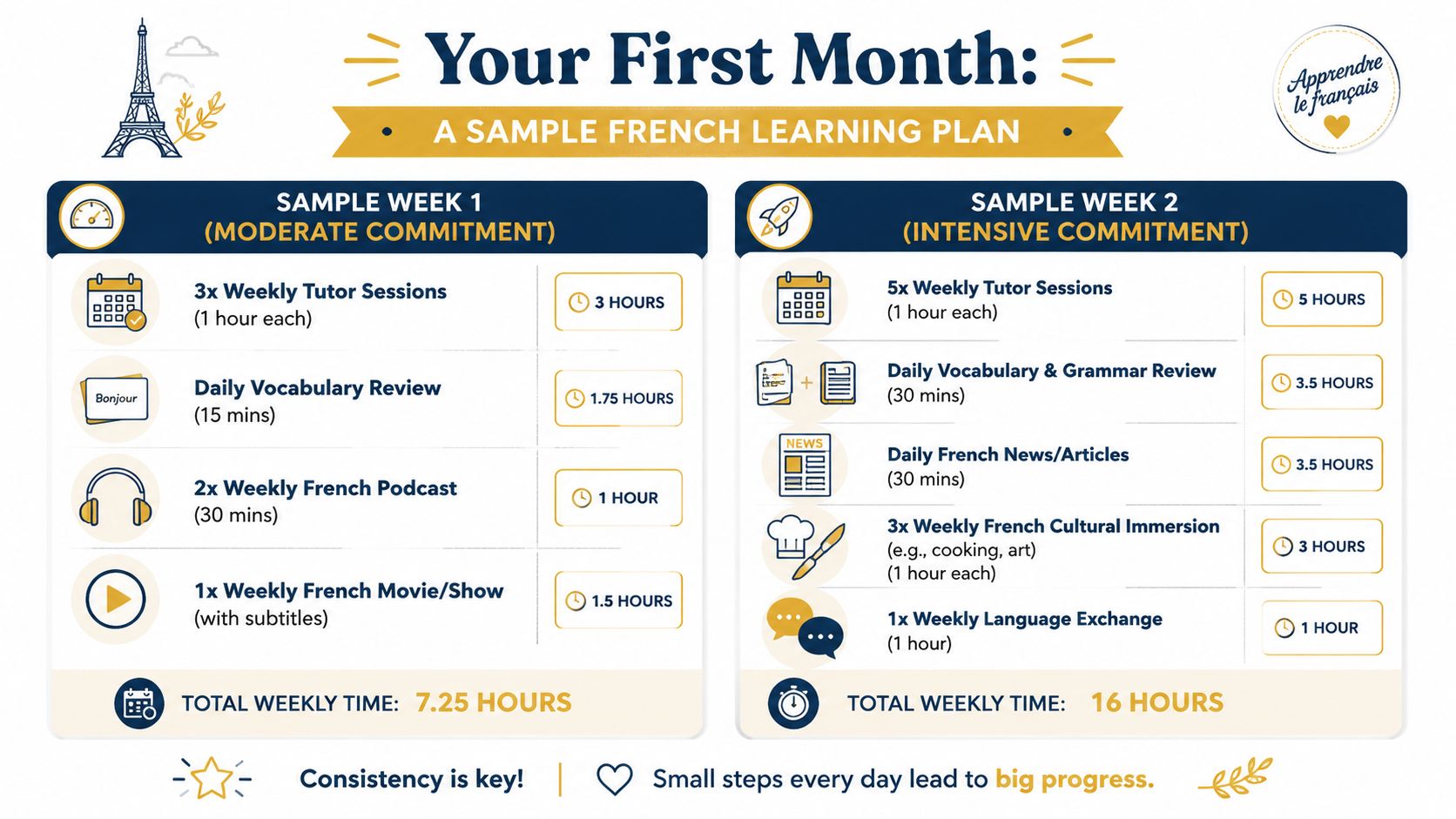
Sample plan for a busy professional
If your goal is travel or general confidence, keep the routine simple enough that you won't quit after week two.
A practical week might look like this:
- Two live lessons each week for focused speaking and correction
- Short daily vocabulary review with phrases pulled from recent lessons
- A few listening blocks during commutes or walks
- One low-pressure speaking task each week, such as describing your day aloud or rehearsing a restaurant exchange
The point isn't intensity for its own sake. The point is consistency. Professionals do best when French becomes part of the calendar, not an aspirational side project.
Here's the mindset I recommend: protect your lesson times first, then build small habits around them. If you want a model to compare against, a structured French study plan can help you map lesson time, review time, and speaking practice into one workable routine.
Sample plan for a focused exam student
Exam students need more deliberate practice. That usually means live instruction plus written work and oral rehearsal.
A stronger first-month rhythm might include:
- Several focused tutoring sessions each week centered on oral and written tasks
- Assigned grammar and writing review tied to weak points found in lessons
- Regular listening and reading practice using level-appropriate material
- Weekly timed practice to build comfort under pressure
- Error tracking so the same mistakes don't repeat unchecked
Don't judge your plan by how ambitious it sounds. Judge it by whether you can repeat it for a full month without falling apart.
If you're a parent building a plan for your child, use the same logic. Keep the schedule steady, match it to the child's school demands, and avoid overloading them with disconnected extra work.
The first month should answer two questions fast. Are the lessons targeted enough? And can you sustain the routine? If the answer to either is no, adjust early.
Frequently Asked Questions About San Diego French Lessons
How long does it take to become conversational in French
Longer than one might hope, and faster than one might fear if the lessons are well targeted. “Conversational” also means different things to different learners. Ordering food on a trip, chatting socially, and handling work meetings are not the same target. I tell students to focus less on an imaginary finish line and more on building a routine they can sustain.
Are online French lessons as effective as in-person ones
Yes, they can be, especially for adults. The key issue isn't location. It's whether you're getting active speaking time, strong correction, and regular practice between lessons. Online often wins for busy learners because it removes commuting and makes consistency easier.
What's the best type of lesson for a young child
For young children, I prefer instruction that connects directly to the child's school experience, attention span, and language level. If the child is in a bilingual or immersion program, curriculum-aligned support is usually more useful than a generic beginner class. Parents should ask whether the tutor can use the child's actual school materials.
Should I choose private lessons or group classes
Choose private lessons if your goal is specific, your schedule is tight, or progress speed matters. Choose group classes if you value structure, social learning, and a lower-pressure environment. The wrong choice isn't private or group. The wrong choice is paying for a format that doesn't match your reason for learning.
If you're still comparing French lessons in San Diego, the next smart step is simple. Shortlist the formats that fit your goal, then book a consultation with the provider you're seriously considering and ask direct questions about personalization, pacing, and speaking practice.
If you want a personalized recommendation based on your goal, schedule, and current level, you can book a free 20-minute consultation with Elite French Tutoring.