Skip to content

You're probably here because you've already opened six tabs, compared a few French programs in Greenwich, and still don't know which one will help. That's normal. Individuals seeking French lessons in Greenwich aren't shopping for “French” in the abstract. They need a real outcome: a child has to pass class at Greenwich High School, a parent wants curriculum support that matches school expectations, or a professional needs French for relocation, meetings, or an exam.
I'll be blunt. It's common to choose badly by starting with the tutor's website, not one's own goal. That's backwards. The right program for a middle school student is not the right program for a UN-affiliated professional, and neither should be shopping the same way.
Table of Contents
Start With Your Goal Not the Tutor
If you search French lessons in Greenwich without defining the result you want, every option looks plausible. That's why people waste time on polished websites, vague “all levels welcome” promises, and trial classes that feel pleasant but lead nowhere.
The first decision isn't online or in person. It isn't private or group. It's this: what problem are you solving in the next few months?

A lot of families underestimate how much targeted support matters. A critical gap exists in French proficiency in North America: over 70% of students begin learning French before high school, but only 2% achieve functional proficiency by graduation, which is exactly why standard classroom exposure often isn't enough and personalized support matters (North American French proficiency gap).
Three common Greenwich buying situations
Most buyers in Greenwich fall into one of these groups:
School support buyers. Your child needs help with homework, quizzes, oral presentations, grammar tests, or credit recovery. You do not need a charming conversation club. You need curriculum alignment.
Professional buyers. You need French for relocation, client communication, internal meetings, email writing, or an internationally mobile career. You need precision and relevance.
Lifestyle buyers. You want to speak confidently for travel, family reasons, or personal growth. That's valid, but you still need structure if you want results.
Practical rule: If you can't state your goal in one sentence, you're not ready to choose a tutor.
What to decide before you book
Before you spend money, answer these five questions:
What does success look like? A higher class grade, stronger speaking confidence, DELF/DALF prep, or workplace fluency.
What is the deadline? Next exam period, a move abroad, a work trip, or no hard deadline.
What format will you sustain? A perfect setup you won't attend is worse than a practical one you'll keep.
Do you need structure or conversation? Many people need a hybrid, but they don't say so.
How much customization do you expect? If you want lessons built around a textbook, school syllabus, or professional field, say it upfront.
That last point matters more than is commonly understood. Tutors default to their own style unless you clearly define yours. If you need a more structured path, start by comparing a structured French study plan instead of generic “learn French” offers. For learners who want a more effective learning experience, you can also compare that approach with Elite French Tutoring, which offers customized lessons for students, professionals, and families.
In-Person vs Online Lessons A Greenwich Comparison
People often overcomplicate the decision. The question isn't which format is better in theory. The question is which format removes friction and gives you access to the right level of tutor.
For many adults, personalization matters more than location. In the U.S. and globally, over 78% of adult learners prioritize 1:1 or small-group sessions over generic online courses to reach fluency faster (personalized French tutoring demand). That doesn't automatically mean online wins. It means buyers want lessons built around them, not mass-market classes.

The tradeoff that actually matters
In-person lessons in Greenwich work best when the student needs physical presence, tighter accountability, or a local routine that parents can manage easily. That's especially useful for some younger learners.
Online lessons work best when you need access to a better tutor pool, more scheduling flexibility, or highly specialized instruction that isn't easy to find locally. For adults, executives, exam candidates, and many older students, online usually gives you better options.
What I tell clients is simple: choose the format that makes consistency easier. Convenience is not a minor detail. It determines whether lessons keep happening in week six.
Learning format comparison
| Feature | In-Person (Greenwich) | Online Lessons |
|---|---|---|
| Commute | Requires travel time and scheduling around local traffic | No commute, easier to fit into busy days |
| Tutor pool | Limited to tutors available locally | Wider access to specialized tutors |
| Best for | Younger students, local families, learners who focus better face-to-face | Busy professionals, exam prep, adults with irregular schedules |
| Environment | Dedicated physical learning space | Home or office convenience |
| Scheduling flexibility | Often more rigid because travel affects both sides | Easier rescheduling and broader availability |
| Parent oversight | Easier for some families who want visible structure | Easier if parents want minimal logistics |
| Specialization | Can be harder to find niche support locally | Better for business French, relocation goals, and exam prep |
If your target is specialized, don't let geography shrink your options.
What I recommend in practice
I'd choose in-person if:
Your child loses focus online
You want a strong weekly routine anchored to a place
You've found a local tutor who knows the school context
I'd choose online if:
You need business French or exam prep
Your calendar changes often
You want access to a native instructor outside the immediate Greenwich area
If you're comparing French lessons in Greenwich and feel torn, it helps to review a stronger benchmark first. Start by looking at what good online French lessons include, then compare local options against that standard.
A Guide for Parents Navigating Greenwich Schools
Parents usually come to me after generic tutoring has already failed. The child “likes” the tutor, sessions seem pleasant, but homework is still chaotic and test results don't move. That's because school French and general French are not the same purchase.
Greenwich High School offers a robust language program, yet many local services still market broad adult-style lessons instead of school-aligned academic support. That mismatch matters because over 40% of U.S. parents report their children struggle with foreign language homework, while many tutoring options still don't speak directly to curriculum alignment (Greenwich school language program context).
Why generic tutoring fails school-based learners
A student in a school program doesn't need random vocabulary themes and casual conversation every week. They need someone who can work with what's happening in class:
The current textbook and chapter sequence
Teacher expectations for written work
Quiz and exam format
Oral presentation practice
Grammar points taught in the school's order, not the tutor's preferred order
That's especially true in a demanding district. If your child is in French I, French II, or an advanced track, “native speaker” alone isn't enough. A tutor has to teach to the academic target.
Questions parents should ask before hiring
Use these in your first conversation:
Can you teach from my child's textbook and class materials?
How do you prepare students for quizzes, oral assessments, and writing tasks?
Will you review teacher comments and adjust the lesson plan accordingly?
How do you handle homework support without turning sessions into simple answer-giving?
Can you balance grammar repair with speaking confidence?
Here's the difference in real life. One Greenwich-area parent came in with a familiar complaint: her teenager was attending lessons elsewhere but still freezing during oral participation and losing points on verb forms. We rebuilt the work around classroom units, teacher-style prompts, and short speaking drills tied to current assignments. The result wasn't magic. It was alignment. Within a short stretch, the student stopped dreading French class and began participating with far more confidence.
Parents should buy specificity. If a tutor can't describe how they support school performance, keep looking.
If your child needs targeted academic support rather than general enrichment, compare options built for French for school and use that as your filter when interviewing local tutors.
For Professionals French for Your Career
If you're a professional in Greenwich, generic French classes can waste months. You don't need to spend twelve weeks discussing hobbies if your real challenge is relocation, boardroom communication, or a certification that proves competence.
This matters in Greenwich because there's a very specific underserved market here. For the 200+ internationally affiliated families and professionals in Greenwich, demand for Business French and DELF/DALF preparation tied to relocation or career advancement is a real niche that generic adult classes often ignore (French for international professionals in Greenwich).
What professionals should buy instead of generic classes
Professionals need a tutor who can work in one or more of these lanes:
Business communication, including meetings, presentations, email tone, and sector vocabulary
Relocation French, including practical communication for housing, schools, medical visits, and administration
Diplomatic or international workplace French, where register and nuance matter
DELF/DALF preparation, when you need an external credential
Don't be distracted by “conversation classes” unless they're anchored to your use case. A lawyer, finance executive, NGO professional, and relocating family all need different lesson design.
A real student success story
One professional I worked with in the broader New York area had a clear issue: she could read French documents reasonably well but could not speak under pressure in meetings. Her previous classes were broad and cultural, which made the lessons enjoyable but professionally useless.
We switched the focus to meeting simulations, interruption handling, short spoken summaries, and correcting only the errors that blocked clarity or credibility. Her confidence changed because the content finally matched the job. That's what successful adult learning looks like. Not “more French.” Better-targeted French.
A professional lesson should sound like your workweek, not a tourist phrasebook.
If your goal is career mobility, client communication, or relocation readiness, compare tutors who explicitly offer French for business rather than broad “adults welcome” classes.
How to Vet Tutors and What to Ask in a Trial Lesson
Most trial lessons are too polite. The student wants to be liked. The tutor wants to seem encouraging. Nobody asks the hard questions, and then people commit to months of lessons with no real way to judge fit.
A strong tutor does more than explain grammar. The best instructors adapt to the student's correction preferences, keep the conversation moving, and know when to stop using the learner's native language so immersion can start doing its job. That pattern came out of expert analysis of over 200 tutoring sessions (what effective French tutors do).
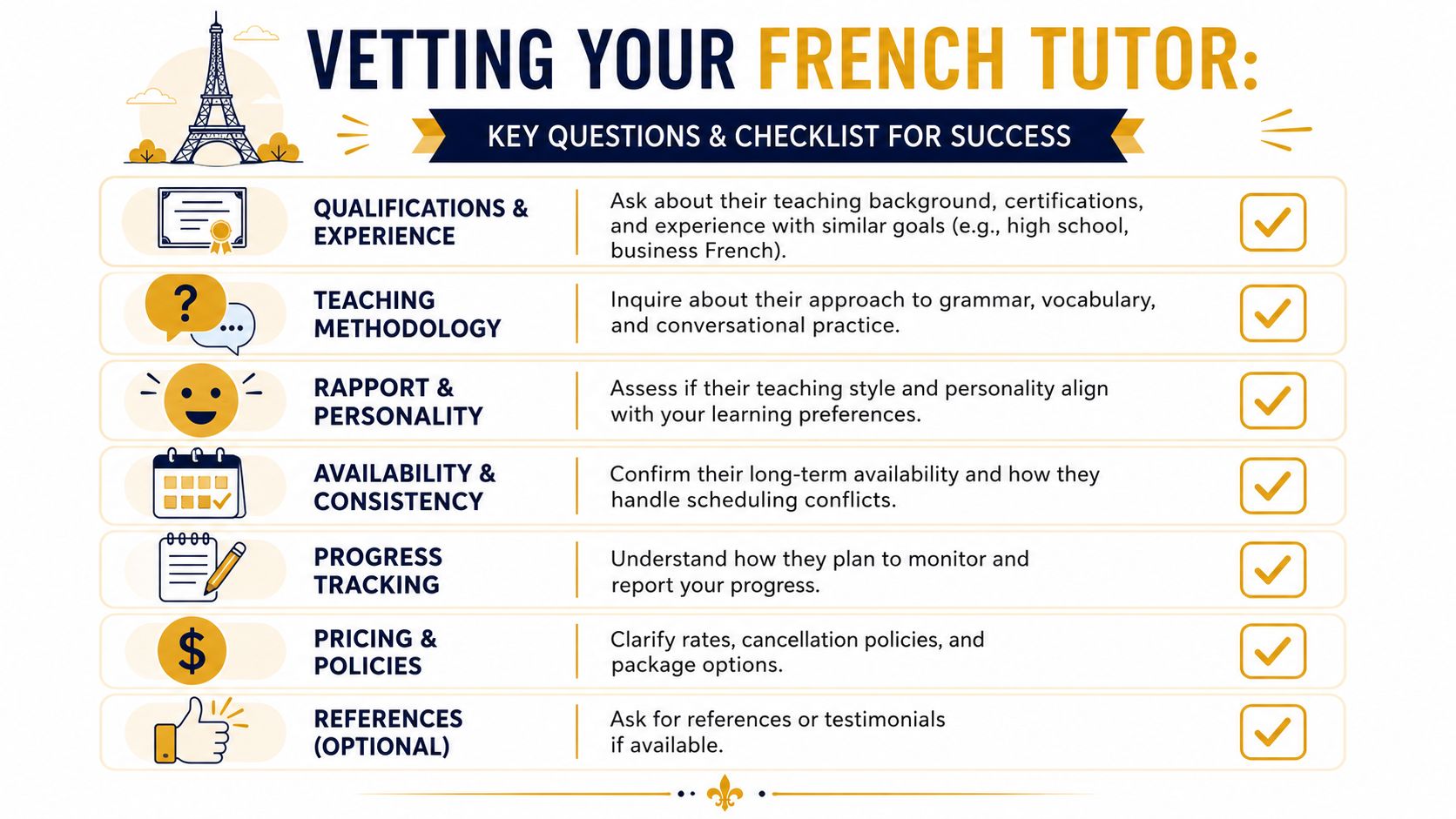
What a good trial lesson should reveal
You should leave a trial lesson knowing the answer to these questions:
Did the tutor listen to my goal, or force me into their default method?
Did they explain how they'd structure future sessions?
Did they create enough comfort for me or my child to speak?
Did correction feel helpful, not constant and disruptive?
Did they ask smart questions about materials, timeline, and obstacles?
If you leave saying “they were nice,” that's not enough.
My trial lesson checklist
Use this checklist and take notes during the call or session.
| What to evaluate | What good looks like | Red flag |
|---|---|---|
| Goal matching | Tutor quickly identifies your actual target | Tutor gives a one-size-fits-all pitch |
| Correction style | Tutor asks whether you want immediate or delayed correction | Tutor interrupts constantly without asking |
| Lesson plan | Tutor outlines how future lessons would work | Tutor stays vague and improvisational |
| Materials | Tutor can use your school, work, or exam materials | Tutor insists on only their own generic material |
| Speaking environment | You speak a lot and feel safe making mistakes | Tutor dominates the conversation |
| Scheduling | Tutor can support a realistic consistent routine | Tutor has scattered availability only |
Ask these directly:
How do you correct mistakes during speaking practice?
What would the first month look like for someone with my goal?
How do you track progress without making lessons feel rigid?
Have you worked with learners in my exact situation before?
What happens if motivation drops or life gets busy?
The trial lesson is not a performance. It's a screening process.
If you're comparing several options for French lessons in Greenwich, score each tutor on fit, clarity, responsiveness, and teaching style right after the trial. Don't trust memory after three conversations.
Making It Stick Booking and Building Momentum
A good hiring decision gets you started. A repeatable schedule gets you results.
Students who receive tutoring show a 27% higher success rate in the San Diego Mesa College research, and the strongest method includes a diagnostic consultation, a fixed weekly schedule, and immersive practice between sessions (tutoring success and structured learning).

The booking decision that changes results
Booking tends to be reactive. Individuals schedule when they have time, cancel when life gets busy, and then wonder why progress feels thin.
That's the wrong model. The best approach is boring and effective:
Start with a diagnostic conversation. Pin down level, goals, and learning style early.
Book a fixed weekly slot. Protect it like any other serious commitment.
Choose a session length you can sustain. Longer isn't always better if it leads to inconsistency.
Define the lesson type. Structured, conversational, or hybrid.
Agree on between-session work. Even a small recurring task helps.
What to do between lessons
Between-session practice shouldn't feel like school detention. It should be simple and repeatable.
For students. Review class vocabulary aloud, rewrite corrected sentences, and practice likely oral prompts.
For professionals. Summarize a relevant article, rehearse a work scenario, or record a short spoken recap.
For adult learners. Read something short, listen to a brief clip, and come ready to talk about it.
A short visual overview can help if you're deciding how to structure lessons and follow-through:
The common mistake is treating each session like a standalone event. French sticks when each lesson connects to the next. That's why the right tutor, the right format, and the right schedule have to work together.
If you're ready to stop comparing random options and start with a plan that fits your actual goal, it's worth booking a consultation and comparing a few personalized programs before you decide. If you want a premium benchmark, you can explore Elite French Tutoring and see how a customized lesson path is structured for students, professionals, and families.