
You've probably already done the first frustrating part. You searched for French lessons in Tampa, opened a few tabs, saw group classes, private tutors, online options, and a lot of vague promises about “conversation practice.” Then you hit the question: which option fits what you need?
That's where individuals often lose time and money. They compare prices before they compare outcomes. They pick the closest class, the cheapest package, or the first tutor who says they're a native speaker. Then a few months later, they're still stuck introducing themselves and ordering coffee.
In practice, the smartest way to choose French lessons in Tampa isn't to ask, “What's available?” It's to ask, “What kind of lesson matches my exact goal?” A parent needing support for a child in a bilingual program shouldn't shop the same way as an adult preparing for travel. A professional who needs diplomatic or workplace French needs a different structure than someone who wants casual conversation.
Table of Contents
Your Guide to Finding the Right French Lessons in Tampa
A Tampa parent books weekly French tutoring because their child is struggling in school. An adult learner signs up for a group class because it looks convenient. A professional chooses conversation lessons before a move abroad. All three can end up in the wrong room, even when the teacher is qualified and the program is legitimate.
That is the main challenge in Tampa. The question is rarely, “Are there French lessons available?” The harder question is whether the lesson type matches the result you need.
After helping hundreds of learners through Elite French Tutoring, I can say this with confidence: the fastest progress usually comes from alignment. Travel-focused learners need practical listening and speaking under realistic conditions. Students in French immersion or IB programs often need structured academic support tied to school expectations. DELF candidates need exam strategy, timed production, and feedback that follows the scoring criteria. Those are three very different jobs, and one generic class will not serve all three equally well.
A polished website or a convenient schedule can make options look interchangeable. They are not. Group classes, private tutoring, school support, business French, and test preparation each solve different problems. The wrong format can still feel productive for a few weeks, but it often leads to slow progress, frustration, and extra spending later when the learner has to switch approaches.
Use this section as a filter. Start by asking what you need to be able to do in French after the next 8 to 12 weeks. Hold a conversation during a trip. Raise a grade. Pass an exam. Rebuild rusty speaking skills. Once that outcome is clear, the search gets much easier.
If you want a practical adult-focused framework before contacting tutors, read this guide on how to find the perfect French tutor for adult learners.
First Define Your Pourquoi Before You Pay
The biggest mistake I see is starting with logistics. People ask about cost, commute, Zoom versus in person, or whether classes are available on Tuesdays. Those matter, but they come second. Your pourquoi, your reason for learning, should drive every other decision.
A learner with a specific target usually progresses more smoothly because the lessons stay focused. That approach matches what's happening more broadly as well. The need for objective-driven learning is growing, and the University of Tampa's French offerings include work in diplomatic writing, listening, and speaking, which points to real local demand for specialized outcomes rather than generic conversation alone (University of Tampa French course descriptions).
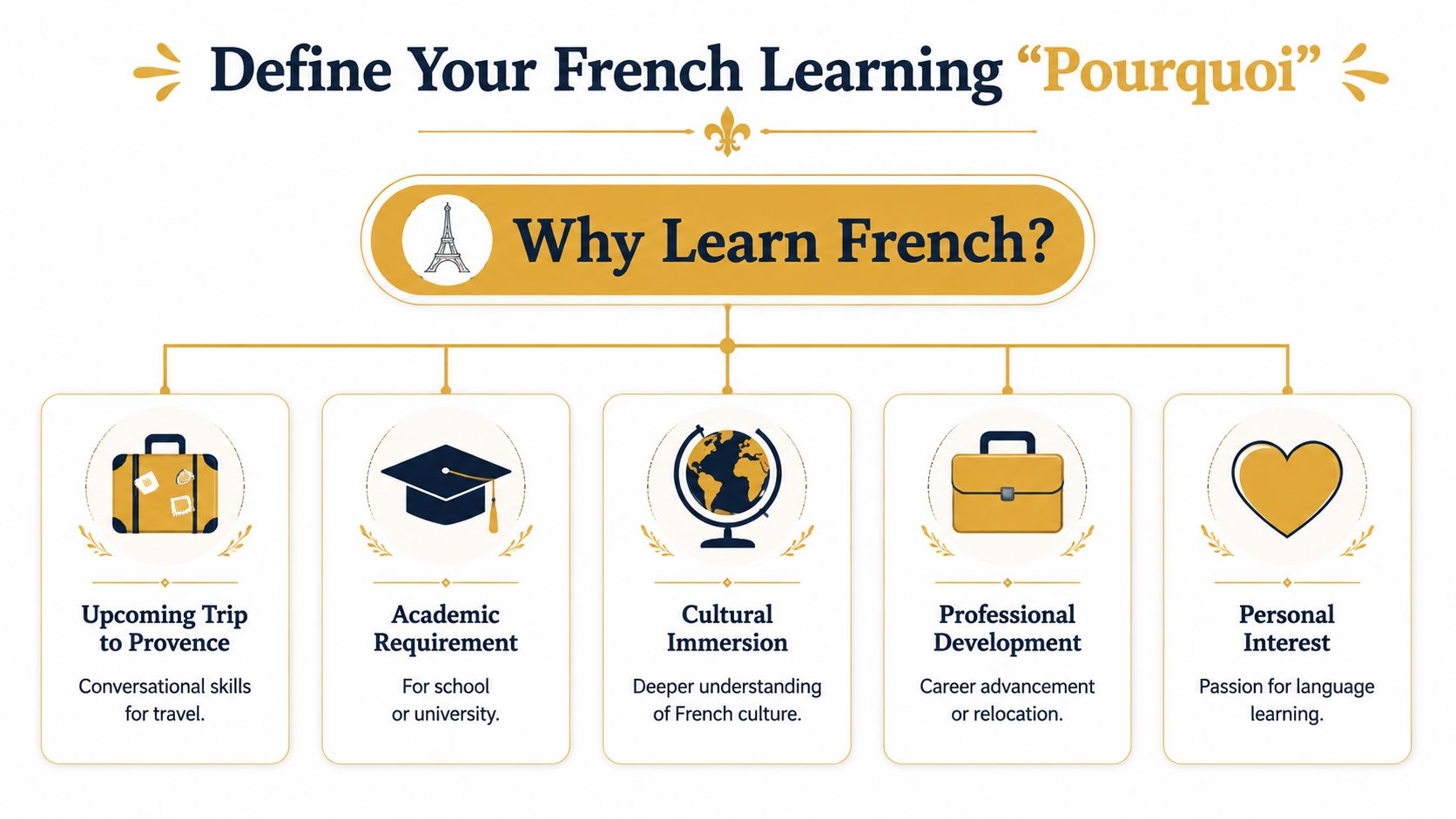
Three common goals that need different lesson types
Travel conversation works best with practical speaking, listening, role-play, and high-frequency vocabulary. If you're heading to France and want to deal with hotels, trains, restaurants, and day-to-day interactions, you don't need a class that spends too much time on written exercises that never show up in your actual trip.
Academic or school support needs alignment. If a child is already in a French or bilingual program, the lesson shouldn't drift into unrelated beginner content. It should reinforce class vocabulary, reading expectations, grammar sequence, and the exact kind of oral participation the school expects.
Professional or exam-focused study needs structure and precision. Someone preparing for DELF, DALF, relocation, or a job with formal French communication needs targeted correction, measurable milestones, and role-specific language. General conversation classes often don't go deep enough here.
If your goal is precise, your lesson plan should be precise too.
A fast self-check before you book anything
Before paying for French lessons in Tampa, write down these answers:
Your real use case: Are you learning for travel, school support, work, relocation, or certification?
Your deadline: Is there a trip, exam date, school term, or job transition driving the timeline?
Your weakest skill: Speaking, listening, writing, grammar accuracy, or reading speed?
Your preferred accountability: Do you thrive in a group, or do you need a teacher who adjusts every lesson to your pace?
When a student can answer those four questions clearly, the decision gets much easier. You stop shopping blindly and start filtering options based on fit.
Choosing Your Format Online vs In-Person Classes
Once the goal is clear, the next trade-off is format. Many Tampa learners hesitate at this stage because both options can work. The better choice depends on how much flexibility, personalization, and schedule control you need.
The local market includes both group and remote formats. One Tampa Bay provider lists an adult French program that runs for 13 weeks, meets once per week for 1.5 hours, costs $425 per person plus $60 for textbook and workbook materials, and is available in person or online via Zoom. The same market also shows average private French tutoring rates of about $35/hour for native speakers and $33/hour for non-native speakers (FASTB adult education and tutoring information).
What group classes do well
Group classes are often a good fit when you want:
A lower upfront commitment: Shared instruction usually costs less than private work.
Built-in social practice: You hear other accents, mistakes, and questions.
A steady external schedule: Some learners need a fixed weekly rhythm to stay engaged.
That said, group classes have limits. The pace is shared. The curriculum is fixed. If you miss a class, the group moves on. If you're stronger in one skill and weaker in another, the class won't always bend around that.
Where private online lessons usually win
Private online tutoring tends to work better when your life is busy or your goal is narrow. Parents juggling school pickups, professionals with changing calendars, and students preparing for exams often do better with a format that can adapt quickly.
Here's the comparison I'd use if I were advising a Tampa learner one-on-one:
| Feature | In-Person Group Classes | Private Online Tutoring |
|---|---|---|
| Schedule | Fixed calendar and start dates | More flexible scheduling |
| Pace | Set by the group | Set by the learner's progress |
| Personalization | General curriculum | Built around one learner's goal |
| Speaking time | Shared across the room | Focused on one student |
| Accountability | Group structure helps some learners | Direct instructor feedback helps others |
| Best fit | Casual learners, social learners, routine-seekers | Busy professionals, families, exam candidates, learners with specific targets |
For many adults, online lessons remove the hidden friction that causes inconsistency. No commute. No arriving late from traffic. No losing momentum because the next group cycle hasn't opened yet.
If you're comparing remote options specifically, this roundup of online French lesson options can help you evaluate what to look for beyond just availability.
How to Vet Instructors and Their Teaching Methods
A native accent is nice. It's not enough.
The instructor is the single factor that most strongly shapes whether your French improves in a meaningful way. A strong teacher knows how to sequence material, correct without shutting you down, and adjust the lesson when you're stuck. A weak one just chats, assigns pages from a book, and hopes repetition carries you through.
A structured program should also know how to place your level and map progress against a recognized benchmark. French study is commonly measured with the CEFR, and one published guide estimates that reaching B2 typically takes about 500 to 600 hours, while A1 to A2 can take around 12 weeks or 90 to 100 hours, A2 to B1 about 24 weeks or 350 to 400 hours, and B1 to B2 about 36 weeks or 500 to 600 hours (CCFS Sorbonne CEFR guide).
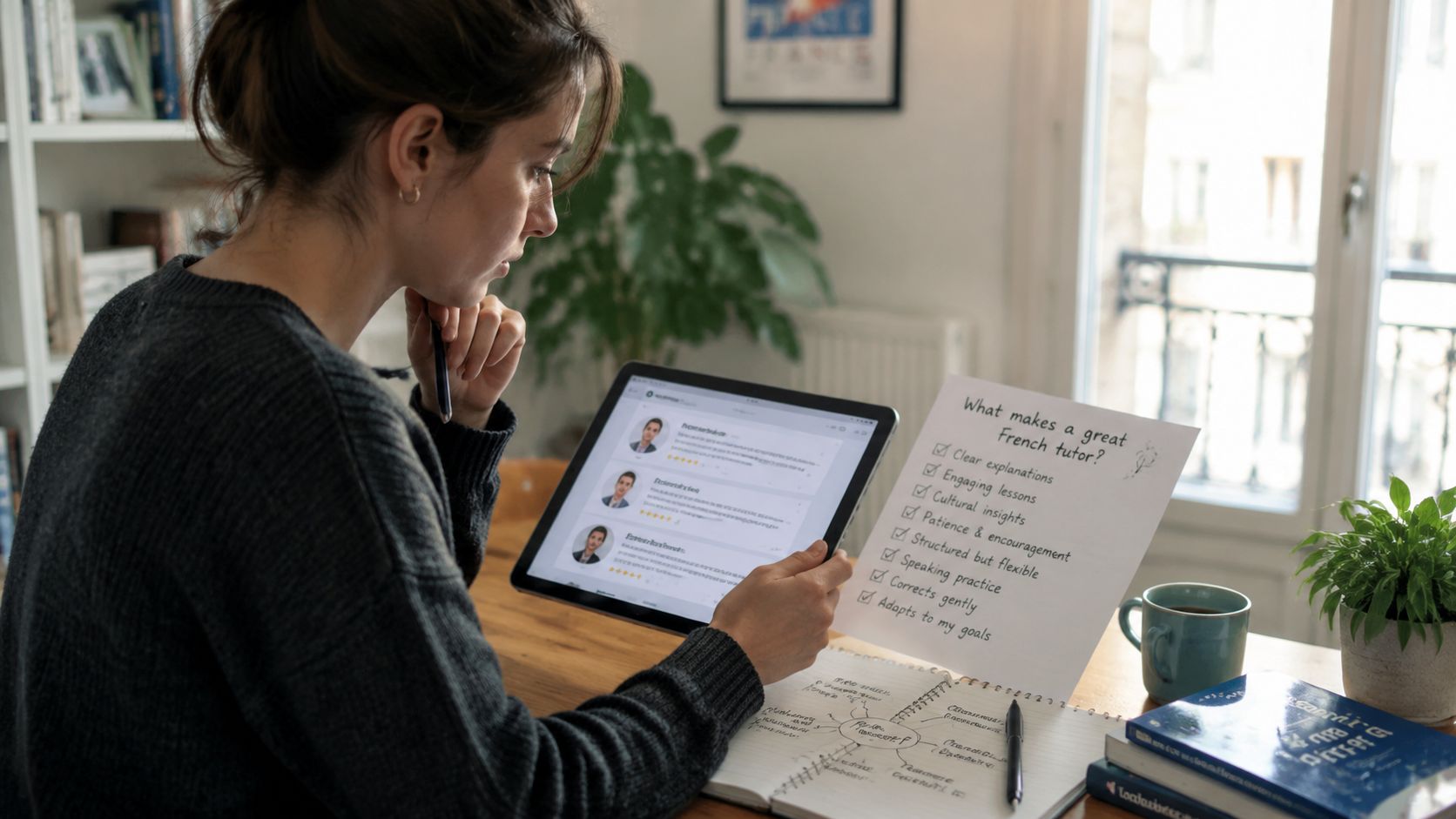
What serious French instruction looks like
Good instructors don't promise vague fluency. They explain the path. They can tell you what you need to work on now, what comes next, and how they'll know you're improving.
Look for signs like these:
Clear level assessment: They don't guess your level from a quick greeting.
Defined lesson objectives: Each session has a purpose beyond “practice.”
Active correction: They catch patterns, not just isolated mistakes.
Skill balance: They know when to focus on speaking, listening, reading, or writing.
Progress tracking: They can explain how your work connects to a bigger benchmark.
A serious tutor doesn't just fill an hour. They build a sequence.
Questions worth asking before you commit
When you speak with a potential instructor, ask questions that reveal method, not marketing:
How do you assess level? You want more than “beginner” or “intermediate.”
How do lessons change for travel versus DELF versus school support?
How do you handle correction during speaking? Too much correction freezes people. Too little leaves errors untouched.
What happens between lessons? Strong programs usually give structure for review and retention.
How do you measure progress over time?
If you want an example of what a structured, customized approach can look like, this overview of French tutoring methodology is worth reviewing before you interview instructors.
Understanding French Lesson Pricing and Packages in Tampa
A Tampa parent enrolls in a low-cost group class for a middle schooler. A Hyde Park professional books private sessions for a work trip to Montreal. Both are studying French, but they should not be shopping the same way. Price only makes sense once the goal is clear.
French lesson costs in Tampa vary because the formats do different jobs. Group classes usually spread the cost across several students and follow a shared syllabus. Private lessons cost more per hour, but they give you targeted correction, more speaking turns, and a pace built around one learner. For DELF prep, school support, pronunciation repair, or conversation practice tied to a deadline, that difference matters fast.
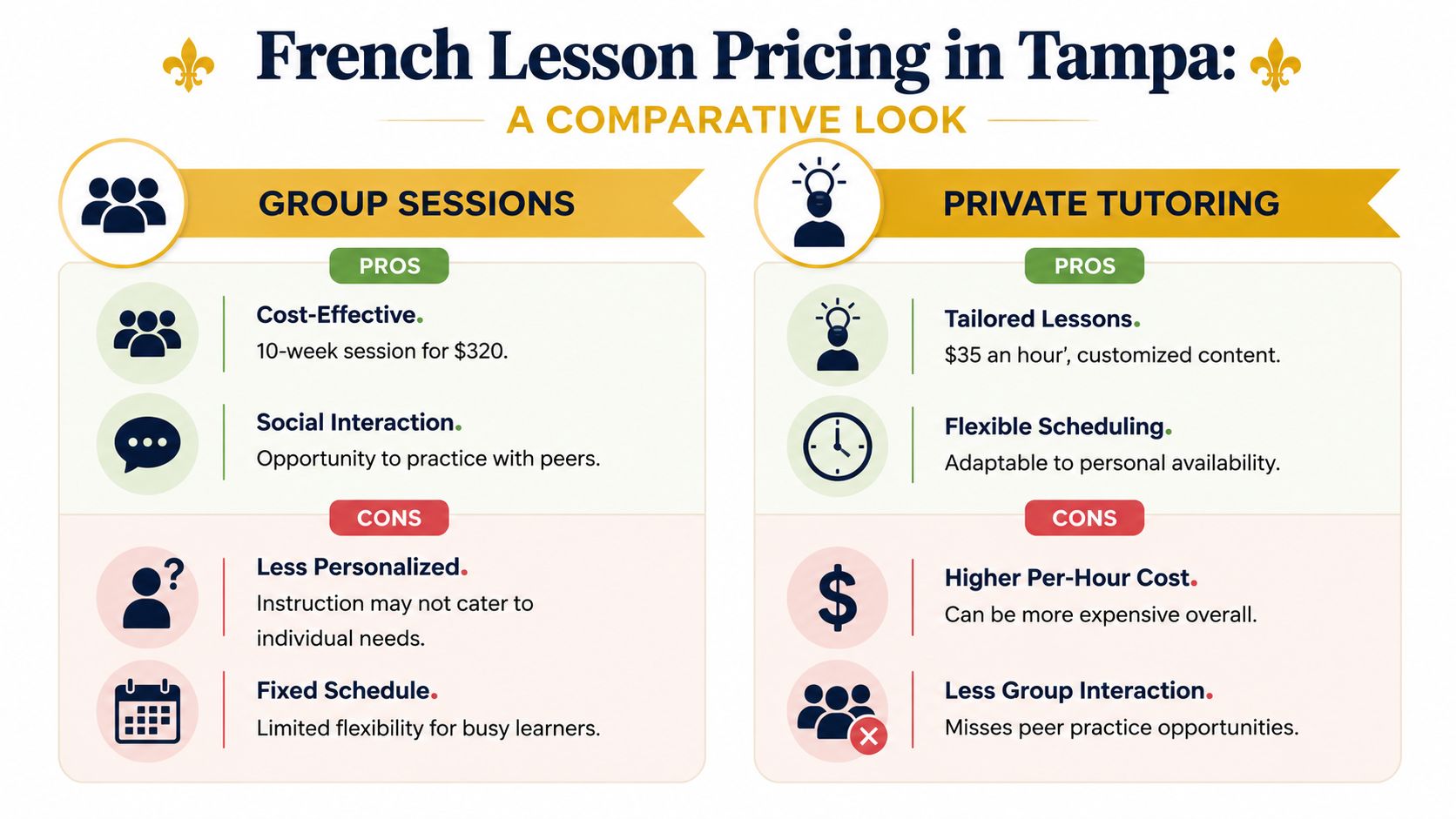
What you're paying for
I tell Tampa families to compare packages on four points, not one.
Speaking time: In a group, each student may only get a few meaningful chances to speak and be corrected.
Precision: Private lessons can target one problem, such as nasal vowels, verb tense confusion, or weak listening under pressure.
Flexibility: Fixed-session courses work well for learners who like structure and a steady pace. They are less useful if you need to pivot quickly toward a test, presentation, or trip.
Total cost: Registration fees, books, missed-class policies, and homework support all affect the actual price.
A cheaper package can still be the wrong investment if it gives you very little practice in the skill you need most.
That is the trade-off many directories miss. They present all French lessons as if they were interchangeable. They are not. A travel learner who needs restaurant, airport, and family conversation practice should evaluate options differently from a high school student trying to raise grades or an adult preparing for the DELF B1.
How value changes with the learner's goal
For beginners who want a gentle introduction and enjoy learning with others, a group class can be a sensible starting point. It lowers the pressure and usually costs less upfront.
For learners with a narrow target, private lessons often save time. I have seen this repeatedly in Tampa. A student who freezes during spontaneous conversation does not need another broad beginner course. That student usually needs guided speaking drills, careful interruption at the right moment, and review built around recurring mistakes. The hourly price is higher, but the progress is often faster because the lesson type fits the goal.
The same logic applies to exam prep. DELF students need timed tasks, writing feedback, and scoring criteria. Casual conversation groups rarely provide that. Parents looking for school support should ask whether the tutor can work from the child's textbook, teacher comments, and quiz patterns. Travelers should ask how much lesson time is spent on usable spoken French rather than broad grammar coverage.
If you are comparing structured private options, a personalized French study plan built around a specific outcome can make sense for learners who want a clear sequence instead of a fixed group curriculum.
A good pricing decision is personal. The right question is not “Which package is cheapest?” It is “Which format gets me to my goal with the least wasted time and money?”
Your Next Steps to Speaking French with Confidence
A learner in Tampa books the first French option they find, signs up for ten classes, and realizes by week three that the course is built for casual beginners while their real goal is a DELF deadline, a move abroad, or support for school French. That mismatch costs time more than money. The next step should give you evidence that the lesson type fits the result you want.
A trial lesson or consultation is useful because it reveals how the teacher works under real conditions. You hear the pace. You see how corrections are handled. You find out whether the instructor asks sharp questions about your goal or defaults to placing you into a standard package. After hundreds of lessons with Tampa students, I can say this clearly. Good teaching starts with diagnosis.
What to bring to a trial lesson or consultation
Come in ready to be specific. The more concrete you are, the easier it is to tell whether the teacher can build the right kind of lesson for you.
Bring:
A one-sentence goal: “I need spoken French for travel in Quebec,” “I'm preparing for DELF B1,” or “My child needs help keeping up with school French.”
A timeline: A travel date, exam month, school term, or relocation window changes the pace and lesson design.
Recent material: Writing samples, textbook pages, teacher feedback, quiz results, or notes from a past tutor.
Your actual sticking points: Trouble hearing fast speech, freezing during conversation, weak verb control, poor pronunciation, or limited vocabulary in a specific setting.
The right teacher should leave you with more clarity.
Pay attention to the questions you are asked. A strong instructor usually wants details about context, not just level. Someone preparing for a French trip needs role-play and listening practice for real situations. A DELF student needs timed production, scoring-based feedback, and targeted correction. A child in school often needs lessons built around the class syllabus, teacher expectations, and upcoming assessments.
How to decide after the first meeting
After the first meeting, look for three concrete signs:
You got a clear picture of your current level
You received a lesson recommendation tied to your goal
You understand what will happen in the first few sessions
That third point matters. Vague promises are common. Useful planning is specific. If a teacher says, “We'll improve everything,” keep asking questions. If they say, “We'll spend the first month on travel listening, survival speaking, and pronunciation repair because those are your weak spots,” you are hearing a real plan.
For learners who want to compare that level of structure, this example of a structured French study plan built around a specific outcome shows what organized progress can look like.
One more trade-off is worth keeping in mind. Comfort and progress are not the same. Some instructors are kind but let errors pass for too long. Others correct every sentence and drain the learner's confidence. The better balance is steady correction, clear priorities, and enough speaking time to practice under pressure.
If you are comparing French lessons in Tampa, choose the provider who can explain why their format fits your goal. That is the difference between buying classes and making a smart investment in progress.