Skip to content


Your child's French teacher has flagged a writing problem, your employer wants you ready for a Paris posting, or your DELF B2 deadline is approaching. You search for a French professor and find academic biographies, conversation tutors, and language-school packages that all sound reassuring. The problem isn't finding someone who speaks French. It's figuring out who can solve your particular problem.
I'd start with the outcome you're buying, not the title on the instructor's profile. A good match should be able to explain what you'll practice, how they'll assess it, and why their approach fits your deadline.
Table of Contents
- Why Picking a French Professor Feels Harder Than It Should
- What a French Professor Actually Is
- French Professor vs Private Tutor vs Instructor
- How to Vet a French Professor Before You Book
- What a Real French Professor Program Looks Like
- A Student Story and the Outcomes That Followed
- Your Next Step Based on Who You Are
Why Picking a French Professor Feels Harder Than It Should
A parent comparing lessons for a child at Lycée Français needs different evidence from an executive preparing for client meetings. The parent needs someone who understands the school's assignments and expectations. The executive needs someone who can coach a difficult conversation without turning every session into a grammar lecture.
An exam candidate has another problem entirely: being comfortable chatting doesn't establish readiness for timed comprehension or structured writing. Yet all these learners may search for the same phrase, French professor, and receive remarkably similar sales pitches.
Start with the problem you need solved
I recommend writing a short buying statement before contacting anyone. Keep it concrete:
- For school support: My child needs to understand assigned reading and produce organized written answers independently.
- For professional French: I need to explain recommendations, answer follow-up questions, and disagree appropriately in meetings.
- For certification: I need preparation matched to my exam, current weaknesses, and registration deadline.
These statements make comparison easier. An instructor who responds with a relevant task, a sensible assessment process, and a clear teaching rationale deserves another conversation. Someone who immediately recommends a package without asking about your situation hasn't earned your commitment.
Don't pay extra for an ambiguous title
Treat professor, tutor, teacher, and instructor as starting points for questions, not reliable service specifications. Ask what the person takes responsibility for: explaining homework, delivering a course, or managing an individualized learning program.
Buying rule: Pay for relevant expertise and accountable teaching, not the most impressive label.
You should also separate an ambitious goal from an appropriate purchase. A learner who wants enjoyable conversation and gentle accountability may not need extensive program design. A family dealing with a specific assignment may need targeted academic help rather than a broad proficiency course.
My recommendation is simple: choose the least complicated service that fully addresses your need. Add specialization when the work demands it, not because a provider makes a more elaborate program sound more serious.
What a French Professor Actually Is
For private lessons, I use French professor to describe an advanced language specialist who takes responsibility for designing, delivering, and adapting a structured program around a learner's outcome. That's a service standard, not a claim that everyone using the title holds a university appointment.
The distinction matters because you're hiring someone to make instructional decisions, not merely supply explanations. Their work should connect what happens during a lesson to what you need to do outside it.
The responsibilities should be visible in the proposed service.
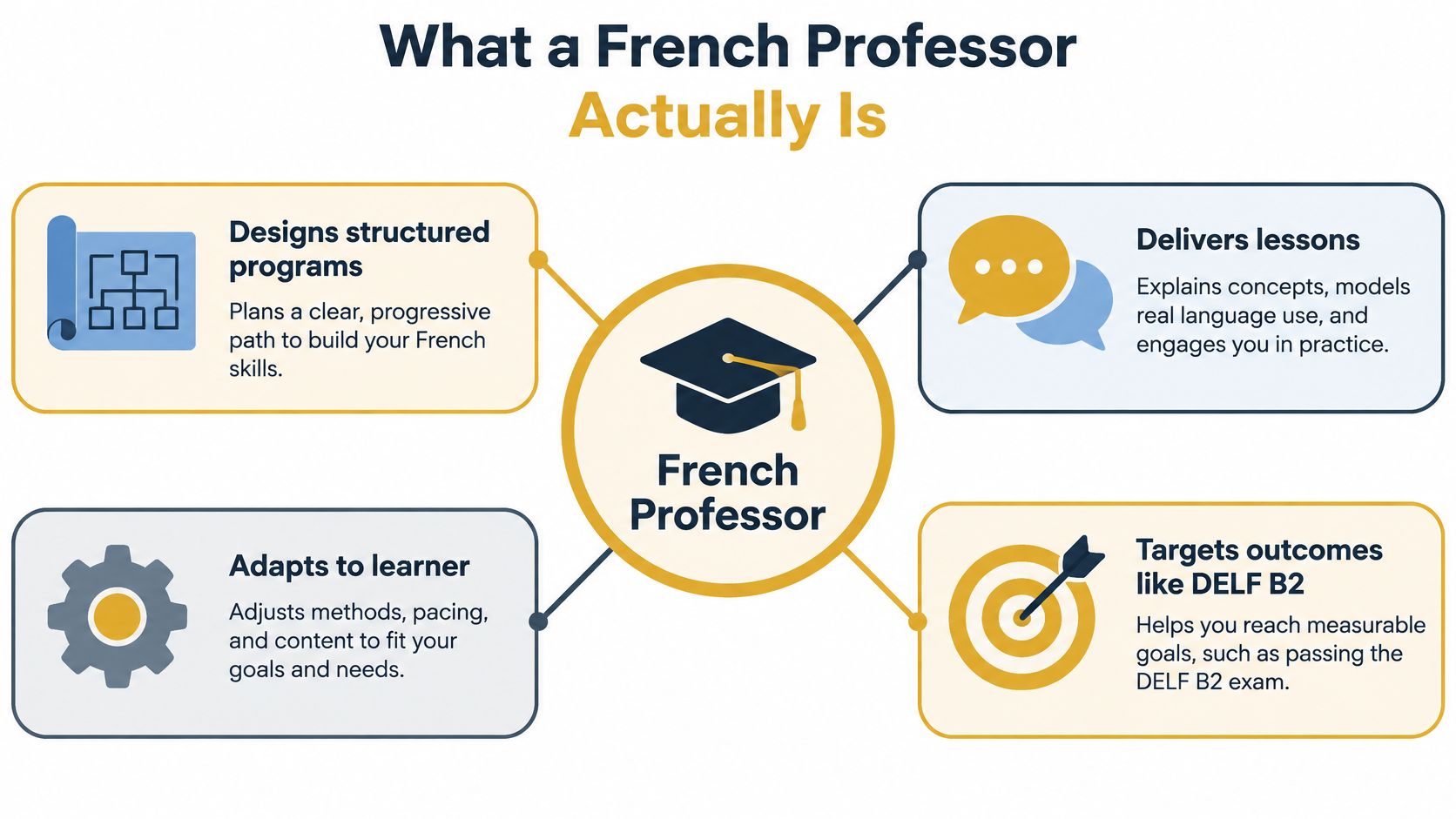
Look for program ownership
A professor-level service should begin with a destination and work backward. If you need to participate in professional discussions, the instructor should identify the language functions involved, such as clarifying a proposal, qualifying a claim, and responding to objections.
That doesn't mean abandoning grammar. It means teaching grammar where it supports the task, then checking whether you can use it under realistic conditions.
A Canadian study of 90 French-as-a-second-language teachers found that CEFR-focused professional learning shifted instruction toward speech acts, authentic materials, and action-oriented tasks; 44% identified increased oral and listening practice as producing the strongest perceived proficiency effects. These were teachers' reports, not a guaranteed improvement rate for individual learners.
Distinguish expertise from performance
I wouldn't hire a professor because they can explain an obscure grammatical point beautifully. I'd ask whether they can identify why a learner hesitates, choose a useful intervention, and determine whether it helped.
The service should include:
- Purposeful selection: Materials chosen for your task, not just your nominal level.
- Responsive teaching: Changes when your work reveals an unexpected weakness.
- Explicit expectations: A clear explanation of what you'll do independently between lessons.
A French professor isn't a grammar encyclopedia, a conversation companion, or an automatic route to exam success. Nor does every learner need this degree of oversight.
If your main difficulty is completing homework correctly, a capable tutor may be the right purchase. If you need someone to coordinate the whole learning process, look for genuine program ownership, whatever title the instructor uses.
French Professor vs Private Tutor vs Instructor
Buy the scope of work you need. I wouldn't rank these roles from inferior to superior. A strong private tutor can be a better match than an academic specialist, and a well-run group class can be preferable to private lessons for someone who values social interaction.
Use the comparison below as a purchasing framework, not a universal description of job titles. Providers can combine these responsibilities, so ask them to confirm what their fee includes.
French Professor vs Private Tutor vs Instructor
| Dimension | French Professor | Private Tutor | Language Instructor |
|---|---|---|---|
| Scope | Individualized program and ongoing adjustment | Targeted help with identified difficulties | Delivery of a defined course |
| Credentials to examine | Relevant advanced study, teaching preparation, specialist experience | Subject knowledge and evidence of effective support | Teaching qualifications and course-specific experience |
| Lesson structure | Sequenced around an individual outcome | Responsive to assignments or immediate needs | Organized around a syllabus |
| Program designer | Usually the specialist in consultation with you | May follow schoolwork or a learner's priorities | Often the school or course provider |
| Best-fit need | Complex professional, academic, or certification goal | Homework, revision, focused language support | Shared progression and group participation |
| Setting to confirm | Private online or in person | Private online or in person | Group, institutional, or private |
| Price signal to assess | Whether the fee includes design, marking, and reporting | Whether preparation and follow-up are included | Whether tuition covers group contact only or additional support |
Match the purchase to your circumstances
Parents should skip the professor label when the requirement is straightforward weekly support. Ask instead whether the tutor understands the curriculum, can explain concepts clearly, and helps the child become less dependent on adult assistance.
A professional preparing for a bilingual posting should be more demanding about specialization. I'd want evidence that the candidate can work with meeting agendas, presentations, and appropriate professional register. General conversation experience alone wouldn't persuade me.
For someone seeking enjoyable, steady practice without a deadline, a group instructor at a cultural center may offer the right balance of structure and company. There's no reason to buy intensive individual planning if you won't use it.
Compare the full cost, not an unsupported price band
I wouldn't assign a standard price range to any title without actual quotations. Instead, compare what you'll receive: live teaching, preparation, written corrections, materials, scheduling terms, and communication between sessions.
Use a French tutoring investment comparison to frame those questions, then request a written scope from each candidate. The cheaper session isn't necessarily the cheaper program if you must purchase essential support separately.
How to Vet a French Professor Before You Book
Ask candidates to show you how they think. A polished biography establishes neither diagnostic skill nor compatibility with your learning needs.
Start with relevant preparation: an advanced degree in French as a foreign language or applied linguistics, teaching certification, curriculum experience, or DELF/DALF examiner experience. None should be accepted as a substitute for seeing how the instructor would approach your work.
Use this checklist to organize the conversation.
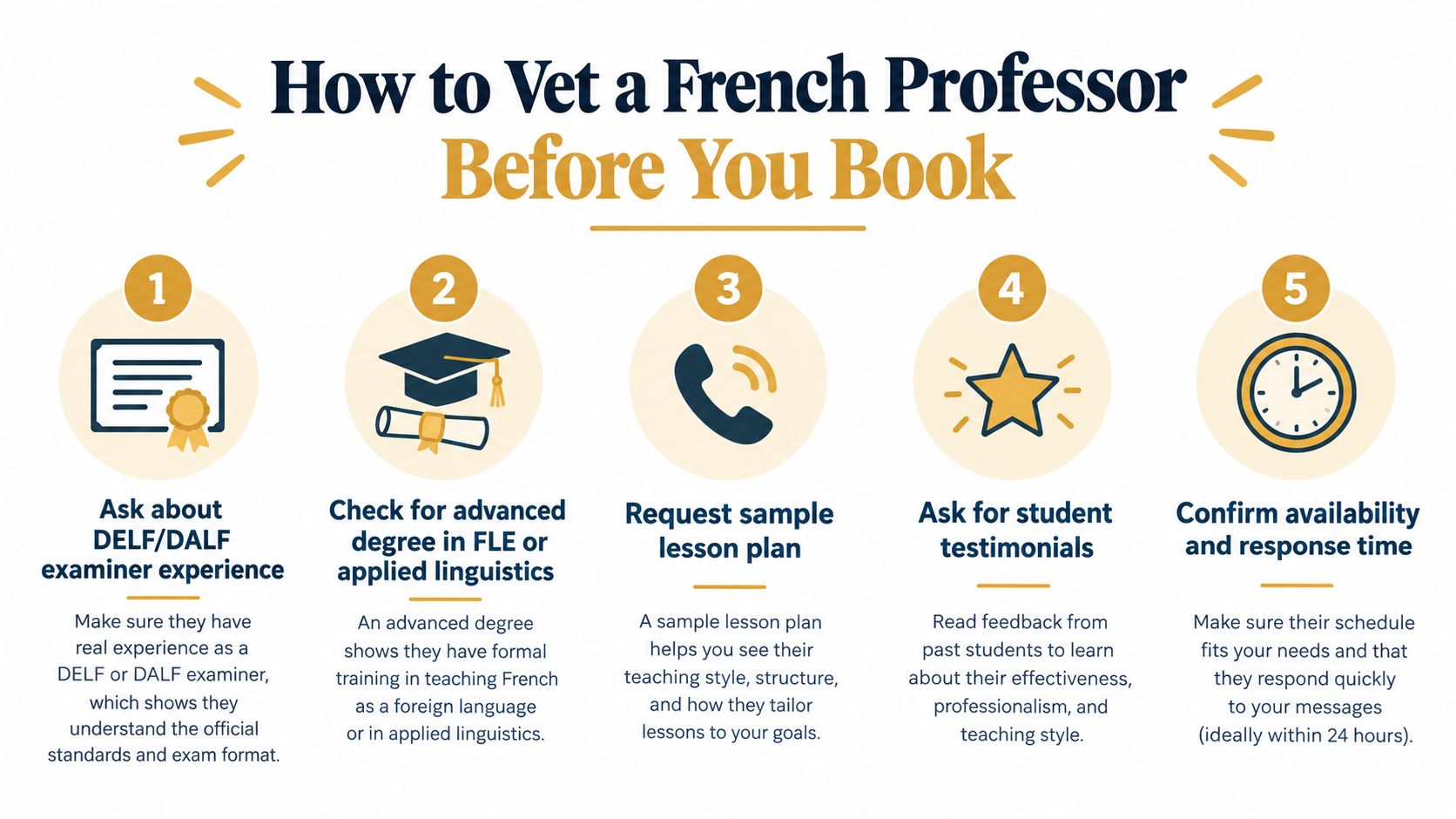
Ask for evidence you can inspect
Request an anonymized lesson plan, a corrected writing sample, or a description of how the instructor handled a comparable learning difficulty. They should protect student privacy while still explaining their methods.
For exam coaching, ask how feedback connects to assessment criteria. France Éducation international's examiner manual states that every DELF and DALF written and oral production is assessed independently by two trained, authorized examiners, with a harmonized scoring process to reconcile differences.
Private preparation doesn't need to reproduce that staffing arrangement. It should reproduce the discipline: defensible judgments, criterion-specific comments, and an explanation of what would improve the performance.
Ask these questions directly:
- Diagnosis: What work would you need to see before recommending a program?
- Level: How would you distinguish my overall proficiency from a weakness in a particular skill?
- Feedback: Can you show me what an actionable correction looks like?
- References: Can a former learner speak about a comparable goal?
- Practical fit: What are your availability, cancellation terms, and usual response expectations?
Review how CEFR proficiency levels apply to French learning before the call so you can ask about descriptors rather than accepting a vague level label.
Reject promises that bypass assessment
Native fluency and teaching competence are different qualifications. I'd rather hire someone who can explain a learner's recurring difficulty than someone who assumes that speaking naturally is enough to teach effectively.
A credible candidate can explain both what they recommend and what they still need to learn about you.
Walk away from a fixed success promise, an unexplained package, or a refusal to discuss sample materials. Be equally cautious if the instructor can't describe how they'll recognize progress.
Your screenshot-ready checklist is short: relevant qualifications, diagnostic process, sample feedback, verifiable references, and workable terms. If those are missing, don't let an impressive title settle the decision.
What a Real French Professor Program Looks Like
A well-designed first month should establish a baseline, introduce targeted work, and give you something concrete to review. I wouldn't expect a dramatic level change because a calendar month has passed.
The interaction should center on the learner's performance, with the teacher observing, prompting, and correcting deliberately.
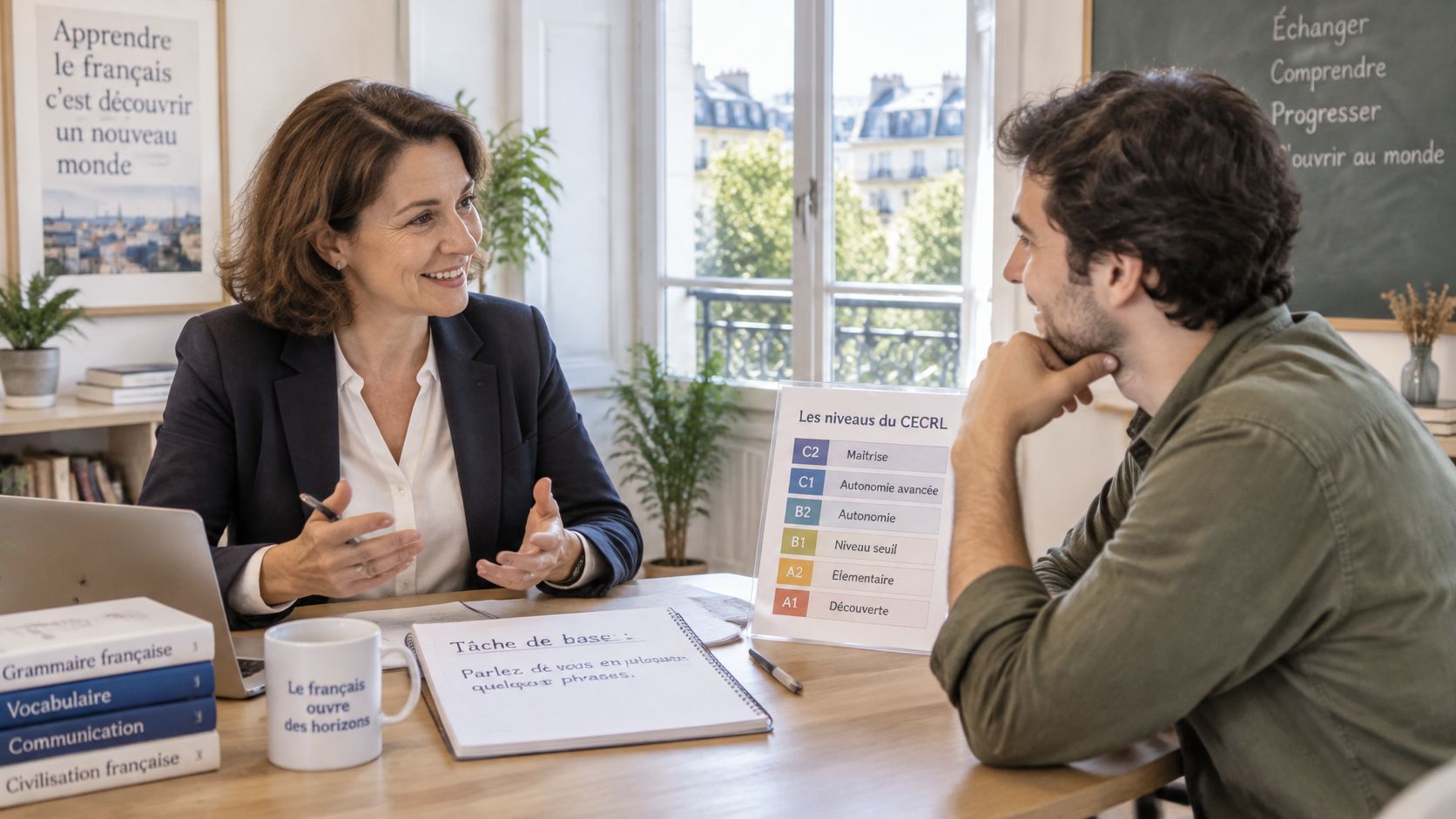
Establish a usable baseline
Begin with a diagnostic conversation and short tasks selected for your objective. A speaking sample can reveal hesitation and interaction difficulties, but it can't establish your reading or writing performance.
Keep the initial work. With permission, record the speaking task and retain the writing sample so later judgments aren't based on memory.
For a school learner, the target might be organizing a response to an assigned text. For relocation, it might be explaining a housing problem and answering unscripted questions. These are proposed instructional targets, not promises of a particular proficiency gain.
Exam preparation requires additional attention to current requirements. France Éducation international data reports 513,435 DELF and DALF registrations in 2025, alongside guidance on changes including removal of specialty fields from DALF C1 production tasks and both DALF C2 examinations. Ask the instructor which current documents they use.
Judge progress through comparable work
A practice cycle should include preparation, performance, feedback, and another attempt. Compare similar tasks rather than comparing a rehearsed introduction with an unfamiliar discussion.
Useful evidence includes clearer narration, more independent responses, better turn-taking, and more appropriate register. An encouraging conversation is welcome, but it isn't a progress report.
Use the video below as a discussion prompt about lesson expectations, not as evidence of a particular learner's results.
For exam candidates, balance matters. The official DELF A1 rules require 50/100 overall, with no skill below 5/25, across listening, reading, writing, and speaking. That's a concrete reason not to purchase conversation-only preparation for a multidimensional assessment.
I also recommend pairing coached work with manageable real-life practice, then bringing difficulties back to class. Don't assume exposure alone will correct a persistent problem.
Compare a provider's French tutoring methodology against its actual proposed schedule. If nobody can articulate the target, practice tasks, and review cadence, you're buying sessions rather than a program.
A Student Story and the Outcomes That Followed
The most useful success story isn't necessarily a dramatic individual transformation. It's one where you can inspect the starting difficulty, the intervention, and the evidence afterward.
Consider the documented experience of first-year students in a University of Ottawa pilot course. These learners needed support using French for university study, not more opportunities to memorize vocabulary.
A documented academic success story
The students came from communities where French speakers represented less than 5% of the population; more than 70% believed the course improved their French academic writing and literacy skills and increased their confidence, and participants performed significantly better in other French-taught courses than nonparticipants, according to the University of Ottawa pilot case study published by HEQCO.
This is a cohort story, not a named private-tutoring testimonial. It also isn't proof that any particular professor or lesson package will produce the same result.
What makes it relevant to a buying decision is the match between instruction and the students' real academic demands. The course addressed university-level literacy across disciplines, and the reported outcomes extended beyond students enjoying the support.
I'd apply that logic when choosing academic tutoring. Ask whether the instructor will work on the kinds of reading, writing, and reasoning the student encounters in class, rather than offer unrelated exercises because they're convenient.
Read private success stories critically
For a corporate attorney preparing for Paris, I'd look for a case study showing professional interaction and written communication. I wouldn't accept a general fluency claim as evidence of readiness for legal work.
For a child who avoids speaking, I'd want to know whether the instructor documented greater participation and increasing independence. For an exam candidate, I'd want to distinguish a practice result from an official result.
Evidence standard: A useful testimonial explains what changed, how it was assessed, and what the learner contributed.
If you read a provider's account of Emma's French-learning journey, apply the same questions. A compelling narrative should begin your evaluation, not replace it.
Ask about the learner's starting point, attendance, independent work, and assessment method. Also ask what didn't improve as quickly as expected. A candid explanation of limits tells me more about an instructor's judgment than an uninterrupted string of success claims.
Choose the candidate whose evidence resembles your challenge, not the candidate with the most glamorous client story.
Your Next Step Based on Who You Are
Your next conversation should end with a relevant recommendation, not just an available lesson slot. Send the candidate a short description of your situation and any materials they need to understand it.
Use your learner profile to choose what to request.
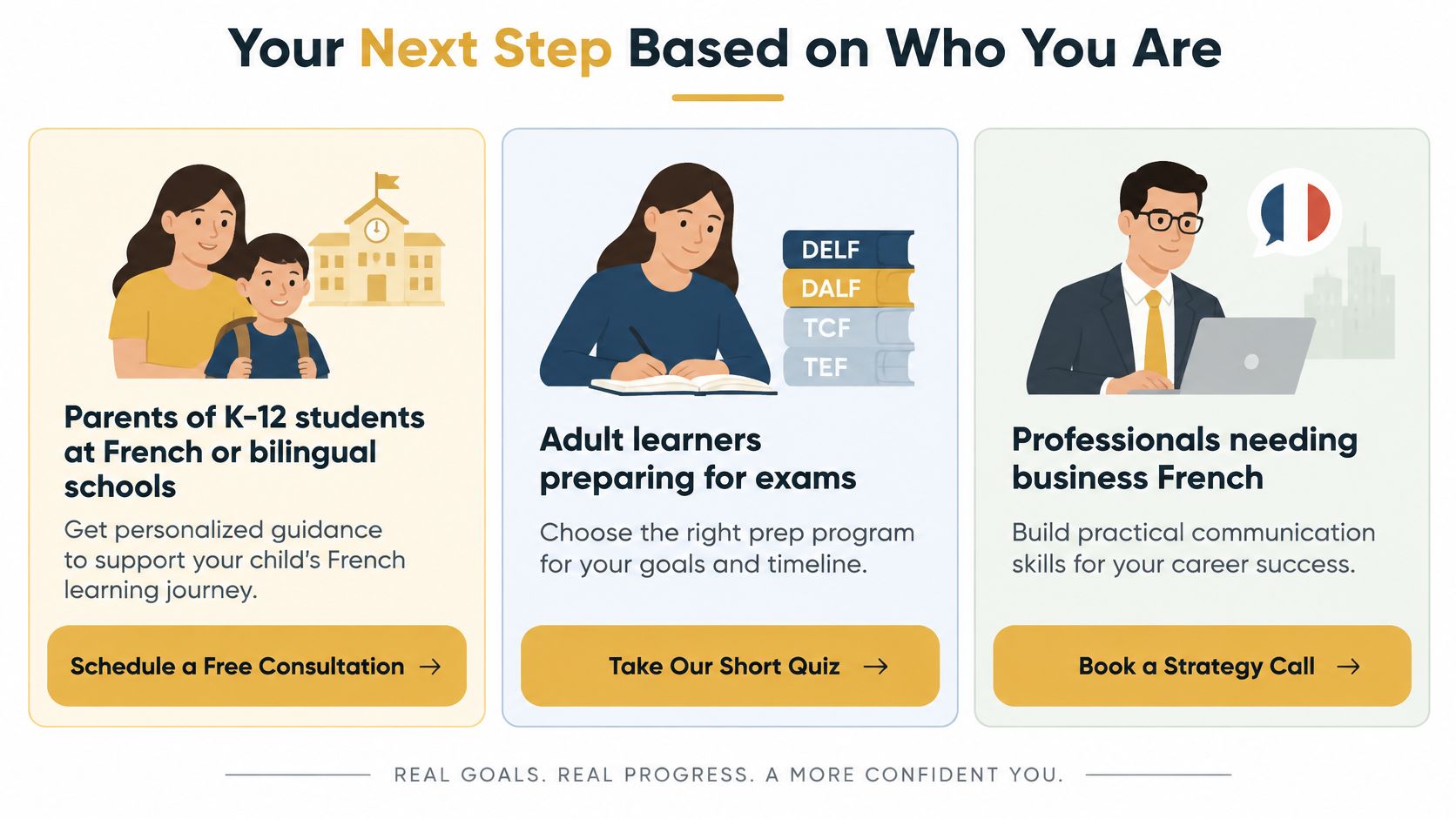
Request the right starting point
- Parents of school-age learners: Bring a recent assignment and teacher feedback. Request support connected to the next school milestone, with independence as an explicit aim.
- Professionals and corporate teams: Provide representative meeting, presentation, and writing tasks. Ask which situations the instructor would rehearse and what confidentiality arrangements apply.
- DELF and DALF candidates: Share your intended exam and deadline. Request an appropriately scored baseline and a written preparation recommendation.
- Relocation clients: Identify your immediate housing, banking, school, and professional needs. Ask for a phased plan organized around what you'll face on arrival.
- Remote learners: Confirm time-zone compatibility, document-sharing arrangements, and how speaking and written feedback will work online.
Choose a low-risk first commitment
Compare an independent specialist, a structured language-school course, and a customized private provider according to the responsibility you need them to take. Elite French Tutoring is one option offering private in-person lessons in New York and online lessons for learners elsewhere, with programs covering school support, professional communication, and exam preparation.
If that format fits, book a free 20-minute consultation and bring your goal, current challenges, and realistic availability. Ask for a recommendation built around those details. You don't need the most impressive title. You need an instructor who can explain the work ahead and help you do it.