Skip to content


You've tapped through months of app drills, you can recognise the right answer almost every time, and then a real person asks you a simple question in French and your mind goes blank. That's the gap online French conversation lessons are meant to close. We rank formats below by one thing that predicts progress, minutes of live, corrected speaking per week, then set that against monthly cost so you can choose on fit and budget together.
Table of Contents
- Online French Conversation Lessons at a Glance
- How a Live Lesson Unfolds, Step by Step
- Matching Format to Speaking Anxiety and Schedule
- Checklist for Choosing a Tutor or Program
- What Online French Lessons Cost per Hour
- What One Structured French Program Achieved
- Making Progress Between Lessons
- Book a Trial Lesson Before You Commit
Online French Conversation Lessons at a Glance
Say you've spent two years on an app. You land in Lyon, a stranger smiles and asks where you're from, and you freeze. You know the words. You've never had to retrieve them, in order, out loud, while someone waited for an answer. Recognising French isn't speaking French, and I see that distinction trip up diligent learners more than any grammar rule.
An online French conversation lesson is a scheduled session where a native French tutor holds the conversation with you, corrects your mistakes, and adapts the topic to your level and goal. You're not watching a recording or tapping answers. You're producing French in real time and getting told, kindly and specifically, what to fix.
What each format actually gives you
| Format | Live speaking per week | Who gives feedback | Best for |
|---|---|---|---|
| One-to-one live (video or audio) | Largest share, you talk for most of the session | Your tutor, in real time | Speaking goals, exam prep, professional French |
| Small group live | Shared among participants | Tutor and peers | Budget-friendly practice with regular speakers |
| Asynchronous exchange | Recorded tasks, reviewed later | Tutor, in writing or audio | Busy schedules and time zone gaps |
| AI conversation practice | High volume, low stakes, no fixed minutes | Automated, so errors need a human check | Vocabulary and repetition between lessons |
| Self-paced course with occasional calls | Limited unless calls are booked | Course tutor on booked calls only | Learners who need a fixed syllabus |
The trade-off is plain arithmetic. In a one-to-one lesson, you do most of the talking, so nearly every error you make gets heard. In a group of six, that same hour is divided, and you may listen far more than you speak. Listening helps, but it doesn't train the retrieval that failed you in Lyon.
Practical rule: Choose the format by how many minutes of live, corrected speaking you can fit into each week, not by the lowest sticker price.
If you can only protect one slot a week, I'd spend it one-to-one rather than spread thinly across group sessions where you barely open your mouth. If you have three or four slots, a mix of one-to-one correction and cheaper group or AI volume often works better than either alone. Fit first, price second, and the rest of this guide gives you the checks to apply in that order.
How a Live Lesson Unfolds, Step by Step
A useful session isn't a pleasant chat with a phrase list. It's built around breakdowns, the moments where your French doesn't quite carry your meaning and you have to repair it. The Cambridge Handbook chapter on interaction in second-language learning describes interaction as activating modified input, corrective feedback, and modified output, with learner attention directed toward linguistic features and subsequent noticing. In plain terms, you notice a problem, you adjust, and you produce something more precise. That's where learning happens.
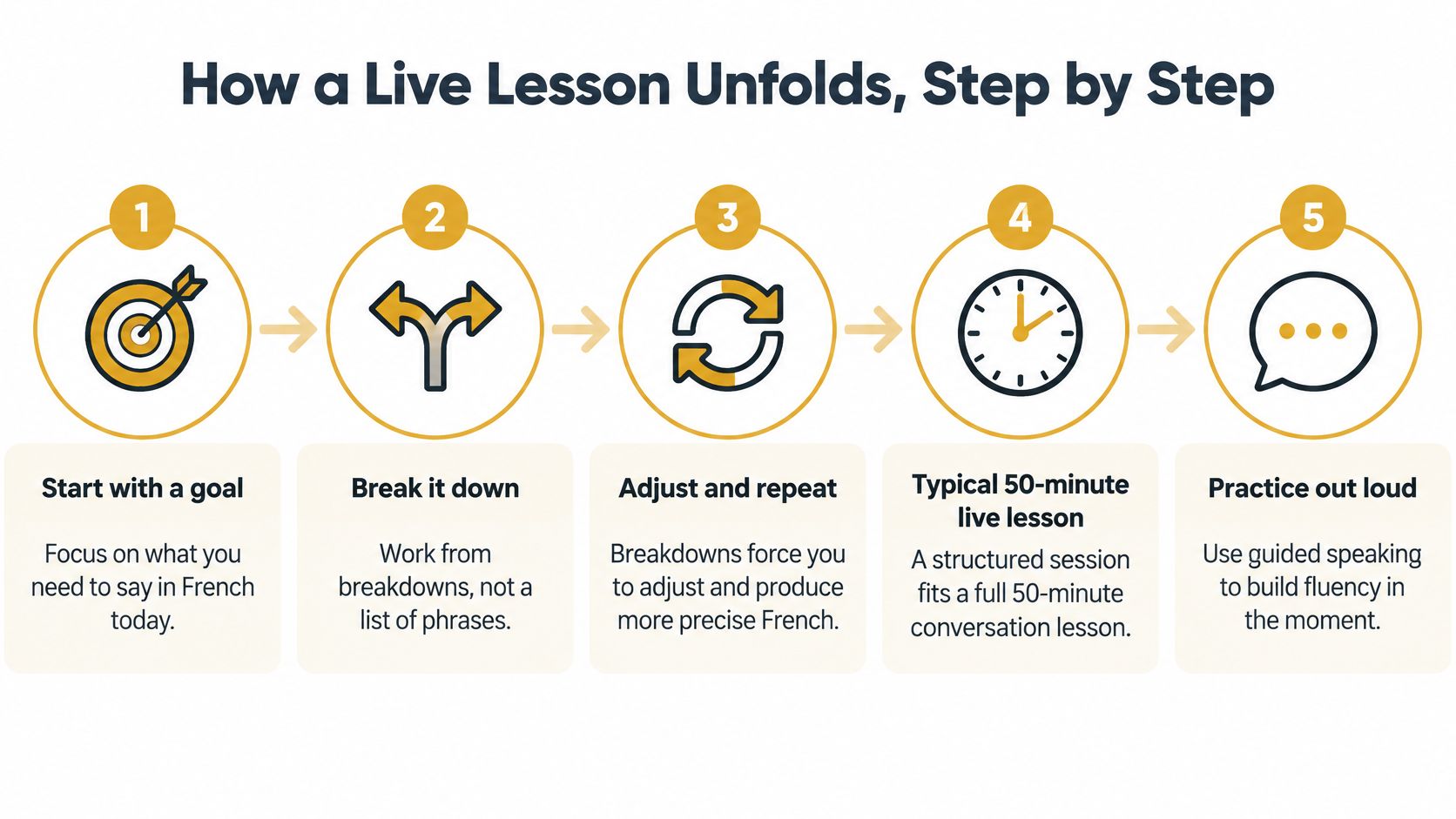
Here's how we structure a typical 50-minute session.
Warm-up, about 5 minutes. Your tutor asks about your week and introduces today's topic in French. This lowers the temperature and activates vocabulary you'll need shortly, so you aren't reaching for cold words mid-task.
Task set-up, about 5 minutes. You get an information-gap task or role-play, such as agreeing a project deadline with a colleague. Each of you holds information the other needs, so you can't finish without asking real questions.
Main conversation, 25 to 30 minutes. You speak, your tutor listens and responds naturally. For a professional learner this might mean negotiating a deadline. For a DELF or DALF candidate it might mean defending a position against polite pushback, under mild time pressure.
Where the correction actually lands
Repair moments, inside the conversation. When meaning breaks down, you clarify, paraphrase, and try again rather than switching to English. Those repair strategies are a skill in themselves, and they're exactly what you'll need with a stranger who can't slow down for you.
Corrective feedback, 5 to 8 minutes. Your tutor works from notes on your recurring errors, offers a short reformulation, and asks you to reuse the corrected form at once in a new sentence. Immediate reuse matters. A correction you only nod at rarely survives until next week.
Reflection, 3 to 5 minutes. You write down three corrected phrases to practise before the next session. Three is deliberate. It's few enough that you'll say them aloud during the week.
A good session leaves you with three phrases you can say on purpose, not thirty you merely recognise.
If a trial lesson skips the task and the feedback record, you've bought conversation quantity, not quality. Ask for both before you judge the tutor.
Matching Format to Speaking Anxiety and Schedule
Speaking pressure isn't a character flaw, and it changes which format will help you. A study reported in the Cambridge journal Language Teaching on speaking anxiety and online learning surveyed 262 learners and found that 45.5% of participants in a group with additional mental-health needs strongly agreed they often felt tense when speaking their target language, compared with 25.3% in the comparison group. Only 16.7% of the former group said they felt confident when required to speak, compared with 30.3%, and spoken assignments were strongly anxiety-provoking for 36.4% versus 15.8%.
Read those figures carefully. They come from learners with additional mental-health needs, so they show how much pressure can matter at the sharp end, not what the average learner feels. I use them as a reminder to take format seriously, not as a diagnosis of you.
Three choose-this-if rules
- Choose one-to-one live lessons if you freeze in front of others and need slower, individually paced correction. A predictable structure and a tutor who adjusts to you remove the audience, which is often the main problem.
- Choose a small group if you want regular peers and a lower hourly cost, and you accept that speaking time is shared. Groups also give you other accents and other people's mistakes to learn from, which has real value once basic confidence is in place.
- Choose asynchronous recordings if you need to rehearse before speaking live, or your schedule crosses time zones. You record when you're calm, your tutor replies with corrections, and you build toward live sessions rather than dreading them.
On video versus audio, I'd stay with what you can verify for yourself. A webcam adds gesture, gaze, and facial cues that support meaning, and some learners feel more connected on camera. Others talk more freely without watching themselves, and audio-only practice is a fair rehearsal for phone calls, where no visual help exists.
So run a small test before you commit. Book one video trial and one audio-only trial, with the same kind of task in each. Note which one leaves you talking more, repairing more, and dreading the next session less. Your own speaking minutes beat anyone's general advice, including ours.
Checklist for Choosing a Tutor or Program
Most buying mistakes happen because learners pay first and investigate later. Every item below can be verified with one direct question before money changes hands.
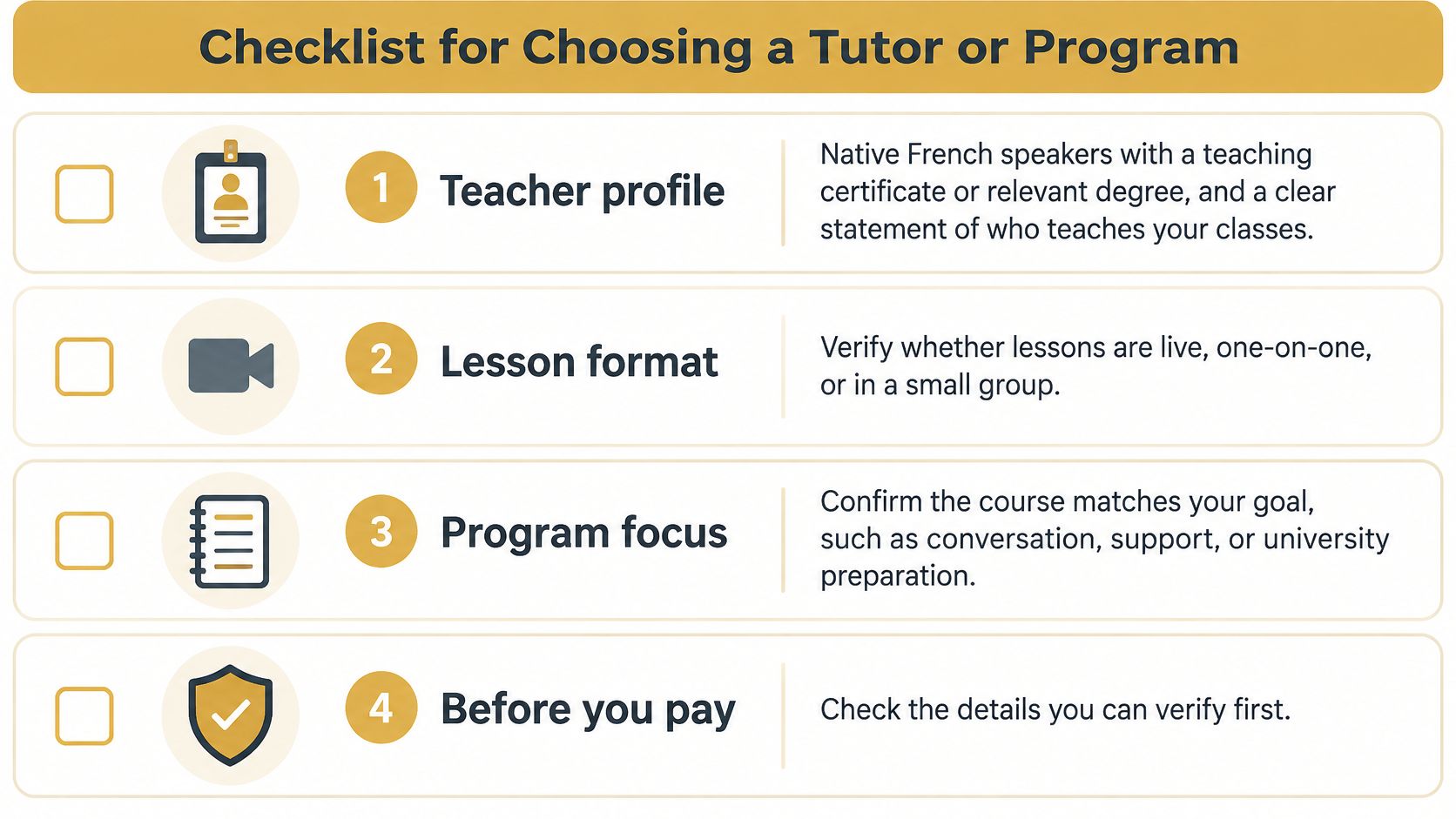
Teacher profile. Look for native French speakers with a teaching certificate or relevant degree, and a clear statement of who teaches your lessons. Our own teachers are all native French speakers, and a profile that won't name your tutor is a warning sign.
Level assessment. You want a short call or test that places you at a level and sets a speaking goal. Our guide to finding the right French tutor as an adult learner walks through what a sensible assessment covers, and no assessment at all usually means generic lessons.
Instructor continuity. Ask whether the same tutor stays with you across sessions. Continuity lets one person track your recurring pronunciation slips and word-retrieval gaps instead of rediscovering them every week.
Feedback record. You should receive notes after each session listing errors and next steps. If corrections live only in the call, they'll evaporate by Thursday.
Session length. Confirm whether short exchanges are the default. Very brief sessions can lose a large share of their minutes to introductions and small talk, especially with a rotating tutor.
Exam alignment. For DELF or DALF, check for level-specific mock speaking interviews, not just friendly conversation.
Why exam alignment deserves its own check
The DELF scoring guide from French Journey sets out that the DELF is scored out of 100 points across four equally weighted skills, listening, reading, writing, and speaking, with 25 points assigned to each. Candidates generally need at least 50 points overall to pass, but must also earn at least 5 points in every skill. Speaking is assessed on completion of the interview stages, interaction quality, naturalness, and the accuracy and range of French, not just the number of grammatically correct sentences.
| Goal | What the task demands | What to verify before booking |
|---|---|---|
| DELF or DALF exam | 25 points per skill, at least 5 in each | Mock speaking interview at your target level |
| Business or professional French | Negotiating deadlines, meetings and email | Tutor who uses work-context scenarios |
| Children or school support | Curriculum-aligned topics and clear pronunciation | Tutor experienced with school-age learners |
| Travel or relocation | Everyday situations and asking for help | Role-play sessions in realistic settings |
| Academic French | Discussion and writing in French | Assessment that includes writing as well as speaking |
A conversation package without assessment or mock interviews doesn't replace exam preparation, however fluent the sales page sounds.
What Online French Lessons Cost per Hour
Start with benchmarks, then interrogate them. In 2025, Kapdec's guide to US private tutoring rates reported that online private tutoring in the United States generally cost $25 to $50 per hour. Separately, Tutorbase's summary of average tutoring prices put language instruction at $30 to $60 per hour in 2025. These are US figures, so treat them as a reference point and check rates where you live and in your tutor's market.
What the hourly rate should buy
You're not buying minutes on a call. A defensible rate covers prepared materials matched to your goal, a level assessment that sets your starting point, and written feedback notes you can revise from. If none of that is included, you're paying a tutoring price for an unstructured chat, and our breakdown of whether a French tutor is worth the investment explains how to weigh that trade-off in more detail.
| Monthly plan | At $25 per hour | At $40 per hour | At $60 per hour |
|---|---|---|---|
| Four 45-minute sessions (3 hours) | $75 | $120 | $180 |
| Eight 45-minute sessions (6 hours) | $150 | $240 | $360 |
Those totals exclude any materials fees, so ask whether materials are included before you compare quotes. Set them beside a small group class or an app subscription if you like, but get those prices from the providers themselves, since we haven't listed unverified figures here.
Budget rule: Set your monthly hours first, then pick the format that gives the most corrected speaking per dollar.
A cheap rate with no level test often means paying for sessions that repeat easy conversation you're already comfortable with. Comfortable isn't the same as progressing. Before committing, ask whether the first session or assessment is free, what happens to unused sessions, and whether the rate changes after an introductory period. Three short questions, asked now, prevent most billing surprises later.
What One Structured French Program Achieved
A structured course can be judged by what it aims to improve and how that change is measured. A Higher Education Quality Council of Ontario case study of a University of Ottawa French support course offers one example. Piloted during 2012 to 2013, the course supported students preparing for university coursework delivered in French. Of 69 students who completed it, 58 were included in the analysis. Their mean GPA in the support course was 7.12, compared with 5.87 in their other courses, a statistically significant difference at p < .01. More than 70% of participants felt the course improved their writing and literacy skills and their confidence writing in French for academic purposes.
The result has limits. The researchers cautioned that the small sample restricts generalizability, and the positive effect did not extend to students' other foundational French courses. The finding supports a narrower conclusion: instruction tied to a specific objective can improve a measured outcome related to that objective. It does not show that every French program produces the same result.
Before paying any provider, ask three questions: What goal will be measured? What starting point will be recorded? What should change within eight weeks? A clear answer to each helps you judge whether the course has a defined purpose and a way to track progress.
For a separate example of a French-learning journey, read the account of Emma's six-month study experience. Treat any individual story as context, not a guarantee of results. Compare providers by the corrected speaking time they offer each week, then set that against the monthly cost and the specific progress they propose to measure.
Making Progress Between Lessons
Lessons create corrections. The days between them decide whether those corrections stick. These habits are short on purpose, because a routine you'll repeat consistently beats an ambitious one you'll abandon by week three. Our practical guide to practising French conversation expands on several of them if you want more drills.
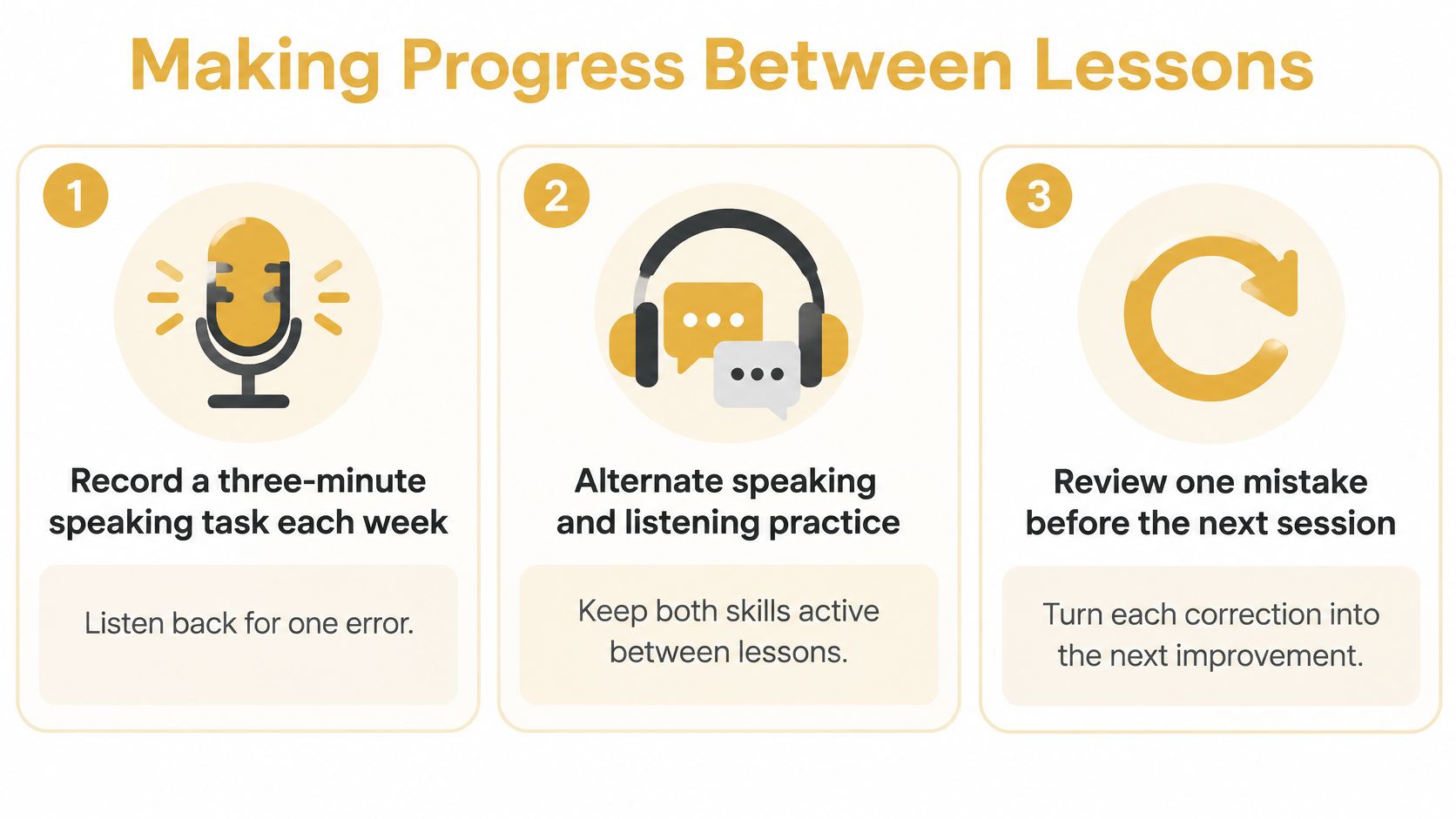
Record a three-minute speaking task each week. Describe your weekend or explain a work problem, then listen back for one error only. One target keeps the task bearable and gives you a recording to compare against next month.
Alternate video-rich lessons with audio-only practice. If you can only sustain a conversation while watching someone's face, a phone call will undo you. Audio-only rounds force you to listen harder and signal confusion clearly.
Use AI conversation practice for retrieval and repetition. A 2025 study summary of mobile language app learners' self-efficacy covering 385 French and Spanish learners found that one month of AI conversation features increased reported self-efficacy for real-life situations, sharing opinions, navigating a city, speaking, and understanding grammar and errors. That's encouraging, but feeling more confident isn't the same as being verified accurate, so keep a human checking your errors.
Habits that compound quietly
Keep a running list of mistakes your tutor repeats. Rehearse those first, out loud, in full sentences. Recurring errors are your personal syllabus, and they're worth more than any generic word list.
Plan the next session's topic in French. Write five rough sentences beforehand. You'll cut the small talk that eats early minutes and arrive with vocabulary already warm.
Measure progress with tasks, not hours. Can you order a meal, reschedule a meeting, or explain a delay unaided this month when you couldn't last month? Task-based proof tells you whether to renew, switch format, or raise the difficulty.
Shorter, well-scaffolded sessions with a clear task often beat longer unstructured chat. If your between-lesson work is focused, even one solid session a week keeps momentum. If it isn't, three sessions a week will mostly rehearse the same comfortable French.
Book a Trial Lesson Before You Commit
Don't buy a term of lessons on a sales page. Book one trial, judge it against the checks above, then decide.
- Shortlist two formats based on your speaking goal and the weekly hours you can realistically protect.
- Book a free assessment call. We offer a complimentary 10 to 20 minute call in which our experts assess your French level and goals, and our online lessons are delivered anywhere in the world at times to suit you.
- Ask for a goal-matched speaking task, such as a DELF-style interview or a work scenario, and confirm the tutor keeps a feedback record.
- Confirm time zone and lesson length, since a very short exchange may leave little room for real speaking after introductions.
Look for a tutor who stretches you without steamrolling you. Our student Alexa describes Pierre as an amazing French tutor who pushes students to challenge themselves, and that balance is exactly what a trial should reveal.
If the assessment call makes sense, book your trial lesson with us, run it against one alternative from this guide, and keep whichever session leaves you with more corrected French you can actually say.