

You enroll in a French course, feel relieved that you finally picked a program, and then the email arrives: you need to take a French placement test first. For most students, that's the exact moment confidence drops. They start wondering whether they've forgotten everything, whether one weak section will ruin their chances, or whether they should cram before clicking “begin.”
I tell students the same thing every week. A placement test french requirement isn't there to punish you. It's there to stop you from wasting time in the wrong class. If you're placed too low, you get bored. If you're placed too high, you spend every lesson catching up. Neither is good value, especially if you're paying for private lessons, a university course, or a language program tied to work, travel, or relocation.
After guiding many learners through these tests, I've seen the same pattern again and again. The students who do best are not the ones who try to “game” the test. They're the ones who understand what the result is for, take it with integrity, and then use it to build a smarter learning plan.
Table of Contents
- That Email Just Landed Your French Placement Test Guide
- What a French Placement Test Actually Measures
- Decoding Different Test Formats and Scoring Systems
- Representative Sample Questions and How to Answer Them
- From B1 to Business Ready A Student Success Story
- Create Your Personalized Prep Plan and Next Steps
- Frequently Asked Questions About French Placement Tests
That Email Just Landed Your French Placement Test Guide
The emotional swing is predictable. One minute you're excited about learning French. The next, you're staring at a testing link and thinking about every verb tense you've ever mixed up.
That reaction is normal. It's also usually based on the wrong assumption.
A French placement test is not a final exam. It isn't asking whether you “deserve” to study French. It's trying to identify where your current skills will let you learn efficiently. That's a very different question. When students understand that, they stop trying to impress the test and start giving an honest performance.
I've worked with students who came back to French after years away, parents trying to support children in bilingual schools, and professionals who suddenly needed French for a transfer or interview. The anxious ones often said the same thing: “I don't know what level I am, so I don't know how to prepare.” The answer is simple. You prepare by aiming for accuracy, not by trying to look advanced.
Why the email feels bigger than it is
Part of the stress comes from uncertainty. You don't yet know the format, the timing, or what happens if the result feels off. That uncertainty makes the test feel high stakes.
In practice, the result is only useful if it's honest. If you overprepare only the narrowest test tricks, you may place too high and then spend weeks in a class that moves too fast. If you rush and underperform badly, you may end up reviewing material you already know. The right placement sits in the middle. It should feel slightly challenging, not punishing.
Practical rule: Your goal is not to “beat” the placement test. Your goal is to land in the course or tutoring plan that fits your real working level.
A lot of students also confuse a placement test with a decision about whether private support is worth it. They're separate questions. The score tells you where you are. The better question after that is how quickly and how efficiently you want to move from that point. If you're weighing that decision, this guide on whether a French tutor is worth the investment is a useful next read.
What students usually need to hear first
Before you open any test portal, remember three things:
- Placement is diagnostic: The result exists to guide class level, lesson design, or teacher recommendations.
- Uneven skills are common: Many people read better than they speak, or know grammar rules they can't use spontaneously.
- A surprising score is fixable: If the result and your actual classroom experience don't match, instructors can usually adjust.
That's why I like to treat the placement test as the first useful piece of data in your learning plan, not the final word on your French.
What a French Placement Test Actually Measures
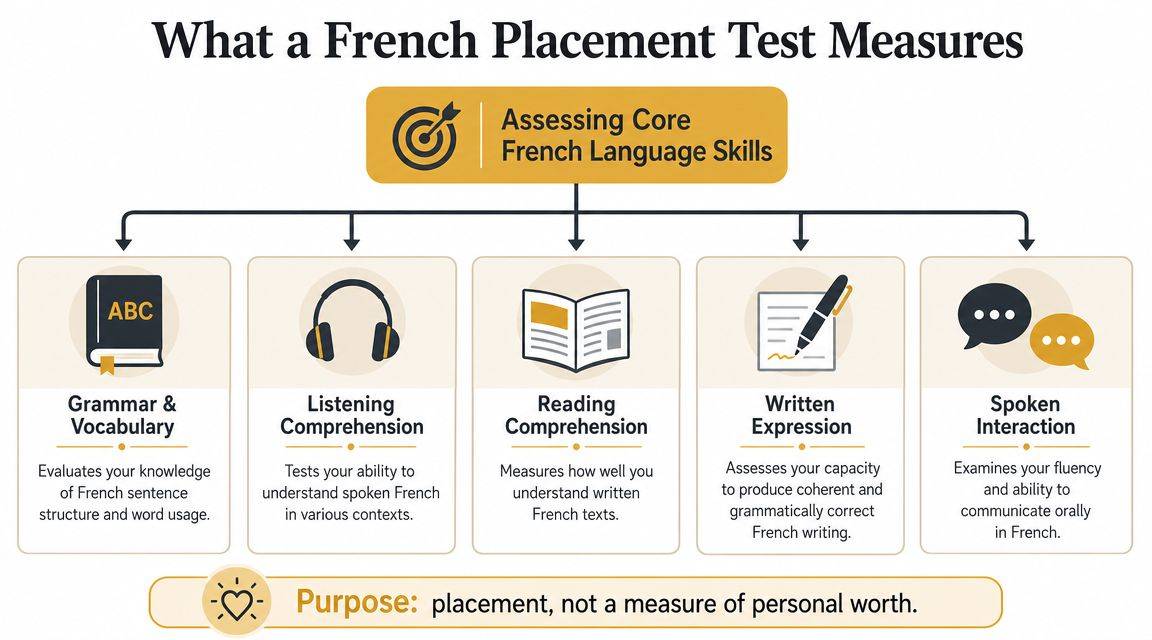
A French placement test measures usable ability, not just stored knowledge. The goal is to see what you can recognize, process, and produce with enough consistency to succeed in the next class, tutoring plan, or program level.
That distinction matters. A student may remember plenty of grammar terms and still struggle to follow spoken French or build a clear answer under time pressure. Another student may speak with confidence but make frequent written errors. Good placement looks at the whole profile because that is what helps a teacher build the right starting plan.
The core skills most tests look for
Grammar and vocabulary show how well you control the building blocks of the language. Examiners are usually looking for dependable use, not perfect textbook recall. Can you choose the right tense, article, pronoun, or common expression quickly enough to keep meaning clear?
Reading comprehension checks whether you can get meaning from a text without translating line by line. Students who place well here usually spot structure fast, infer unfamiliar words from context, and separate the main point from supporting detail.
Listening comprehension often gives the clearest picture of your current level. Many learners look stronger on paper than they do with real audio. If you can follow instructions, identify key details, and catch the speaker's intent at a natural pace, your placement becomes much more accurate.
Then come the productive skills, where passive knowledge has to turn into output.
- Writing shows whether you can organize ideas, connect sentences logically, and control common spelling and verb forms.
- Speaking shows fluency, hesitation patterns, pronunciation, and how well you keep communicating when you do not have time to stop and edit yourself.
Why this matters for your placement result
The strongest placement tests do not treat French as a pile of rules. They check whether those rules are available when you need them. That is a practical difference, and it affects what happens after the score.
I have seen students ace multiple-choice grammar questions and then freeze in a short interview. I have also taught students whose written accents and agreements were inconsistent, but who could manage a useful, natural conversation. Those students need different next steps, even if they look similar on a narrow test.
That is why I tell students to read their result as the first useful map of their learning plan. If your profile shows stronger reading than speaking, tutoring should focus on active production. If listening is lagging behind everything else, the plan should address that early. Used well, the placement test is not a hurdle. It is the starting point for more efficient, more targeted French study.
The best placement result is the one that shows where your French is solid, where it breaks down, and what to work on first.
If your report mentions A1, B1, or C1 and you want a clearer practical meaning, this guide to mastering French language proficiency CEFR levels will help you match the label to real-world ability.
Decoding Different Test Formats and Scoring Systems
Not all placement tests are built the same way. A university often needs a standardized process that can sort large numbers of students into curriculum levels. A private language school usually wants a more flexible diagnostic picture, especially if the next step is a customized course.
That difference matters because students often panic when they compare one test experience to another. They shouldn't.
What changes from one institution to another
Some university tests are tightly timed, mostly objective, and delivered online. A representative example is 88 questions in 75 minutes through the University of California, Irvine testing center's French placement format, which places students into specific lower-division levels. That format shows how an efficient test can still separate learners across multiple course levels, as described on the UCI French placement overview.
Other university models use a different scoring logic. The University of Wisconsin explains that its French Placement Test grew out of a collaboration between UW System faculty and Wisconsin high school teachers beginning in 1984. It offers two separate tests, one for language usage and one for reading comprehension. UW also allows 60 minutes, converts a raw correct score to a 150–850 scale, and applies no penalty for guessing. That structure appears on the University of Wisconsin French Placement Test page.
Private language schools often add a human layer. A written diagnostic may be followed by a short conversation, a review of past study, or a discussion of goals. That format is usually less rigid and more useful for building a customized program.
Comparison of French Placement Test Types
| Feature | Typical University Test | Private Language School Test (e.g., Elite French Tutoring) |
|---|---|---|
| Main purpose | Place students into curriculum levels | Match learner to the right lesson plan, teacher approach, and pace |
| Format | Often multiple-choice and online | Often mixed format, with written tasks plus conversation |
| Timing | Usually tightly timed | Usually shorter and more flexible |
| Scoring | Standardized scale or course-placement bands | Diagnostic interpretation based on strengths, gaps, and goals |
| Best for | Large-volume academic placement | Personalized learning decisions |
| Common weakness | Can underrepresent speaking confidence | Can feel less familiar if you expect a traditional test |
How to read the score without overreacting
Students often make two mistakes with scores.
First, they treat the number as an identity. It isn't. A score is a placement tool. Second, they assume one weak section invalidates the whole result. Usually, it doesn't. Uneven profiles are normal.
If your placement comes back lower than expected, ask better questions than “How did I do?” Ask these instead:
- Which skills pulled the result down: Reading, listening, grammar, writing, or speaking?
- What setting is this score for: University sequence, private tutoring, exam prep, or business communication?
- How was the score interpreted: Automatic level assignment or teacher review?
A B1-level result for academic placement can still hide a very practical issue such as weak spoken spontaneity. The opposite also happens. A student may communicate well but need structured grammar review before joining a formal class.
That's why I always tell students to treat the number as the start of the conversation, not the end of it.
Representative Sample Questions and How to Answer Them
Seeing the shape of the questions lowers anxiety fast. Even when the exact items differ, the logic behind them tends to repeat.

A grammar question that tests control not memory
A typical item might look like this:
Hier, nous ____ au musée avant le déjeuner.
a) allons
b) sommes allés
c) irions
d) allons aller
What is this really testing? Not whether you remember one isolated rule, but whether you can connect a time marker like hier with the tense that fits the sentence.
The best strategy is to scan for time clues first. “Hier” points to a completed past action. That should immediately make you suspicious of present or conditional forms.
How to think through the distractors:
- a) allons is present tense, so it clashes with the time marker.
- c) irions is conditional, which doesn't fit the context.
- d) allons aller suggests a near future, which also clashes.
- b) sommes allés matches a completed action in the past.
The right habit is not memorizing the answer pattern. It's noticing the signal word before you even look at the options.
A reading question that rewards calm scanning
You may get a short passage about work, school, travel, or daily life followed by a main-idea question. Students often sabotage themselves by trying to translate everything.
Don't.
Read the title, first sentence, and last sentence first. Then identify repeated ideas. If an unfamiliar word appears once, it may not matter. If a theme appears three times, it probably does.
When you don't know a word, ask whether you need it to answer the question. Often you don't.
For main-idea questions, I tell students to avoid choices that are too narrow. A detail may be true without being the point. The best answer usually covers the whole passage, not one sentence from the middle.
A listening or speaking task that checks functional ability
In listening, the trap is rushing. Students hear one familiar word, assume the topic, and stop listening carefully. Better results come from tracking the speaker's intention. Are they inviting, comparing, apologizing, explaining, or asking for help?
In speaking, the examiner usually isn't hunting for elegant phrasing. They want to know whether you can respond, clarify, and keep the exchange moving. If you need a second to think, that's fine. A simple correct answer is better than an ambitious broken one.
Try these habits:
- For listening: Write one or two keywords only. Full notes slow you down.
- For speaking: Start with a clear basic sentence, then add detail if you have it.
- For both: Don't chase perfection. Functional communication places you more accurately than rehearsed complexity.
From B1 to Business Ready A Student Success Story
One student I worked with, David, came in for a career reason rather than an academic one. He was a corporate lawyer preparing for a possible move to Paris. His company's internal placement process put him at B1, which sounded encouraging on paper, but he didn't trust it. He said he could read documents and follow familiar topics, yet his speaking confidence collapsed in live conversation.

What the placement result showed
The B1 label wasn't wrong. It was incomplete.
His reading and grammar were stronger than his spoken performance. That profile is common in professionals who learned French in school, then used it mostly passively. They can recognize a lot, but retrieval under pressure is slow. In meetings, that delay feels much bigger than it looks on a placement report.
What helped most was treating the result as directional, not definitive. We used it as a baseline and then asked a more practical question: what did he need to do in French at work?
What changed once the plan matched the goal
His program shifted away from generic intermediate review. Instead, we focused on legal and business vocabulary, structured speaking drills, and simulated client conversations. We practiced summaries, interruptions, clarifications, and formal meeting language. The point was to turn passive knowledge into usable speech.
That's the difference a good interpretation makes. A placement test can tell you level. It cannot by itself build the bridge between level and real-world performance.
If you like seeing how personalized planning changes outcomes, this student story about how Emma mastered French in just six months shows the same principle in a very different context.
Create Your Personalized Prep Plan and Next Steps
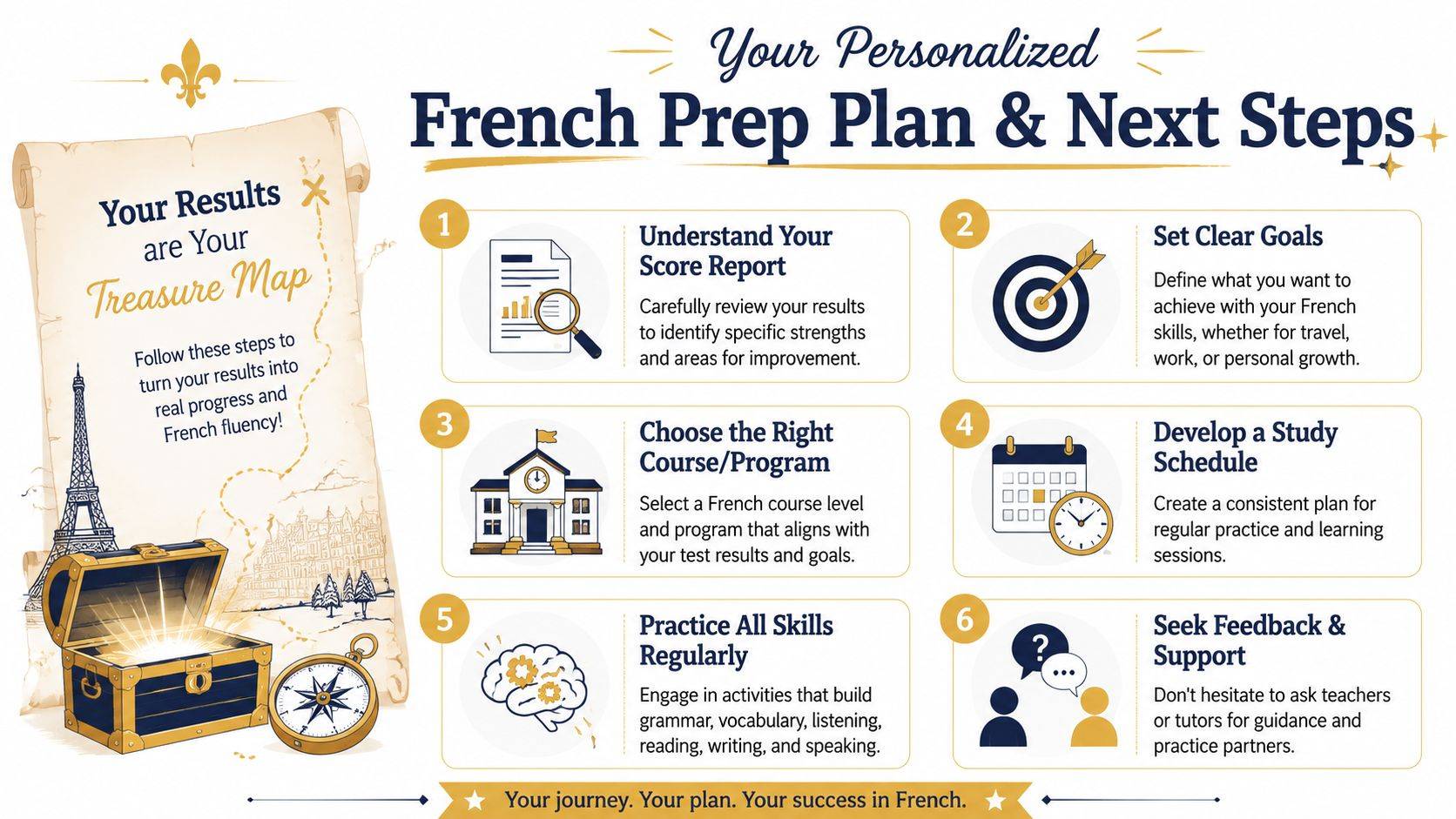
Once your result arrives, most of the value is still ahead of you. The score report is useful because it shows where effort will pay off fastest.
Common score profiles and what to do next
Some patterns appear constantly.
Strong reading, weak speaking
You likely have enough vocabulary input, but not enough retrieval practice. Prioritize live conversation, short response drills, and repetition of everyday structures out loud. Reading more won't solve the core problem by itself.
Good grammar, weak listening
This student usually learned French through textbooks. Shift toward audio with transcripts, then re-listen without the text. Focus on identifying chunks, not every word.
Comfortable speaking, messy writing
This profile often appears in bilingual environments or among socially confident learners. The fix is more structured. Do short written tasks, get corrections, and recycle the corrected forms fast.
Flat across all skills
Keep it simple. Build consistency before intensity. A modest weekly schedule that touches all core skills beats random bursts of study.
A prep plan works better when it ties directly to the result:
- Match activities to weaknesses: Don't spend most of your time on the skill that already carried you.
- Use the target context: Academic French, travel French, business French, or exam French each require different emphasis.
- Review errors by category: Articles, verb forms, listening gaps, pronunciation, or sentence structure.
A placement result is a map. It only becomes useful when you decide where you're trying to go.
When tutoring makes the placement result more useful
Self-study helps, especially for maintenance. But it often misses the diagnosis behind the diagnosis. A score might say “intermediate.” A good tutor can tell you whether the bottleneck is speed, confidence, listening discrimination, grammar transfer, or limited active vocabulary.
If you need a structured path after a B1-style result, this guide to DELF B1 preparation is one useful benchmark for the kind of work that turns an intermediate label into reliable performance.
For learners who want a personalized route rather than a fixed course sequence, one option is Elite French Tutoring, which offers a consultation-based assessment and builds custom private lessons around the student's goals, level, and learning style. That model is especially relevant when your placement result doesn't tell the full story of what you need next.
If your test is coming up and you'd like help turning the result into a realistic lesson plan, compare private lesson options or book a consultation with a tutor who can interpret the score in context.
Frequently Asked Questions About French Placement Tests
A student opens the placement email, sees a timer, and assumes one wrong answer will send them backward. That fear is common. In practice, a French placement test is there to put you in the class, tutoring plan, or program level where you can make steady progress without wasting weeks on work that is too easy or too advanced.
Can you fail a French placement test
No. The result shows where to begin.
A lower placement is not bad news. It often saves students from landing in a course that moves too fast, piles on frustration, and hides the skills that need attention first.
How long should I expect the test to take
It depends on the school or program. Some tests are short online diagnostics. Others include writing, listening, or a live speaking interview.
University formats and private-school formats can feel quite different, so read the instructions carefully before test day. The smartest approach is simple: check the timing, check the sections, and make sure you know whether the score is immediate or reviewed later by a teacher.
When should I take it
Take it as soon as the program allows. Schools often need time to review the result and place you properly before classes begin.
If you wait until the last minute, you may lose flexibility. I have seen students end up in a less suitable group because the better-fit option filled before their score was processed.
Should I study beforehand
A light review helps. Heavy cramming usually hurts more than it helps.
The goal is an honest reading of your current French so your course or tutoring plan starts in the right place. Reviewing core verb forms, common question words, and basic listening practice is sensible. Memorizing pages of rare vocabulary the night before is not.
What if my placement feels wrong
Say something early, ideally after the first class or two. Good programs know that placement tools are useful, but not perfect.
Sometimes the score is accurate and the discomfort comes from rustiness or nerves. Sometimes the test misses a real strength, especially in speaking, or overestimates someone who guesses well on multiple-choice questions. A short conversation with a teacher or tutor usually clears this up quickly.
Is a placement test the same as DELF or DALF
No. A placement test is for level matching. DELF and DALF are formal certification exams.
That difference matters because the prep is different. Placement tests check where you are now. DELF and DALF require targeted exam training, timing control, and task-specific technique.
What should I do the night before
Keep the routine simple and calm.
- Check the format: Confirm whether you will do speaking, writing, listening, or only online questions.
- Set up your space: Use a quiet room, reliable internet, and headphones if the test includes audio.
- Get some rest: Clear attention is more useful than late-night memorization.
- Bring what you need: Have your login, notebook, and any required ID ready in advance.
Used well, a placement test gives you a starting point you can work with. That is the first step in a learning plan built around your real level, your goals, and the kind of French you want to use.