Skip to content

You can get the dream, a quiet terrace, a local market, and a life that feels anchored instead of rushed. The part that derails people isn't the lifestyle choice, it's the paperwork they underestimate, the tax status they misunderstand, and the French they assume they can “pick up later.” If you want to retire in France without turning the move into a drawn-out mess, treat the visa, tax residency, housing, healthcare, and language plan as one package from day one.
France isn't a blank slate for retirees. INSEE reported 15,762,192 retired persons in France in 2023, equal to 27.9% of the population, up from 14,662,765 in 2017 and 14,086,972 in 2012 (INSEE demographic data). That matters because you're moving into a country with a mature senior system, not an emerging expat fantasy. The people who do this well prepare like relocation clients, not like tourists with a pension.
Table of Contents
- Understanding French Retirement Visa Requirements
- Financial Planning and Tax Residency Rules
- Choosing Your Region Based on Cost and Lifestyle
- Navigating the French Healthcare System
- Why French Language Skills Make or Break Your Retirement
- Your 12-Month Retirement Relocation Timeline
Understanding French Retirement Visa Requirements
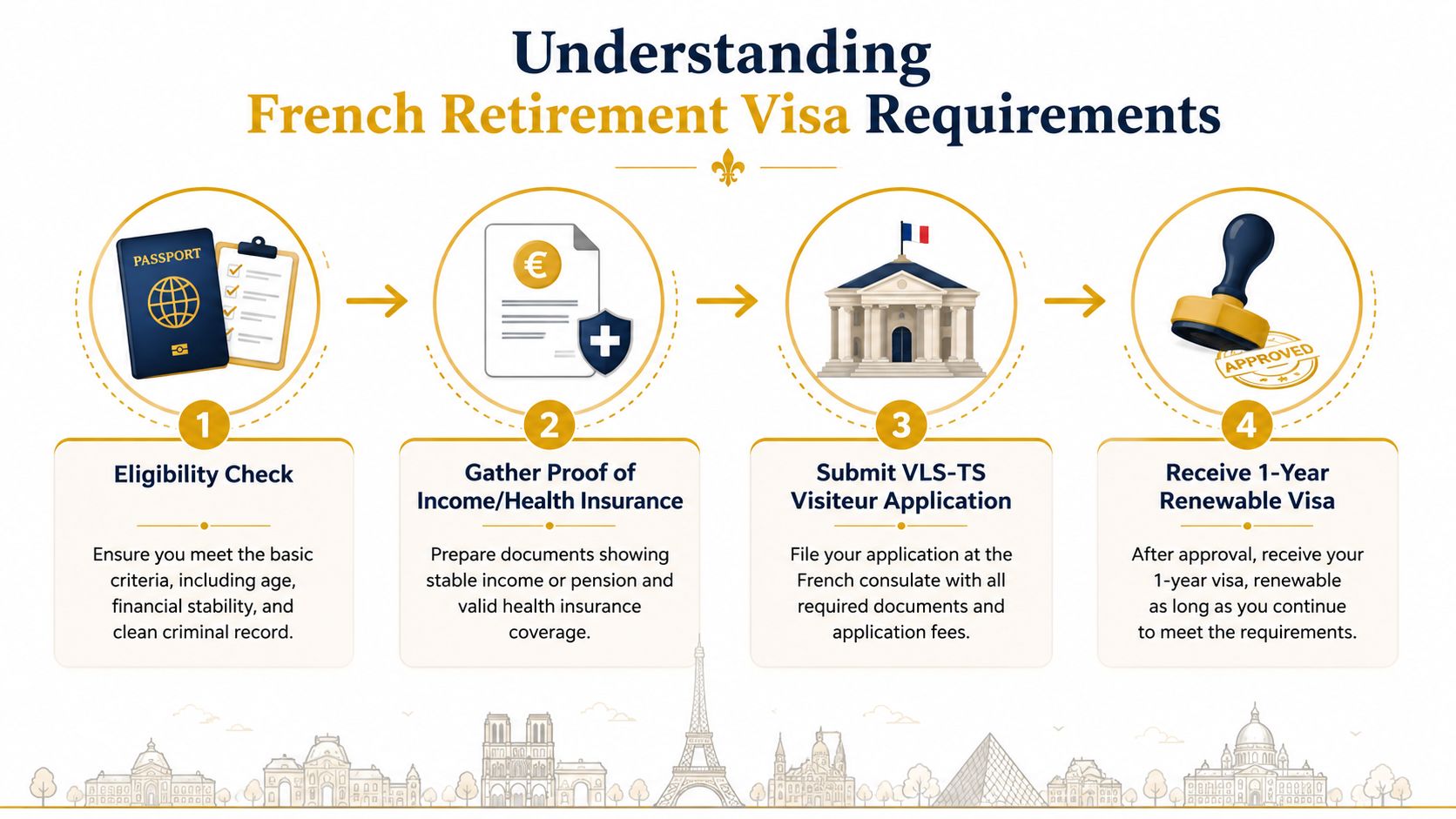
If you're picturing your mornings in a village café and your evenings with a bottle from the local cave, start with the boring truth. France doesn't hand out a special retirement visa for most non-EU retirees, and the route people use is the long-stay visitor visa, the VLS-TS Visiteur. That's the file you need to build, and consulates care about the quality of the whole package, not just one bank statement.
What consulates actually want
The cleanest applications show stable resources, private health insurance, and proof of housing. One practical benchmark tied to the French minimum wage is about €1,867.02 gross per month from June 1, 2026 (tax guidance for expats). Another source used for non-EU retirees cites a net benchmark of roughly €1,477.93 per month for a single applicant in 2026 and also describes the general range as about €1,400 to €1,500 net per month (retirement visa overview). I tell clients to treat those figures as screening thresholds, not comfort levels, because a file that barely qualifies on paper can still look weak in practice.
Practical rule: don't rely on one income source if you can avoid it. A stronger file usually combines pension income, annuities, dividends, rental income, or savings, because officers want to see recurring stability.
The most common rejection pattern is simple. People submit income that is technically close to the line but poorly documented, irregular, or hard to verify. That's not a paperwork problem, it's a credibility problem.
The post-arrival step people miss
After arrival, compliance doesn't stop. One source states that US citizens must apply for a residence permit at the local préfecture within two to three months of arriving in France (residence permit guidance). Handle that as part of the move, not as an “I'll sort it later” admin task. If you want a deeper walk-through for American applicants, read this guide for Americans considering retirement in France.
Financial Planning and Tax Residency Rules
The biggest retirement-planning trap is assuming your visa settles your tax position. It does not. French tax residency can apply when your center of economic interests is in France, even if you retain foreign assets or receive a pension from abroad (tax residency analysis). Many retirees discover this only after the move, when their filing obligations are already more complicated.
Build the file for stability, not improvisation
A French consulate reviews income as a pattern, not as a single balance. Pension payments usually form the foundation, but rental income, dividends, annuity payments, and accessible savings can make the overall file easier to understand. Each source should look durable, recurring, and simple to verify.
Fix weak documentation before applying. Prepare bank statements, pension letters, evidence of recurring deposits, and health insurance documents that match the visa timing. If your funds come from several accounts or countries, label and organize them so the reviewing officer can follow the story quickly.
A qualifying income figure does not protect you from an unclear file. Irregular deposits, unexplained transfers, or outdated letters can create doubts even when the money is available.
France does not tax you based on a visa. Tax treatment follows residence and economic ties.
Map those ties before relocating. Record where you sleep, where your main home is, where your spouse or close family lives, where your banking relationships are based, and where your pension originates. Spending more than 183 days in France can raise tax-residency questions. So can having your main home there (tax residency analysis). Keep a written calendar and evidence of your living arrangements instead of relying on memory.
What this means in real life
Pension-led income calls for clean, current records. Rental income and dividends need a recurring history, not merely a balance snapshot. Savings withdrawals require a clear explanation showing why the funds can support the relocation plan over time.
Handle the tax review before signing a lease or transferring your financial life. Your visa answers whether you may stay. Your tax profile determines where your income and assets may need to be reported. Treat those as separate workstreams and obtain advice before the first French return is due.
Language preparation belongs in the same timeline. Reading official letters, responding to requests, and discussing banking or tax paperwork becomes much easier when you start before arrival. This page for adults planning a move to France provides preparation support for adults planning a move, so language and administration can progress together.
Choosing Your Region Based on Cost and Lifestyle
Pick the region first, and the retirement budget starts to make sense. Pick the region badly, and even a comfortable pension can feel tight. France gives you real choice, but the trade-offs are obvious once you stop shopping by postcard and start shopping by daily life.
Compare the places people actually choose
| Region | Monthly Budget (Single) | Healthcare Access | Expat Community | Climate |
|---|---|---|---|---|
| Paris | Higher | Strong urban hospital access | Large, international | Variable, city climate |
| Brittany | Moderate | Solid regional access | Established in many areas | Mild coastal |
| Provence | Higher | Good in main towns | Strong in popular pockets | Sunny, Mediterranean |
| Bordeaux | Moderate | Good city access | Active and diverse | Atlantic, temperate |
| Rural Normandy | Lower | More limited locally, better with travel planning | Smaller | Cooler, quieter |
The table is a conversation starter. Paris gives you density, services, and convenience, but it's rarely the relaxed retirement value play. Provence has the lifestyle pull, yet it can cost more than a quieter inland option. Brittany and rural Normandy tend to appeal to buyers who value pace and space over café prestige.
Choose by daily friction, not fantasy
If you need frequent specialist care, you should favor regional centers with stronger hospital access. If you want an English-speaking support network, look for places where expat communities are already visible and active. If your priority is budget discipline, stop chasing famous names and look at quieter towns with rail access and decent local services.
Bordeaux often works because it balances city amenities with a more measured feel than Paris. Provence rewards people who will use the climate and outdoor life instead of visiting twice a year and paying a premium for the idea of it. Rural Normandy is for clients who want calm and lower housing pressure, provided they're realistic about transport and day-to-day logistics.
The smart move is to shortlist by healthcare access, community, and monthly comfort, not just scenery. You're not buying a holiday. You're buying your next routine.
Navigating the French Healthcare System
France's healthcare system is one reason people settle here and stay. Access is not automatic on arrival day, so handle the gap before a paperwork delay becomes a medical problem. Put health cover and registration on your first-weeks checklist, alongside housing and banking tasks.
How the enrollment sequence works
The process runs through CPAM, the local health authority. You register, submit your visa and supporting documents, then wait for your Carte Vitale health card. Guidance for retiring in France notes that applicants can join the French system after living there for three months. Residence paperwork follows a separate track through the local préfecture, and the two processes do not replace each other.
During that waiting period, arrange private insurance that covers care before French enrollment becomes active. Read the exclusions carefully, especially for pre-existing conditions, hospital treatment, and specialist appointments. A low-cost policy that fails when you need treatment is a false economy.
What coverage really means
Public healthcare commonly reimburses 70% of eligible services, as outlined in the French healthcare coverage data. That reimbursement is useful, but it does not eliminate every bill. Retirees who want more predictable costs often add supplemental insurance to cover part of the remainder.
Don't arrive assuming your old policy will follow you. Verify what is covered in France before you fly.
Medical French deserves a place in the relocation plan. You may need to describe symptoms, confirm medication instructions, book appointments, or understand specialist paperwork. French lessons for medical professionals can help you prepare for those conversations. Learn the phrases you will use at reception and the pharmacy before you need them.
The first three months are where paperwork gets postponed. New arrivals settle into their homes, enjoy the change of pace, and leave registration until illness forces action. Set up temporary insurance immediately, submit the required documents promptly, and track every application. Treat language practice as part of healthcare preparation, not a task for later.
Why French Language Skills Make or Break Your Retirement
Your first mairie appointment exposes the problem quickly. The clerk asks for one missing document, the form uses unfamiliar terms, and your spouse is unavailable to translate. English may work in tourist settings, but retirement depends on handling legal, medical, and social routines without constant assistance.
Where French pays off immediately
Healthcare comes first. You must understand instructions, confirm medication details, describe symptoms, and ask follow-up questions clearly. A misunderstanding at the pharmacy or during an appointment can delay treatment or create avoidable stress.
Administration creates a second pressure point. Forms, appointment confirmations, tax letters, and requests from local offices require action, not recognition of a few familiar words. Build enough vocabulary to identify deadlines, missing documents, and the next required step.
French also affects the practical welcome you receive. A retiree who can manage a short conversation at the mairie, pharmacy, or local club usually gets clearer help and more patient explanations. Daily transactions shape your relationships and your confidence far more than occasional tourist interactions.
A client example that still sticks with me
One of our students arrived with strong English and weak French. During her first months, she depended on her spouse for every appointment and local errand. She then began private lessons focused on daily conversations, medical vocabulary, and phrases used at local offices.
The change was practical. She handled pharmacy visits herself, booked appointments without panic, and joined local activities without waiting for translation. Her lessons were not an academic exercise. They removed specific points of dependence.
People do not need literary French to retire well. They need enough command to handle pharmacy visits, mairie appointments, and unexpected medical questions independently.
B1-level French opens doors that pure English does not. It will not make every conversation easy, but it changes how much of daily life you can manage alone. For a practical starting point, read this page on why French language matters before deciding how much support to book.
The cheapest language plan is the one you start before the move, not after the first confusing appointment.
Treat lessons as relocation infrastructure. Start with the conversations your visa, healthcare, housing, and daily administration will demand, then build from there.
Your 12-Month Retirement Relocation Timeline
A retirement move starts going wrong long before departure. Documents arrive late, tax questions remain unanswered, and French lessons get postponed until appointments are already booked. Build the move in stages, with language preparation alongside finances, housing, healthcare, and visa work.
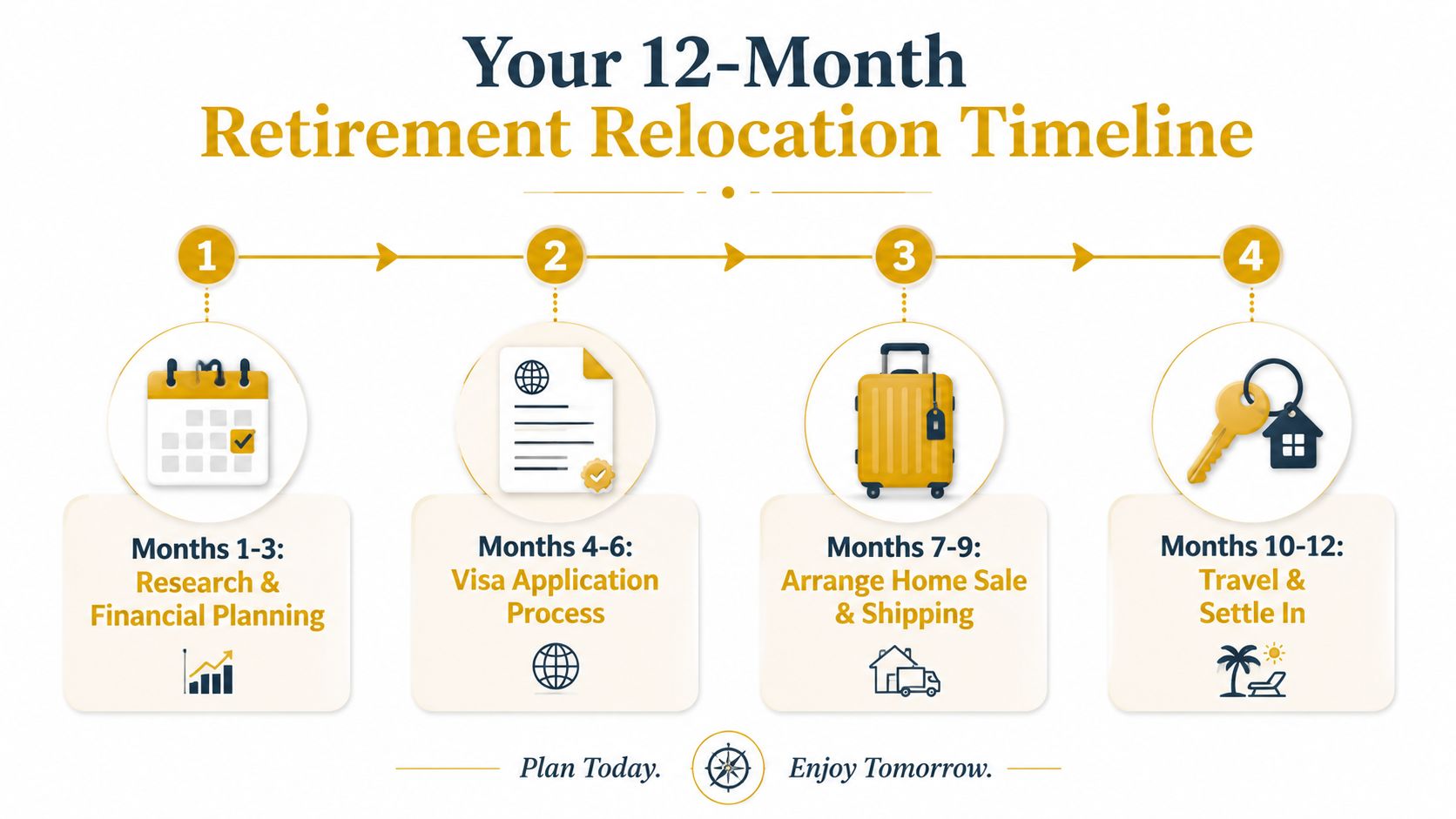
Months 1 to 3
Create your money file, shortlist possible regions, and begin French lessons. If you are comparing structured study options, this page on studying in France can help you assess support that fits relocation preparation. Compare healthcare arrangements and decide whether you want a city, coastal town, or quieter inland base.
Collect income documents, housing evidence, insurance information, and other records that may support the visa application. Separate documents needed for the visa from those that help you choose and secure a home. This prevents tax, housing, and immigration tasks from becoming one disorganized pile.
Months 4 to 6
Submit the visa application and keep every document ready for follow-up requests. If you are buying or renting, secure housing as early as your circumstances allow. Proof of accommodation connects directly to the administrative file, and delays here can hold up the wider move.
Best move: keep every translated document, bank letter, insurance policy, and housing proof in one dedicated folder. Consulates and prefectures respond better to clear, complete files.
Check that your financial records tell a consistent story. Income sources, available funds, insurance, and accommodation should support the same application rather than raise avoidable questions.
Months 7 to 9
Arrange shipping, give notice on your current home, and confirm travel dates. Continue French training, focusing on the conversations you will need immediately after arrival. Booking appointments, asking officials for clarification, and handling small household problems all become harder when you depend on someone else to translate.
Months 10 to 12
Travel, register, and establish your first routines in France. Complete the healthcare steps and residence paperwork, then rehearse the language needed for pharmacies, local offices, and service providers. Preparation turns the first weeks from a paperwork scramble into a manageable settling-in period.
A well-timed language plan belongs in the relocation file, alongside finances and housing. Elite French Tutoring can provide personalized guidance on structuring lessons around your move, current level, and timeline.