Skip to content

The worst advice about apartments to buy in Paris France is that the city is too expensive to bother with. That's lazy thinking. Paris is expensive, yes, but the mistake is treating every arrondissement as if it were priced the same and every purchase as if the listed price were the final bill.
I tell buyers to stop chasing famous postcodes first and start by asking where the spread between price, lifestyle, and future resale strength is working in their favor. In Paris, that question matters more than in most cities because the gap between districts is wide, and the cash you need at closing is usually far above the sticker price. If you buy well, you're not buying “cheap.” You're buying intelligently.
Table of Contents
- Why Paris Real Estate Defies the Expensive Label
- Understanding the Current Paris Apartment Market
- Neighborhood Guide to Paris Apartments
- The French Home Buying Process Explained
- Real Costs Beyond the Listing Price
- How to Search and Negotiate Effectively
- Financing Options and Long-Term Ownership Costs
Why Paris Real Estate Defies the Expensive Label
Paris is not one market. It's a stack of very different micro-markets, and the cheapest mistake buyers make is relying on the citywide average as if it tells the whole story. It doesn't. The official Paris price map reported a standardised apartment price of €6,120 per m² at the end of May 2026, while the INSEE Paris apartment index stood at 121.7 in Q1 2026 versus 120.5 in Q1 2025 in the official methodology tracked by the Paris notaries and INSEE, which still places the market above its 2015 base even after cooling. That official framework also excludes notary fees, transfer duties, and agency commission, which means the actual budget is always higher than the headline number suggests. Paris price map and INSEE pricing data
The real opportunity is dispersion
The useful question isn't whether Paris is expensive. It's where the premium is justified and where it isn't. Recent market data show Pont-de-Flandre in the 19th at about €6,510/m², while Saint-Thomas-d'Aquin in the 7th is about €15,090/m², and top-tier properties in the 4th, 6th, 7th, and 8th can reach €20,000/m² or more. That spread is where smart buyers win, because citywide averages flatten the difference between a practical family purchase and a trophy-address decision. Paris district price dispersion and 2025 activity
My rule: if a guide only tells you Paris is “costly,” it's not helping you buy. A useful guide tells you where the value pocket is and what you give up to get it.
The strongest opportunities right now are not the obvious prestige names. They're the districts where demand is real, but the price doesn't yet reflect the same level of international competition. That's where buyers can still find apartments that work as both a home and a long-term asset.
Understanding the Current Paris Apartment Market
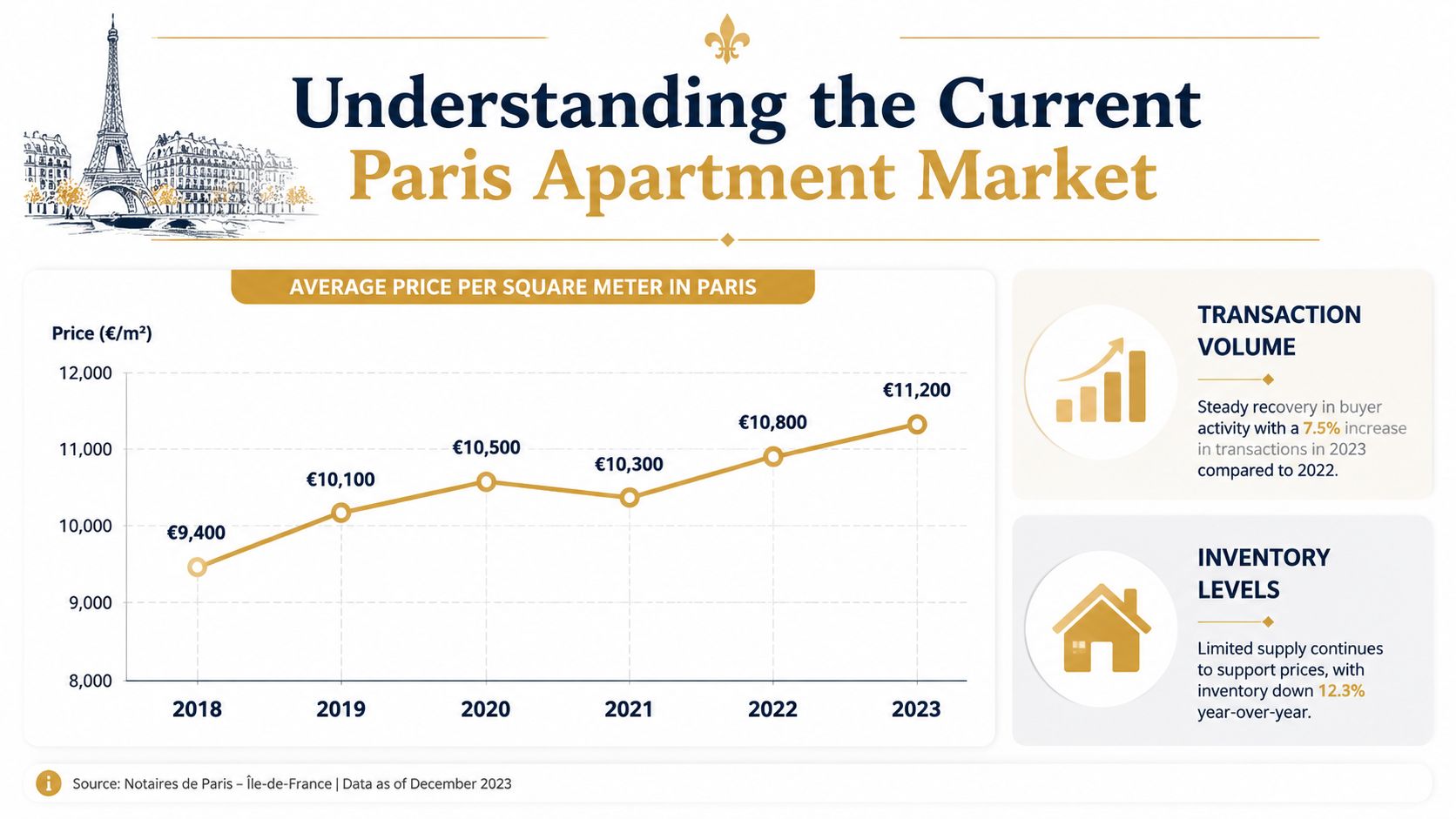
Paris stays tight because it is still a renter-heavy city, and that shapes what buyers face. APUR housing structure data show that among about 1.39 million Paris homes, 53% are occupied by tenants and only 30% by owner-occupants, while private individuals own 946,000 homes and legal entities own 417,000. The same source says individuals hold 846,000 condominium homes, or 61% of the Paris housing stock. On the wider French market, INSEE data cited in 2024 show 57% of households own their primary residence and 40.3% are tenants, so Paris remains clearly less owner-occupied than France overall. APUR housing structure data
Why supply stays tight
A renter-heavy city produces fewer resale options, fewer family-sized listings, and more competition for any decent apartment in a good building. That is the practical effect of the tenure structure. Buyers who understand it stop waiting for a flood of inventory that will never arrive. They move quickly and judge buildings harder than listings.
Historical pricing gives the same message. INSEE's appendix shows average Paris housing values ranged from €4,514 to €6,549 per m² during 2003–2007, so the market had already climbed sharply long before the 2020s. The city is expensive because it has stayed expensive for a long time, not because of a temporary spike. Serious buyers need a long view, not a reactive one.
What the recent market signals mean
Early 2026 pricing shows the market remains active but selective, with slight year-on-year growth of about 0.9% to 1.5%. Official and market-report data place averages around €9,580 to €9,739 per square meter, with citywide figures also cited near €9,600 per square meter. A standard 50 m² apartment therefore sits near €479,000 to €487,000 before transaction costs, and central arrondissements can run well above that level. Paris property market report
Recent 2025 data also show 27,410 transactions over the last twelve months, up 5% year over year, while prices held relatively stable near €9,700/m². That is the market in plain terms. Deals are still happening, but only for buyers who are precise about location, building quality, and the costs attached to the purchase.
Neighborhood Guide to Paris Apartments
The right arrondissement depends on what you are buying, a home, a pied-à-terre, or a property that needs to hold value without drama. Paris punishes vague shopping. Prime addresses cost more, and entry prices shift sharply once you move outside the most obvious names. Buyers who understand that spread stop chasing headlines and start buying with a plan.
Here's the clean comparison I use with clients.
| Arrondissement | Price Range (€/m²) | Best For | Typical Apartment Size |
|---|---|---|---|
| 7th | High, often premium | Prestige buyers, embassy-adjacent living, long-term hold | Smaller classic apartments, elegant larger units in prime streets |
| 6th | High, often premium | Pied-à-terre buyers, central convenience | Compact and refined apartments |
| 8th | High, often premium | Corporate buyers, flagship address appeal | Mix of compact and larger formal layouts |
| 4th | Very high in top pockets | Buyers prioritizing historic center living | Smaller character apartments, especially around Rue des Rosiers and parts of Île Saint-Louis where older stone buildings and tight floor plates dominate |
| 19th | Lower entry than central core | Value-focused buyers, buyers willing to trade prestige for price | More practical family layouts and mixed-size stock |
For the full neighborhood feel of the city, I'd pair your apartment search with a broader trip plan and local orientation, especially if you're buying remotely. A useful starting point is this Paris travel planning resource, because buyers who know the streets usually choose better than buyers who only know the map.
How I'd rank the options
The 7th, 6th, and 8th remain the safest choices if your priority is prestige and resale recognition. They are expensive for a reason, and they stay liquid when the market gets selective. The 4th is for buyers who want the historic center and accept the price that comes with it.
The 19th is where value becomes interesting. It won't suit every buyer, and that is the point. If you want genuine room to buy without paying the most obvious premium, look there before you default to the well-known central districts.
The best Paris purchase is rarely the prettiest listing on the first page. It is the one that fits your use case, building quality, and exit strategy.
A trophy postcode delivers lifestyle. A smarter arrondissement often delivers investment value.
The French Home Buying Process Explained
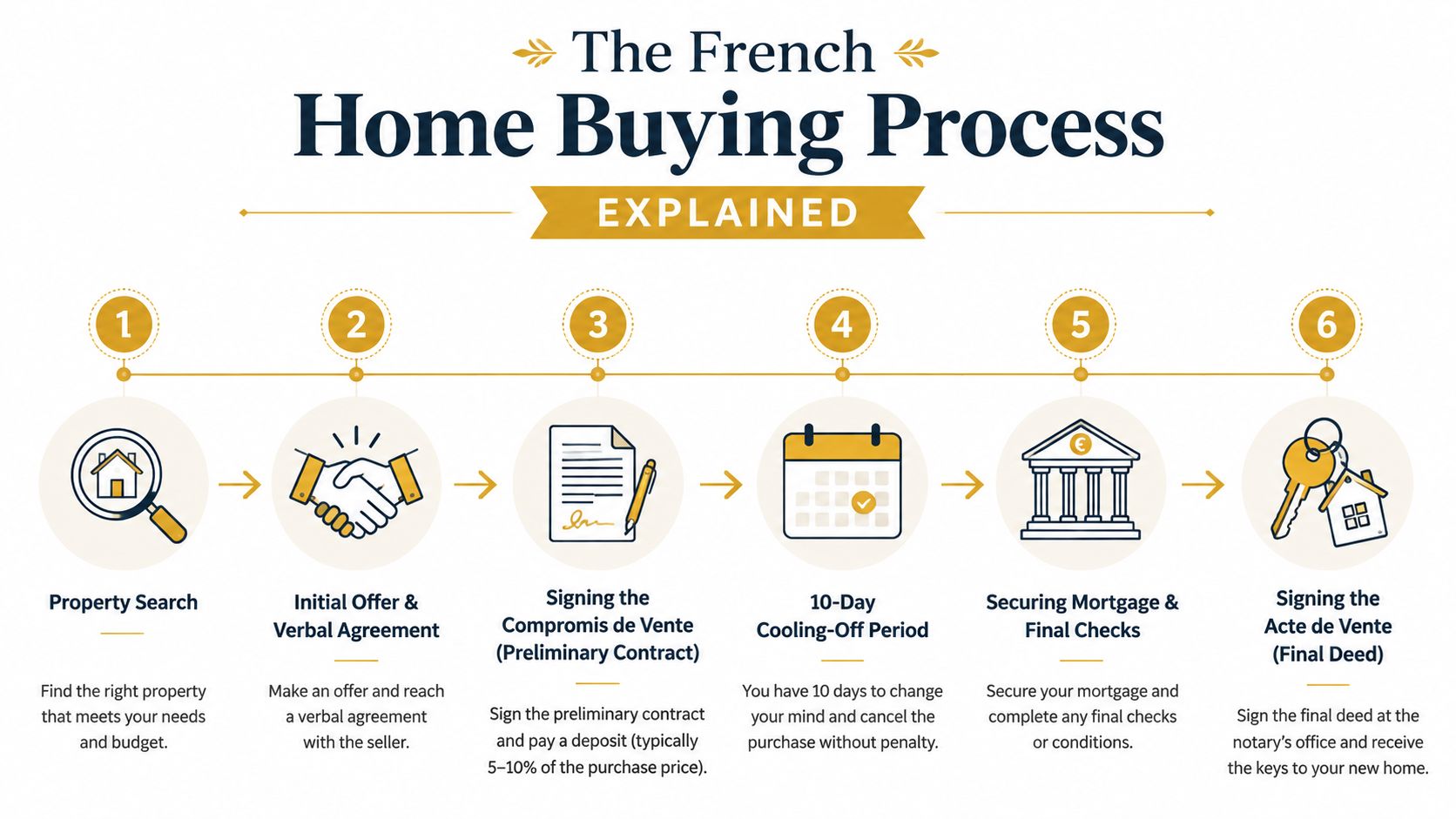
French property deals run on paperwork and timing. International buyers often assume the sale is settled after an accepted offer. It is not. The notaire sits at the center of the process, and the documents drive every stage. Treat that role as peripheral, and you risk delays or a weak position at signing.
The steps that matter most
Property search. Move fast and stay selective. The better Paris apartments do not wait around for indecisive buyers.
Offer and acceptance. A verbal green light is only a signal of intent. Sellers care about proof that you can close.
Signing the compromis de vente. This preliminary contract fixes the terms before the final deed. Buyers often miss one point here, the suspensive conditions. If mortgage approval or another condition is not met, those clauses can stop the deal from becoming binding.
Cooling-off period. The 10-day cooling-off period starts after the preliminary contract is signed and the full file is delivered. That detail matters, because missing documents can delay the start.
Mortgage and final checks. Get your financing papers in order early. Buyers who wait until the last minute lose time and bargaining power.
Signing the acte de vente. This is the final deed. Ownership transfers only at this stage.
The notaire checks title, manages the legal steps, and handles the funds. That neutrality keeps the transaction disciplined, which matters in a market where clean documentation can matter as much as your offer price.
If your purchase is tied to relocation, the visa side can affect timing and paperwork. A practical overview like this work visa resource helps buyers who need to align a property move with residency planning.
One thing international buyers should do early
Prepare your file before you view apartments. Bring identity documents, income evidence, and financing proof if you need a loan. Sellers take prepared buyers more seriously, and that can decide a deal when strong apartments draw quick interest.
Real Costs Beyond the Listing Price
A Paris apartment's asking price is only the starting point. Buyers who ignore acquisition costs can misjudge both their budget and their negotiating position. Older resale property typically adds about 5.81% to 8% in acquisition costs, while new-build purchases are lower at about 2% to 3%. Another Paris guide places older resale costs at roughly 7% to 8.5%. Compare each property by total acquisition cost, not headline price. That is the difference between a realistic offer and a fantasy one. Paris purchase costs guide Paris buying costs and taxes
Where the money actually goes
“Notary fees” are not one single charge. The notary's own remuneration is regulated and scale-based, with official bands of 3.870% up to €6,500, 1.596% from €6,501 to €17,000, 1.064% from €17,001 to €60,000, and 0.799% above €60,000. Official guidance gives an example of €1,995.25 excluding tax in notary emoluments for a €200,000 apartment purchase. Transfer tax usually represents the much larger share of the closing cost. Government-style notary fee guidance
Agency commission and financing costs also affect the final bill. Paris market guidance commonly places agency fees around 4% to 5% of the sale price. They are usually included in the advertised price and paid by the seller from the proceeds. If you borrow, one Paris purchase guide notes an arrangement fee of about 1%, with other closing expenses possible. Read every listing with a calculator, not only with your eye for the apartment.
For an €800,000 resale flat, additional closing costs can reach roughly €56,000 to €64,000. That amount directly limits how high your offer can go. The total budget is the purchase price plus these costs.
What to prioritize
- Resale versus new-build: resale usually costs more to close, while new-build purchases carry lower acquisition costs.
- Included agency fees: confirm whether the advertised price already includes commission.
- Total cash needed: bank approval does not cover every purchase expense, so budget beyond the loan amount.
Price dispersion across Paris makes this calculation especially useful. A less famous arrondissement can offer better value only if its acquisition costs, building condition, and financing burden still fit the full budget. Buyers who understand the transaction structure can negotiate with numbers rather than postcode prestige.
How to Search and Negotiate Effectively
Paris rewards speed, but only if you're disciplined. The market is busy, listings disappear quickly, and some apartments are already effectively sold by the time a distant buyer reacts. That's why I tell clients to filter hard before they contact anyone. If a listing looks vague, inconsistent, or overly polished without details, it deserves skepticism.
Search like a serious buyer
Start with the listing language. If a description avoids mentioning floor level, light, building condition, or co-ownership health, I'd be cautious. Ask for the syndic paperwork, recent building charges, and any major works already discussed by the co-owners. A good apartment in a weak building is still a bad purchase.
Negotiation in Paris is not about being clever. It's about being credible. Sellers and agents respond to buyers who are ready to sign, ready to finance, and ready to move on practical timing. If you're shopping from abroad, your communication style matters too, especially in a market where agents may be dealing with multiple languages and many active buyers. That's why a businesslike, concise approach helps more than charm alone. A useful cultural refresher is this French business communication guide.
My negotiation priorities
- Lead with proof of readiness: financing clarity beats a vague higher offer.
- Focus on building risk: expensive cosmetic issues are less serious than structural or co-ownership problems.
- Move quickly on clean apartments: hesitation costs you more than a modest discount ever saves.
- Don't overpay for a famous street: prestige is only worth it if the apartment itself is strong.
A concrete example from our work: one international buyer we helped had nearly committed to a central, high-profile address before we redirected the search to a quieter district with stronger value. She ended up with a better apartment, a better building, and a purchase that matched her actual use of the property. That's the kind of success that matters. Not a famous postal code, a better result.
Financing Options and Long-Term Ownership Costs
Financing in Paris is more flexible than many overseas buyers assume. A French mortgage can be available to non-residents, and international buyers often have more options than they expect, including borrowing in France, borrowing at home, or buying in cash. I usually prefer a French mortgage when the buyer qualifies, because it keeps the debt in euros and can preserve liquidity elsewhere. For many buyers, that's the cleaner financial structure.
What to plan for after closing
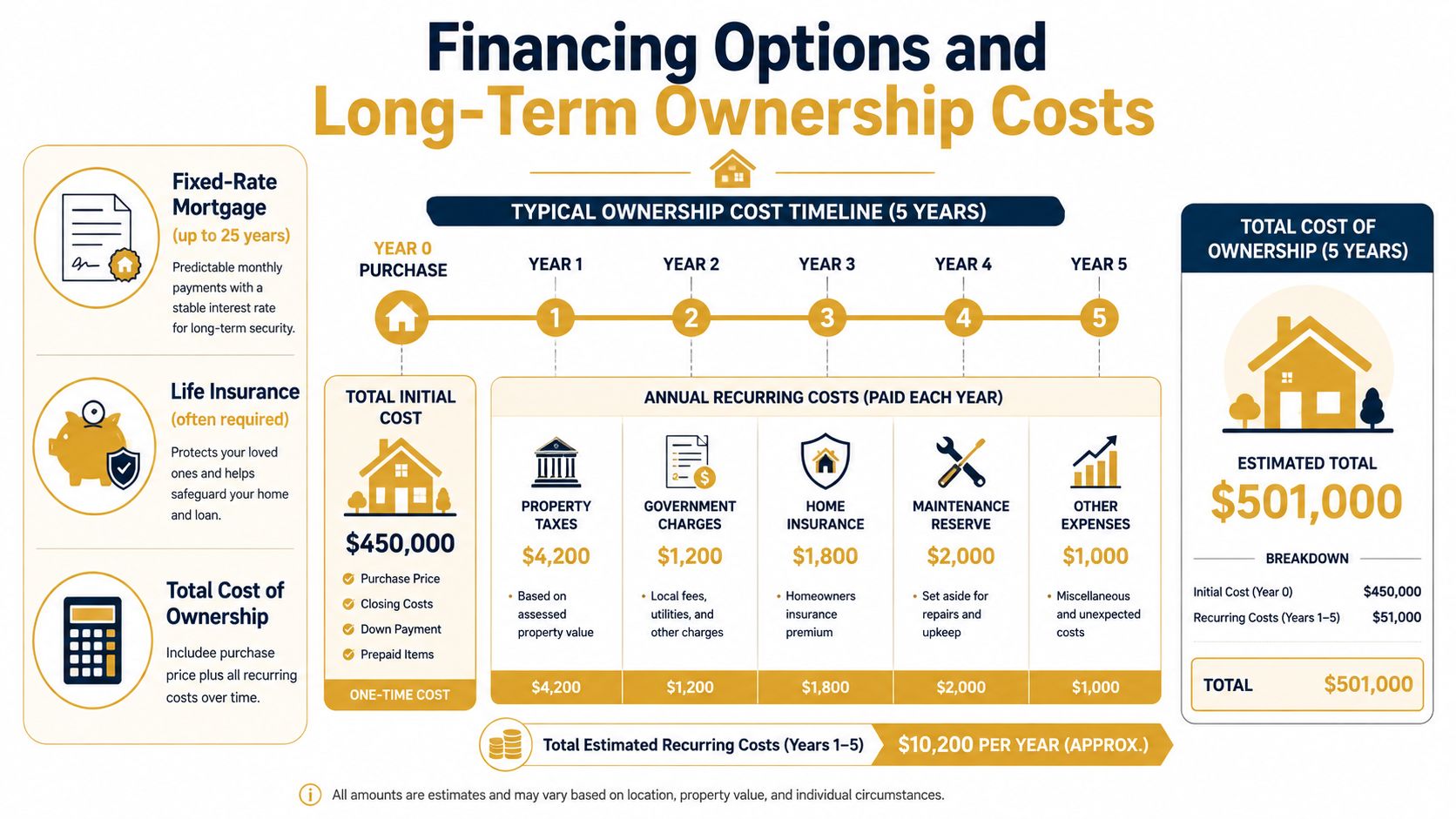
French mortgage guidance for international buyers notes that banks may lend between 50% and 80% of the purchase price, with some cases higher depending on the profile and the bank. The same guidance says mortgage rates are generally fixed for the life of the loan, usually up to 20 years, and that French life insurance is commonly required. French apartment financing guide
For ongoing ownership, Paris buyers should budget for recurring costs as part of the purchase decision, not as an afterthought. Property tax guidance for non-residents shows taxe foncière often running at roughly 0.1% to 0.2% of the purchase price, and non-residents may also face taxe d'habitation on second homes. France's real-estate wealth tax, IFI, applies when net taxable real estate wealth exceeds €1.3 million as of January 1, with foreign assets excluded for non-residents and the tax charged only on real estate located in France. Property tax guide for non-residents
If you're buying as an owner-occupier or a pied-à-terre owner, don't think only about entry cost. The real ownership decision is whether the apartment still makes sense after taxes, insurance, and co-ownership charges.
My bottom-line financing advice
- Get financing clarity first: don't start viewing until you know your borrowing position.
- Separate purchase price from total cost of ownership: the second number is the one that matters.
- Check tax exposure before you fall in love: a beautiful apartment can still be the wrong financial move.
For buyers who are weighing a Paris property against relocation or retirement plans, the tax and banking picture should be part of the decision from day one. If you want a broader lifestyle context, this France retirement resource is a useful companion read.
If you're seriously evaluating apartments to buy in Paris France, don't start with headlines and don't start with prestige. Start with arrondissement value, acquisition cost, and your real financing position. Then speak with a French-speaking expert who can help you compare listings, documents, and negotiation language before you commit. If you want a more confident search, consider booking a free consultation with Elite French Tutoring, especially if your purchase is tied to relocation, business, or daily life in France.