Skip to content

You're in the room with a French-speaking patient, they're describing chest pain in words that don't match your app's textbook phrases, and the usual “basic French” scripts don't help fast enough. That moment is exactly why French for medical professionals has to be treated like a real clinical skill, not a hobby language. Under pressure, what matters is whether you can take a history, explain a next step, and hand over safely in the right register.
Table of Contents
- Why Medical French Demands a Real Training Plan
- Demand for French in Healthcare Settings
- Assessing Your Starting Point and Clinical Goals
- Comparing Training Paths for Working Clinicians
- Core Vocabulary and Roleplay Templates by Clinical Setting
- Integrating Private Tutoring for Accelerated Results
- Your Next Step Toward Clinical French Confidence
Why Medical French Demands a Real Training Plan
A clinician can know how to say hello, ask where it hurts, and still freeze when a patient says something like, in effect, “It's crushing me here, and it comes and goes.” That gap is the whole problem. Medical French isn't general French with a stethoscope bolted on. It's a shifting register that changes between triage, consultation, consent, handoff, and documentation.
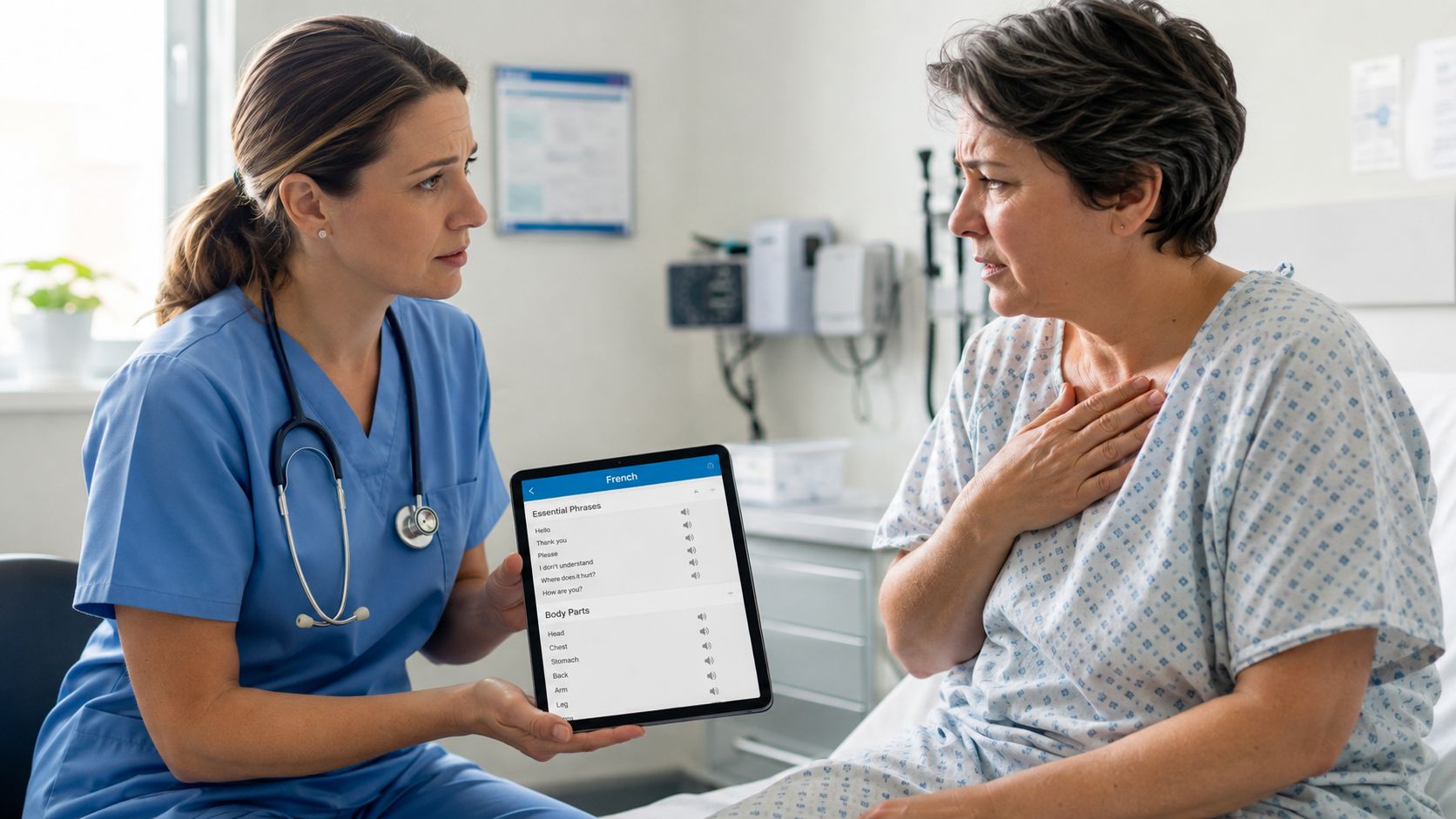
A vocabulary app can teach isolated words. It won't teach you how those words sound when a nurse is interrupting, a relative is anxious, or the emergency department is full. That's why a structured plan beats random memorization every time.
Practical rule: if your practice never includes spoken follow-up questions, you're training for recognition, not for patient care.
A good training plan also accounts for the setting. The phrases you need in a GP clinic are not the same as the language you use in an urgent triage bay or during a quiet discharge conversation. A useful roadmap has to build fluency in context, not just flashcard recall.
I've seen clinicians make faster progress when they stop asking, “What's the word for this?” and start asking, “What do I need to do in this interaction?” That mindset changes everything. It pushes the learner toward roleplay, listening drills, and real clinical documents, which is exactly the kind of practice that survives pressure.
For learners who want a more disciplined approach, a structured French study plan is usually a better starting point than scattered self-study. The reason is simple. In medicine, the cost of unclear language is not just embarrassment, it's time, confusion, and sometimes risk.
Demand for French in Healthcare Settings
A clinic can run on English for routine admin and still fall apart the moment a patient switches to French. In healthcare, that shift is not academic. It changes how you triage, how you explain risk, and how quickly you can verify understanding.
The strongest case for French for medical professionals is labor-market reality. In Canada outside Quebec, Statistics Canada found that in 2021, 1.5 million health care workers were employed, and 157,000 of them knew French; 10.6% knew French, while 3.8% used it regularly at work (Statistics Canada). That is not a side skill for a hobbyist. It is a working language in bilingual care environments, where a nurse, physician, or intake clerk may need to switch fast and stay precise.
Where the need is concentrated
The pressure is sharper in specific service areas. In New Brunswick, 49.0% knew French and 39.3% used it regularly at work, while in Ottawa the figures were 38.7% and 26.5%, respectively (Statistics Canada). For clinicians, that means French cannot be treated as a nice extra if the job sits inside a bilingual catchment area.
Occupation data point in the same direction. 18.9% of general practitioners and family physicians knew French, compared with 12.1% of dentists and 10.8% of pharmacists (Statistics Canada). In practical terms, French ability matters most in front-line roles where conversation is continuous, interruptions are common, and the phrasing changes from one patient to the next.
France gives a different but equally useful signal. As of January 1, 2025, France had 237,214 practicing doctors, including 118,957 women and 118,257 men, which means women became the majority of doctors for the first time in the country's history (Le Monde). The same source says the number of doctors rose by 9.9% since January 1, 2012, and the share trained abroad reached 11% in 2025, up from 7% in 2012 (Le Monde). France's health system is large, modern, and more international than it used to be, so language precision matters even more during handoffs, consults, and discharge instructions.
The setting changes the French you need. Emergency triage calls for short, controlled questions and immediate safety checks. A general practice consult asks for rapport, symptom history, and careful explanation. Humanitarian triage often compresses both into a high-pressure exchange where you need clarity, speed, and basic empathy at once.
A formal credential can matter as much as spoken confidence. The Diplôme de français professionnel, Médical B2 assesses listening, reading, speaking, and writing through simulated professional tasks based on medical and paramedical documents (France Compétences). That design matters because it tests workplace performance, not just general grammar.
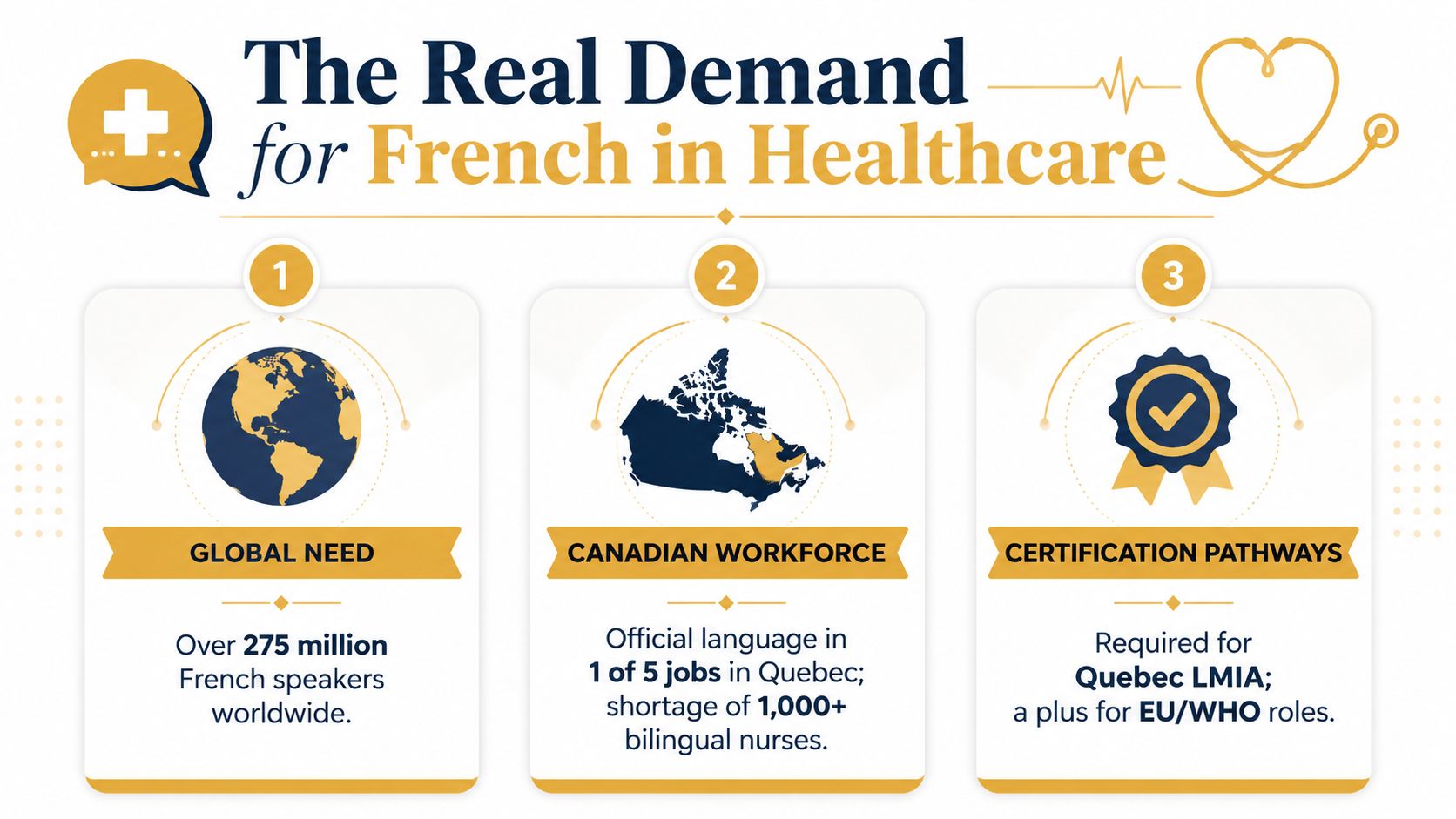
For clinicians choosing a path, the trade-off is clear. Some training is built for conversation under pressure. Some is built for certification and formal assessment. If your role requires proof of professional French, the certification route is usually the cleaner fit, while live clinical practice demands a method that drills the exact setting you work in.
Assessing Your Starting Point and Clinical Goals
Before choosing a course, start with a clinical self-audit. A learner who wants to chat comfortably with patients needs a different program from someone preparing for a formal exam or a rotation in an emergency setting. The first question is not “How good is my French?” It's “What will I have to do with French on the job?”
Build your profile first
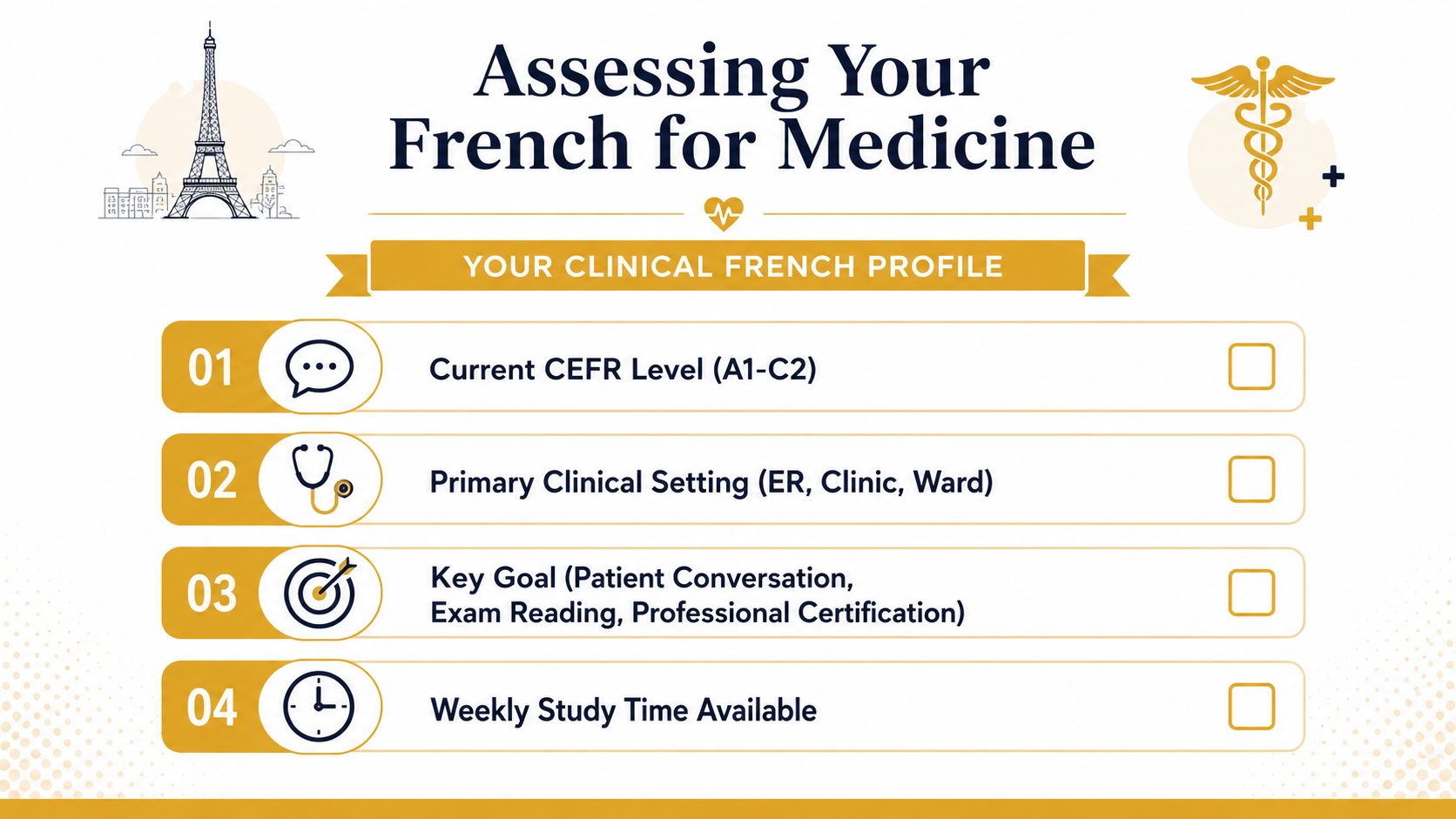
Use four filters.
- Current CEFR level. If you're near beginner level, you'll need a different pace than an advanced speaker polishing accuracy.
- Primary setting. ER, clinic, ward, surgery, pediatrics, or humanitarian work all require different language.
- Goal type. Decide whether you want patient conversation, document reading, or formal certification.
- Study time. A realistic weekly schedule matters more than ambition.
That last point sounds obvious, but it's where many professionals misjudge themselves. A program can be excellent and still fail if it doesn't match the time you have. That's why placement testing isn't a formality.
McGill's French for Healthcare Professionals page requires all new participants to first take a French Placement Test, with results available in Athena in at most 10 days before registration (McGill Continuing Studies). The point is straightforward. A placement step helps match the learner to the right level instead of guessing.
Working rule: if a provider skips placement entirely, ask how they prevent advanced learners from stagnating and beginners from drowning.
Match the program to the job
If you're aiming for a short hospital rotation, you need spoken survival skills quickly. If you're aiming for a diploma, you need a more exam-shaped path. And if you're aiming for a cross-border career, you need both confidence and documentation literacy.
A useful benchmark is the 720-hour intensive model delivered as 80 hours per month or 20 hours per week over 9 months, starting at CEFR A1 for entry into intensive programs (FLE). That's a serious commitment, and it's designed for sustained clinical communication across hospitals, private practices, and humanitarian settings.
For readers comparing structured enrollment options, a French placement test is a smart first step because it reduces guesswork before you commit time or money.
The best learners I work with don't start by buying lessons. They start by defining the exact French job they need to do.
Comparing Training Paths for Working Clinicians
A clinician deciding on french for medical professionals usually has to match the training path to the work ahead. A short ER rotation calls for fast spoken survival skills. A GP clinic needs smoother intake, symptom clarification, and follow-up language. Humanitarian triage often sits somewhere else again, with compressed questions, limited context, and a need to stay calm while information is incomplete.
| Training Path for French for Medical Professionals | Duration | Weekly Hours | Cost Range | Best For |
|---|---|---|---|---|
| University academic pathway | Structured across 12 total units | Varies by semester | Tuition varies by institution | Clinicians who want an academic route with prerequisites and electives |
| Intensive group program in Toulouse | 9 months, 720 hours | 20 hours per week | €998 per month, €8,982 for 9 months, plus €68 registration fee (ICT Toulouse) | Professionals who can commit to immersion and want sustained progress |
| DFP Healthcare B2 certification | Exam-based pathway | Not fixed | Certification fees vary by provider | Candidates who need a recognized professional diploma |
| Private one-on-one tutoring | Flexible | Flexible | Pricing varies by tutor | Busy clinicians who need customization and speaking correction |
The university route is concrete, and it suits clinicians who want a formal academic frame. The University of Washington/St. Louis pathway requires 12 total units, including the required course FRENCH 3015 Medical French, which itself requires FRENCH 3070 Cultural Expression. The remaining 9 units must come from medical-humanities-focused electives (Washington University bulletin). That works well if you need prerequisites, electives, and an academic record, but it is a harder fit for clinicians working rotating shifts.
The Toulouse intensive route asks for sustained effort. It runs from A1 to B2, with 80 hours per month and a total of 720 hours over 9 months (ICT Toulouse). That makes sense for learners who want immersion and can handle a demanding schedule. The trade-off is plain. It is not built for casual study, and it does not leave much room for a light workload.
The certification path is more outcome-focused. DFP Healthcare B2 is built around professional tasks in listening, reading, speaking, and writing. If your goal is to show workplace French for hiring, promotion, or mobility, a recognized credential gives you a clearer signal than a conversation class alone.
Private tutoring sits in the middle as the most adaptable option. It does not replace structure, but it lets you target pronunciation, handoffs, documents, and roleplay built around the exact setting you work in. For clinicians who need a faster weekly rhythm, an intensive French lesson format can turn a broad plan into work that gets done between shifts.
If your schedule is unstable, start with tutoring and placement. If your schedule is fixed, a cohort or university path can be more efficient.
The strongest plan is often hybrid. Use a structured program for the backbone, then add private sessions for the exchanges you cannot rehearse anywhere else.
Core Vocabulary and Roleplay Templates by Clinical Setting
The fastest progress comes from practicing language where you'll use it. A phrase that works in a calm clinic can sound clumsy in an emergency bay, and a line that feels polite in pediatrics can sound too soft in triage. That's why setting-specific roleplay matters more than generic word lists.
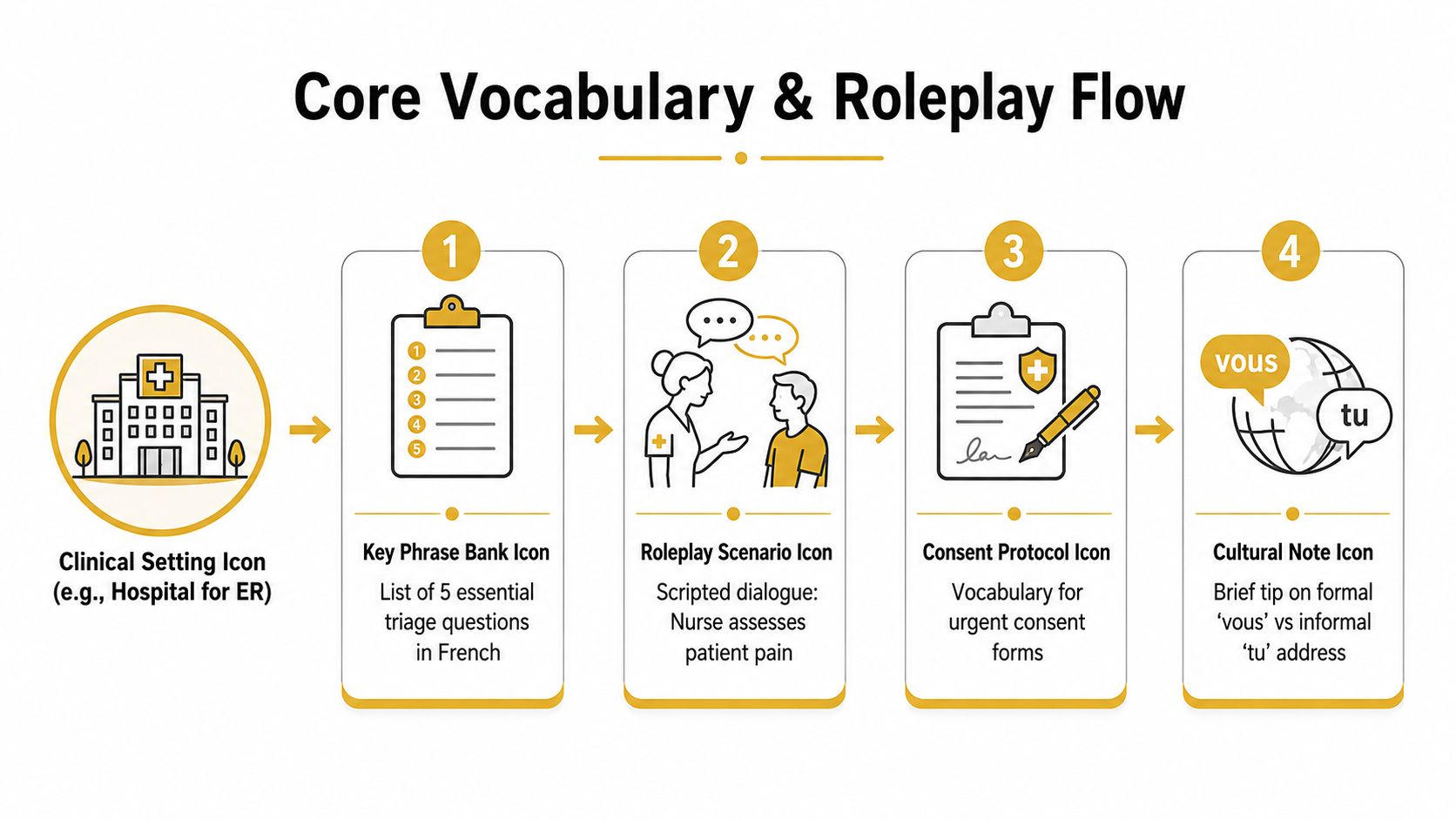
Emergency department and triage
In the ER, brevity matters. A learner needs to ask where it hurts, how severe it is, when it started, and whether the patient can breathe, speak, or move normally. The tone has to stay calm even if the room doesn't.
Useful phrases include “Où avez-vous mal ?”, “Depuis quand cela dure-t-il ?”, and “Sur une échelle de 0 à 10, quelle est l'intensité de la douleur ?” These aren't just vocabulary items. They're the skeleton of a quick triage conversation.
A good roleplay template is simple. One person plays the patient and uses short, fragmented answers. The clinician asks only one question at a time and practices redirecting when the patient starts narrating too much. The aim is controlled communication under pressure.
GP clinic and chronic follow-up
In general practice, you need softer transitions and more space for history-taking. The conversation often includes medication adherence, symptom evolution, and next steps. Here, “Depuis votre dernière visite”, “Prenez-vous ce médicament régulièrement ?”, and “Je vais vous prescrire…” are more useful than emergency-style commands.
The roleplay should feel slower. One speaker gives a chronic complaint, like recurring headaches or blood pressure follow-up, and the clinician practices reflective listening. The key skill is not speed. It's making the patient feel heard while still moving the consult forward.
Surgery and pediatrics
Surgery asks for precise coordination. You need pre-op briefing language, consent vocabulary, and clear post-op instructions. A clinician should be able to say, “Nous allons vérifier les risques ensemble”, “Avez-vous compris les consignes ?”, and “Vous devrez revenir si…” without sounding uncertain.
Pediatrics changes the register again. Parents need reassurance, but not vagueness. The learner has to explain symptoms, milestones, and warnings in language that is firm without sounding alarming. In a pediatrics roleplay, I like to have one person play a worried parent and another practice both empathy and boundaries.
Clinical habit: always rehearse the same phrase in two versions, one for a colleague, one for a patient. The register shift is where many learners stumble.
The best practice session ends with a document. Read a referral note, a prescription, or a discharge summary aloud, then summarize it as if you were handing it to a colleague. That bridge between speech and paperwork is where medical French becomes usable, not just recognizable.
Integrating Private Tutoring for Accelerated Results
Private tutoring works best as an accelerator, not as a standalone miracle. It sharpens what self-study and clinical exposure already started. For busy clinicians, that difference matters because time is limited and every session has to hit a real need.
A French tutor is most valuable when the work is specific. Pronunciation correction for nasal vowels, roleplay for triage, reading actual medical documents, and reformulating clinical notes are all high-yield uses of one-on-one time. If you already have a group class or a formal program, tutoring can fill the exact gap those formats leave behind.
One of my students, a hospital resident, came to sessions able to manage a basic intake conversation but hesitated during handoffs. We built a small routine around real discharge summaries, short oral handoff drills, and repeated correction of register. The turning point wasn't a flash of inspiration, it was repetition with targeted feedback until the phrasing stopped sounding translated.
What made that work was consistency. We used fixed weekly scheduling, and the student came in with concrete materials from the rotation. That gave each lesson a purpose, and it prevented the sessions from dissolving into generic conversation practice.
For clinicians comparing tutors, the important question is whether the tutor can work around your actual job. A guide to finding the right French tutor is only useful if it helps you choose someone who can handle professional vocabulary, not just travel French.
A simple competency checklist helps track progress.
- Listening: understand patient complaints, colleague instructions, and discharge explanations.
- Speaking: handle intake, pain assessment, handoffs, and consent language.
- Reading: follow prescriptions, referrals, and clinical notes.
- Writing: draft brief referral notes or summaries without overtranslating from English.
If a tutor can help you practice all four, the gains tend to show up faster in the clinic than in a textbook. The point is not to sound perfect. The point is to sound clear enough that the care team can move.
Your Next Step Toward Clinical French Confidence
If your next rotation, relocation, or certification goal depends on French, don't buy a random class and hope it fits. Start with your setting, your timeline, and whether you need speaking confidence or an official credential. Then choose the path that matches those constraints instead of fighting them.
For many clinicians, the smartest next move is a short consult that maps current level to clinical goals. If you want a personalized plan for French for medical professionals, book a free 20-minute consultation with Elite French Tutoring and compare lesson options before you commit. That's the fastest way to turn uncertainty into a plan that fits your work, your level, and your schedule.