
You're staring at three browser tabs, a half-finished program shortlist, and a visa checklist that looks like it was built to test your patience. That's normal. The students who do well in study abroad in France are rarely the ones who “figure it out later,” they're the ones who split the process into decisions, deadlines, and documents, then move in order.
The good news is that France rewards students who plan with discipline. It's not a system for improvisers, but it is a system with deep institutional experience, a large international student community, and enough program variety to fit different goals if you choose carefully. The trap is thinking every path looks the same, because the hidden access gap, the language tradeoff, and the visa paperwork all change the actual experience in ways glossy brochures never mention.
Table of Contents
- Why France Deserves Your Study Abroad Plans
- Choosing the Right Program for Your Goals
- Navigating the Student Visa Process
- Financing Your French Adventure
- Language Preparation That Actually Works
- Arrival and Finding Your Footing
- Your Complete Study Abroad Timeline
Why France Deserves Your Study Abroad Plans
Many students spend weeks comparing Paris, Lyon, and Toulouse, then freeze because every option looks good enough. The mistake is trying to judge everything at once. Strong applicants break the decision into phases, first the academic fit, then the visa path, then the budget, then the language plan.
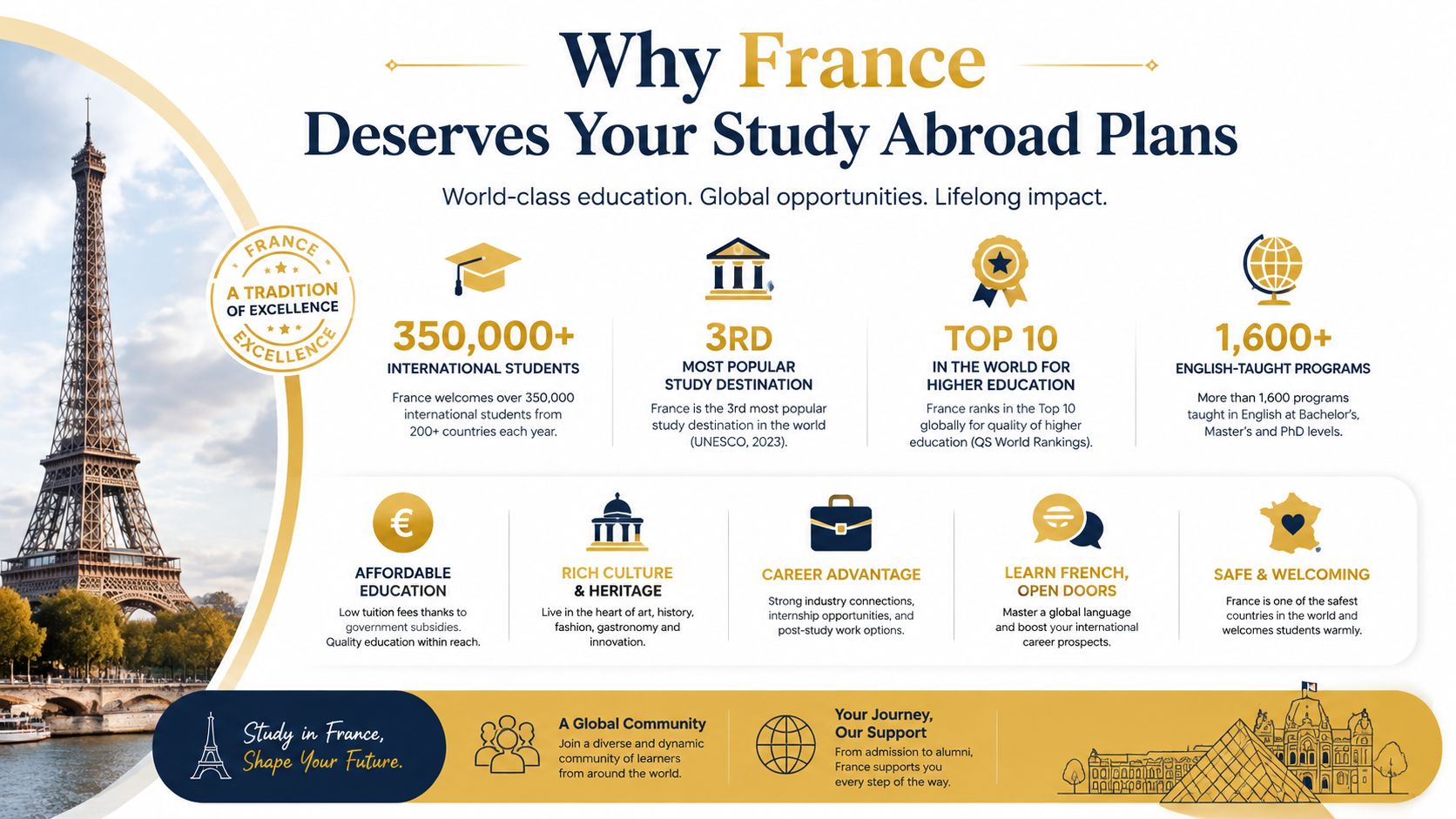
France deserves a spot on your shortlist because the system is built for international mobility, not just tourism. In 2024-2025, France hosted 443,500 international students, and foreign students made up about 15% of all higher-education students in France, according to Campus France. That scale matters. It means real infrastructure, offices that know the process, and a peer community that will not leave you feeling like the only foreign student in the room.
What These Numbers Mean for You
The broader pattern is even more telling. Foreign enrollment in France rose by 17% over five years, and the Ministry of Higher Education reported 329,100 students in France on international mobility pathways in 2024, up 38% over 10 years in Campus France's key figures report. That is not a fragile system. It is a country that has been running international study at scale for years.
France also sends a lot of its own students abroad. In 2021, more than 105,000 French students went abroad to study for a degree, and that figure was 16% higher than in 2016 in the same report. Campus France says France is the 6th most important country of origin for internationally mobile students, and earlier European Commission analysis ranked France as the world's fourth-largest receiving country for international students, behind only the United States, the United Kingdom, and Australia. You are not choosing a fringe destination.
Practical rule: when a destination has this much two-way student movement, expect stronger administrative know-how, more housing competition, and a wider network of peer support.
The Access Gap You Should Take Seriously
Many guides soften the truth of who gets to take advantage of these opportunities. An INJEP-backed review notes that nearly 40% of school-leavers in 2017 had some form of stay abroad, but participation is much higher in engineering and business schools than in universities, upper-secondary graduates, and young people from modest backgrounds, despite Erasmus+ funding, as summarized by IH2EF. That is the gap. France is open, but access is still uneven.
I would tell any student from a less privileged track to stop reading France as a prestige market and start reading it as a system that rewards preparation. Look for programs with transparent aid, ask whether exchange slots are reserved by department, and check whether housing support is included. If you need the cultural adjustment piece many guides skip, read this comparison of French and American culture before you commit.
Choosing the Right Program for Your Goals
Most students lose time by asking the wrong question. They ask, “Which city is best?” The smarter question is, “Which program gives me the mix of academics, language access, and integration I need?” If you want real immersion, the program structure matters more than the postcard.
Compare the program types before you commit
Direct university enrollment usually works best if you're independent, flexible, and ready for less hand-holding. Exchange partnerships can be cheaper and cleaner administratively, but they often limit your course options. Third-party providers are convenient if you want structure and support, though they can keep you inside an English-speaking bubble longer than you expect. Specialized programs are the strongest option when your major, professional goal, or language background already points toward a specific path.
| Program Type | Best For | Language Requirement | Cost Range | Integration Level |
|---|---|---|---|---|
| Direct university enrollment | Students who want autonomy and full local immersion | Often higher, especially for regular university courses | Usually variable by institution | High |
| Exchange partnership | Students whose home school already has a French partner | Depends on the host university and course selection | Often more predictable | Medium to high |
| Third-party provider | Students who want logistical support and built-in advising | Often lower for entry, especially in English-taught tracks | Usually higher because of service fees | Medium |
| Specialized program | Students with a clear academic or career objective | Mixed, depending on the program design | Variable | Medium |
Choose for fit, not for branding
Don't pick a program because the brochure is polished. Pick it because it matches your actual constraints. If your French is limited and you need a gentle transition, a guided option can be worth the premium. If your goal is to live like a local and push your language fast, direct enrollment is usually the better bet.
Ask admissions offices pointed questions. How are students placed in courses? How much academic advising is available in English? Is housing guaranteed or merely suggested? What percentage of classes are open to visiting students? If the answers are vague, take that as your answer.
My rule of thumb: the best France program is the one that solves the two problems you're worst at solving alone, usually paperwork and housing.
For a deeper look at immersion formats, I'd compare your options against these French immersion program models. That kind of comparison is far more useful than chasing the “best” city on social media.
Watch for the American bubble effect
Many programs market “international experience” while surrounding you with other English speakers. That's fine if you want comfort. It's a bad choice if you want growth. Real integration shows up in mixed housing, local course enrollment, and whether you're pushed to handle everyday life outside the classroom.
A strong program won't just teach you in France. It will make you function in France.
Navigating the Student Visa Process
The French student visa process looks simple until you're inside it. Then you discover the workflow has several control points, and each one can slow you down if you miss the sequence. I've seen students delay departure because they treated the visa like a final form instead of a chain of steps.
Follow the sequence, not the panic
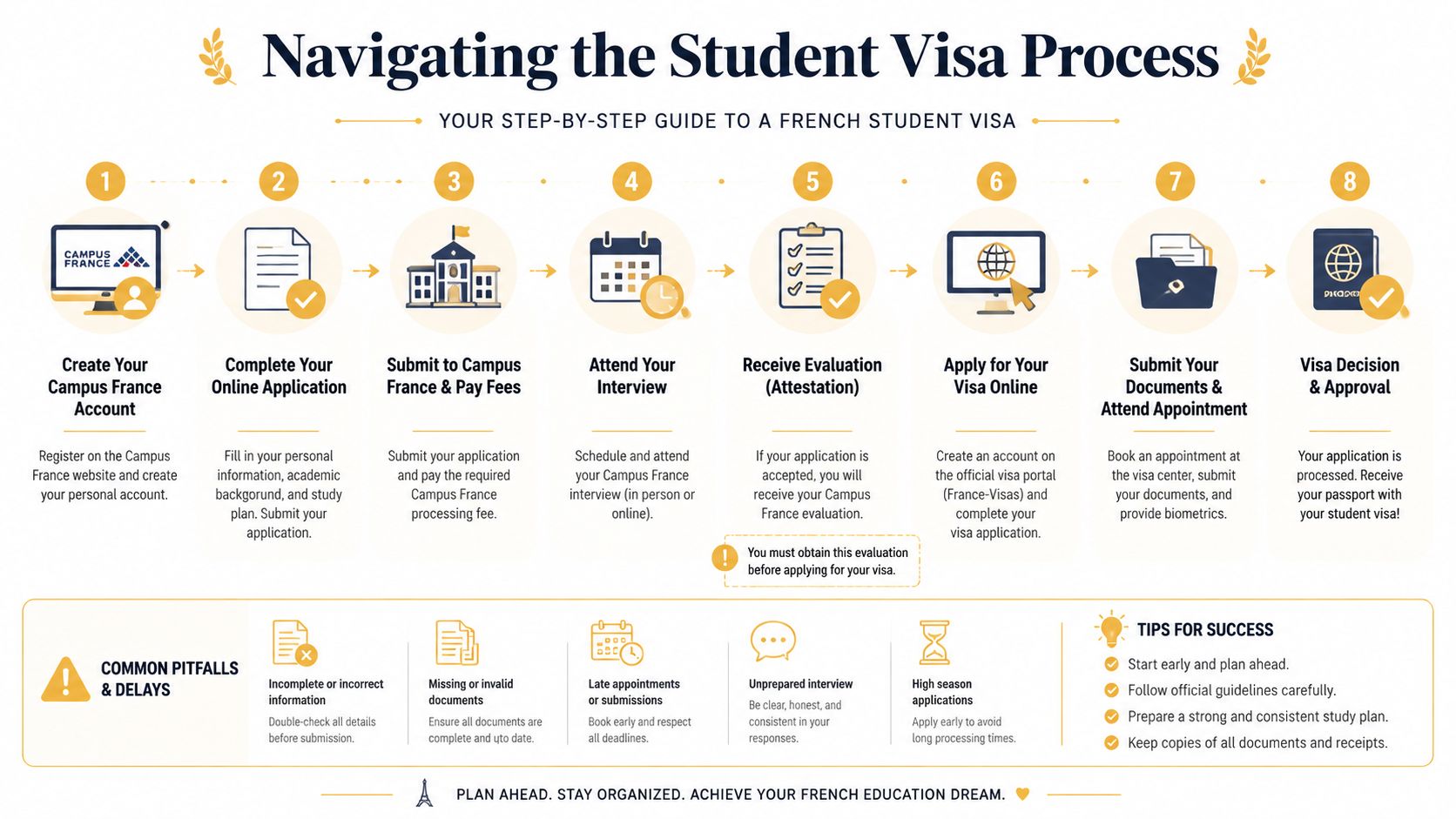
The basic workflow starts with your account on the Campus France or Études en France platform, where you upload academic and identity documents before moving to the consular visa application and biometric appointment. After that, your passport is held while the file is processed, often for several weeks, according to the Rice University study abroad guide.pdf). That processing window is why I push students to start early. Visa work is not something you squeeze into the week before departure.
For a U.S.-based applicant, Rice lists a Campus France processing fee of $250 standard or $390 expedited, plus a €50 visa fee and a separate VFS Global service fee of $40 or $88 for a full-service package in the same guide. If you're budgeting, don't forget that the “official visa fee” is rarely the whole bill.
Know whether you even need the visa
The cutoff matters. U.S. passport holders studying in France for more than 90 days must obtain a student visa before departure, according to USAC. That 90-day line is the practical dividing point between a short stay and a real visa process. If your program crosses it, stop treating travel like tourism and start treating it like immigration paperwork.
For the actual visa category, France uses a VLS-TS “student” long-stay visa valid for 4 months to 1 year, and applicants must show an admission offer and financial resources of at least €615 per month according to Service-Public. French student-visa guidance also requires proof of accommodation for at least the first three months and medical insurance with minimum coverage of €30,000, as summarized by GMAC.
Do this early: book your biometrics and line up your documents before your housing search gets urgent. Late visa filing plus late housing searching is how students end up paying for rushed decisions.
Don't make avoidable mistakes
The common rejection pattern is predictable. Students submit incomplete paperwork, underestimate processing time, or assume one document can substitute for another. Don't do that. French authorities are not impressed by urgency after the deadline has already passed.
The safest strategy is to work backward from departure, then build in slack. If your program starts in late August, you shouldn't be “starting the visa” in July. You should already be moving through it.
Financing Your French Adventure
Money is where many students get unrealistic fast. They either assume France is cheap because it's in Europe, or assume it's out of reach because Paris exists. Neither view is useful. The smart move is to compare financing paths side by side and choose the one that matches your city, your program, and your documents.
Compare your funding options before you apply
The visa rule gives you the floor, not the full budget. France requires non-scholarship students to prove financial means of at least €615 per month according to France Diplomatie. That amount is the minimum support level for the visa, not a promise that life will feel comfortable on it in every city.
Paris is a different financial game from smaller cities. In Paris, housing can consume your budget fast, while smaller university towns often give you more breathing room and a simpler housing search. If you care about affordability, city choice is one of your biggest levers.
| Funding Route | Best For | Strength | Tradeoff |
|---|---|---|---|
| Family support | Students who have predictable funding | Simple visa proof | Can limit independence |
| Scholarship funding | Students with strong academic records or access needs | Reduces monthly pressure | Competitive and paperwork-heavy |
| Savings plus support | Students who can combine sources | Flexible and practical | Requires planning discipline |
| Part-time work | Students who want supplemental income | Helps cover day-to-day costs | Not a substitute for full funding |
Be selective about where you save
Don't cut the wrong costs. Save on city choice, housing type, and transport before you slash the things that make the experience worthwhile. A cramped budget can still support a strong year if you keep your expectations realistic and choose the right location.
Students from underrepresented backgrounds should also look beyond the obvious scholarship names. University-specific aid, departmental awards, and mobility support can matter more than flashy national branding, especially when the access gap described earlier is part of your story. Start with the programs that ask who you are, not just what your GPA looks like.
Budget rule: if you can prove the minimum for the visa but not the month-to-month reality, your first priority should be lowering fixed costs, not hoping the rest works itself out.
Document your funds cleanly
Visa officers want proof, not optimism. Bank statements, sponsor letters, scholarship letters, and award confirmations need to be organized and easy to read. If your money comes from more than one source, present it as a coherent package.
I'd also keep one margin note in your own planning file, separate from the visa paperwork. Ask yourself what happens if rent is higher than expected or you pay a larger deposit than planned. That's not pessimism. That's basic survival planning.
Language Preparation That Actually Works
You can technically land in France with limited French and survive. You won't get the full experience, and you'll work harder for every normal task, but you can survive. The students who do best build language before departure so they're not trying to learn housing vocabulary, admin phrases, and social language all at once.
Match your prep to your starting point
If you're a beginner, prioritize survival French first. That means greetings, directions, transport, food, housing, and how to ask for help. If you already have classroom French, shift quickly into listening and speaking, because many students discover that reading and grammar don't help much when they're on the phone with a landlord.
The question isn't whether English is available in some programs. It's how much French you need for housing, healthcare, admin, and social integration in the city you choose. That tradeoff is exactly where many students get blindsided, especially if they assume classroom language and daily language are the same thing.
Build a prep plan that's actually sustainable
A focused routine beats random app use. Use one structured method, one conversation outlet, and one review system. That's enough if you stay consistent. If you want a framework that doesn't waste time, I'd start with this structured French study plan and then layer in real-life speaking practice.
- Start with high-frequency phrases: Learn what you'll say in a café, on a train, at the mairie, and with a landlord.
- Practice speaking out loud: Reading to yourself won't prepare you for spontaneous replies.
- Use native audio daily: Short podcasts, news clips, and street-style videos force your ear to adapt.
- Get correction fast: Mistakes stick when nobody fixes them.
Useful benchmark: if you can't comfortably introduce yourself, ask for clarification, and explain a simple problem, you're not ready for the first month abroad yet.
Don't overvalue certificates
DELF and DALF can matter for some programs or applications, but don't mistake a certificate for readiness. I've seen students with neat credentials freeze during ordinary interactions because they never practiced real conversation. If your goal is functioning abroad, speaking practice wins.
The fastest path is usually the least glamorous one. Small daily reps, corrections from a real teacher or partner, and repeated exposure to everyday French beat app streaks and last-minute cramming.
Arrival and Finding Your Footing
The first week in France is rarely graceful. Jet lag, new rules, and too many administrative tasks hit at once. One student I worked with, Ana, landed determined to “handle everything” in a single day. She left exhausted, skipped two important errands, and spent the next week fixing avoidable problems. A steadier approach would've saved her time and nerves.
Handle the first 72 hours in order
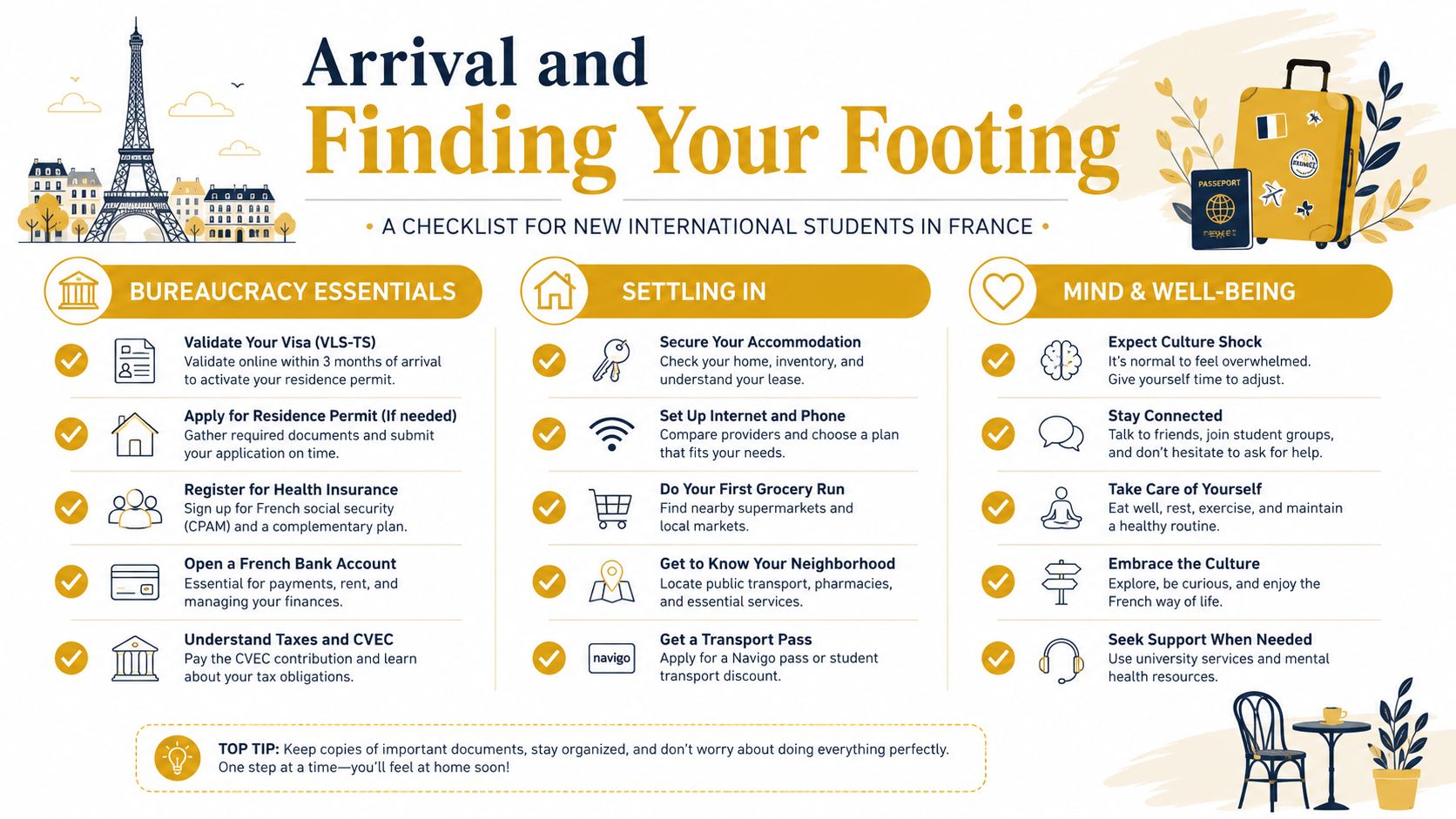
Your first tasks should be practical, not social. Validate the visa if required, confirm how your housing move-in works, get a local phone plan, and open the account you need for day-to-day payments. Don't chase sightseeing until the paperwork is under control.
After that, solve the basics that make you functional. Buy a transit card if your city uses one, identify a pharmacy near your housing, and save the contact details for your school's international office. Students who stay calm during this phase adjust faster because they stop treating every errand like an emergency.
Watch for housing and social mistakes
The biggest early housing mistake is signing too fast because you're scared of missing out. If a listing feels rushed, opaque, or strangely cheap, step back and verify it carefully. International students are often targeted when they're new, tired, and eager to say yes.
For social life, don't make your world only other Americans. That's comfortable, but it shrinks the value of the experience fast. Join one class activity, one campus event, or one local routine that forces you into French-speaking settings.
Practical insight: homesickness gets worse when your day has no structure. A regular café, grocery store, or walking route gives your brain something familiar to hold onto.
For a few travel-ready phrases that make the first week easier, keep these common French phrases for travelers on your phone.
Adjust your expectations fast
French academic culture can feel more formal than what many students expect. That's not a problem if you recognize it early and adapt. Be on time, follow the course format, and pay attention to how staff communicate with students.
Ana's second week went better because she stopped trying to “win” the system and started learning it. That's a significant first-month win in France, not confidence, but calm competence.
Your Complete Study Abroad Timeline
If you want this to go smoothly, start earlier than you think you need to. A strong plan isn't complicated, it's sequenced. The students who feel settled by arrival are almost always the ones who treated every task as part of a calendar, not a mood.
Work backward from departure
Twelve months out, choose your program type and city with your academic goals in mind. Nine to ten months out, handle language prep and begin gathering the documents schools and visa offices are likely to ask for. Six months out, lock in housing strategy, funding proof, and application deadlines. Three months out, focus on visa appointments, departure logistics, and any remaining administrative gaps.
A few items deserve special attention. Keep your passport valid, track school-specific requirements separately from visa requirements, and don't assume your housing will sort itself out after arrival. The French system rewards students who keep their paperwork organized and their deadlines visible.
Use a simple checklist, not a giant spreadsheet
- Program decision: pick the academic structure that matches your goals.
- Funding proof: organize scholarship letters, savings evidence, or sponsor documents.
- Visa action: book the appointment path early and leave room for processing.
- Language prep: build enough French to handle daily life, not just class.
- Arrival setup: plan phone, transport, banking, and housing before landing.
Know where to get help when things wobble
Every student abroad hits a snag. What matters is knowing who to contact first. Your school's international office, housing contact, and local student networks usually solve problems faster than internet forums do. Keep emergency numbers in your phone and print what you'll need if your phone dies on arrival.
If you want a smoother start, especially with language confidence before departure, book a customized French lesson plan with Elite French Tutoring. A focused prep course can save you from weeks of avoidable stress, especially if you want help with speaking, real-life travel language, or DELF/DALF preparation before you leave.