You're probably doing this right now: comparing camp websites in five tabs, translation school pages in three more, and still asking the same question. What does summer camp in French even mean?
Sometimes it means a local bilingual day camp. Sometimes it means a residential language program in France. Sometimes it means a camp where kids do crafts and games with a light French theme, but most of the day still runs in English. That's why parents get stuck. The search term itself is muddy, and the results are all over the place.
I see this constantly when families come to me for advice. They aren't looking for another giant list of camps. They want to know which kind of program will help their child speak more French, feel more confident, and make the summer investment worth it. That's the core question.
This guide gives you a framework I'd use with my own students' families. You'll sort the options, compare the tradeoffs, and decide whether your child needs a local camp, a camp in France, or a more personalized alternative.
Table of Contents
- That Overwhelming Summer Camp Search
- Decoding the Types of French Summer Camps
- Comparing Camp Models The Immersion Spectrum
- How to Choose the Right French Camp for Your Child
- A Real Success Story From Hesitant to Confident
- Beyond Camp The Power of Personalized Tutoring
- Building Your Child's French Learning Roadmap
That Overwhelming Summer Camp Search
Most parents start with one simple search and end up with a mess. You type in summer camp in French, expecting a clear answer, and instead you get a mix of U.S. bilingual day camps, city-based programs, and immersion camps in France. That confusion is real. One overview of current search results notes that this phrase is ambiguous, with options ranging from U.S. day camps to France-based immersion programs, and that parents rarely get the decision criteria they need in one place (overview of the fragmented search landscape).

The bigger problem is that these options solve very different problems. A local camp might be perfect if your child needs gentle exposure and social comfort. It's the wrong fit if your goal is spoken fluency. A residential program in France can be powerful, but it's not automatically the smart choice for every child.
What parents usually mean when they search
In practice, I find families usually mean one of three things:
- A nearby French camp: They want summer structure, language exposure, and no international travel.
- A real immersion experience abroad: They want French used beyond the classroom.
- A flexible support option: They want progress, but camp schedules, readiness, or cost make a different format more realistic.
If your child still needs stronger foundations before camp season, structured French classes for kids can help you figure out whether a camp is the next step or whether a simpler summer plan makes more sense.
Practical rule: Don't shop for camps until you name your goal. Exposure, confidence, fluency, independence, and childcare are not the same purchase.
My direct advice
Don't ask, “What's the best French summer camp?” Ask, “What kind of summer experience will help my child most right now?”
That shift saves time, money, and disappointment.
Decoding the Types of French Summer Camps
Three very different experiences sit behind the phrase summer camp in French. Parents make better decisions as soon as they separate them.
Camp in France with real cultural roots
The first category is the classic camp in France model. In French culture, this connects to the long tradition of colonies de vacances. A French-language overview explains that these holiday camps became part of the educational system after World War I, reached a golden age between 1930 and 1960 with more than 4 million French children attending each summer, and still serve more than 1 million children per year today (history of French holiday camps).
That matters because this isn't some trendy niche product. It's a long-standing institution tied to youth development, group life, and education.
For a parent, this usually means:
- residential living
- structured supervision
- French integrated into daily routines
- a stronger cultural experience than a classroom-only program
This option suits children who are ready for some independence and can tolerate the discomfort that comes with real immersion.
Local immersion camp
The second category is the local immersion camp. This is often the most practical choice for families in major cities or suburban areas who want a serious French environment without flights, passports, or overnight separation.
These camps usually work best for children who:
- need a lower-stakes first step
- want peers and activities
- have some French already, but need more speaking practice
- aren't ready to live abroad yet
The quality gap here is huge. Some local programs run real language blocks and build the day around French. Others use French as branding while most interactions happen in English.
French-themed day camp
The third category is the lightest version. I'd call it the French-themed day camp. These programs may include songs, cooking, art, games, or a few basic phrases, but they aren't designed for major language growth.
That doesn't make them bad. It just means you should buy them for the right reason.
| Camp type | Main purpose | Best for |
|---|---|---|
| Camp in France | Immersion and independence | Students ready for deeper language use |
| Local immersion camp | Structured practice close to home | Kids who want French without overseas travel |
| French-themed day camp | Fun exposure | Younger kids or total beginners |
If your child needs measurable language progress, don't confuse “French present during camp” with “French driving the camp.”
Comparing Camp Models The Immersion Spectrum
If you care about language results, you need to compare camp models by how much French your child will use, not by how attractive the brochure looks.
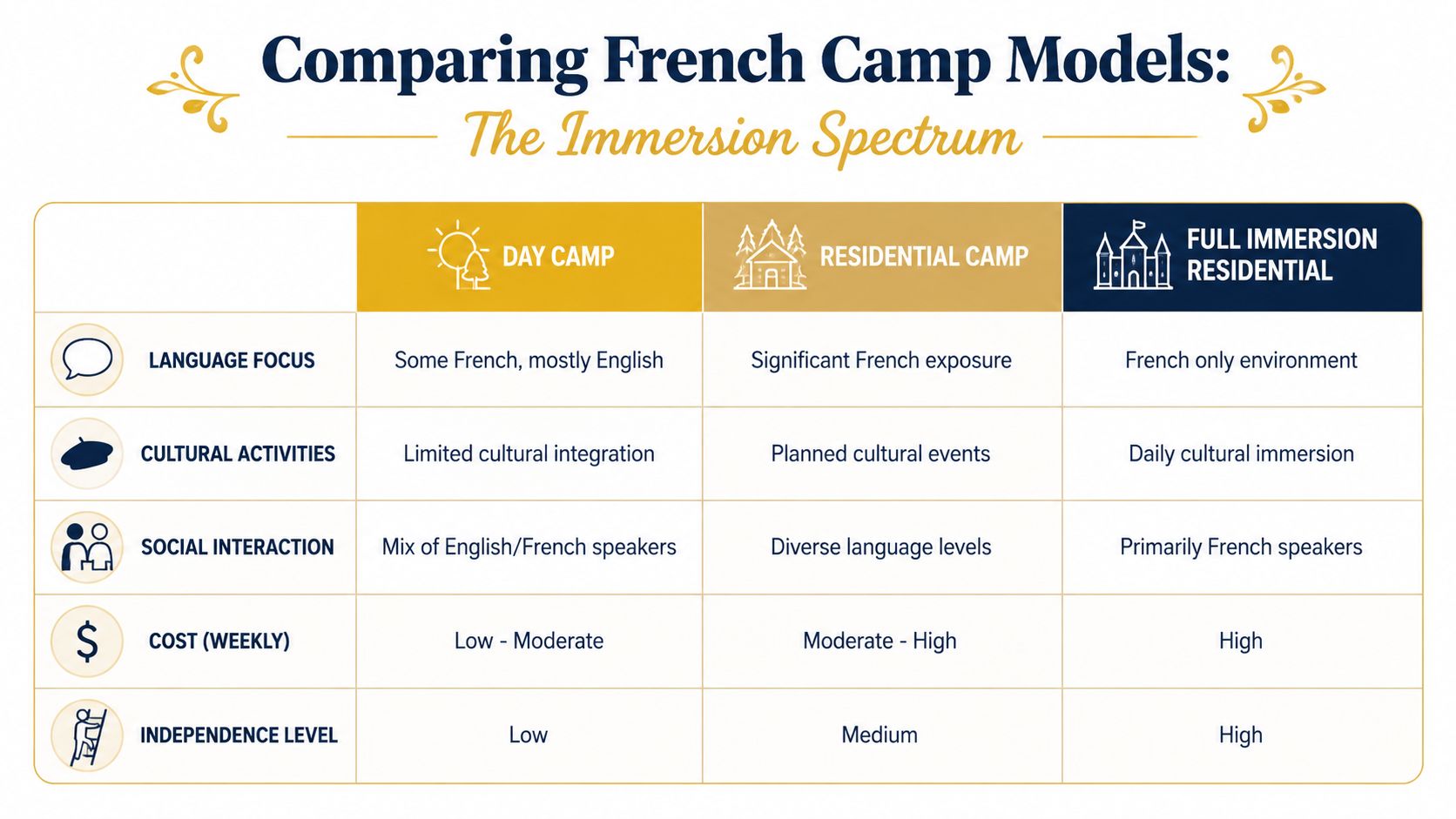
French Summer Camp Models at a Glance
| Factor | Camp in France Full Immersion | Local Immersion Camp | French-Themed Day Camp |
|---|---|---|---|
| Language environment | French built into class, meals, and daily life | French varies by program and staff consistency | Usually partial exposure |
| Travel and logistics | Highest complexity | Manageable for most families | Easiest |
| Social experience | Strong cultural and peer immersion | Strong peer interaction, lighter cultural immersion | Familiar and low pressure |
| Best use case | Serious speaking growth | Skill-building without going abroad | Introductory exposure and summer fun |
| Parent priority | Language plus independence | Balance of convenience and progress | Simplicity and comfort |
Why immersion works differently from class time
Independent guidance on language camps in France notes that many programs use a full-board, all-inclusive model that combines daily French lessons with activities, excursions, accommodation, and meals. That same guidance describes a common format of about 15 lessons per week, with some intensive options adding more instruction or private sessions (guide to immersive language camp design in France).
That setup matters more than parents realize.
A child doesn't learn French only during formal lessons. They learn when they have to ask for something at lunch, follow instructions during an activity, decode what friends are saying in the residence hall, and keep going even when they don't have the perfect word. That repeated use is what changes passive school knowledge into active speaking.
My opinion on return on investment
If your goal is fluency or a major confidence jump, full immersion is the strongest model. If your goal is readiness, a local immersion camp often gives the best balance of challenge and support. If your goal is positive association with French, a themed day camp can do the job without overwhelming your child.
Use this simple filter:
- Choose camp in France if your child is socially adaptable, reasonably independent, and ready to use French beyond class.
- Choose local immersion camp if you want real practice but need a softer landing.
- Choose French-themed day camp if this summer is about enjoyment, curiosity, and building momentum.
For families who want a more structured version of concentrated practice before or after camp, intensive French immersion programs can fill the gap that many camps leave behind.
The most expensive option isn't automatically the smartest one. The right fit is the program your child can fully engage with.
How to Choose the Right French Camp for Your Child
You are not choosing a camp. You are choosing the kind of summer your child can use.
That is the question parents miss when they search summer camp in French. The phrase sounds specific, but it covers very different options. A local day camp with songs and crafts, a structured immersion program near home, and a residential camp in France are not interchangeable. Start by deciding what outcome you want this summer to deliver.
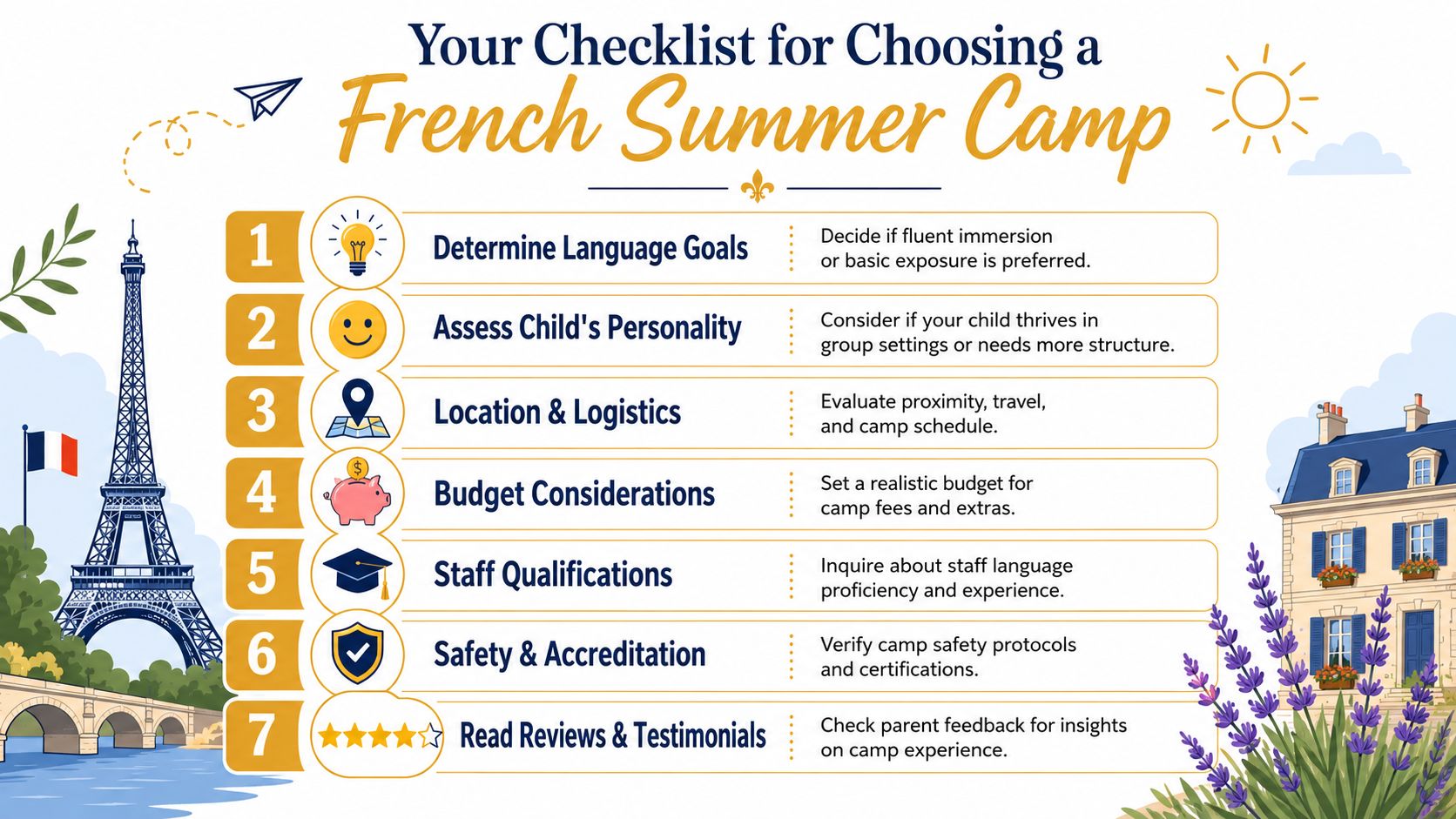
Match the camp to the child first
Age matters. Temperament matters more.
A good program for a younger child should feel predictable, warm, and active. A good program for an older child can ask for more independence, longer focus, and clearer speaking expectations. Parents often overvalue prestige and undervalue fit. That is backward.
Consider your child:
- Needs routine to feel secure: choose a camp with a clear daily schedule, consistent staff, and tight supervision.
- Gets quiet in groups: choose smaller classes and structured speaking activities, not a socially loose program that assumes kids will join in on their own.
- Loves people and novelty: a broader social environment can work well, as long as French is still expected outside lessons.
- Resists academics in summer: avoid camps that are basically school with a prettier brochure.
A shy child can do very well in French immersion. But only if the camp builds participation into the day instead of waiting for confidence to appear.
Check how the language is actually taught
I would ask for the daily schedule before I asked for the photo gallery.
Strong camps can explain exactly how French shows up across the day. Weak camps hide behind the word immersion and hope parents fill in the blanks. Do not reward that.
École des Roches offers a useful example because it gives concrete details about structure, including morning lessons and small class groups in its summer program (French summer camp schedule and class size details). That tells me the camp has thought about teaching, not just activities.
Ask these questions and expect direct answers:
- How are students grouped by age and French level?
- How much formal instruction happens each day?
- What language do counselors use during meals, sports, and downtime?
- What happens when a child is ahead, behind, or anxious about speaking?
- How do you keep English from taking over outside class?
If the answer to that last question is vague, keep looking.
Choose the budget category early
This decision saves families a lot of wasted time.
French camps usually fall into three buckets:
- Local and lower-lift: easier logistics, lower cost, less total immersion
- Structured immersion near home: stronger language gains without international travel
- Residential or abroad programs: higher cost, more intensity, more independence required
Do not compare camps only by sticker price. Compare what is included, how many hours of real French your child will use, what supervision looks like, and whether the setting matches your child's maturity. The most expensive option often buys travel, facilities, and convenience. It does not automatically buy better learning.
Treat supervision as part of the learning model
Safety is not a separate checklist item. It shapes whether a child will speak, participate, and recover from hard moments.
Ask who is responsible between activities, how homesickness or social issues are handled, and how parents are updated if something is off. I also want to know whether staff are trained to bring quieter students into the group, because language growth drops fast when a child starts withdrawing.
A clear answer is a good sign. A polished but vague answer is usually a warning.
Use this framework before you commit
Choose the camp type that fits your main goal:
- Confidence and gentle momentum: pick a French-themed or light immersion camp
- Consistent speaking practice with support: pick a structured local immersion program
- High-intensity use of French across the full day: pick a residential or France-based program, but only if your child is ready for that level of independence
Parents want the right answer fast. The better approach is to choose the right category first, then compare camps inside that category. That is how you avoid paying for an experience that looks impressive and delivers very little for your child.
A Real Success Story From Hesitant to Confident
A parent I advised a while ago came to me with a familiar concern. Her son, Leo, was in middle school, earning acceptable grades in French, and speaking almost none of it aloud unless a teacher called on him. He wasn't failing. He was stalled.
His mother first assumed a camp in France was the obvious answer. After a longer conversation, it was clear that wasn't the right move yet. Leo liked French, but he didn't have the confidence for a fully immersive residential environment. He needed a bridge, not a leap.
Why the first choice would have been wrong
Leo shut down when he felt exposed. In a highly immersive overseas setting, that kind of student can retreat socially and let stronger personalities carry the conversation. The family didn't need the most ambitious option. They needed the option he would use.
So we narrowed the target:
- a structured local immersion experience
- clear daily routines
- enough speaking built into the day
- support before camp so he didn't arrive feeling behind
The turning point
The breakthrough wasn't dramatic. It happened in a normal exchange during camp when Leo needed to ask a counselor for help in French and then keep the conversation going instead of freezing. That kind of moment sounds small, but for a hesitant student it changes everything.
Once a child realizes, “I can get through this in French,” classroom anxiety starts to loosen. Leo came back more willing to answer spontaneously, less obsessed with getting every verb perfect, and more comfortable sounding imperfect while still being understood.
Confidence in French rarely appears all at once. It usually arrives after a student survives several imperfect conversations and realizes nothing bad happened.
His progress didn't come from camp alone. It came from choosing the right level of challenge, then reinforcing it with steady support afterward. That's the pattern I trust most.
Beyond Camp The Power of Personalized Tutoring
Some families think tutoring and camps compete with each other. I don't see it that way. The smartest summer plans often combine them, or replace camp with tutoring when camp isn't the right fit.
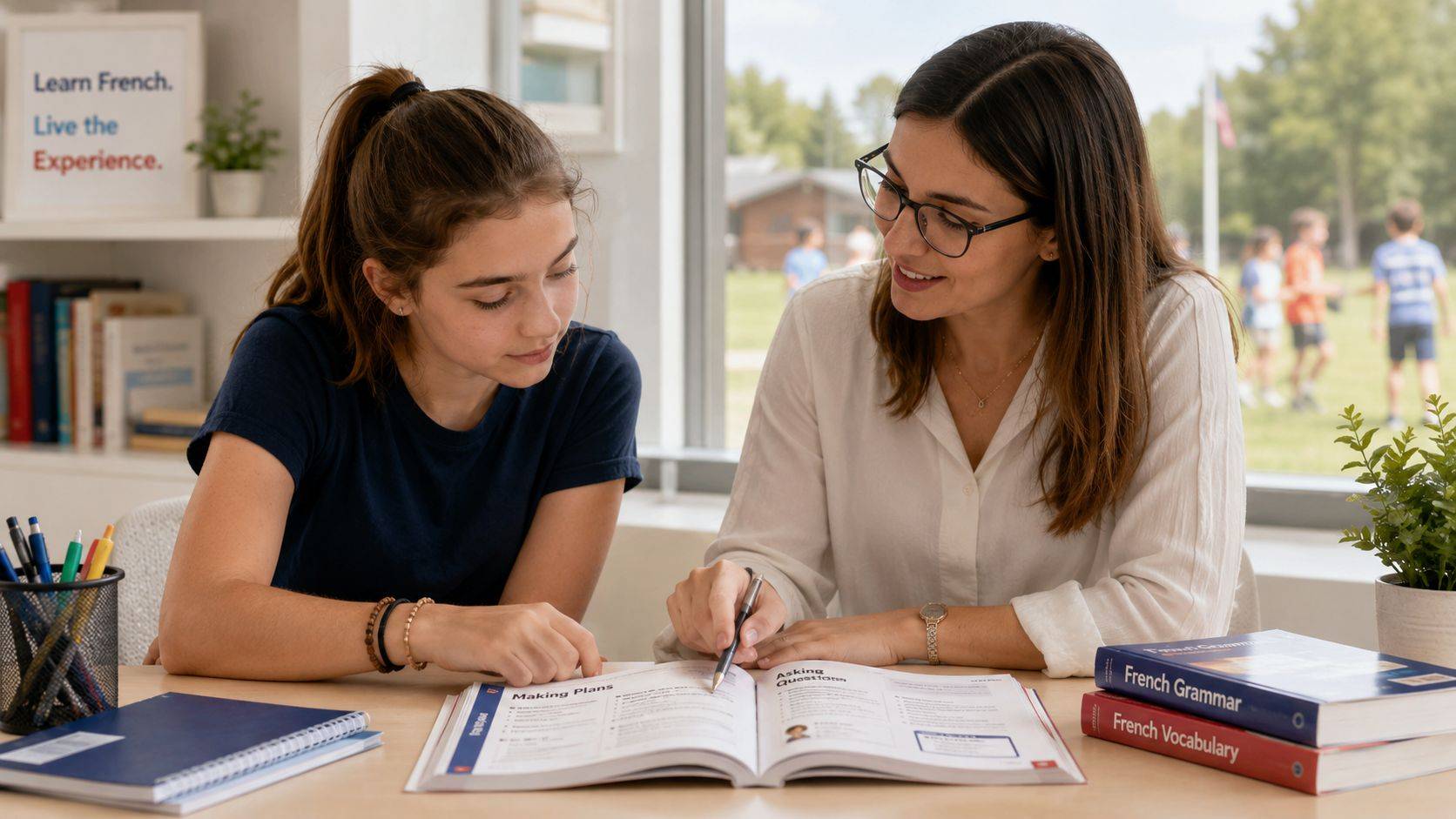
Tutoring before camp
This is the most underrated move.
A child who knows how to introduce themselves, ask basic questions, handle confusion, and survive common camp interactions will get far more out of immersion. Pre-camp tutoring reduces panic. It also lets a student arrive ready to participate instead of spending the first days just trying to cope.
Tutoring after camp
This matters just as much. Camp creates momentum, but momentum fades fast if no one helps the student hold onto it.
Post-camp tutoring helps a child:
- keep new vocabulary active
- turn camp memories into real speaking practice
- fix recurring grammar problems while motivation is still high
- carry summer gains into the school year
Tutoring instead of camp
Sometimes camp isn't the right buy. The schedule doesn't work. The travel is too complicated. Your child needs individualized support more than a group environment.
That's where a customized option can make more sense. For example, Elite French Tutoring offers private online instruction and can function as a summer learning plan for families who want flexible, personalized French support without committing to a camp format. If that's the direction you're considering, their online French tutoring options show what a home-based alternative can look like.
A child who gets the right amount of targeted speaking practice often makes better use of summer than a child placed in the wrong group program.
Building Your Child's French Learning Roadmap
You are not choosing a camp. You are choosing a summer role for French in your child's life.
For one child, French should be a low-pressure way to stay interested and keep the language present. For another, it should be a serious speaking push before a school year, an exam, or a future exchange. Parents get stuck when they search for “summer camp in French” as if all options solve the same problem. They do not.
Start with the outcome. Then match the format to that outcome and to your budget.
If your child needs enjoyment and exposure, a lighter French-themed day camp may be enough. If they need consistent speaking practice without the complexity of international travel, a local immersion camp is often the smarter buy. If they are ready for daily language use, more independence, and a stronger cultural experience, a residential program in France can make sense.
Cost matters. So does return. Some France-based programs are long-established and serve international families at scale, and premium two-week residential options can cost several thousand euros, as noted earlier. Treat that decision the same way you would treat any major educational purchase. Pay for intensity only if your child is ready to use it.
Use this framework before you book:
- Define the goal clearly. Conversation confidence, cultural exposure, academic support, or independence.
- Choose the right model. Local, abroad, or a tutoring-based alternative.
- Check the daily schedule. Hours of actual French use matter more than glossy photos and broad promises.
- Plan for before and after. A child who prepares well and reviews afterward gets more from the summer.
This is the point many families miss. The best option is not the most expensive camp or the one with the most polished marketing. It is the one that fits your child now.
If you want a practical next step, a personalized structured French study plan for summer learning can help you decide whether your child needs a camp, private tutoring, or a mix of both.