Skip to content

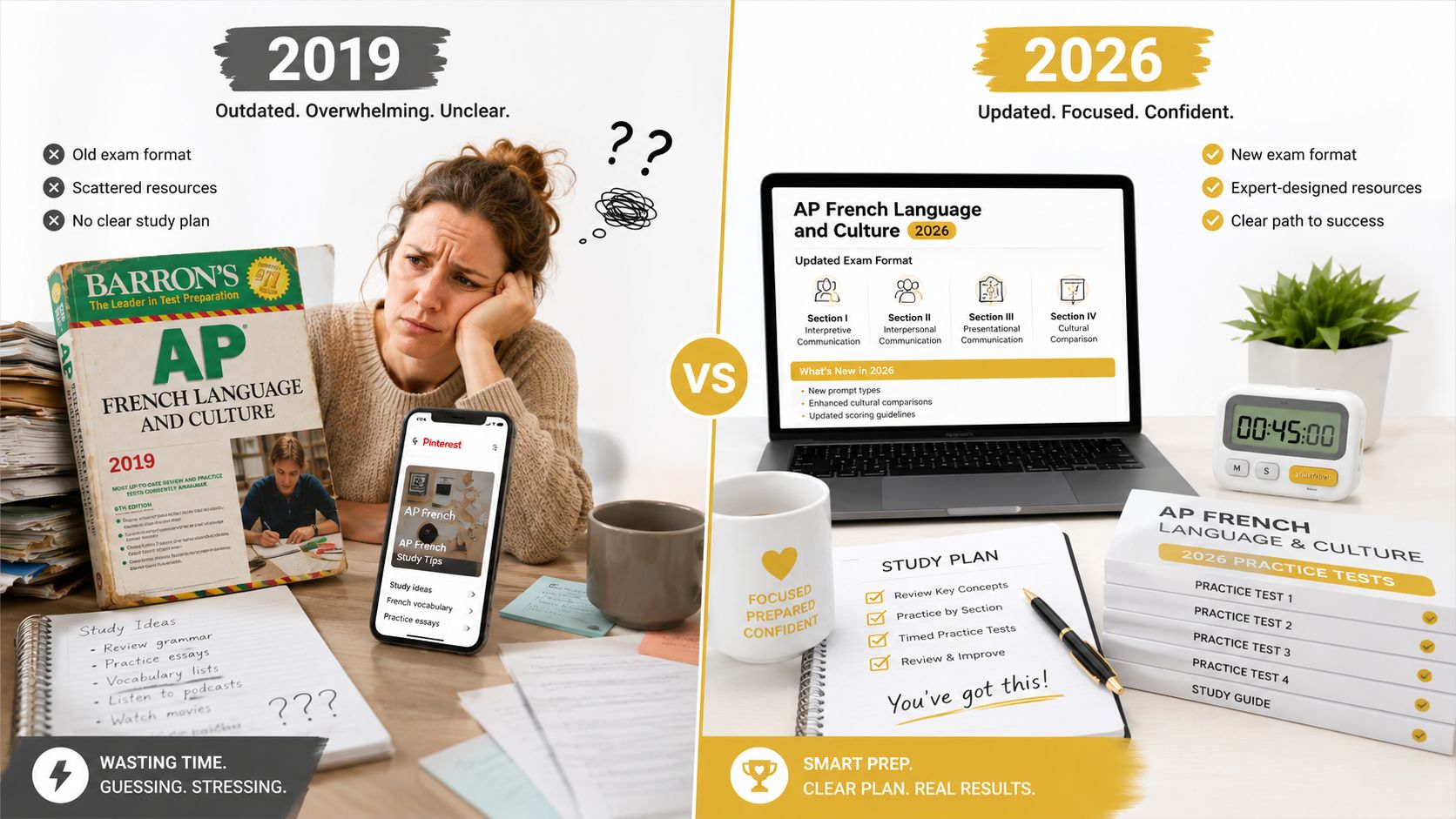
Your child's AP French prep books might be the wrong year, and that matters more than most families realize. I've seen juniors open an older study guide, find handwritten essay drills and paper-based speaking advice, and then freeze when their teacher mentions Bluebook, typed responses, and recorded prompts. The ap french language and culture exam now asks students to perform in a very different format, and the students who score well are usually the ones who prepare for the actual machine, not the memory of the old one.
That's the core problem behind this test. Families don't just need a syllabus recap, they need a map from today's exam to the exact habits that move a score from a 3 to a 4 or 5. I'm writing this the way I coach my own students, which means I'll tell you what matters, what doesn't, and where a private tutor can save months of trial and error.
Table of Contents
- Why the AP French Language and Culture Exam Feels Different in 2026
- Exam Structure and Timing in the Bluebook App
- Question Types and How Each Task Is Scored
- The Six Themes That Connect Every Section
- CEFR Alignment and What Each AP Score Really Means
- A Six-Month Study Timeline With a Sample Prompt
- From a 2 to a 4 in One Semester
- How Personalized Tutoring Targets the Gaps and What to Do Next
Why the AP French Language and Culture Exam Feels Different in 2026
A lot of families still prepare for AP French as if it were a paper exam with handwritten essays and a live speaking setup. That habit leads to late-year panic, because the current exam is a fully digital test in the Bluebook app, and responses are automatically submitted at the end of the exam. College Board describes the AP French and Culture Exam as just over 3 hours long, with 65 multiple-choice questions and 4 free-response questions.
What changed in practice
The biggest shift is not cosmetic. Students now read, listen, type, and respond inside a digital workflow, so pacing, screen stamina, and on-screen note-taking matter much more than they used to. The interpersonal speaking task uses recorded prompts, not a live conversation partner, so students have to manage silence, timing, and response length without help from another person in the room.
Typed writing changes the whole rhythm of the exam. A student who once planned with a pencil and rewrote paragraphs by hand now needs to draft quickly, organize cleanly, and revise mentally while typing. That is where many otherwise strong French students lose points, because they know the language but have not practiced under digital timing pressure.
Practical rule: if a student hasn't practiced in Bluebook, they haven't practiced today's exam yet.
Families also miss one more point, the exam is not rewarded like a grammar quiz. The modern AP French framework weighs communication across interpretive, interpersonal, and presentational modes, so students have to show they can use French in realistic tasks, not just identify rules on a worksheet. That is why the rest of this guide focuses on the performance demands families need to coach, and on the sub-skills that help a 3 become a 4 or 5.
Exam Structure and Timing in the Bluebook App
Exam day runs on a tight clock, and Bluebook makes students feel that clock in a very specific way. The AP French exam is divided into two sections that together include 65 multiple-choice questions and 4 free-response questions. That outline matters, but families usually learn more by asking how the minutes are spent inside the app.
The first section is a two-part listening and reading experience, and the second section moves into writing and speaking. Students are not just switching tasks. They are switching mental gears, from choosing the best interpretation of a source to producing French under time pressure. A student who prepares only with paper handouts is missing part of the test.
| Section | Task | Questions/Parts | Time | Weight |
|---|---|---|---|---|
| Section I | Reading | About 30 questions | 70 minutes | 50% |
| Section I | Listening | About 35 questions | 55 minutes | 50% |
| Section II | Interpersonal Writing | 1 email reply | 18 minutes | 50% |
| Section II | Interpersonal Speaking | 4 recorded prompts | About 3 minutes | 50% |
| Section II | Presentational Writing | 1 argumentative essay | About 15 minutes | 50% |
| Section II | Presentational Speaking | 1 cultural comparison | About 2 minutes | 50% |
Bluebook also builds in a 10-minute reading window before listening begins and a 15-minute final reading period between sections, along with breaks. Those pauses are not filler. They are the exam's built-in reset points, and strong students use them to steady their pace instead of staring at the screen and mentally drifting. I tell families to rehearse the full sequence in the Bluebook preview app before exam day, because the interface itself affects performance.
A useful way to coach timing is to treat each task like a different race. Reading rewards quick sorting, listening rewards concentration without the luxury of replay, and the free-response tasks reward calm production when the clock feels louder than your notes. Students often know the French. They lose points because their pacing falls apart after the first shift.
One practice run is helpful. Two is better. A full mock exam before spring break, then another closer to May, gives students a chance to feel the digital rhythm before the test starts. That rhythm matters just as much as vocabulary lists, because Bluebook does not just hold the exam, it shapes how students experience it.
Question Types and How Each Task Is Scored
The multiple-choice section rewards the kind of reading and listening that happens in real life, not isolated grammar drills. College Board says the exam uses four sets of authentic print sources and a range of authentic audio materials, and the reading questions ask students to identify main ideas, supporting details, vocabulary in context, audience, point of view, and cultural or interdisciplinary information (College Board assessment overview). In listening, students have to follow interviews, podcasts, and dialogues while staying alert to tone and implied meaning.
Where the free-response points live
The four free-response tasks are where coaching matters most. In Interpersonal Writing, students reply to an email, and scorers want a clear answer to the prompt, an appropriate tone, and enough language variety to sound like a real person, not a translation exercise. In Interpersonal Speaking, students answer four recorded prompts, and the score rises when the response stays relevant, intelligible, and sustained rather than clipped or stalled.
Presentational Writing is the argumentative essay, which asks students to type a structured argument using provided sources. A strong response does not just “have opinions.” It connects ideas, cites evidence naturally, and stays organized enough that the reader never wonders where the writer stands. Presentational Speaking is the cultural comparison, where students compare a francophone cultural feature with one from their own culture in a timed oral response.
How scoring really works
The College Board's score descriptions use 0 to 5 rubrics for both written and spoken tasks, which means scorers are judging the total performance, not counting every tiny error like a red-pen grammar worksheet. That's why comprehensibility matters more than perfection, and why a student can still earn a strong score with a few mistakes if the message stays controlled and coherent.
| Task | What scorers listen for | Common gap I see |
|---|---|---|
| Email reply | Direct response, tone, accuracy | Students answer only part of the prompt |
| Interpersonal speaking | Sustained, relevant speech | Short answers that stop too early |
| Argumentative essay | Clear claim, organization, evidence | Ideas are good, but paragraphs feel scattered |
| Cultural comparison | Specific comparison and coherence | Students list facts without drawing a real comparison |
A strong 4 or 5 usually comes from rhetorical control, not fancy vocabulary sprayed everywhere. If a student knows how to open, develop, and close an answer clearly, the score tends to move up fast. For practice materials that mirror that scoring logic, I often point families to a structured AP French language practice exam before they start stacking random worksheets.
The Six Themes That Connect Every Section
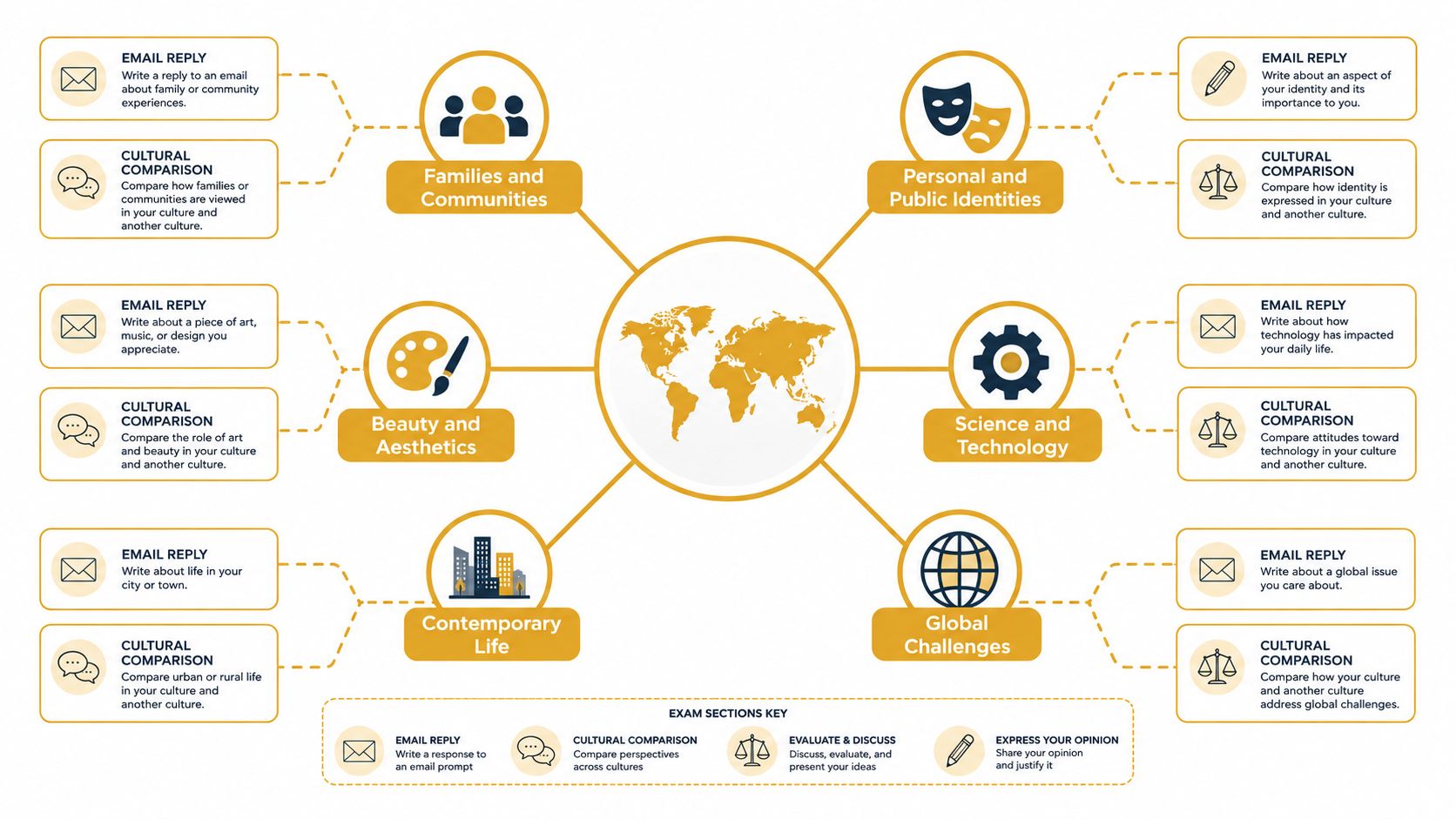
The six AP French themes are the backbone of the course, and they show up everywhere students look. They're Families and Communities, Personal and Public Identities, Beauty and Aesthetics, Science and Technology, Contemporary Life, and Global Challenges. If a student knows these themes well, they stop treating the exam like disconnected tasks and start seeing repeated patterns in content and language.
Why themes matter more than vocabulary lists
A theme is not just a word bank. It's a lens for recognizing how francophone cultures talk about work, identity, art, technology, or environmental pressure. That's why the same broad idea can show up as a podcast clip about immigration, an article on francophone cinema, or an infographic on climate activism in Senegal.
When students understand the theme, they start anticipating the kinds of arguments and examples that fit the prompt. A Contemporary Life prompt might surface in a reading about French workplace culture, then reappear in an email reply about weekend plans in Dakar, and later show up in a cultural comparison about how families structure free time. The content shifts, but the thinking stays aligned.
What thematic fluency looks like on exam day
The best students recycle transitions, connectors, and topic-specific lexis without sounding memorized. They know how to shift from one example to the next with phrases that signal contrast, cause, or nuance. That kind of fluency helps in both writing tasks and speaking tasks, because scorers hear a student who can organize thought under pressure.
The exam rewards students who can recognize the theme quickly and stay inside it with purpose.
The benefit for families is that a student who studies by theme can use one set of materials to prepare for reading, listening, writing, and speaking at once. This is more efficient than drilling isolated lists and builds the flexibility the exam measures.
CEFR Alignment and What Each AP Score Really Means
Families often ask what an AP French score means outside the AP bubble. The cleanest translation is the CEFR, the Common European Framework of Reference for Languages. College Board's alignment places an AP 5 roughly at C1, an AP 4 at B2 to C1, an AP 3 at B1 to B2, an AP 2 at A2 to B1, and an AP 1 at A1 to A2.
| AP Score | CEFR Level | What Students Can Do | College Credit |
|---|---|---|---|
| 5 | C1 | Defend a position, handle complexity, write polished essays | Often eligible, depending on institution |
| 4 | B2 to C1 | Argue clearly, summarize opposing views, communicate with control | Often eligible, depending on institution |
| 3 | B1 to B2 | Describe events and handle familiar topics with some independence | Sometimes eligible, varies by school |
| 2 | A2 to B1 | Manage basic exchanges, but with limited consistency | Usually not enough for credit |
| 1 | A1 to A2 | Very early proficiency | Not enough for credit |
That difference matters in real life. A student sitting at a 5 can usually defend an opinion in a formal debate, summarize another person's argument, and write a controlled essay with stronger grammar choices, including more reliable use of the subjonctif. A student at a 3 can often narrate present and past events, but the performance gets shaky when the task asks for hypotheticals, nuance, or abstract argumentation.
Colleges and universities may award credit for 4s and 5s, but placement decisions usually depend on broader proficiency judgments, which is why the CEFR framing is so useful. An AP 4 is not a consolation prize. For students who plan to study, intern, or work in France, Quebec, Senegal, or Switzerland, it can be practically valuable because it suggests a level of language control that transfers beyond a single exam.
If you want a deeper sense of how these levels translate into study choices, the most helpful comparison is often a broader CEFR proficiency guide for French learners that shows what students at each band can do in conversation and writing.
A Six-Month Study Timeline With a Sample Prompt
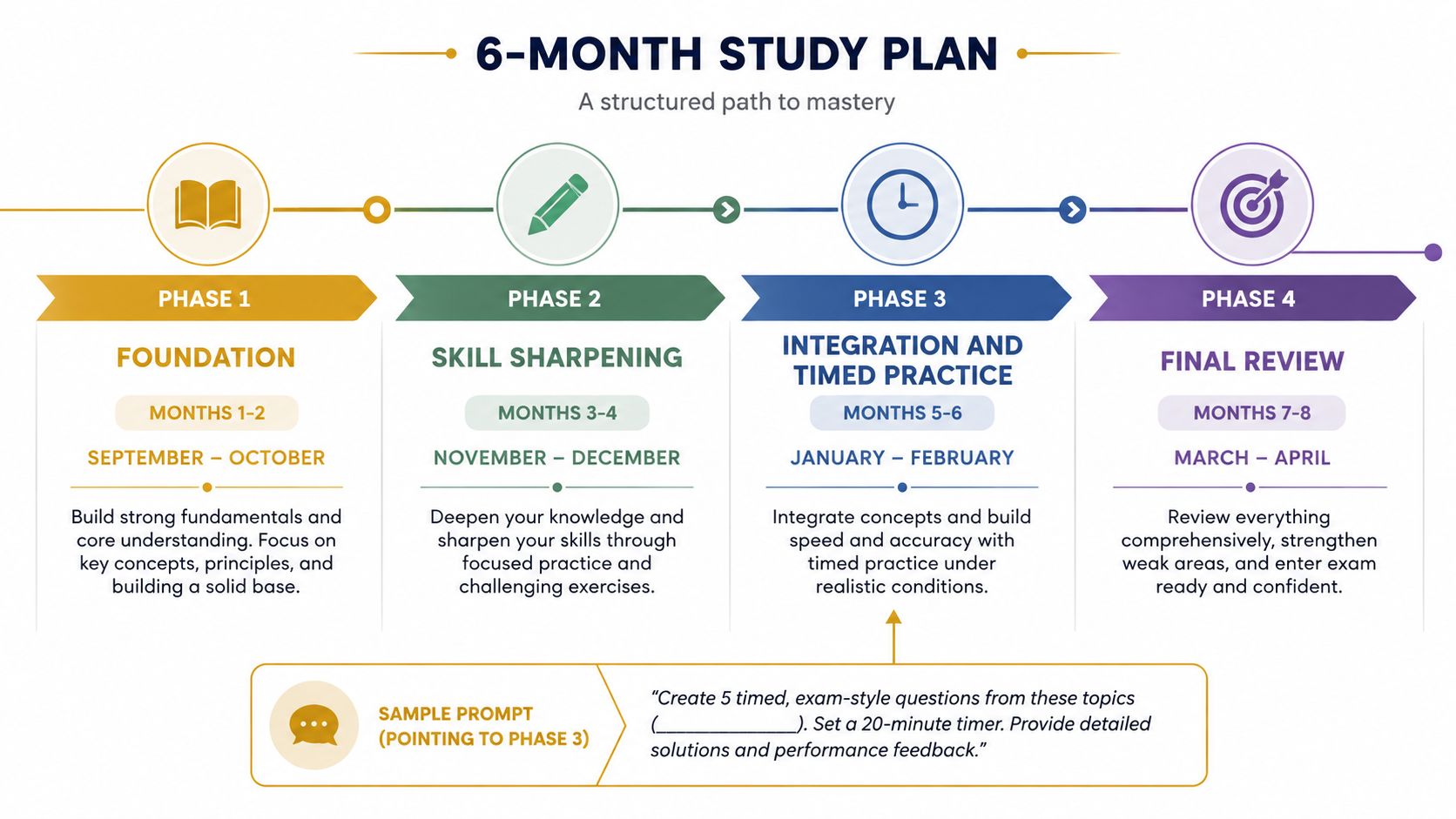
The students who improve most usually don't cram, they build a rhythm. I like a six-month plan that starts with foundation work and ends with full exam simulation, because AP French rewards accumulated habits more than last-minute intensity. A good schedule gives each skill a lane, then keeps looping the six themes through every week.
A workable weekly rhythm
Phase 1, foundation. Build vocabulary by theme, listen to shorter authentic clips, and read for gist before details.
Phase 2, skill sharpening. Add timed writing, speaking drills, and annotation practice on the reading set.
Phase 3, integration and timed practice. Mix reading, listening, and production in one sitting so the brain learns to switch tasks.
Phase 4, exam simulation and polish. Run full sections, review rubrics, and patch weak spots instead of chasing new content.
A practical weekly routine can look like this, with small but steady outputs:
- One RFI article per week, so the student practices reading a real article with purpose.
- One Les Journalistes podcast episode, so listening gets exposure to varied voices and pacing.
- One written réponse éclair by class day, so short-form writing stays quick and accurate.
- One 10-minute recorded monologue each week on a Contemporary Life theme, so speaking becomes less intimidating.
That kind of repetition builds the habits scorers notice, especially coherent openings, transitions, and sustained responses. It also prevents the common April panic where a student suddenly realizes that they have studied French content, but not French performance.
Sample prompt to rehearse this week
A Senegalese pen pal writes that family members expect a career path in medicine, but the student wants to study science and technology in a field that feels more creative and independent. The email asks for advice on balancing family expectations with personal goals.
A strong response opens by answering the question directly, acknowledges the tension, and gives at least two practical suggestions. It might use connectors like d'abord, ensuite, and en plus, while keeping the tone warm and personal. A weaker response usually restates the prompt, gives one vague suggestion, and ends before fully addressing the relationship between family and ambition.
Checklist before the timer starts: identify the task, name the audience, outline two key points, and choose three connectors you can use without thinking.
For families who want a more formal study structure, a structured French study plan is often the difference between random practice and steady score growth.
From a 2 to a 4 in One Semester
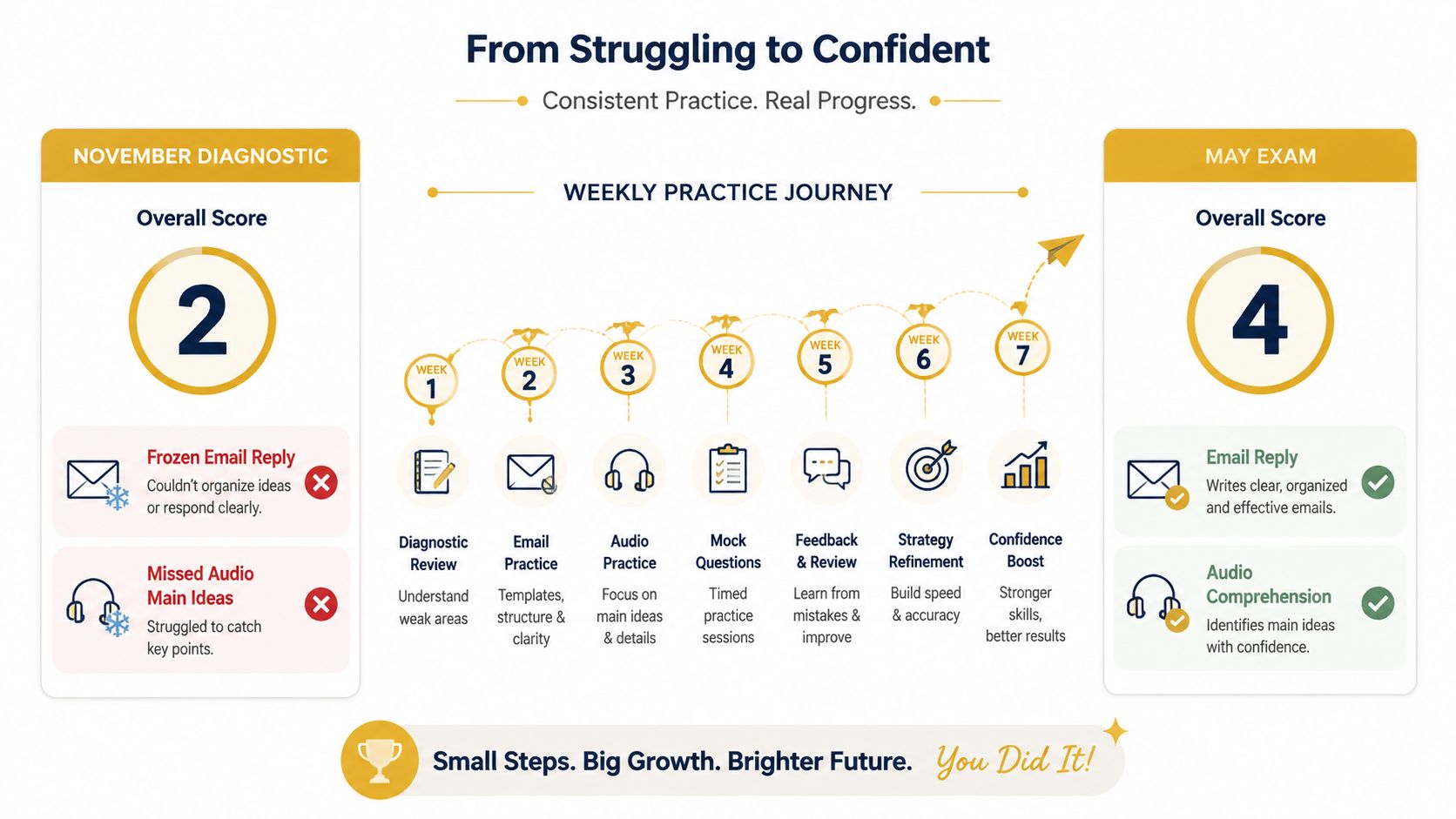
Maya, a junior at a Texas high school, started November with a diagnostic that told the truth quickly. She froze during the simulated email reply, and in two listening selections she missed the main idea because she was trying to translate every word instead of tracking the speaker's stance. Her French was not weak, but her test habits were.
The fix wasn't dramatic. We worked on weekly tutor sessions built around timed listening drills, plus a vocabulary journal organized by the six AP themes. She also recorded two presentational speaking tasks each week, then listened back with feedback on pacing, fillers, and clarity.
What changed by March
By March, Maya was catching the implied stance in audio prompts instead of just the surface facts. Her cultural comparison essays stopped sounding like disconnected notes and started following a real line of thought, with one example supporting the next. The biggest change was confidence under time pressure, because she had already done the exact task enough times to stop treating it like a surprise.
On exam day, she earned a 4. Her interpersonal writing was strong because she answered the prompt fully and stayed on tone, and her presentational speaking sounded natural because she had practiced speaking in complete ideas instead of memorized fragments.
That's the lesson parents should keep in mind. A score jump like that usually comes from targeted repetition, not talent alone. The student who improves is the one who practices the same task until the structure feels boring, then performs it calmly when it counts.
How Personalized Tutoring Targets the Gaps and What to Do Next
A strong diagnostic usually points to a specific weak spot, and the weak spot is rarely the same for every student. One student misses implied meaning in audio. Another writes essays with weak transitions. A third has enough French vocabulary for conversation, but the interpersonal writing still sounds cramped and repetitive. A private tutor can work on each gap directly instead of handing out the same homework to everyone.
A general French tutor may help with homework and vocabulary. An AP French specialist does something different because they know the rubric, the digital Bluebook flow, and the pacing pressure built into each task. That matters for a student trying to turn a shaky 3 into a secure 4, or push a strong 4 toward a 5.
What a smart tutoring package usually includes
A serious AP French program should begin with a diagnostic assessment, then move into a study plan built around that student's gaps. Weekly timed practice with rubric-based feedback keeps the work tied to the exam, and full-length mock exams show whether the gains hold under pressure. The pattern is familiar to experienced AP teachers. Students often know more French than their scores show, but they have not practiced the exact response shape the exam rewards.
That is also why whether a private French tutor is worth the investment depends on the student's needs. Some families only need enrichment. Others need a specialist who can spot why a response loses points, then train that skill until it shows up on command.
Some families wait too long because they assume more schoolwork will solve the issue. Often it won't. If the student can understand French in class but falls apart in timed production, the fix is guided repetition, not just more exposure.
For families deciding on support, the question is simple. Does the student need broad French enrichment, or targeted AP coaching focused on scoring and timed performance? That distinction explains why some students stay stuck while others keep improving.
If you'd like a low-pressure next step, book a free 20-minute consultation with Elite French Tutoring to review the student's diagnostic, talk through their timeline, and decide whether a tutoring track makes sense before the May exam.