Skip to content
You've got a shortlist, a deadline, and a French level that's still catching up. That's the precise moment when prestige can become a distraction, because the core question isn't which name sounds strongest, it's which campus will truly work for your language level, budget, and admissions route. The best universities in France for international students are the ones that fit the way you'll study, live, and apply, not just the way they rank on paper.
For families and applicants, I'd compare these seven through the same lens I use with students: English-taught access, admissions friction, tuition reality, and the amount of French you'll need for daily life. France's international student base is large and varied, with 443,500 foreign students in 2024–25, about 15% of higher-education students, and universities hosted 63% of them, so you're not looking at a niche environment. I've lined the picks up so you can see where each one is strong, where it's demanding, and where a French preparation plan matters most. If you want the shortest path to a workable shortlist, start there.
Table of Contents
- 1. Université Paris-Saclay
- 2. PSL University
- 3. Sorbonne University
- 4. École Polytechnique
- 5. Sciences Po
- 6. HEC Paris
- 7. Université Grenoble Alpes
- Top 7 French Universities for International Students
- Turning Your Shortlist Into a Confident Application Plan
1. Université Paris-Saclay
Université Paris-Saclay is the safest “high ambition, public-university price” choice for STEM-minded international students. Its reputation comes from depth in math, physics, computer science, AI, life sciences, and engineering, not from broad lifestyle branding, and that matters if your goal is a serious graduate track. The university also sits in the Paris region, so you get access to a major research ecosystem without jumping straight into the most expensive private-school model.
Why it works for internationals
Campus France places Paris-Saclay among France's internationally significant universities, and the broader French system shows why that matters. International students are spread across universities, business schools, and engineering schools, but universities still host the largest share, so Paris-Saclay sits in the part of the system where you'll find a mature international office, mixed cohorts, and established onboarding support. The university's International Welcome Desk is a practical plus because it helps with visa, housing, and health coverage.
Practical rule: If you want research intensity without private-school tuition, Paris-Saclay is one of the first names to price out carefully.
The trade-off is simple. The strongest English-taught breadth is usually at the Master's level, so bachelor's applicants should be realistic about how much French they'll need early on. If you're targeting a program here, check the program page line by line, then build a French plan around housing, admin, and internship language before you apply.
Buying decision verdict: Best for STEM applicants who want a top research environment and public-university value.
French-preparation step: Book a French level check early, then work toward the level needed for housing, admin, and internship life, not just classroom entry.
2. PSL University
PSL is the pick for students who want selectivity, smaller academic groups, and a central Paris environment. It's not a single campus experience, it's a collegiate structure with institutions such as ENS, Mines, and Dauphine, which gives it unusual range and a strong research identity. What draws internationals is the combination of elite academic branding and tightly managed study pathways.
PSL's English-language offer is strongest at the graduate level, with Master's and PhD tracks in English and integrated PSL PhD Track pathways. That makes it attractive if you're aiming for research continuity rather than a stand-alone degree. It also publishes tuition and scholarship information centrally, which is exactly what you want when you're comparing schools with uneven fee structures.
The catch is competitiveness. PSL is not a “apply broadly and hope” university, and the admissions bar reflects that. For many families, the question isn't whether PSL is excellent, it's whether the applicant's file is strong enough to justify the effort and whether the student is ready to sit in an intensely selective environment.
One detail that matters in practice is language certification. If your plan depends on English-taught admission but you still need French for daily independence, you'll want to prepare the language side deliberately, not casually. French language certification support is worth exploring if your file needs stronger proof or you're balancing multiple application systems.
Buying decision verdict: Best for academically ambitious students who want elite selectivity and can handle a highly competitive admissions process.
French-preparation step: Confirm whether your target program expects a certified French or English level, then prepare the document before deadline season.
3. Sorbonne University
Sorbonne University is the strongest choice here for students who want a classical research university with targeted English options and the credibility of a global name. It's especially compelling if your field sits in science, engineering, physics, computer science, or biosciences, while still benefiting from the university's broad academic prestige. For international students, that mix is useful because it gives you brand recognition without forcing you into a narrow professional school.
Sorbonne's English-taught Master's portfolio is curated rather than sprawling, which I see as a strength. You're not sorting through a huge catalogue of mismatched options, you're looking at programs with clearer academic intent. The university also offers international training programs, Erasmus Mundus links, and language-learning resources through its student services, so the support side is more structured than many applicants expect.
Practical rule: Sorbonne works best when the degree is the priority and the city is a bonus, not the other way around.
The tuition question needs attention. France's published non-EU differentiated rate for 2026–2027 is €2,902 for licence-level study and €3,950 for master's, though universities can grant exemptions or waivers in certain cases through their own policies and conditions. That means Sorbonne can still be financially workable, but only if you verify your status and program-level rules carefully.
Buying decision verdict: Best for research-driven applicants who want a prestigious public university with some English-taught graduate options.
French-preparation step: Check whether your route is a French-medium bachelor's application or an English-taught master's, then plan accordingly before you commit.
4. École Polytechnique
École Polytechnique is for students who want one of France's most intense STEM environments and are willing to work for it. The big advantage for internationals is that it offers an entirely English Bachelor of Science with structured progression, plus English-taught Master of Science and Technology options in areas like data, AI, IoT, and engineering. That makes it one of the clearest entry points into the elite French engineering world for students who aren't yet fluent in French.
The other reason it stands out is structure. Small cohorts, strong mentoring, and close ties to the broader Institut Polytechnique de Paris ecosystem make it feel very different from a large public university. It also publishes clear cost information, which helps when you're comparing it against schools where the price architecture is harder to decode.
That said, this is not a relaxed campus. The workload is heavy, and the pace leaves less room for extensive part-time work or casual adjustment time. If your profile is strong in mathematics and physics and you want an English route into elite engineering, it's a serious option. If you need a gentler transition into French academic life, it can be too sharp an entry point.
Buying decision verdict: Best for high-performing STEM students who want an English bachelor's route into France's top engineering ecosystem.
French-preparation step: Treat French as a parallel skill-building project, because life outside class will still require it even when the degree itself is in English.
5. Sciences Po
Sciences Po is the right call if your target field is political science, international affairs, public policy, law, or economics and you want a very international student environment. It has a global reputation that makes sense for students aiming at diplomacy, NGOs, multilateral work, or policy-facing careers. Unlike a general university, the whole institution is built around social sciences and professional pathways, so the fit is more obvious.
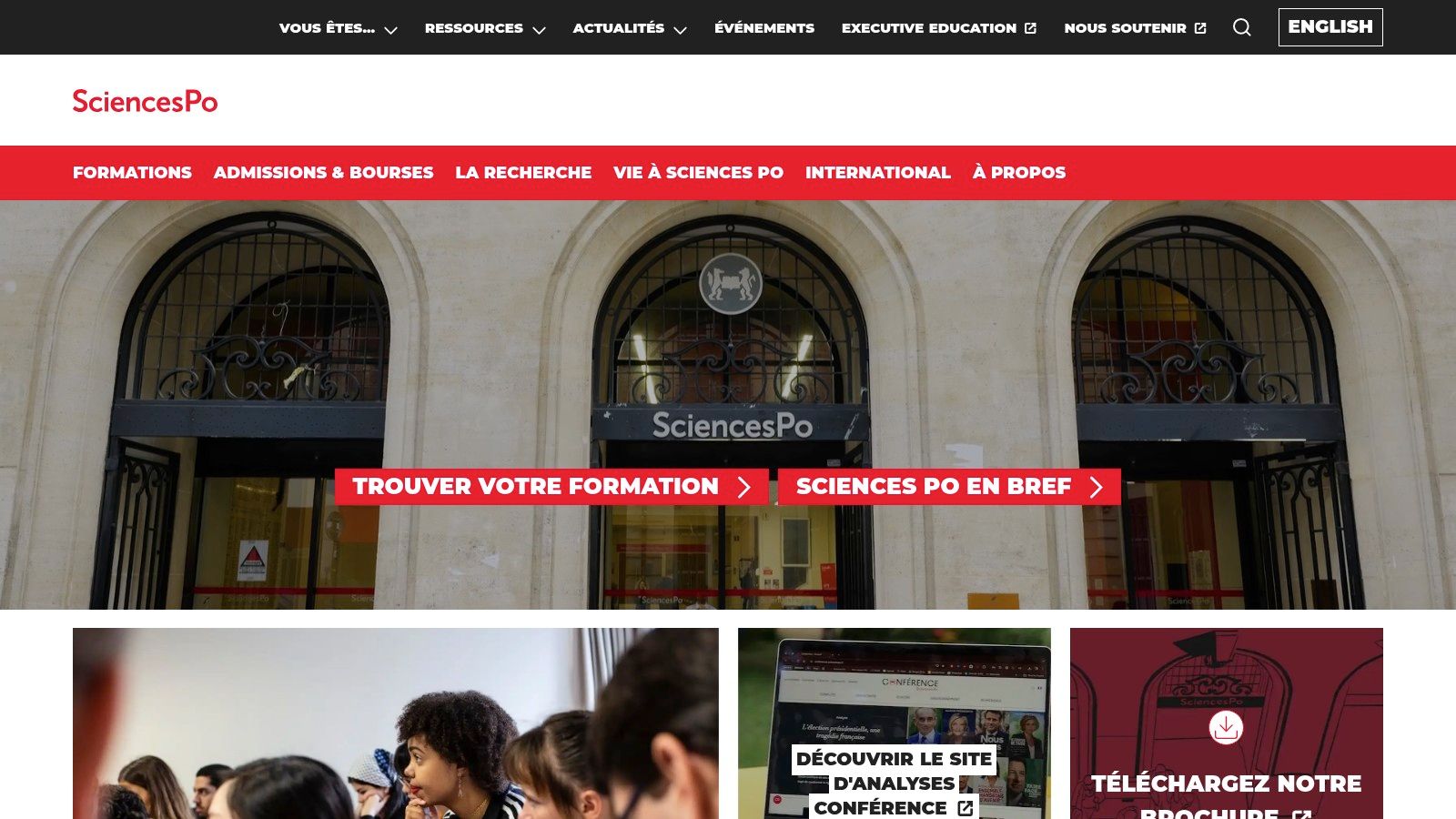
The undergraduate English pathway is especially useful. Its campuses in Reims and Le Havre give international students full three-year tracks in English with regional specialisms, while the graduate side, especially PSIA, is one of the most visible international-affairs options in France. That combination makes Sciences Po feel more globally oriented than many schools with stronger general brand recognition.
I also like the way it presents fees and aid. Transparent tuition scales and scholarship information help applicants understand the true cost before they commit, which is important because this is not a low-cost option. If you're comparing it against a public university, the tuition gap is large enough to change the decision.
Buying decision verdict: Best for policy, IR, and social-science applicants who want English-medium study and a highly international peer group.
French-preparation step: Even with an English track, start building everyday French early so admin, housing, and internship life don't become the weak link. Study abroad in Paris guidance is a useful next read if Paris is part of your plan.
6. HEC Paris
HEC Paris is the business-school answer for international students who want a top European brand and are prepared for the cost. The flagship Master in Management is taught in English and built around internships, exchanges, and specialized tracks, which makes it a strong fit for consulting, finance, and strategy careers. If the goal is employer recognition plus a dense alumni network, this is one of the clearest bets in France.
Cost and return need to be weighed together
The tuition picture is very different from the public universities above. HEC's MiM is listed at €58,900, and some programs carry an additional €2,000 for international students. That doesn't make it a bad investment, but it does mean the decision is mostly about career targeting, not affordability.
The upside is that HEC is built for outcomes. Career services, employer access, and a large international cohort are part of the reason it stays on so many shortlists. The downside is obvious too, the financial commitment is substantial, and you should only choose it if the post-degree path is strong enough to justify it.
Best business universities in France is worth a look if you're comparing HEC with other business options and want to sanity-check the fit before you apply.
Buying decision verdict: Best for applicants targeting consulting, finance, or strategy who can support the tuition.
French-preparation step: Don't ignore French just because the program is in English. It still helps with internships, networking, and life beyond campus.
7. Université Grenoble Alpes
Université Grenoble Alpes is the smart value pick for students who want broad English-taught options, a large international community, and a student city that feels livable. It's especially strong in science, engineering, health, and the social sciences, and the setting at the foot of the Alps gives it a very different energy from Paris. For many internationals, that balance between academic seriousness and day-to-day comfort matters more than brand prestige.
Study abroad in France overview can help if Grenoble is part of a wider regional search, especially if you're comparing public universities outside Paris.
The university's dedicated international pages and CUEF French-as-a-foreign-language center make it particularly practical if you expect to need language support after arrival. That's one reason I often see Grenoble work well for students who want a real transition into French academic life rather than a purely English bubble. The downside is name recognition, which is lower internationally than the big Paris institutions, and some administrative information still appears primarily in French.
Grenoble is one of those places where the fit can be better than the brand, especially if you want public-university pricing and a city that feels manageable.
Buying decision verdict: Best for students who want broad English-taught choice, lower living pressure than Paris, and a strong international campus feel.
French-preparation step: Use the CUEF or a similar French plan before arrival so you can handle admin, housing, and daily life with confidence.
Top 7 French Universities for International Students
| Institution | 🔄 Implementation complexity | ⚡ Resource requirements | ⭐📊 Expected outcomes | 💡 Ideal use cases | Key advantages |
|---|---|---|---|---|---|
| Université Paris‑Saclay | Moderate 🔄: coordinated Master's/PhD admissions; some program‑specific steps | Low–Moderate ⚡: public tuition; Paris‑area living costs; strong lab infrastructure | ⭐⭐⭐⭐ 📊 High research output; strong MSc→PhD progression | 💡 Affordable, research‑intensive STEM master's and PhD pathways for internationals | World‑class STEM research; extensive international student support |
| PSL University – Paris Sciences et Lettres | High 🔄: highly selective collegiate admissions; integrated program pathways | Moderate–High ⚡: variable fees; fully funded PSL PhD Tracks reduce student costs | ⭐⭐⭐⭐⭐ 📊 Elite mentorship and research placements; strong academic career prospects | 💡 Candidates seeking fully funded integrated MSc+PhD with small cohorts | Selective cohorts; structured, fully funded PhD tracks |
| Sorbonne University | Moderate 🔄: program‑specific admissions; undergraduate French requirements | Low–Moderate ⚡: public tuition; 2026–27 exemption policy may lower non‑EU fees | ⭐⭐⭐⭐ 📊 Prestigious research profile with targeted English Master's options | 💡 Students wanting historic research brand and specific English Master's programs | Strong brand prestige; potential tuition exemption for eligible students |
| École Polytechnique (l'X) | High 🔄: competitive grande école entry; rigorous, intensive curriculum | High ⚡: higher tuition than public universities; published cost guidance; limited scholarships | ⭐⭐⭐⭐⭐ 📊 Excellent industry placement and international partnerships | 💡 Students seeking a full English BSc and elite STEM career pathways | Full English BSc; small cohorts, intense mentoring, strong industry links |
| Sciences Po | Moderate–High 🔄: selective but varied by program; multiple entry routes | High ⚡: tuition above public rates; clear scholarships and fee info; Paris living costs | ⭐⭐⭐⭐ 📊 Strong global mobility and placements in policy, law, economics | 💡 Social‑sciences students aiming for international careers and dual degrees | Highly international student body; extensive exchange and dual‑degree network |
| HEC Paris | High 🔄: competitive MiM/MBA admissions; complex applications | Very High ⚡: among highest tuition (MiM ≈ €58,900); scholarships and external funding options | ⭐⭐⭐⭐⭐ 📊 Top employer recognition; strong placements in consulting and finance | 💡 Candidates targeting elite business careers and powerful alumni networks | Elite reputation; deep corporate recruitment and career services |
| Université Grenoble Alpes | Low–Moderate 🔄: broader access; some administrative content in French | Low–Moderate ⚡: public tuition; lower living costs than Paris; robust campus facilities | ⭐⭐⭐ 📊 Solid regional outcomes; strong applied‑science and interdisciplinary programs | 💡 Students seeking affordable English programs with outdoor lifestyle amenities | Broad English‑taught options; strong international community and language support |
Turning Your Shortlist Into a Confident Application Plan
The fastest way to move from browsing to deciding is to narrow this list to two or three universities and then test each one against the program page, not the marketing page. I'd start by checking whether your target degree is taught in English, whether the admissions route is DAP, Parcoursup, Études en France, or direct application, and whether the tuition outcome is the national rate, a differentiated non-EU rate, or a school-specific fee. That's the point where many applicants discover that the “best” university on paper isn't the best one for their specific timeline.
For language, don't treat French as optional even if the degree is in English. The practical question is how much French you need for housing, internships, healthcare, and everyday life, because those are the places where a weak level causes stress after arrival. If your target program needs a certified French level, build in time for DELF or DALF preparation rather than trying to squeeze it in at the end.
I'd also keep one budgetary check in view. France's published non-EU public-university rates for 2026–2027 are €2,902 for licence and €3,950 for master's, while some universities grant exemptions or reductions and some private schools charge far more. Once you know whether you're comparing a public university, a grande école, or a business school, the cost picture gets much clearer and much less misleading.
If you want a practical next step, book a free 20-minute consultation with Elite French Tutoring at elitefrenchtutoring.com. We can look at your current French level, map it against the universities you're considering, and build a French plan that fits your chosen program instead of forcing you into a generic one.