Skip to content

You're reviewing a French contract when mise en demeure appears beside a payment clause. You translate it as “reminder,” move on, and miss the fact that the notice may place the debtor in default and start statutory default interest. A few pages later, arrêt becomes “judgment,” cour becomes “court,” and prescription becomes “limitation.” The English looks polished. The legal effect is wrong.
That's why French legal terminology can defeat capable bilingual readers. The problem isn't usually grammar. It's false friends, procedural mismatch, and institutional confusion. A term's meaning may depend on the court issuing it, the procedural stage, the legal field, and the statute behind it. A glossary that gives one English equivalent without that context can create more confidence than accuracy.
I teach legal French as a system of consequences rather than a vocabulary list. For each term, we need to ask three questions: Who uses it? Where does it appear? What does it do legally? That method helps a U.S. lawyer, an expatriate family, or a procurement officer decide when an English equivalent is safe, when it needs explanation, and when it should be left in French.
Table of Contents
- Why Legal French Keeps Tripping Up Smart Anglophones
- How French Became the Language of French Law
- Core Legal Vocabulary Where Mistranslation Carries Consequences
- Common-Law Versus Civil-Law Concepts and the False Friends in Between
- Contract and Corporate Terms That Actually Appear on the Page
- Litigation and Procedural Phrases by Court and Stage
- Family and Administrative Law Terms With Hidden Footprints
- Precision Beats Plainness in Modern Legal Drafting
- Quick-Reference Tables and Cross-References
- Practice Exercises and a Path to Real Fluency
Why Legal French Keeps Tripping Up Smart Anglophones
A U.S. executive reading cour d'appel in a summons may assume the document concerns an ordinary “court of appeal.” In French procedure, that translation conceals the institution's position. Cour signals a court with a particular status, while tribunal identifies a different level or type of court. The wording places the case within France's judicial structure before the reader reaches the substance.
Grammar is rarely the obstacle; false friends, procedural mismatch, and institutional confusion defeat capable bilingual readers. In a contract, domicile may resemble the English term while referring to an address clause, a tax concept, or a civil-law status with a different function. Ordonnance may denote a procedural order or another legally defined instrument, rather than an English “ordinance.” The surrounding court, statute, and procedural stage determine which sense applies.

Working rule: Before translating a legal term, identify the field, institution, procedural stage, and legal effect.
A list of pairs such as arrêt = judgment or mise en demeure = notice leaves the main risk untouched. Build a termbase with the exact French term, grammatical category, field, plain-French definition, recurring collocations, and an authentic sentence. The French legal vocabulary collection from the Ministry of Culture notes that legal meanings can differ from general-dictionary meanings.
The practical choice depends on the reader. A translator may need a defensible English equivalent, a lawyer may need to preserve procedural force, and a family may need clear instructions about the action required. The strongest translation preserves the term's legal function, even when that means explaining it or retaining the French wording.
How French Became the Language of French Law
Modern French legal language rests on an institutional decision made long before contemporary codes and contracts. The Ordinance of Villers-Cotterêts was signed by King François I in August 1539 and registered by the Parlement of Paris on 6 September 1539. It contained 192 articles, with Articles 110 and 111 addressing the language of justice and administration. France Archives records the ordinance and its language provisions.
Article 111 required judgments, court procedures, registers, investigations, contracts, commissions, sentences, wills, and other legal acts to be pronounced, recorded, and delivered in “maternal French” rather than Latin. Its practical purpose was to reduce misunderstanding caused by Latin legal wording and to shorten litigation by making official acts more accessible to parties and witnesses.
The measure followed earlier attempts to replace Latin in legal practice, including the Ordinance of Montils-lès-Tours in 1454 and the Ordinance of Moulins in 1490. It's common to describe Villers-Cotterêts as making French the official language of law, but that shorthand needs care. Regional languages and dialects didn't disappear immediately, and local linguistic practices persisted in parts of the kingdom.
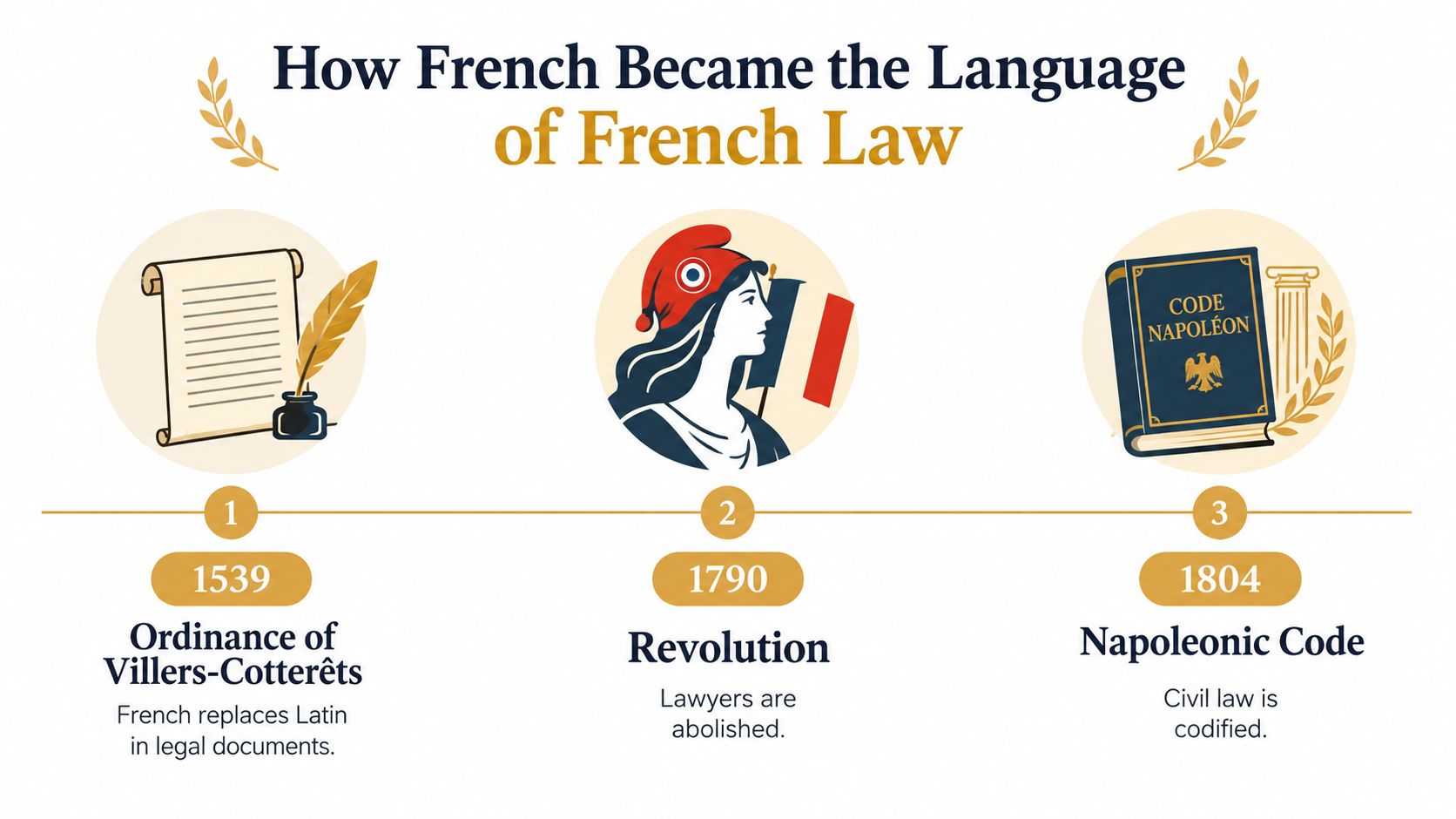
The lasting result was institutional rather than merely linguistic. French became dominant in legislation, court procedure, and public administration, creating a legal language where consistency and defined usage carry authority. For a broader historical perspective, readers can also consult this overview of the history of French.
That history helps explain today's controlled terminology. The Ministry of Culture collection compiles terms and definitions recommended through France's official terminology-enrichment system. Under Article 11 of the 1996 decree, terminology published in the Journal officiel is mandatory for French government services instead of foreign equivalents. A learner working with public authorities therefore needs more than elegant French. They need the institutionally accepted term.
Core Legal Vocabulary Where Mistranslation Carries Consequences
A translator renders loi as “law” in a contract, then treats règlement as another synonym. The English reader loses the distinction between a text voted by Parliament and a regulatory instrument. French legal terminology works as an institutional system, so identify the issuing authority and legal function before choosing an English equivalent. General meanings can mislead, as the Ministry of Culture's official legal vocabulary resource explains.
| French term | Plain-French definition | Literal English | Working English equivalent |
|---|---|---|---|
| droit | Ensemble des règles juridiques, or a right held by a person | law / right | law, legal system, or right, depending on context |
| loi | Texte voté par le Parlement | law | statute or Act |
| décret | Acte réglementaire pris par l'autorité exécutive compétente | decree | decree or executive regulation |
| arrêté | Décision réglementaire ou individuelle prise par une autorité administrative compétente | stopped order | administrative order or decision |
| règlement | Ensemble de règles, or an implementing regulatory text | regulation / settlement | regulation, rules, or settlement |
| jurisprudence | Solutions dégagées par les décisions des juridictions | jurisprudence | case law or judicial decisions |
| fait juridique | Événement auquel le droit attache des effets | legal fact | legally significant event |
The false couples are easiest to catch by asking what institution created the document. Droit can name the legal system, a field such as droit civil, or an individual entitlement. Loi identifies a parliamentary text, so “statute” or “Act” may tell the reader more than the generic “law.” Décret comes from executive regulatory authority. Arrêté is an administrative decision or order, never a translation of the verb “stopped.” Règlement may describe a body of rules or an implementing text, while “settlement” belongs only to particular contexts.
Build a termbase instead of a word list
For every entry, record:
- Field: civil, criminal, administrative, corporate, or family law.
- Grammar: noun, verb, adjective, or fixed phrase.
- Plain-French definition: explain it without another obscure term.
- Legal function: specify the right, duty, deadline, decision, or procedure involved.
- Authentic sentence: preserve the collocation and document type.
Consistency matters as much as elegance. If a contract repeatedly uses partie, retain “party” rather than alternating with “participant” or “stakeholder.” The European Union Joint Practical Guide supports clear, simple, precise drafting, consistent terminology within the same act, alignment with related legislation, and definitions for ambiguous terms in one initial article.
Common-Law Versus Civil-Law Concepts and the False Friends in Between
English-speaking readers often search for a familiar legal label before identifying the French institution. That reverses the safe order of work. First determine the French concept, then choose the English explanation that preserves its function.
A cour isn't a U.S. “court.” A French arrêt generally identifies a decision of a higher court, rather than serving as a generic word for every judgment. A jugement is associated with a tribunal, while an ordonnance may identify a procedural decision or another specific legal instrument. Sentence also demands caution, because the French term may refer to a judicial decision or penalty context depending on usage, while the English “sentence” has a narrower everyday legal association.
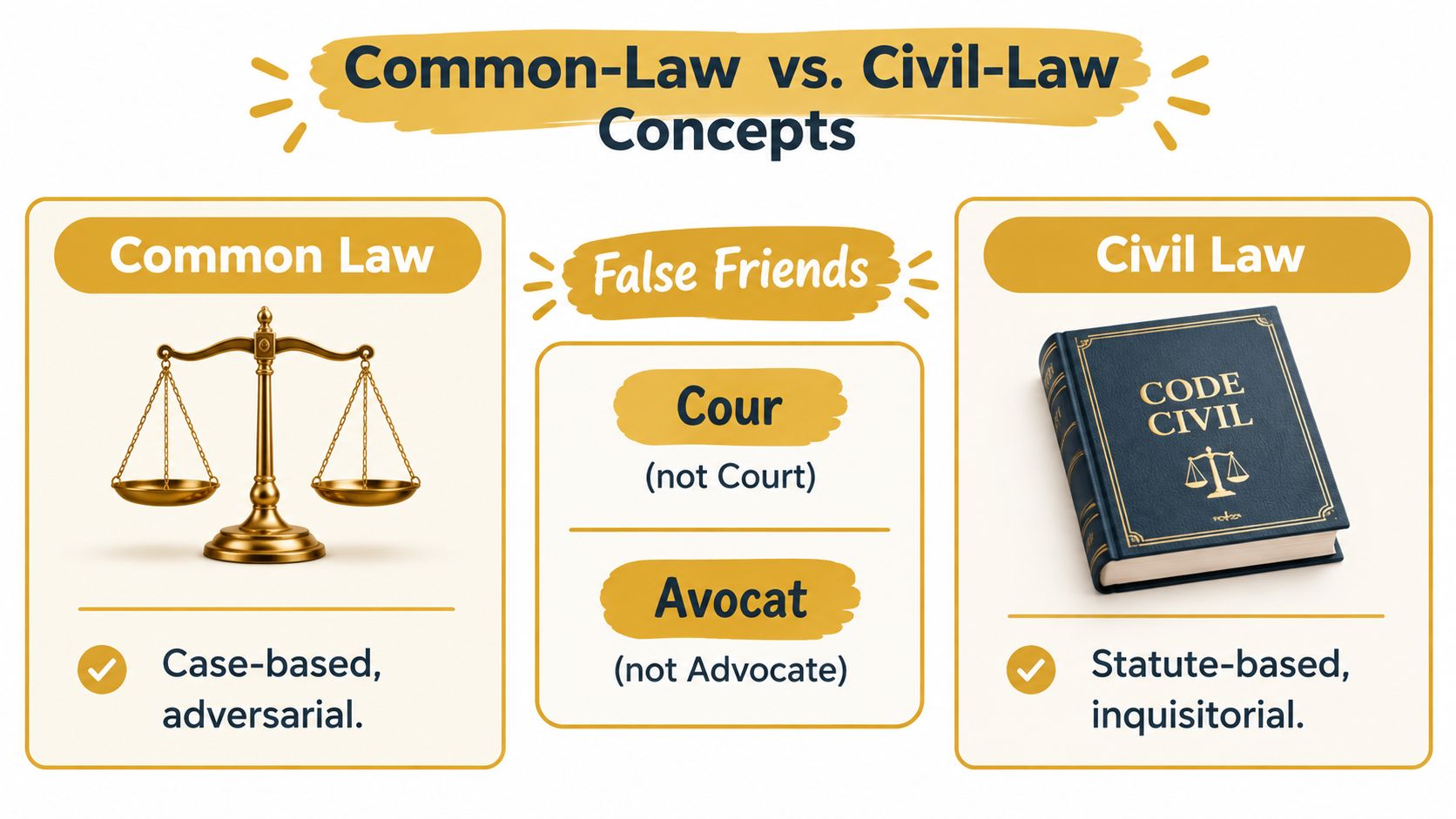
The procedural setting controls the translation:
| French expression | Question to ask | Safer working approach |
|---|---|---|
| arrêt | Which higher court issued it? | Identify the court, then use “decision” or “judgment” with that context |
| ordonnance | Is this procedural, administrative, or legislative? | Preserve the instrument's type rather than choosing a generic “order” automatically |
| pourvoi | Is a party challenging a decision before the Cour de cassation or Conseil d'État? | Use “appeal on a point of law” or explain the review mechanism |
| mise en demeure | Does the notice trigger default or another legal consequence? | Use “formal demand placing the debtor in default” where needed |
| prescription | Does time extinguish a right or affect an action? | Check the legal rule before choosing “limitation” |
The distinction is not academic. A 2025 Court of Justice recruitment notice stated that many texts are translated from French, particularly judgments and orders, and that the work requires legal analysis as well as translation. A bilingual reader must therefore understand the legal architecture behind the word.
Readers preparing for work across francophone environments should also separate French legal terminology from regional usage. A French course for Quebec can be useful when the document's institution and vocabulary reflect a different jurisdiction. The habit to keep is simple: ask which court, which stage, and which source before selecting an English equivalent.
Contract and Corporate Terms That Actually Appear on the Page
Contract review becomes safer when you read terms in clusters. A clause about performance may contain obligation, débiteur, créancier, inexécution, and mise en demeure. Translating each word separately can miss the relationship between them.
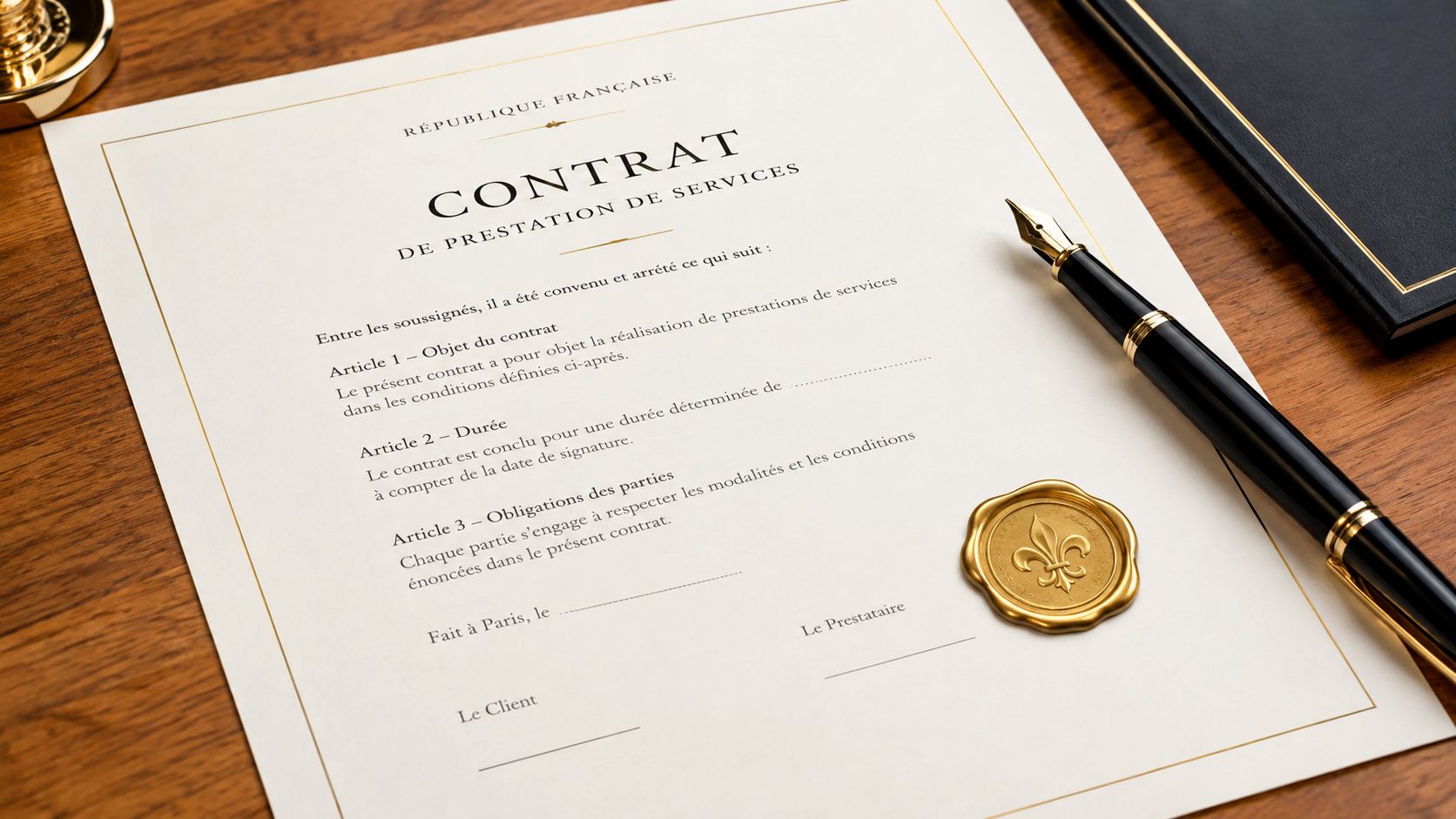
Under Civil Code Article 1344, mise en demeure means a formal demand placing a debtor in default. For monetary obligations, Article 1344-1 provides that the mise en demeure causes statutory default interest to begin running without requiring the creditor to prove financial loss. The rules originated in the contract-law reform introduced by Ordinance No. 2016-131 of February 10, 2016. The Civil Code provisions set out the mechanism.
A contract-style sentence such as Le débiteur sera mis en demeure de payer les sommes dues should not become “the debtor will receive a payment reminder” unless the surrounding law supports that weaker meaning. Depending on the clause and notice, the timing can affect interest and available remedies.
For contract review, I mark four items before translating:
- Parties and roles: partie, débiteur, créancier, cédant, and cessionnaire describe legal positions, not just people in a transaction.
- Performance language: obligation de moyens and obligation de résultat require analysis of the promised standard, not a word-for-word translation of “means” and “result.”
- Risk allocation: force majeure, responsabilité, garantie, and indemnisation often operate together, so the clause must be read as a unit.
- Corporate identity: société, dirigeant social, assemblée générale, SARL, SAS, and SA identify organizational forms or roles that shouldn't be flattened into “company” and “director.”
Here's a useful contract example: La société est représentée par son dirigeant social dûment habilité. The working translation may be “The company is represented by its duly authorised corporate officer,” but the exact choice depends on the entity's governance and the authority granted.
Later in the document, check droit applicable, loi applicable, and juridiction compétente separately. A governing-law clause and a jurisdiction clause answer different questions. Stylistic variation is not a virtue if it makes those functions harder to identify.
Litigation and Procedural Phrases by Court and Stage
Litigation vocabulary becomes clearer when arranged by institution and sequence rather than alphabetically. Start with the forum. A tribunal judiciaire is not interchangeable with a cour d'appel, the Cour de cassation, or the Conseil d'État. Each institution gives surrounding terms their procedural weight.
At an early stage, a claimant may begin proceedings through an assignation, while the parties exchange conclusions. A case may move through mise en état, appear at an audience, and then enter délibéré before the decision. The result may be a jugement from a tribunal, an arrêt from a higher court, or an ordonnance whose meaning depends on the procedure and issuing authority.
The challenge is to translate the phrase, not merely the noun. Consider these examples:
- Le demandeur délivre une assignation au défendeur. This concerns formally commencing proceedings, not just “sending a claim.”
- L'affaire est renvoyée à la mise en état. The case is being managed procedurally, not merely postponed.
- La cour a rendu un arrêt. The court issued a decision, with the institution and level supplying the essential context.
- Le défendeur forme un pourvoi. The party seeks review through the relevant supreme court mechanism, not an ordinary retrial.
Deadlines need both terminology and calculation
The phrase se prescrit par deux ans illustrates why a short expression can control a dispute. In a 19 May 2021 decision, the Cour de cassation applied the Civil Code rule that claims brought by professionals concerning goods or services supplied to consumers are generally subject to a two-year prescription period.
That doesn't mean every consumer dispute has the same deadline. The claimant, transaction, legal basis, and starting point must be checked. A translator who turns se prescrit par deux ans into “has a two-year warranty” changes the legal proposition entirely.
When you encounter appel, pourvoi, or cassation, identify the decision being challenged and the reviewing court. The same English word, “appeal,” can conceal different routes and standards of review.
Family and Administrative Law Terms With Hidden Footprints
Family-law vocabulary often looks transparent because the words resemble ordinary French. Mariage, divorce, and résidence seem easy until a document attaches a specific legal consequence to them. Résidence habituelle may matter in family proceedings without being identical to residence for tax or immigration purposes. Garde may appear in everyday discussion, while the legal document may use autorité parentale, résidence habituelle, or another more precise formulation.
A family-law termbase should therefore preserve the relationship between the person, the child, and the decision being made. Prestation compensatoire isn't just “compensatory payment” in every context. It refers to a family-law mechanism whose purpose and conditions need to remain visible in translation. Likewise, PACS should be identified as the French civil solidarity pact rather than absorbed into the broader English category of partnership.
Administrative terms carry a different institutional footprint. An arrêté préfectoral is a decision or regulatory instrument issued by a prefect. An arrêté can also be signed by a minister or mayor, so it isn't a generic label for any administrative decision. Requête may designate an application to a court or authority, while référé-liberté names an urgent administrative procedure protecting a fundamental freedom.
The French government legislative drafting guide distinguishes prescription from forclusion. Prescription is a method by which a right is acquired or extinguished through time. Forclusion is the sanction that extinguishes a person's legal action when the applicable deadline expires.
That difference matters in family and administrative files because a missed deadline may affect the action, the underlying right, or both. Before translating voie de recours, intérêt à agir, or délai, identify who can act, against what decision, before which authority, and within what procedural framework.
Precision Beats Plainness in Modern Legal Drafting
“Use simpler French” is good advice only if simplification preserves the legal distinction. Removing a technical term can reduce precision. Leaving a technical term unexplained can prevent the reader from using the document. Effective drafting has to solve both problems.
The 2025 draft ISO 24495-2 standard defines plain legal communication as wording, structure, and design that help readers find, understand, and use information while remaining clear, effective, and precise. The discussion of plain legal communication and écriture inclusive shows why accessibility and institutional rules can collide.
For écriture inclusive, choose the form according to the document's status:
- Gender-neutral reformulation: usually the safest option when the sentence can be rewritten without losing legal specificity.
- Feminine professional titles: appropriate when the person's role is known and the form is accepted in the relevant institutional setting.
- Doublets: useful in public-facing or HR communication when both genders need explicit visibility.
- Median dot: may suit some private or social contexts, but can create accessibility, readability, or institutional-acceptance concerns.
A school notice, employment policy, public authority form, and private marketing message don't necessarily follow the same style rules. For teams drafting externally visible documents, French business writing support can help test whether a reformulation remains precise and usable.
The practical standard is not maximum simplicity. It's maximum comprehension without loss of legal effect.
Quick-Reference Tables and Cross-References
Use the table below as a first routing tool. It won't replace the statute or procedural file, but it tells you where to investigate.
| Field | Terms to group | First context to check |
|---|---|---|
| Civil | obligation, créancier, débiteur, prescription, mise en demeure | Civil Code and contract clause |
| Corporate | société, SARL, SAS, SA, dirigeant social, assemblée générale | Entity form and governance documents |
| Administrative | décret, arrêté, requête, référé-liberté, service public | Issuing authority and public-law procedure |
| Family | PACS, prestation compensatoire, autorité parentale, résidence habituelle | Family status and judicial framework |
| Litigation | assignation, conclusions, jugement, arrêt, pourvoi | Court and procedural stage |
| Official terminology | defined institutional terms and regulatory vocabulary | Journal officiel and related legislation |
False-couple index
- Prescription versus forclusion: ask whether time affects the right itself or only the ability to bring an action.
- Domicile versus résidence: check whether the document concerns civil status, family law, tax, or immigration.
- Arrêt versus jugement: identify the issuing court before selecting “decision” or “judgment.”
- Cour versus tribunal: preserve the institutional distinction rather than using “court” for both.
- Mise en demeure versus reminder: determine whether the notice places a debtor in default and affects interest.
Keep repeated terms stable inside one document. The EU drafting guidance recommends defining ambiguous terms once and using terminology consistently throughout the act, rather than changing wording for stylistic variety.
Practice Exercises and a Path to Real Fluency
Set a timer for a focused practice session. First, translate a short mise en demeure, then mark every phrase that could affect default, payment, or interest. Next, place prescription and forclusion on a calendar and explain whether the deadline affects the right or the action. Finally, rewrite an inclusive clause using a neutral formulation, then compare the result for clarity, precision, and institutional suitability.
A Manhattan professional I worked with began by guessing through French employment contracts. We built a termbase around her actual documents, rehearsed the clauses aloud, and practised asking for clarification in French. She progressed from avoiding contract discussions to taking part in negotiations with a clearer command of the terminology and the confidence to challenge an ambiguous phrase.
If you're preparing for legal work, an exam, a relocation, or bilingual contract review, French for lawyers can be one route to targeted practice. Elite French Tutoring offers a free 20-minute consultation to discuss a customised legal-French program for an individual, an international family, or a corporate team.
Book the consultation when you have a real document or professional goal in mind. Bring a clause, summons, policy, or contract excerpt, and use the session to identify the false friends and procedural terms that deserve focused practice.