Skip to content

You're probably staring at two tabs right now, one with a Paris dream, one with a deadline you just discovered, and wondering why the process already feels like a small bureaucracy exam. That reaction is normal. Study abroad in Paris France is not hard because Paris is impossible, it's hard because students and parents treat it like a travel decision when it's really a long, parallel project with academic approval, language proof, housing, funding, and visa timing all moving at once.
France hosted 443,500 foreign students in higher education in the 2024–2025 academic year, up 3% year over year and 17% over five years, and foreign students made up about 15% of total higher education enrollment nationwide, according to Campus France. Paris sits at the center of that ecosystem, with 96,400 foreign students in the Paris Region and 80,700 in universities and similar institutions, which represented 30.5% of all foreign students in French higher universities and similar institutions. That density is the reason Paris is both attractive and unforgiving, the market is deep, but the competition is real. Campus France's 2024–2025 foreign-student update and the earlier mobility figures showing 343,000 foreign students in 2019, 412,087 in 2022–2023, and 443,500 in 2024–2025 make the trend clear, Paris is a mature, heavily used study-abroad destination, not a casual one. Campus France mobility figures
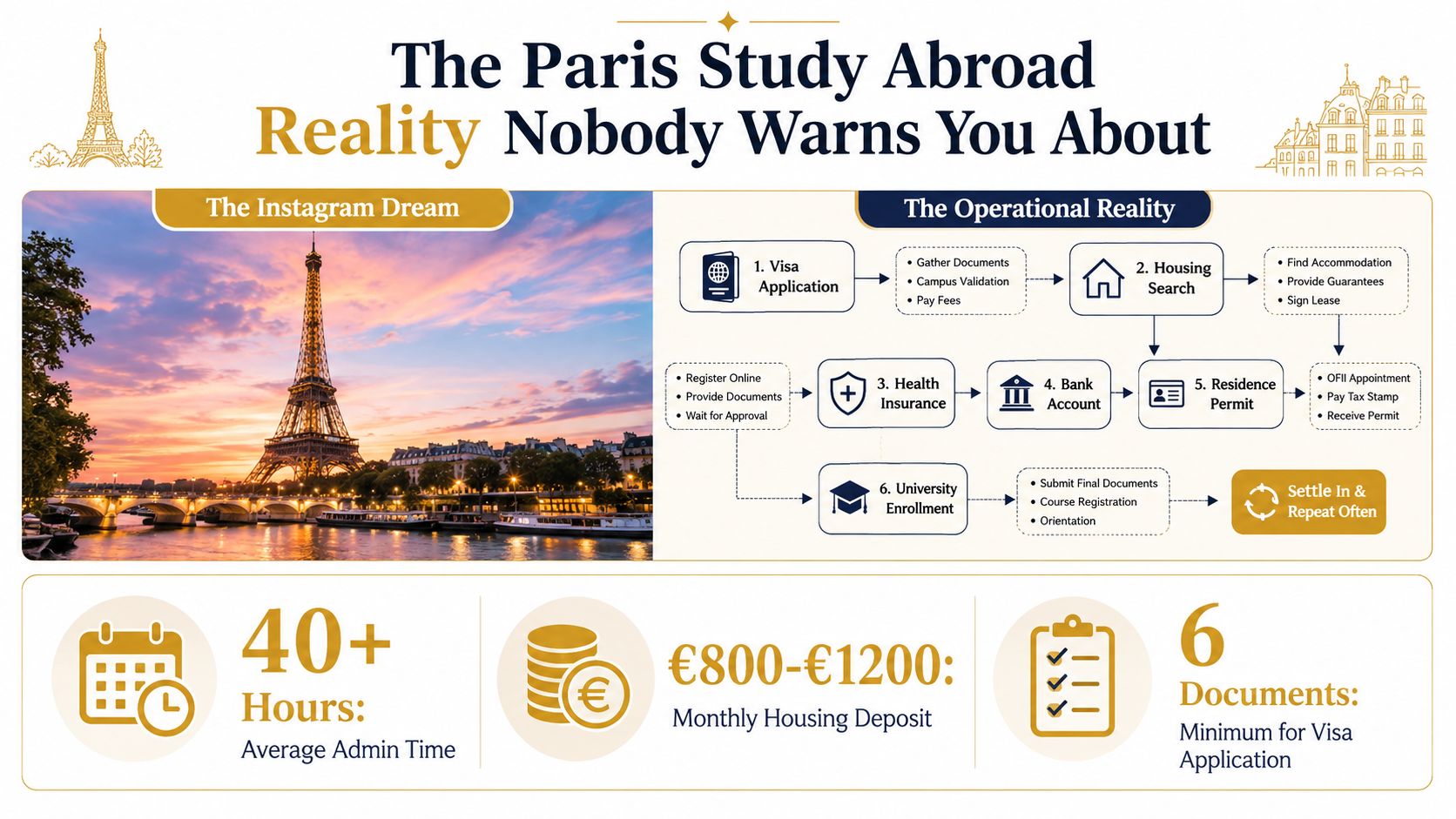
A Houston sophomore I've seen in this exact position had her semester fantasy collide with a May 1 file deadline she didn't know existed. That's the Paris story for most students. The students who land well do one thing differently, they start the year before they fly, and they treat housing, language evidence, and funding as separate workstreams instead of one giant to-do list.
Table of Contents
- The Paris Study Abroad Reality Nobody Warns You About
- Choosing the Right Program Type for Your Goals
- Your 10–14 Month Application Timeline
- Visas, Insurance, and the True Cost of Living in Paris
- Housing Options and the Lead-Time Trap
- Maya's Semester at Sciences Po What Actually Worked
- Arrival, Language Prep, and Getting the Most Out of Paris
The Paris Study Abroad Reality Nobody Warns You About
A pretty feed doesn't get you admitted, housed, or cleared to enroll. The first mistake students make is assuming every Paris route works the same way. It doesn't. Exchange students, direct-enrollment students, language-program students, and interns all face different gates, and the wrong choice can cost you a semester before you've even bought a ticket.
The four pathways that actually matter
Exchange is the cleanest route if your home university has a Paris partner. You keep credits in motion, and the host institution already knows how to process visiting students. Direct enrollment is better when you need a specific degree path or your school has no partnership, but it demands more paperwork and more self-management.
Language institutes fit a different goal. They work if your main objective is French improvement, not a full academic load. Internships are the most career-facing option, but they're usually the least forgiving on timing because employers, schools, and visa paperwork all have to line up.
Practical rule: if your home university already has a Paris exchange, start there. Only pay for a third-party or direct-enrollment route when the exchange slot, course selection, or language requirements make the free path unrealistic.
The Paris problem is not that there's no path. It's that there are too many paths, and each one has a different deadline stack. Families who assume they can sort it out after acceptance usually lose the best housing options, and sometimes the course options too.
Why Paris is competitive in a way generic guides gloss over
Paris isn't just another European city with a few study centers. It is one of the densest international student markets in France, which means seats, rooms, and deadlines move fast. The historical growth from 343,000 foreign students in 2019 to 443,500 in 2024–2025 tells you something important, the city has long been absorbing global demand, and the institutions know how to process it. Campus France mobility figures
That maturity is helpful, but it also creates pressure. Paris schools expect you to arrive organized. They're not building a plan around a late applicant who's still figuring out transcripts, French proof, and housing after the deadline has passed.
Choosing the Right Program Type for Your Goals
A student who chases the lowest sticker price usually pays for it later in admin friction, blocked course choices, or weak language access. Choose the route that matches the goal first, then compare cost. Ask three questions upfront: do you need credit transfer, do you need French-language access, and do you need a built-in housing or admin workflow?
The four pathways that matter
| Program Type | Eligibility | Typical French Level | Duration | Cost Profile | Best For |
|---|---|---|---|---|---|
| University exchange | Home university nomination, host approval | Often B1 to B2, depending on courses | Semester or year | Usually lower direct tuition than other routes | Students whose schools already have Paris partnerships |
| Direct enrollment | Apply directly to the host institution | Often B2 or higher for many classes | Semester, year, or degree path | Higher administrative and tuition burden | Students who need a specific academic program |
| Language institute | Open to learners focused on French | From beginner upward | Short term to long term | Varies by intensity and support level | Students prioritizing language progress over credit load |
| Internship placement | School, employer, and visa readiness all matter | Functional French helps a lot | Fixed placement period | Depends on placement structure | Career-focused students who want professional exposure |
Exchange is usually the cleanest academic route, but it only works if your home university has Paris partners and will nominate you on time. If that partnership does not exist, stop waiting for a workaround. Direct enrollment becomes the better choice when the academic match is stronger than the paperwork burden.
Language institutes and internships solve different problems. If your French is the main bottleneck, choose a language program with around 15–20 hours per week so the pace is serious enough to move you, not just keep you busy. If your career goal matters more, an internship can be the smarter route, but only if you can handle visa timing and housing without scrambling.
The wrong choice is easy to spot. A student wants a semester in Paris, picks the cheapest route on paper, then spends the term fighting course access, slow approvals, or a schedule that never quite fits. That is not a bargain. It is hidden friction.
Your 10–14 Month Application Timeline
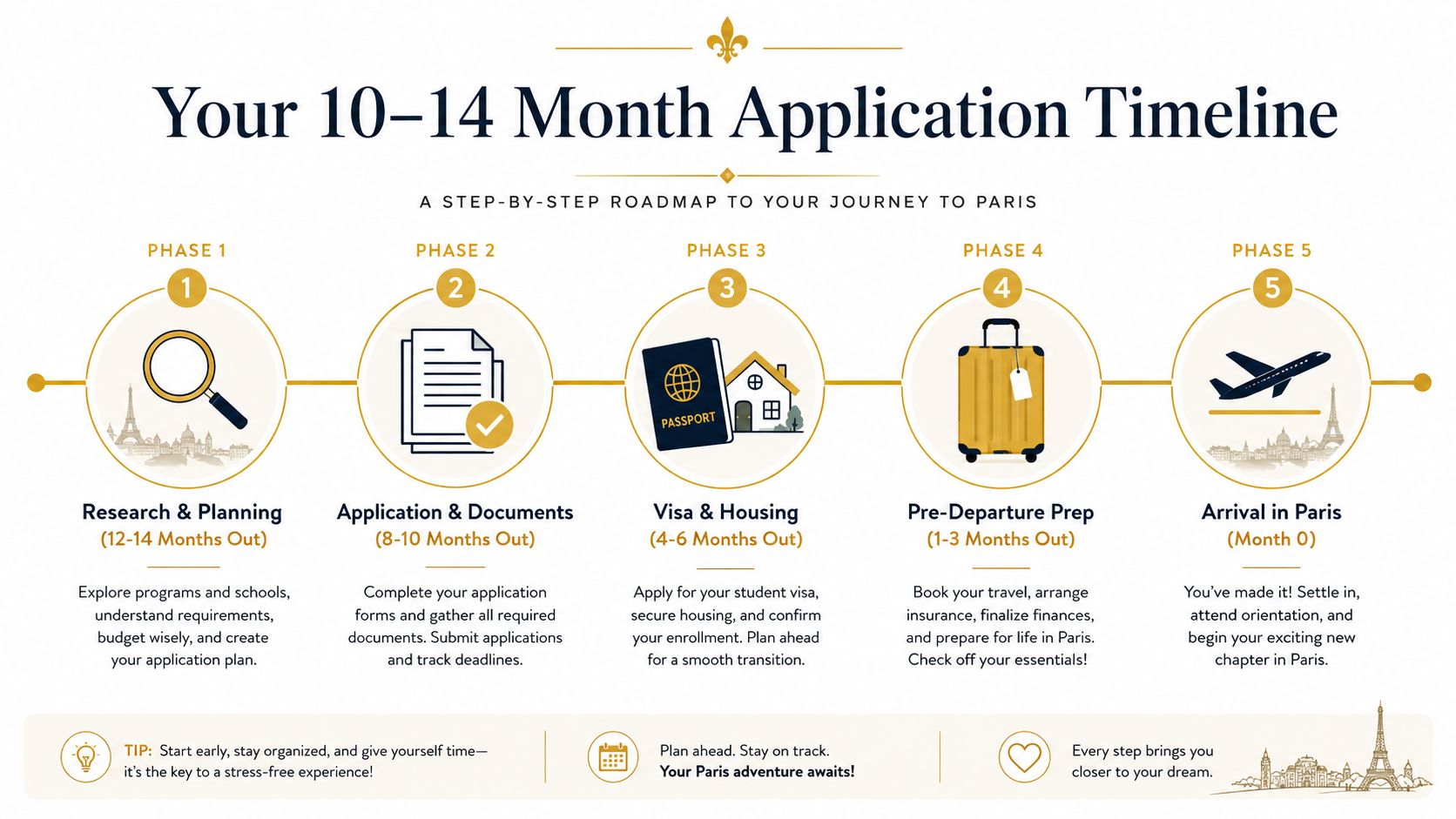
The students who do Paris smoothly don't “get ready” in one burst. They run a sequence of parallel tasks, and they start early enough that one delay doesn't collapse everything. Paris 1 Panthéon-Sorbonne's exchange benchmark is a useful reality check, nominated students submit a full file by May 1 for September or full-year entry, or October 15 for January entry, with documents including a signed learning agreement, proof of French at minimum B2 for bachelor's and master's classes, transcripts, passport copy, and, for some non-Erasmus applicants, a CV and cover letter. Paris 1 exchange student guidance
Month 12 to Month 9
Start with program fit, not flight prices. Confirm whether you're an exchange candidate, a direct applicant, or a language-program student. If you need French proof, begin now, because waiting until you've been nominated is how students miss the course window.
This is also when you gather transcripts, passport copies, and any internal forms your home university requires. Don't treat the home-school nomination as a formality. It's often the first hard gate.
Month 8 to Month 6
Push the host application, language proof, and housing search at the same time. That parallel move matters. If you handle them one by one, you burn months.
Keep your documents in one folder, with one version in French or English if the school allows it, and one clean checklist for parents or guardians who may be helping with funding and signatures.
For students wanting extra language support before departure, Elite French Tutoring's study abroad planning guide is one practical option for aligning French study with the Paris timeline.
Month 3 to Month 1
The visa file and the housing file should already be moving. That's also the time to lock your proof of funds, confirm your admission document, and prep any translation or scanning requirements. If your French level is still wobbling, this is the worst moment to improvise.
A simple family checklist works better than scattered texts and emails.
Home university nomination: Owns the academic advisor, but the student should chase it.
Host university application: Owns the student, with document review from the family if needed.
Language proof: Owns the student, because delays here block enrollment.
Housing applications: Owns whoever responds fastest, usually the student.
Visa file: Owns the student, but the family often helps with funding proof.
The rule is simple. If a task affects admission, housing, or visa timing, do it early and do it in parallel.
Visas, Insurance, and the True Cost of Living in Paris
A Paris plan falls apart fast if you treat the visa and the budget as separate problems. For non-EU students staying longer than 90 days, the required long-stay student visa, the VLS-TS, usually asks for financial resources of about €615 per month, or €7,380 per year. French student visa guidance
That number is only the legal floor. It does not cover what students spend in Paris. Current guidance on living costs puts realistic monthly spending far higher, and housing is usually the biggest reason the gap opens up. Paris cost-of-living guidance Current estimates for 2026 put CROUS rooms around €200 to €500, shared rooms around €600 to €900, and private studios often around €750 to €1,200+, depending on location and demand. Paris 2026 housing estimates
What the budget really looks like
The housing market is where families get caught off guard. University guidance for Paris exchange students points to Cité internationale universitaire de Paris studios around €670 to €780, while other housing routes stay tight and competitive. Université Paris Cité exchange guidance That is why I tell students to stop asking whether Paris is “affordable” in general. Ask a harder question. Can the student secure housing early, cover upfront deposits, and survive the visa minimum without pretending it is enough?
CAF also needs attention. The French government has updated housing aid rules, and current guidance says non-EU scholarship students are no longer eligible for CAF housing aid after 1 July 2026. Service-Public.fr If your budget plan assumes that subsidy, fix it now. Do not build a Paris budget on aid that may not apply.
Health coverage is the other place students cut corners and regret it later. You need the right mix of health insurance, and many students also need to plan for French social security enrollment after arrival. Some will use EHIC, some private international coverage, and others a student mutuelle. The correct setup depends on your citizenship, program structure, and what your host institution accepts.
Bottom line: the visa minimum keeps you compliant, but the Paris housing market sets the real budget.
For a second planning reference on paperwork and long-stay timing, this Paris-focused French relocation page is useful because it shows how French admin deadlines shape real costs and cash flow.
Housing Options and the Lead-Time Trap
Housing is the biggest budget item, and the biggest source of stress. Students who wait until they're officially admitted are already behind. The market rewards fast, complete applications, not hopeful browsing.
The main housing routes
CROUS rooms are the cheapest option, with current guides putting them around €150 to €500 per month, but availability is limited and uncertain. Paris housing guide Cité internationale universitaire de Paris studios sit higher, around €670 to €780 per month, and they're competitive for a reason, the housing quality and student environment make them attractive. Université Paris Cité exchange guidance
Private residences such as Studélites and Les Estudines are a middle path. They're more expensive than subsidized housing, but often easier to secure if you need speed and predictability. Private studios often start around €750 to €1,200+, and shared flats usually fall somewhere below that. Paris 2026 housing estimates Paris cost-of-living guidance
What actually works for international students
If you don't have a French guarantor, Visale can help as a government-backed guarantor scheme, and landlords may also ask for a caution bancaire, which is a bank guarantee. The point is not to memorize the terminology. The point is to build a dossier that a landlord can say yes to quickly.
I tell students to treat housing like a second application. Submit it at the same time as your school file. If you wait, the available options become narrower, more expensive, and more stressful.
A shared flat can be the smarter play than chasing a subsidized room that never materializes. That's the contrarian truth most generic guides avoid. The cheapest bed on paper is not always the safest move when the visa clock is running and you need a reliable landing spot.
For students comparing accommodation and French life outside the classroom, this French immersion resource page is worth a look because language confidence and housing confidence tend to rise together when the move is planned properly.
Maya's Semester at Sciences Po What Actually Worked
Maya was a UCLA junior, and she did what good students do, she chose structure over improvisation. She went for a Sciences Po exchange on the Reims track because her home university already had the exchange in place, and that reduced the amount of decision-making she had to force through the semester before departure. She also knew she wanted credit transfer to stay clean.
She spent the summer before departure on structured French tutoring, about 60 sessions, which is the kind of language prep that changes a semester. By the time she landed, she was still nervous, but she wasn't frozen. She could ask for help, follow administrative directions, and recover when forms didn't behave the way she expected.
The rough spots were real. Her visa appointment got delayed, her first CROUS choice fell through, and she had to scramble for housing. She still landed in the Cité Universitaire, which gave her a stable base once the administrative week started. That stability mattered more than perfect planning would have, because Paris rewards students who can stay calm when one piece slips.
She missed the CAF window before the 2026 rule change took effect, which cost her a subsidy opportunity she had assumed would still be there.
That mistake is worth remembering because it wasn't a language failure or an academic failure. It was a timing failure. The students who do well in Paris don't just work hard, they track deadlines with almost annoying seriousness.
Maya finished at a B2 French level, but the bigger win was functional confidence. She didn't just survive the semester, she used it. That's what strong preparation buys you.
Arrival, Language Prep, and Getting the Most Out of Paris
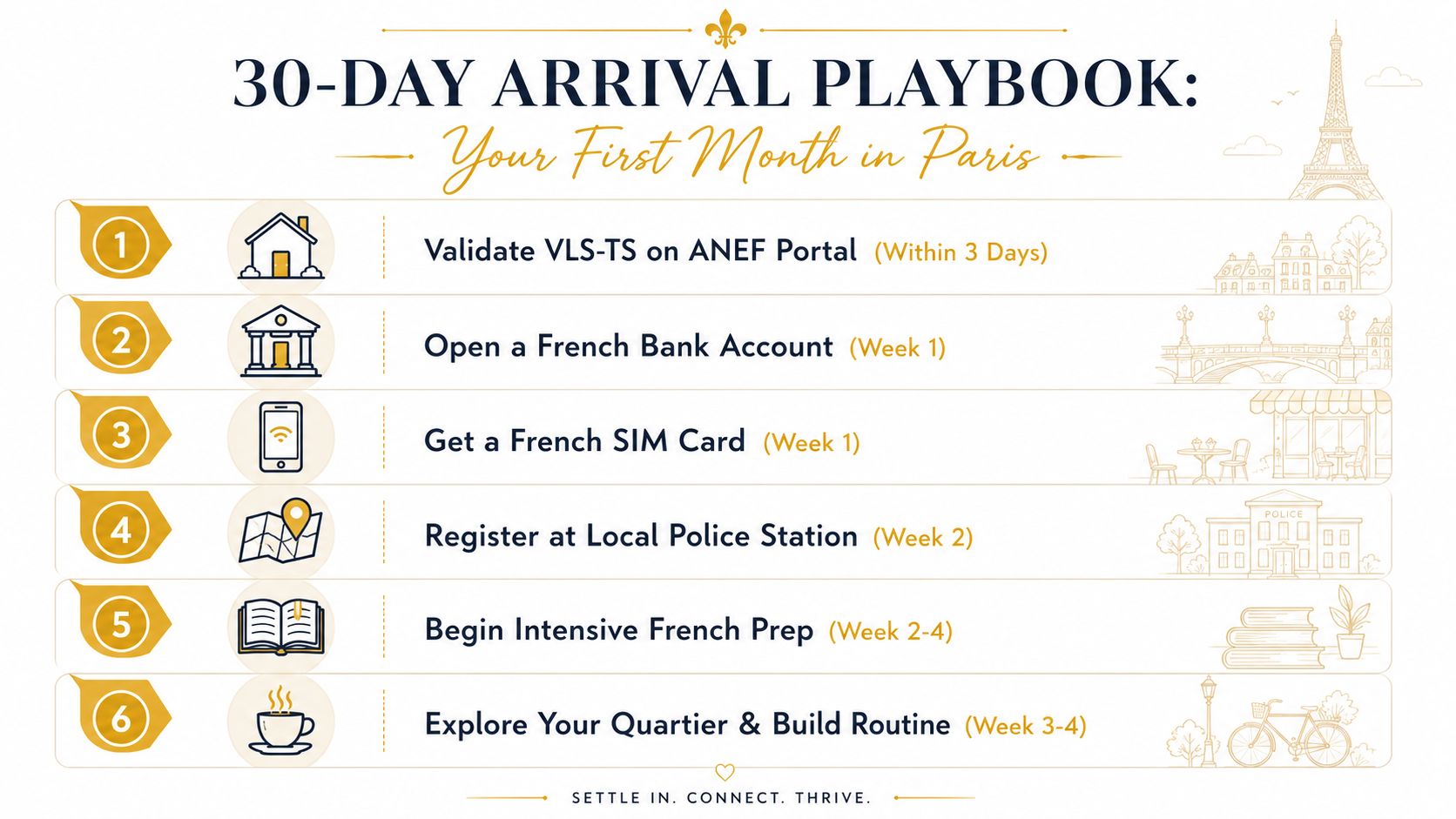
The first month in Paris is operational, not romantic. You're validating paperwork, setting up payment systems, and making the city usable. If you waste that month pretending immersion alone will handle everything, you'll spend the rest of the semester catching up.
30-Day Paris Arrival Checklist
| Week | Priority Tasks | Documents Needed | Risk If Skipped |
|---|---|---|---|
| Week 1 | Validate VLS-TS, open bank account, get a French SIM | Passport, visa, enrollment proof | Admin delays, payment problems |
| Week 2 | Register where required, begin local admin follow-up | Housing details, student documents | Missed registration steps |
| Weeks 2 to 4 | Start intensive French prep, build routine | Class schedule, study plan | Slow language progress, social friction |
The highest-value habit is simple, don't arrive at A2 and hope the city will carry you to B2. It won't. You need structured practice before and during the stay, especially if your program expects classroom participation, not just attendance. A good French tutor can keep your momentum moving when coursework gets messy and daily life starts eating your attention.
The first things to handle
Validate your VLS-TS on the ANEF portal as soon as you can. Open a French bank account when possible, get a French SIM, and register with the local or host administration steps your institution requires. Then find your rhythm, quartier, grocery store, commute, and study spot.
French tutoring fits naturally here, because the arrival phase is where language confidence either compounds or stalls. If you want a structured option, Elite French Tutoring’s Study Abroad in France planning guide can help you build language confidence before departure and navigate the first weeks after arrival.
The best Paris students don't wait for fluency to arrive before they start living. They make the city usable in week one, then keep building. That's the difference between a semester that feels chaotic and one that feels like progress.
If you're planning a Paris term and want help matching your French level to the right prep path, book a free 20-minute consultation with Elite French Tutoring. We'll map the language piece to your departure timeline so you're not trying to improvise B2 readiness after deadlines are already in motion.