Skip to content

Your teen may already be ready for the DELF Junior exam, but confidence in class doesn't automatically translate into points on test day. A student can chat comfortably with friends, then freeze during a timed oral task, lose marks in writing, or arrive unprepared for a compressed schedule that combines written and oral components.
I've guided teenagers through that exact gap. The students who pass aren't necessarily the ones with the biggest vocabulary. They're the ones who choose the correct CEFR level, understand the scoring rules, practise the exam format, and build enough stamina to perform consistently across all four skills.
Table of Contents
- Why Your Teen Should Take the DELF Junior Exam
- The Four DELF Junior Levels Explained
- How Scoring and the 100-Point System Work
- DELF Junior vs Standard DELF
- A Proven Prep Plan for Teenagers
- How Maya Went from B1 Anxiety to a Clean Pass
- 2026 Test Dates, Same-Day Scheduling, and Registration Deadlines
- Choosing the Right Support Before Test Day
Why Your Teen Should Take the DELF Junior Exam
A parent usually notices the right moment unexpectedly. Your teen is speaking with a French exchange student, explaining a school routine, telling a story about a trip, or arguing about a film. The conversation sounds natural. Then comes the question: How can we prove this ability on paper?
The DELF Junior provides that proof. It's the official French language diploma for adolescent learners, issued by the French Ministry of National Education and structured across A1, A2, B1, and B2 on the CEFR scale, as explained by Alliance Française de Pasadena's certification guide. It's designed for secondary-school candidates, with age bands varying by centre but generally focused on teenagers rather than adult learners.
That makes it more useful than a vague classroom label such as “advanced French.” A diploma gives your teen a measurable proficiency target, a formal record of progress, and a credential that can support applications to schools, bilingual programmes, universities, and scholarship opportunities where French ability matters.
The practical advantages for a teenager
- It validates classroom French: School grades can reflect homework, participation, and curriculum requirements. DELF tests whether the student can listen, read, write, and speak under a common international framework.
- It creates an earlier achievement: A teen doesn't need to wait until the pressure of senior year to earn a meaningful language credential.
- It supports motivation: A1 through B2 gives students a visible progression instead of an undefined goal.
- It rewards communication: The junior version uses adolescent-focused situations, so students work with themes that feel closer to school, friendships, travel, and everyday life.
DELF Junior diplomas are recognized internationally and remain valid for life, according to Alliance Française Bruxelles-Europe's DELF Junior information. That permanence matters. Your teen can use the qualification later without retaking the same certification because time has passed.
For families weighing whether formal certification is worthwhile, our guide to the benefits of bilingual education offers useful context. My recommendation is straightforward: if your teen can communicate beyond memorized classroom dialogues and has a clear academic or personal reason to document French, DELF Junior is the right credential to consider.
The Four DELF Junior Levels Explained
DELF Junior isn't one generic test. It's a four-level certification ladder, and preparation should match the exact CEFR target. The official framework covers A1, A2, B1, and B2, as confirmed by France Éducation International's DELF Junior and scolaire overview.
At A1, a teenager handles familiar language. They can introduce themselves, talk about family and school, ask simple questions, and manage concrete tasks such as ordering food. The goal isn't elegant French. It's controlled communication with basic comprehension.
A2 adds independence in routine situations. Students describe experiences, narrate simple events in the past, write a personal message or letter, and exchange information without relying entirely on rehearsed phrases. This is often the first level where school learners feel they can demonstrate usable French.
At B1, the exam expects a sustained response. A candidate must express an opinion, give reasons, connect ideas, and manage an oral exchange even when the examiner asks an unexpected follow-up. The student doesn't need perfect grammar, but they do need structure and the ability to keep communicating.
B2 demands much more control. Teens must understand complex authentic material, present a nuanced position, respond to counterarguments, and communicate with enough fluency for academic or serious social discussion. Strong heritage speakers often target B2 during tenth or eleventh grade, but only after a proper diagnostic.
DELF Junior levels at a glance
| Level | Target Age | Writing Task | Prep Hours | Oral Interview |
|---|---|---|---|---|
| A1 | Typically early secondary-school learners | Short personal message or practical response | Varies by starting level | Brief guided interaction |
| A2 | Typically secondary-school learners with basic classroom foundation | Personal letter, description, or short account | Varies by starting level | Familiar-topic exchange and practical task |
| B1 | Motivated intermediate teenagers | Structured opinion or experience-based response | Varies by starting level | Presentation followed by discussion |
| B2 | Strong advanced teenagers and heritage speakers | Organised argument using complex ideas | Varies by starting level | Extended argumentation and examiner interaction |
The table avoids fake precision because preparation time depends on the student's starting level, skill balance, and access to feedback. A bilingual student may read well but speak hesitantly. Another may converse confidently but lack the writing structure required at B1.
For a clearer explanation of how CEFR levels translate into actual learning goals, use this guide to mastering French language proficiency through CEFR levels. My usual recommendation is A2 or B1 for motivated school learners, while strong heritage speakers may be ready for B2 after an exam-specific assessment.
How Scoring and the 100-Point System Work
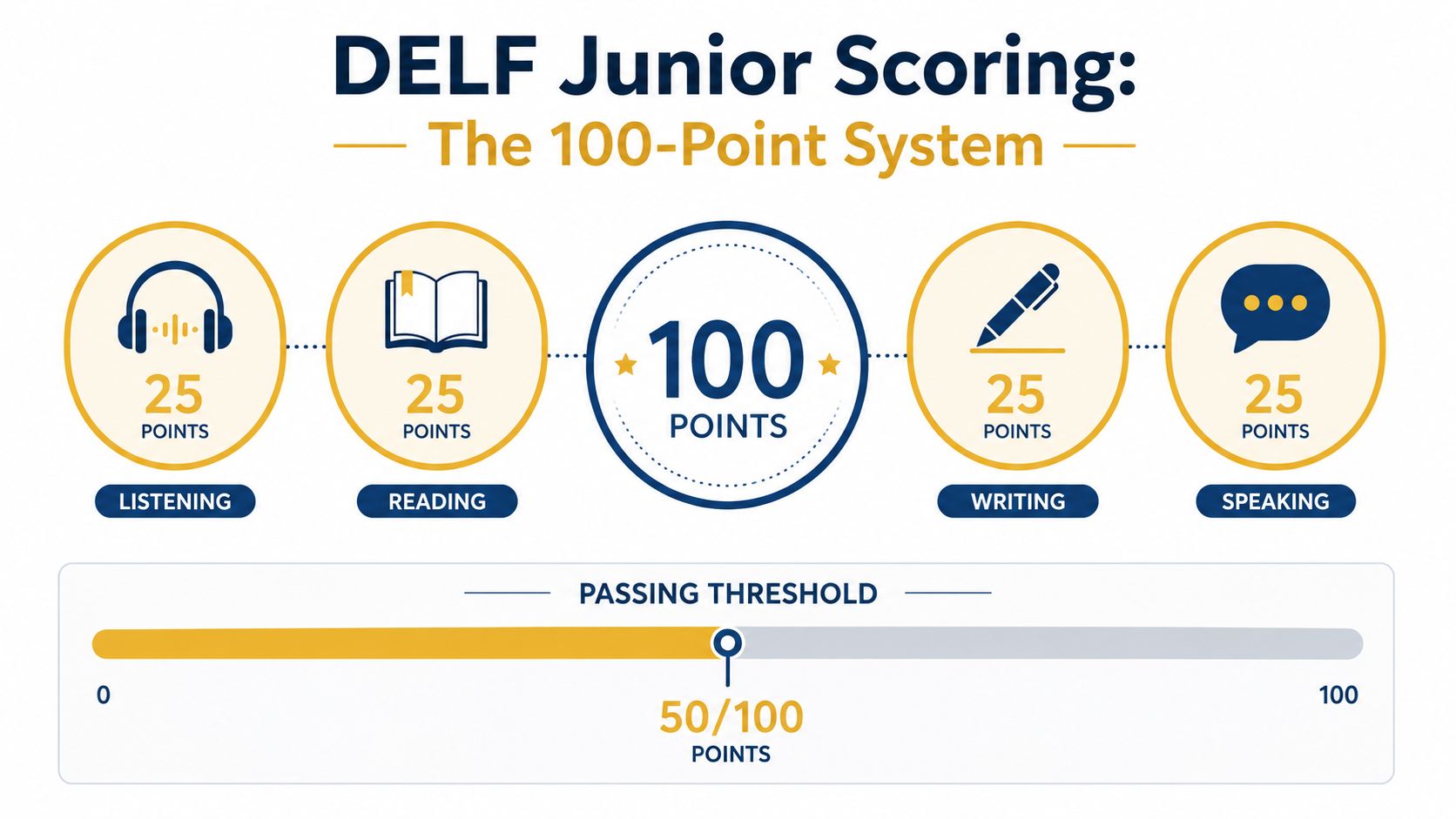
The scoring system is simple, but the pass rule catches families off guard. DELF Junior assesses listening, reading, writing, and speaking, with each skill worth 25 points, for a total of 100 points, according to Alliance Française Hong Kong's DELF Junior assessment information.
A candidate generally needs at least 50 out of 100 overall and at least 5 out of 25 in every skill. The two conditions work together. A student can perform strongly in three areas and still fail if one section falls below the individual minimum.
What assessors are looking for
Listening rewards accurate understanding of the recording and task, not the ability to translate every word. Students should identify the main point, key details, speakers, context, and requested information.
Reading requires disciplined evidence gathering. A teen should locate the passage that answers the question rather than choosing an option because it “sounds right.”
Writing is judged through task completion, organisation, vocabulary, grammar, and communicative clarity. At B levels, a well-developed argument matters more than producing decorative vocabulary. A shorter, logical response usually beats an ambitious response that collapses grammatically.
Speaking carries exactly the same point value as each written skill. That's why oral preparation is the most common strategic weakness I see. Teens often practise grammar worksheets and reading exercises, then assume conversation will take care of itself. It won't.
Practical rule: Protect every skill from falling below the minimum before chasing extra points elsewhere.
Students should practise speaking in the same conditions they'll face during assessment, with timed preparation, a clear response structure, and an examiner who pushes back. Pronunciation doesn't need to sound native, but the message must remain understandable and the interaction must continue.
DELF Junior vs Standard DELF
Many parents hear “Junior” and assume the exam is easier. That's the wrong conclusion. DELF Junior is an age-adapted version of the same CEFR certification framework, not a watered-down qualification.
Both versions cover A1, A2, B1, and B2, assess the same four communicative skills, and use the same overall pass logic of 50/100 with at least 5/25 in each component, as outlined in France Éducation International's candidate guidance. The meaningful change is the context.
A teenager may encounter school life, friendships, hobbies, travel with peers, online communication, or environmental issues. An adult candidate may face workplace, housing, professional, or civic situations. The language task remains serious, but the subject matter is selected for the intended audience.
DELF Junior vs Standard DELF, what actually changes
| Dimension | DELF Junior | Standard DELF |
|---|---|---|
| Intended candidate | Adolescent and secondary-school learners | General public and adult learners |
| CEFR levels | A1, A2, B1, and B2 | A1, A2, B1, and B2 |
| Skills assessed | Listening, reading, writing, and speaking | Listening, reading, writing, and speaking |
| Topic selection | Teen-relevant situations and experiences | Adult everyday, academic, social, or professional situations |
| Linguistic expectations | Level-specific expectations for the selected CEFR band | Level-specific expectations for the selected CEFR band |
| Credential status | Official diploma issued by the French Ministry of National Education | Official diploma issued by the French Ministry of National Education |
The important distinction is this: the topics are more familiar, but the B1 and B2 language demands still require real preparation. A student shouldn't register for B1 merely because the subjects sound teen-friendly.
Treat Junior as a better-fitting context, not an easier exam. Your teen still needs to organise ideas, understand spoken French, respond under pressure, and complete every task at the selected CEFR level.
A Proven Prep Plan for Teenagers
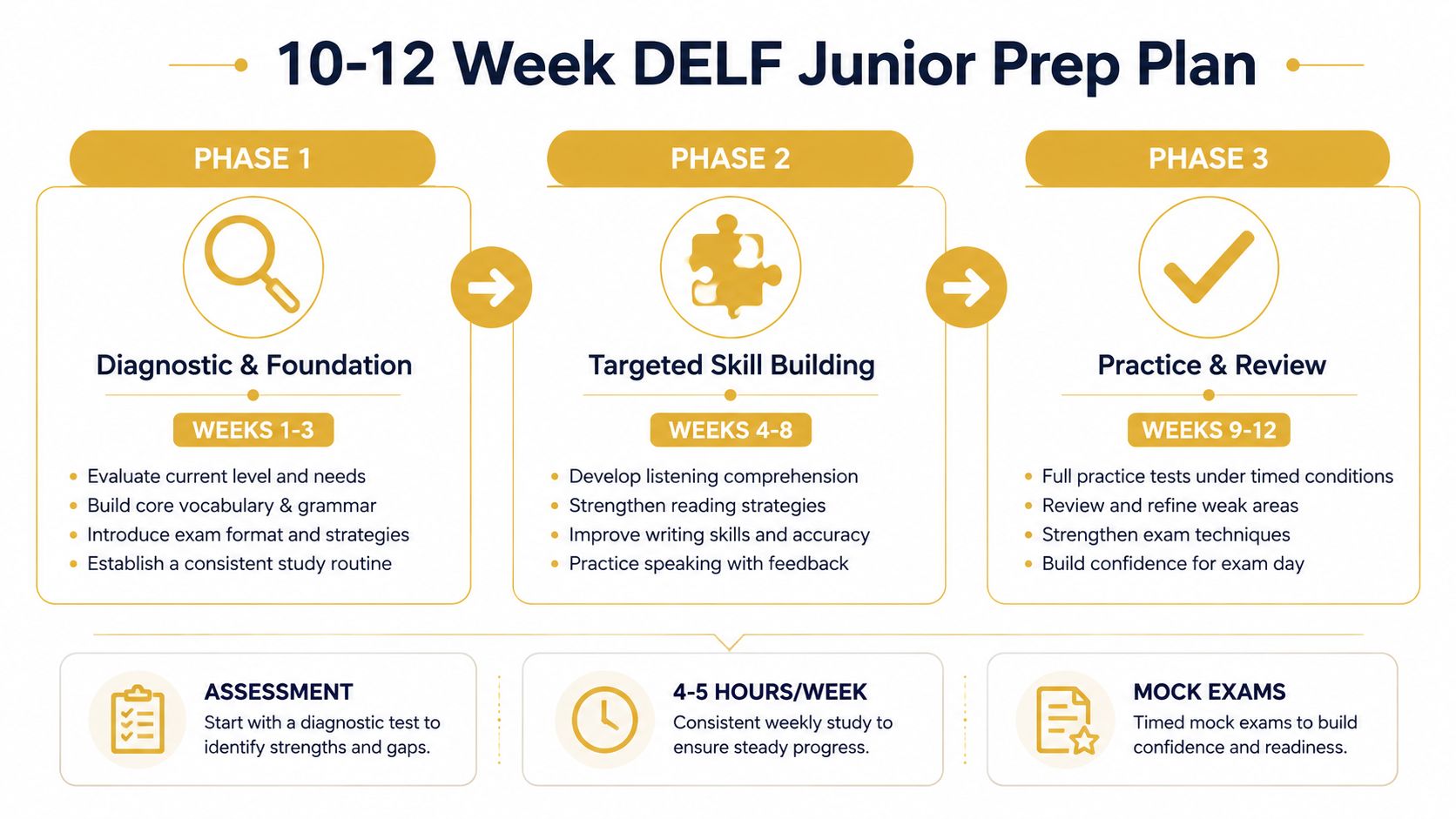
A strong plan begins with diagnosis, not random worksheets. We use a 10 to 12 week preparation cycle, with roughly 4 to 5 hours per week of guided practice and self-study as a working model, then adjust it when the student's schedule or skill profile requires a different balance.
Build the plan in three phases
Weeks 1 to 3, diagnose and repair. Start with a sample from each skill. Identify whether the main weakness is vocabulary, tense control, listening speed, paragraph structure, pronunciation, or interaction. A2 students may need reliable conjugation and everyday vocabulary. B1 learners often need connectors and opinion structures. B2 candidates usually need precision, register, and nuanced argumentation.
Weeks 4 to 8, attack the weakest skills. Most students shouldn't spend equal time everywhere. If writing and listening are lowest, those skills receive the largest share of practice. Use official-style materials from France Éducation International's exam resources and correct writing against the relevant level descriptors rather than relying on a tutor's general impression.
Weeks 9 to 12, rehearse performance. Add full timed papers, recorded speaking tasks, and mock oral examinations. The teen must practise starting quickly, recovering after a mistake, and continuing when the examiner asks for clarification.
The final preparation period should include stamina planning. Some centres schedule written and oral components on the same day, so a student who performs well in isolation may struggle after hours of concentration. Practise with realistic breaks, water, a light snack, and a second performance window.
For students who need accountability between lessons, our structured French study plan provides a useful model for turning broad goals into weekly tasks.
Listening practice should include teen-oriented French podcasts and authentic speech at normal playback speed. Slowing every recording creates false confidence. The exam won't slow down because a learner feels nervous.
How Maya Went from B1 Anxiety to a Clean Pass
Maya was 14 years old and in Year 9 when she came to us six weeks before her DELF B1 Junior session. Her reading and writing were competent, but she froze whenever she had to defend an opinion in real time. Her fear wasn't a lack of French. It was a lack of a repeatable oral process.
We stopped doing broad conversation practice and introduced one strict drill each Tuesday. Maya debated a single teen-relevant topic, such as school uniforms, social media limits, or weekend curfews, in a five-minute structured exchange. I pushed back twice during each session so she had to justify, clarify, and adapt instead of reciting a memorised paragraph.
The three changes that moved her forward
Her writing went through four rewrites against the B1 assessment grid. Each revision focused on a different issue, including connectors, paragraph logic, examples, and grammatical accuracy. By the final practice, she could produce an argument with a clear opening position, supporting reasons, and a conclusion without losing time.
For listening, we used RFI Journal en français facile at normal playback speed from the first day. Maya initially missed details, but the exercise taught her to separate the main idea from information that could be recovered through context.
On test day, Maya scored 72/100, including 18/25 in production orale. Her result reflected a targeted correction plan, not a sudden jump in general French ability.
The lesson I'd give any parent is direct: format-specific repetition beats broad study when the exam date is close. Maya didn't need another general vocabulary list. She needed controlled practice with the exact moment that caused her to shut down.
Families comparing online preparation options can also review this DELF online preparation example to see how a programme can be shaped around an individual learner rather than applied as a fixed course.
2026 Test Dates, Same-Day Scheduling, and Registration Deadlines
Families should plan around the chosen exam centre, not around a universal DELF Junior calendar. Centres publish their own registration rules and schedules, and the available windows differ by region.
Published schedules show recurring international administration. One Asian Alliance Française centre listed three 2025 windows, from April 22 to 25, July 24 to 27, and December 1 to 4, while a European centre listed 2026 sessions in February, June, and October. A North American centre published a concentrated March 16 to 19, 2026 exam period, with registration from January 26 to March 6, according to Bombay Alliance Française's DELF Junior scheduling information.
Some centres have also changed the operational format. Starting in 2025, one official centre states that the written and oral components are held on a single day, while candidates may receive their convocation and schedule about 14 days before the exam, as described by Alliance Française Malaysia's DELF Junior guidance. Don't assume your local centre follows the same arrangement.
2026 DELF Junior sessions at a glance
| Session | Typical Month | Registration Window | Same-Day Format | Action for Parents |
|---|---|---|---|---|
| Winter or spring | Varies by centre | Check the selected centre's published deadline | May be concentrated into one day or a short block | Confirm dates before booking travel |
| Early summer | June appears on some centre calendars | Confirm directly with the administering centre | Written and oral timing varies locally | Ask when the convocation is issued |
| Autumn or winter | October or later dates appear in some calendars | Deadlines are centre-specific | May use a single-day schedule | Reserve recovery time after testing |
The table is intentionally centre-led. A separate European calendar listed deadlines such as March 20 for April testing, May 22 for June testing, and November 20 for December testing, but those dates don't apply everywhere.
Build a test-day buffer
Before registering, ask the centre:
- Exact schedule: Will the written and oral components occur on the same day?
- Attendance requirements: Does the teen need to remain onsite between components?
- Required identification: Which ID and confirmation documents are accepted?
- Materials: Are pencils, pens, water, or snacks permitted?
- Convocation timing: When will the final schedule arrive?
Bring identification, the confirmation email or convocation, permitted writing materials, water, and a light snack if the centre allows it. Missing the oral component can undermine the complete attempt, so don't book a flight that forces your teen to leave early. If travel is necessary, I recommend booking the return for the day after the exam, giving the student time to decompress.
Choosing the Right Support Before Test Day
The right preparation route depends on the teen's level and weakest skill. Group classes can work well for confident A1 and A2 learners who need regular exposure and basic exam familiarity. At B1 and B2, individual feedback becomes much more valuable because written expression and oral interaction depend on the student's specific errors, argument structure, register, and fluency.
Compare the main support options
| Support route | Works well for | Strength | Question to ask |
|---|---|---|---|
| Private French tutor | Students with uneven skills or B-level goals | Personalised correction and speaking pressure | Has the tutor marked DELF-style papers? |
| Alliance Française workshop | Learners who benefit from a centre-based environment | Familiarity with official exam administration | How often are individual mock orals provided? |
| Online DELF-specialist programme | Motivated learners needing flexible scheduling | Regular practice from home with targeted resources | How quickly does a teacher return writing feedback? |
| Generic children's French class | Broad language development | Conversation and classroom confidence | How much time is devoted to DELF task formats? |
I'd avoid any programme that promises a pass through vocabulary memorisation alone. I'd also question a crash course shorter than six weeks, because recurring grammar and organisation problems need time to identify, practise, and reassess.
A serious provider should begin with a 30-minute placement conversation and a short writing sample evaluated against CEFR descriptors. That first meeting should reveal the teen's actual level, not just confirm the level the family hopes to enter.
Before enrolling, ask for evidence of process, not promises: sample feedback, mock oral format, correction turnaround, lesson frequency, and a clear explanation of how weaknesses will be tracked.
Elite French Tutoring offers customised online and in-person French lessons, including DELF and DALF preparation, as one option families can compare with local centre workshops or independent tutors.
Before signing up, I'd want clear answers to five questions:
- Level accuracy: How will the programme confirm A1, A2, B1, or B2 readiness?
- Skill balance: How will the tutor prevent listening or speaking from being ignored?
- Writing feedback: Will each production receive corrections tied to the official criteria?
- Oral simulation: Will the teen practise with timed preparation and examiner follow-up?
- Logistics: Will the final weeks include same-day written and oral stamina practice?
If you're unsure whether your teen should target A2, B1, or B2, book a free 20-minute consultation with a DELF preparation provider and ask for a level assessment plus a realistic study timeline. That conversation should help you compare support options before committing, while giving your teen a preparation plan built around their actual learning style.
Book a free 20-minute consultation with Elite French Tutoring to evaluate your teen's French level, identify the skill most likely to affect the DELF Junior result, and compare a practical preparation timeline before choosing lessons.