Skip to content

Which French female artists are worth exploring first when the list includes sculptors, Impressionists, abstractionists, Surrealists, and contemporary installation artists? A long catalogue of acclaimed names can make it difficult to decide whom to study, view, or collect first.
I use four practical filters: artistic contribution, signature works, historical context, and responsible access. I also separate museum importance from purchase suitability. An artist may be essential to art history while remaining difficult to acquire, or commercially visible while requiring careful scrutiny of edition, provenance, condition, and institutional history.
Several artists here are French-born, while others are francophone, Paris-connected, or closely involved in French art history without being born in France. That distinction matters. Tamara de Lempicka was Polish-born, Cecilia Beaux was American-born, Leonora Carrington built much of her career in Mexico, and Yayoi Kusama is Japanese. Their connections to Paris and French modernism make them relevant to this guide, but they shouldn't be reduced to a single national category.
I also recommend customized French lessons for readers who want to engage more confidently with museum labels, artist biographies, and francophone cultural material. The right vocabulary helps you distinguish une sculpture originale from une édition, discuss la provenance, and ask better questions during a gallery visit.
Table of Contents
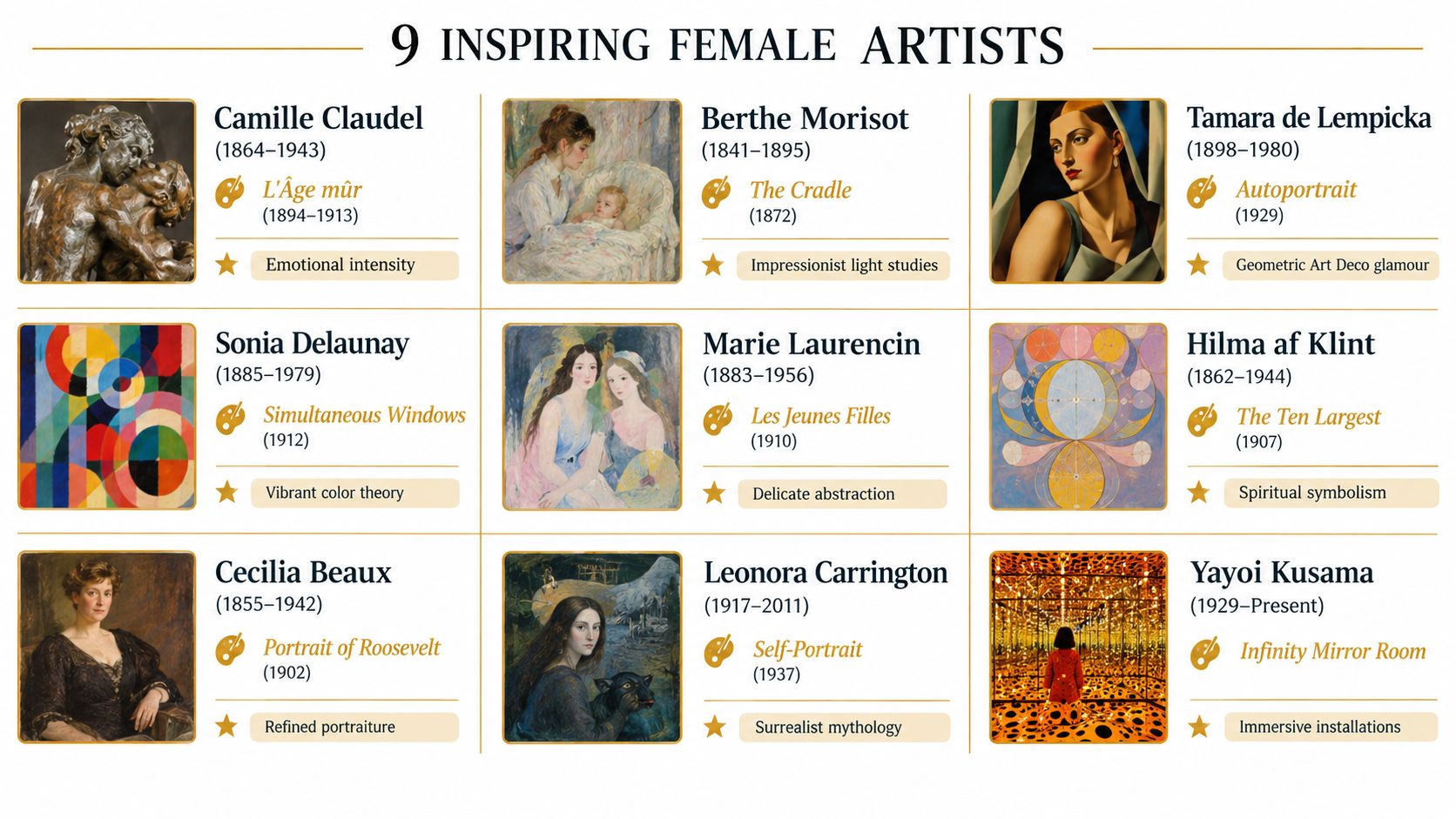
- 1. Camille Claudel 1864–1943 and the Visionary Sculptor
- 2. Berthe Morisot 1841–1895 and the Impressionist Pioneer
- 3. Tamara de Lempicka 1898–1980 and the Art Deco Sensation
- 4. Sonia Delaunay 1885–1979 and the Abstract Pioneer
- 5. Marie Laurencin 1883–1956 and the Feminine Modernist
- 6. Hilma af Klint 1862–1944 and the Abstract Visionary
- 7. Cecilia Beaux 1855–1942 and the American-French Portraitist
- 8. Leonora Carrington 1917–2011 and the Surrealist Visionary
- 9. Yayoi Kusama 1929 to the present and the Contemporary Icon
- 10. A Collector's Practical Checklist for Building Responsibly
- 10 French Female Artists, Collector Comparison
- Choose Your First Artist and Explore With Confidence
1. Camille Claudel 1864–1943 and the Visionary Sculptor
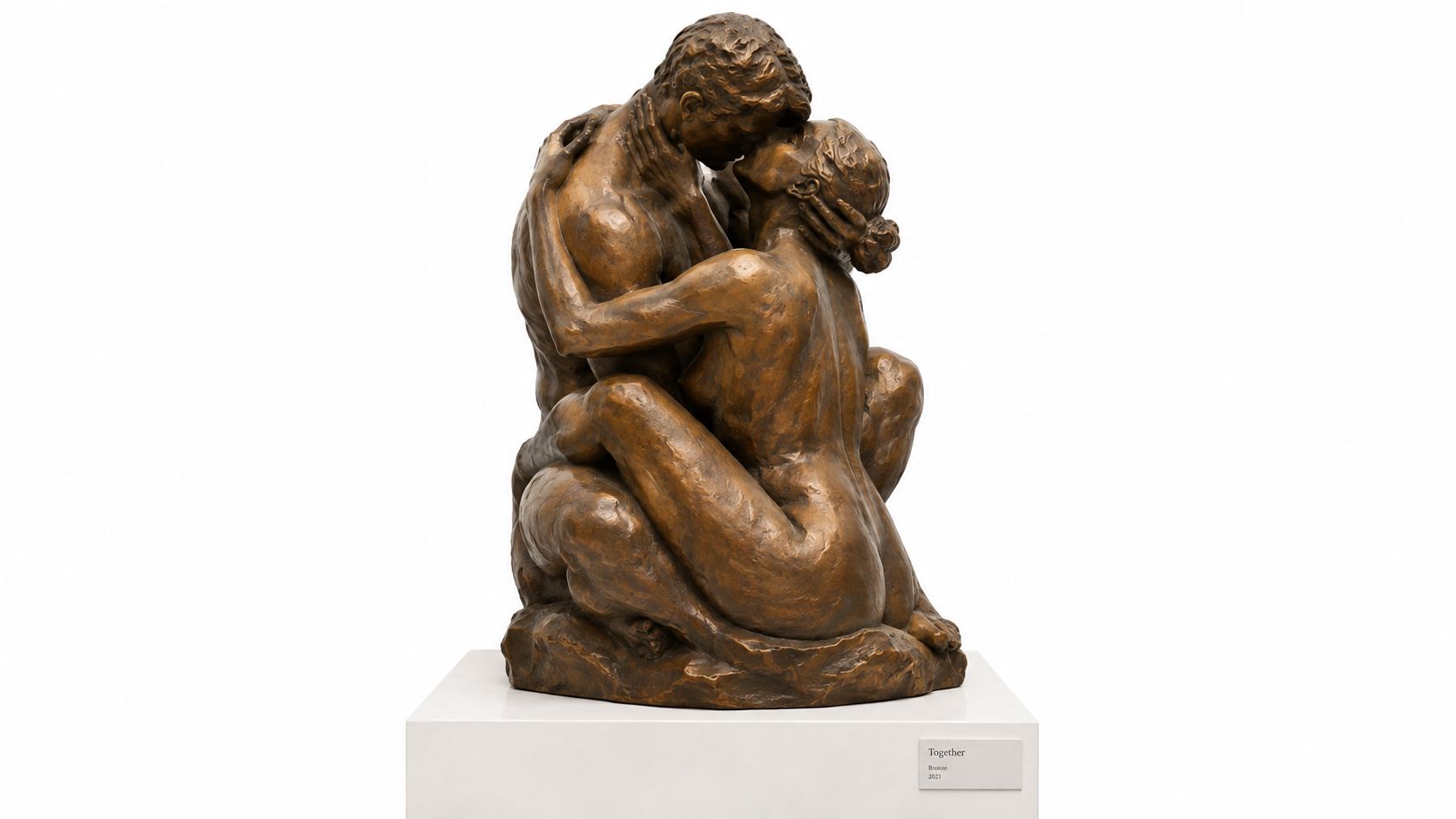
Camille Claudel belongs at the top of any serious introduction to French female artists because her work demands close looking. Her sculpture combines physical movement with emotional tension, making a figure's gesture, posture, or separation from another figure carry the weight of an entire relationship.
Her training under Auguste Rodin shaped her development, but it shouldn't define her. Claudel established a distinct language of emotional realism, especially in bronze and marble. L'Âge mûr, held at the Musée Rodin, conveys separation and irreversible movement on a monumental scale. La Valse turns an embrace into a spiralling, unstable action, while Portrait de Paul Claudel offers a more concentrated study of identity and presence.
What collectors should examine
Claudel's authenticated works are rare, so buyers need to distinguish between an original, an authorised cast, a later reproduction, and an object merely inspired by a famous composition. Ask for a complete ownership history, casting information, exhibition documentation, and specialist authentication before discussing price.
Her legacy also shows why biography shouldn't replace connoisseurship. The strongest purchase begins with the object itself: the quality of the modelling, the surface, the casting history, the condition, and the relationship between the work and the artist's documented practice.
For readers building vocabulary around French art, a guided introduction to popular French artists can make museum conversations more rewarding. I'd start with Claudel in person, then compare her treatment of movement with Rodin and with later sculptors who explored psychological realism.
Practical rule: Treat rarity as a reason for deeper verification, not as proof that a work is authentic or fairly priced.
2. Berthe Morisot 1841–1895 and the Impressionist Pioneer
Berthe Morisot is the right choice for collectors who want Impressionism with intimacy rather than spectacle. Her paintings and drawings turn domestic interiors, gardens, children, and private moments into subjects of serious modern observation.
Her colour is light without becoming weightless. In The Cradle, a quiet scene of looking and being watched becomes a study in tenderness, enclosure, and social space. Woman at Her Toilette examines the private ritual of preparation, while Garden at Bougival opens the composition to shifting air, vegetation, and outdoor movement.
Morisot was not a peripheral participant in Impressionism. She was closely connected to the movement's central artistic networks and developed a recognisable approach to broken brushwork, pale colour, and unfinished-looking surfaces that rewards direct viewing.
A sensible route into Morisot
I recommend seeing her work in a museum before considering any acquisition. Reproductions can flatten the distinction between a delicate pastel, an oil painting, and a drawing, yet those differences affect both interpretation and conservation.
Collectors should prioritise documented works with clear exhibition history. If an original isn't realistic, study catalogues, attend exhibitions, and consider works on paper only after examining condition and authenticity. A Paris vacation with an art-focused itinerary can help connect Morisot's work to the museums, streets, gardens, and cultural settings that shaped how audiences encounter Impressionism.
I'd choose Morisot first if you want a collection with quiet visual intelligence, domestic atmosphere, and a direct connection to Impressionist history. Her work teaches an important collecting lesson: restraint can be more difficult to assess than visual drama, so take your time with surface, scale, and provenance.
3. Tamara de Lempicka 1898–1980 and the Art Deco Sensation
Tamara de Lempicka offers a different route into French modernism. Polish-born, she built her Paris career around the glamour of the 1920s and 1930s, creating portraits with hard edges, polished surfaces, geometric structure, and an unmistakable sense of theatrical self-presentation.
Autoportrait, Tamara in the Green Bugatti remains the essential visual reference for her public image. Phoneuse turns a modern social gesture into a controlled arrangement of shape and colour, while Drago shows how her figures can appear both elegant and psychologically guarded.
Buy the visual language, not just the lifestyle image
De Lempicka is attractive to buyers because the work functions immediately in a contemporary interior. That accessibility can also encourage rushed decisions. Before buying, ask whether the object has a credible place within the artist's catalogue, whether the medium is correctly identified, and whether the seller can document ownership and exhibition history.
I'd compare several works rather than buying the first familiar image. Look for the relationship between the figure, background, surface, and geometry. A work that merely repeats the recognisable Art Deco vocabulary may offer less depth than a less famous composition with stronger documentation and better condition.
Her relationship to Paris also makes her useful for readers interested in the wider culture of design, fashion, and modern luxury. A French lesson built around French luxury fashion houses can provide vocabulary for discussing silhouette, ornament, materials, and the social world surrounding Art Deco.
Choose de Lempicka when you want bold figurative modernism with a strong decorative presence. Don't confuse visual confidence with a guarantee of investment performance.
4. Sonia Delaunay 1885–1979 and the Abstract Pioneer
Sonia Delaunay is one of the strongest choices for anyone who wants colour to operate as structure rather than decoration. Her practice moved between painting, textiles, clothing, book design, stage design, and applied arts, making her especially valuable to collectors who don't want to separate fine art from everyday visual culture.
Works such as Simultaneous Windows, Electric Prisms, and Prismes Électriques show her commitment to rhythm, contrast, and visual movement. Her compositions don't ask the eye to settle on one subject. They make colour generate motion across the surface.
Why Delaunay suits a developing collection
Delaunay's broad output gives collectors more than one way to engage with her work. Paintings, works on paper, textiles, and design objects require different kinds of research and conservation. A textile is not just a cheaper painting, and a print is not automatically a lesser version of a unique work. Each medium has its own history and market context.
Her importance is also visible in the auction record. Among the 100 largest modern-art auction results in 2023, one sale involved a woman artist from the École de Paris, Sonia Delaunay. The same analysis reported fewer than 20 million-dollar auction sales for women artists in modern art, compared with hundreds for male artists, making auction scarcity a useful comparison point rather than a judgement of artistic quality. This market analysis of women artists from the École de Paris is worth reading before making assumptions about price or demand.
I recommend Delaunay to collectors who want historical importance, colour innovation, and flexibility across media.
5. Marie Laurencin 1883–1956 and the Feminine Modernist
Marie Laurencin developed a lyrical form of modernism built from graceful figures, softened contours, pastel colour, and intimate compositions. Her work feels immediately accessible, yet that accessibility shouldn't be mistaken for simplicity.
Les Jeunes Filles demonstrates her preference for an atmosphere of poised relationships rather than dramatic narrative. Apollinaire and His Friends places her within the literary and artistic networks of Paris, while her flower still lifes show how her palette and line create mood even when the subject is conventional.
Laurencin is a strong recommendation for readers who want to explore the Paris School without beginning with a heavily theoretical abstraction. Her paintings and drawings invite comparisons with portraiture, fashion illustration, theatre, and poetry.
Collecting Laurencin with discipline
Start with a drawing or print only after checking the edition, signature, paper, and condition. Her delicate surfaces and pale colours can be vulnerable to poor framing, light exposure, and restoration. For paintings, ask whether the work has been included in specialist scholarship or exhibition records.
I'd choose Laurencin when a collection needs intimacy, softness, and a distinctly feminine modernist vocabulary. She also works well as a teaching subject because her images support discussion of colour, gendered representation, literary circles, and the difference between decorative appeal and artistic structure.
Visit several examples before buying. A single image can make her seem predictable, while a broader view of her practice reveals how deliberately she controlled repetition, pose, and atmosphere.
6. Hilma af Klint 1862–1944 and the Abstract Visionary
Hilma af Klint is not French-born, but she belongs in this guide because her work reshaped how audiences understand European modernism and the history of abstraction. Her spiritually informed paintings developed through symbolic systems, geometric forms, colour relationships, and an ambition that exceeded ordinary categories of painting.
The Ten Largest, including No. 7, Adulthood, demonstrates the scale and visual confidence of her project. Evolution and the Temple series show how she used circles, spirals, diagrams, and organic forms to construct an alternative visual language.
Study before you buy
Af Klint's growing institutional attention makes careful research essential. A famous title or recognisable symbol doesn't tell you whether a work is original, authorised, historically documented, or merely derivative. Buyers should examine the artist's estate or foundation records where available, follow specialist scholarship, and treat claims about scarcity or future value with caution.
Her work is particularly useful for readers who want to question the standard story of abstraction. Don't frame her only as someone who arrived before better-known male artists. Study the structure of her own ideas, the recurring symbols, and the tension between private spiritual practice and public museum interpretation.
I recommend af Klint for museum study, serious scholarship, and collectors prepared to build knowledge before considering an acquisition. The best first purchase may be a catalogue or exhibition publication rather than an artwork.
7. Cecilia Beaux 1855–1942 and the American-French Portraitist
Cecilia Beaux brings a transatlantic perspective to French art history. American-born and active in Parisian artistic circles during the Belle Époque, she developed society portraits with psychological focus, confident brushwork, and a refined sense of social presence.
Her portrait of Theodore Roosevelt demonstrates the challenge of painting public authority without reducing the sitter to a formal emblem. Sita and Sarita offers a more intimate relationship between figures, while Portrait of a Gentleman reveals her command of pose, clothing, and controlled expression.
A portraitist for close comparison
Beaux is a compelling choice for collectors who prefer figurative painting but want more than conventional likeness. Compare how she handles the sitter's face, hands, clothing, and surrounding space. The strongest portraits make those elements work together, so the viewer understands something about status and personality without relying on a written biography.
For a buyer, provenance and condition are central. Portraits can remain in family collections for long periods, and changes in attribution or ownership history require specialist review. Don't rely on a flattering auction description alone. Request documentation and compare the work with securely attributed examples.
I'd recommend Beaux to anyone building a collection around Belle Époque portraiture, professional women artists, and dialogue between American and French traditions. She is also an excellent artist to study before visiting museums with large portrait collections because she sharpens the eye for gesture, finish, and social performance.
8. Leonora Carrington 1917–2011 and the Surrealist Visionary
Leonora Carrington transformed Surrealist strategies into a personal mythology filled with hybrid creatures, alchemical signs, altered bodies, and dreamlike environments. Although much of her career unfolded in Mexico, her Paris Surrealist connections place her within a broader international history of modernism rather than a narrowly French one.
Self-Portrait presents the artist as both observer and participant in an unstable symbolic world. The Pomps of the Circus and The Juggler develop that world through theatrical figures, transformation, and visual ambiguity.
Carrington is a strong choice for collectors who want art that resists a single interpretation. Her work can appear fantastical at first glance, but the details reward sustained attention. Look for recurring animals, ritual gestures, architectural spaces, and references to transformation.
What makes a Carrington purchase responsible
Buyers should insist on strong provenance and estate documentation, particularly for works on paper, mixed media, and objects that may have circulated outside major institutions. Establish the medium, date, dimensions, ownership history, and exhibition record before treating a work as an important example.
I recommend comparing a proposed purchase with documented paintings, sculptures, and drawings rather than judging it by resemblance to a famous image. Carrington's visual vocabulary is distinctive, but imitation can be persuasive.
Choose her when you want Surrealism with literary depth, mythological invention, and an international career story. She also offers a valuable correction to histories that treat women Surrealists as supporting figures rather than independent innovators.
9. Yayoi Kusama 1929 to the present and the Contemporary Icon
Yayoi Kusama offers the clearest entry point for readers drawn to contemporary installation, repetition, and immersive experience. Her practice spans painting, sculpture, installation, performance, and prints, with recurring motifs including polka dots, pumpkins, mirrored spaces, and patterns that seem to extend beyond the object.
The Infinity Mirror Room series makes the viewer part of the work. Pumpkin sculptures and paintings turn a familiar form into a repeated visual sign, while Narcissus Garden, first presented in 1966 and realised in later installation iterations, explores reflection, multiplication, and the relationship between art and audience.
Choose the right Kusama format
A museum installation and a collectible print offer radically different experiences. An installation depends on space, light, access, maintenance, and the artist's authorised presentation. A print or multiple may be more practical for a private collection, but buyers still need to confirm edition information, signature, condition, and documentation.
Kusama's strong public visibility shouldn't remove the need for discipline. Compare the work's medium, edition, date, and exhibition history. Ask how it will be displayed and whether conservation requirements suit your space.
I recommend Kusama for collectors who want contemporary cultural visibility, repeated form, and a work that can connect private ownership with a broader museum experience. Start with an exhibition, then decide whether a print, sculpture, or other edition fits your collection.
10. A Collector's Practical Checklist for Building Responsibly
A responsible collection begins with research, not enthusiasm. The same rule applies whether you're considering a nineteenth-century drawing, a modernist textile, a Surrealist painting, or a contemporary multiple.
Verify the object
- Check provenance: Request invoices, ownership records, exhibition history, and any relevant correspondence.
- Consult specialist records: Use a catalogue raisonné, artist foundation, estate archive, or recognised scholarly source when one is available.
- Inspect condition: Attend a pre-sale viewing when possible, request a condition report, and ask for restoration history.
- Confirm the medium: Distinguish a unique work from a print, authorised edition, later cast, reproduction, or design object.
- Review the total cost: Include insurance, shipping, framing, storage, conservation, and any applicable buyer's premium in your planning.
- Choose qualified advisers: Work with established dealers, reputable auction houses, and recognised specialists for significant purchases.
Works on paper, prints, and textiles can provide practical entry points, but lower acquisition cost doesn't eliminate conservation concerns. Paper may require careful framing and light control. Textiles may need specialist mounting. Sculptures require attention to casting history, surface, stability, and installation.
Separate visibility from value
Museum presence can guide your research, but it doesn't guarantee a sound purchase. The Centre Pompidou's elles@centrepompidou exhibition, held from 2009 to 2011, was a landmark presentation devoted exclusively to women artists. A later rehang of the permanent collection in 2012 displayed works by women artists in only 10% of the works on view, the same proportion reported before the exhibition. The Louvre's holdings were even more limited in the cited analysis, with works by women artists representing 0.78% of its entire collection. This Sciences Po analysis shows why temporary visibility and lasting collection representation must be assessed separately.
For a practical cultural vocabulary, I'd pair collection research with a visit to a specialist French bookstore in New York. Exhibition catalogues and French-language criticism often reveal context that a short sales description leaves out.
10 French Female Artists, Collector Comparison
| Item | 🔄 Implementation complexity | ⚡ Resource requirements | 📊 Expected outcomes | 💡 Ideal use cases | ⭐ Key advantages |
|---|---|---|---|---|---|
| Camille Claudel (sculpture) | High, authentication, conservation and heavy logistics | Very high cost; specialist transport, insurance and expert authentication | High cultural & investment value; long-term appreciation | Blue-chip collectors building authentic French sculpture collections | Rare originals; strong historical significance |
| Berthe Morisot (Impressionism) | Moderate, provenance and condition checks for oils/pastels | High for major oils; conservation for fragile media; specialist authentication | Strong appreciation potential; museum provenance supports value | Collectors of early Impressionism and women artists; exhibition-focused purchases | Pioneering Impressionist voice; relatively accessible vs top male peers |
| Tamara de Lempicka (Art Deco) | Moderate, surface/restoration and provenance verification | High prices for major works; active secondary market and documentation | Good liquidity for desirable pieces; continued decorative-market demand | Collectors of Art Deco, decorative modernism and resale-oriented investors | High marketability; striking decorative appeal |
| Sonia Delaunay (abstract & applied arts) | Moderate, varied media (textiles, paintings) complicate checks | Wide price tiers; textile conservation and specialist dealers | Institutional interest with accessible entry points across budgets | Collectors of color theory, modernism, and textile/applied art | Pioneering simultanism; diverse media and price points |
| Marie Laurencin (lyrical modernism) | Moderate, delicate palettes require careful condition review | Mid–high for major oils; prints/watercolors offer lower-cost entry | Steady appreciation, museum validation for key works | Collectors seeking lyrical Paris School works and decorative modernism | Distinct lyrical style; relatively affordable among Cubist-era artists |
| Hilma af Klint (spiritual abstraction) | High, large series, provenance gaps and conservation needs | High cost for major works; foundation authentication advised | Strong scholarly & institutional interest; recent rapid appreciation (volatile) | Institutions and collectors focused on early abstraction and art history narratives | Early pioneer of abstraction; strong conceptual significance |
| Cecilia Beaux (portraiture) | Moderate, sitter provenance and condition assessments | Mid–high for major portraits; framing and conservation costs | Cultural and historical value; steady collector interest in portraiture | Collectors of Belle Époque, transatlantic modernism and refined figurative work | Refined psychological portraiture; strong documentation |
| Leonora Carrington (Surrealism) | Moderate, mixed media provenance and condition checks | High for major paintings; market-sensitive; specialist advisors useful | Growing institutional interest and market demand; supports thematic collections | Collectors of Surrealism, mythological modernism and feminist narratives | Unique visionary imagery; rising scholarly recognition |
| Yayoi Kusama (contemporary & installations) | Variable, editions simple, installations complex to manage | Wide range from prints to multimillion works; installation logistics substantial | Very high public profile and demand; price volatility possible | Museums, contemporary collectors, experiential exhibition projects | Global brand recognition; crossover appeal and diverse formats |
| Collector's Practical Checklist | Low–moderate, procedural but requires specialist input | Low direct cost; may require paid experts for high-value works | Reduces acquisition risk; improves long-term preservation and value | New and experienced collectors acquiring 19th–21st-century works | Practical steps for authentication, conservation and budgeting |
Choose Your First Artist and Explore With Confidence
The best first choice depends on what you want the artwork to do in your life. If you prefer intimate figurative modernism, start with Berthe Morisot or Marie Laurencin. Morisot gives you Impressionist observation, movement, and light. Laurencin offers a softer, more lyrical approach to figure, colour, and social connection.
Choose Sonia Delaunay if colour and applied arts matter as much as painting. Her work lets you move between abstraction, textiles, design, and the Parisian avant-garde. She's especially suitable for a collection that values visual rhythm and wants to include more than one medium.
Choose Camille Claudel if sculpture is your priority. Her work carries emotional and physical intensity, but acquisition requires exceptional care. Study museum examples, examine casting histories, and don't let scarcity rush your decision.
Choose Yayoi Kusama if you want contemporary installation, repetition, and accessible editions. Decide whether you want an immersive experience, a sculpture, a painting, or a multiple. Those formats aren't interchangeable, and each carries different display and conservation requirements.
For a more historically expansive route, add Tamara de Lempicka for Art Deco portraiture, Cecilia Beaux for transatlantic Belle Époque painting, Leonora Carrington for international Surrealism, and Hilma af Klint for symbolic abstraction. These artists complicate the category of French female artists in productive ways. They show that French art history includes networks, migrations, collaborations, and careers shaped by Paris without being limited to French birth.
Institutional recognition and market momentum also need separate evaluation. Women represented 13.8% of total auction sales value in 2024, up from 6.2% in 2018, while contemporary and young-contemporary artists accounted for 82% of the auction offering of women artists. Yet lots selling for at least $1 million represented only 4.7% of women artists' lots and generated 65.6% of their total sales value. This analysis of women artists in the auction market makes the central point clearly: headline growth can coexist with highly concentrated value.
Institutional records tell a related story. Women artists accounted for 6.6% of artists and 4% of works in the Joconde database. Among 45 Videomuseum member museums in 2022, women represented 15.6% of artists and 11% of works. A UNESCO report found women represented 18.53% of artists in a 120,000-work collection, rising to approximately 40% among visual artists born after 1970. The Sciences Po analysis of heritage and museum representation supports a disciplined approach. Compare museum holdings, exhibition histories, auction records, artist cohorts, medium, nationality, and career stage instead of relying on a short list of famous names.
Annette Messager provides another useful institutional benchmark. She received Japan's Praemium Imperiale in September 2016, a major international art honour often described as France's equivalent of a Nobel Prize for art. The discussion of women's representation in contemporary art places that achievement alongside exhibition history and market performance rather than treating any single measure as definitive.
If you want to discuss French art, plan museum visits, or work with francophone cultural material in the original language, book Elite French Tutoring's free 20-minute consultation. The team can create a customized online or in-person lesson plan around your interests, whether you're an adult learner, parent, professional, collector, diplomat, or student preparing for DELF or DALF.
Learning French doesn't just help you translate an artist's name. It gives you deeper access to original exhibition text, museum terminology, artist biographies, and the cultural context surrounding the work.