

You already speak French well enough to hold the conversation. The problem starts when the room goes slightly quiet after your first sentence, or when someone answers in a more basic way than the situation requires because they didn't fully catch your pronunciation. That's the moment most adults start searching for French accent reduction.
I see this with professionals all the time. Their grammar is solid. Their vocabulary is more than adequate. But their speech still carries habits from English, or another first language, that make them sound less precise, less fluid, or less confident than they really are. The fix usually isn't to “sound native.” It's to sound clear, controlled, and easy to follow under real pressure.
That distinction matters. Good accent work doesn't erase identity. It improves intelligibility, presence, and comfort. It helps your French hold up in meetings, interviews, client calls, relocation prep, and everyday conversation when you don't have time to mentally rehearse every syllable.
Table of Contents
- Speaking French Is Only Half the Battle
- Assess Your Accent and Set Clear Goals
- Your Phonetic Targets for Maximum Impact
- Your Practice Toolkit for Effective Drills
- Comparing Practice Methods and Building a Schedule
- Your Timeline for Measurable Progress
Speaking French Is Only Half the Battle
One executive I worked with could lead a discussion on policy, negotiate nuance, and handle difficult follow-up questions in French. But he still felt that every conversation began with a small credibility tax. People listened to his accent before they listened to his argument.
That's a frustrating place to be, especially when you've already done the hard part of learning the language.
What usually surprises people is that this problem is trainable. Structured pronunciation instruction does help. A review summarized on SpeechPathology.com reported that in 86 pronunciation studies, learners improved by 0.89 standard deviation units after structured instruction, and experimental groups outperformed control groups by 0.80 standard deviation units. That's why I treat accent work as a practical training problem, not a talent issue or a personality trait (review summary of pronunciation instruction findings).
Practical rule: If your French is already functional, accent work should focus on the few speech patterns that most affect clarity, authority, and ease of understanding.
That changes the mindset immediately. Instead of chasing perfection, you start asking better questions. Which parts of my speech create friction? Which sounds matter most? Which rhythm habits make me sound less natural? Which changes will help me in the situations that matter to me?
For some adults, success means speaking more comfortably with in-laws in Lyon. For others, it means sounding polished in a client presentation or more fluid during a relocation interview. The target isn't the same for everyone, and that's exactly why generic sound lists often fail.
I've found that people progress faster when they stop treating accent as a vague personal flaw and start treating it as a set of trainable speech habits. Once you hear your own pattern clearly, the work becomes much less emotional and much more mechanical.
If you want a useful starting point before doing anything else, this guide on how to do a French accent is a good first filter for hearing what native-like rhythm and sound placement involve.
Assess Your Accent and Set Clear Goals
Most adults begin in the wrong place. They start fixing random sounds they've been told are “very French,” usually the French r, nasal vowels, or silent letters. That approach feels productive, but it often misses the actual source of the problem.
A better start is a simple diagnostic.
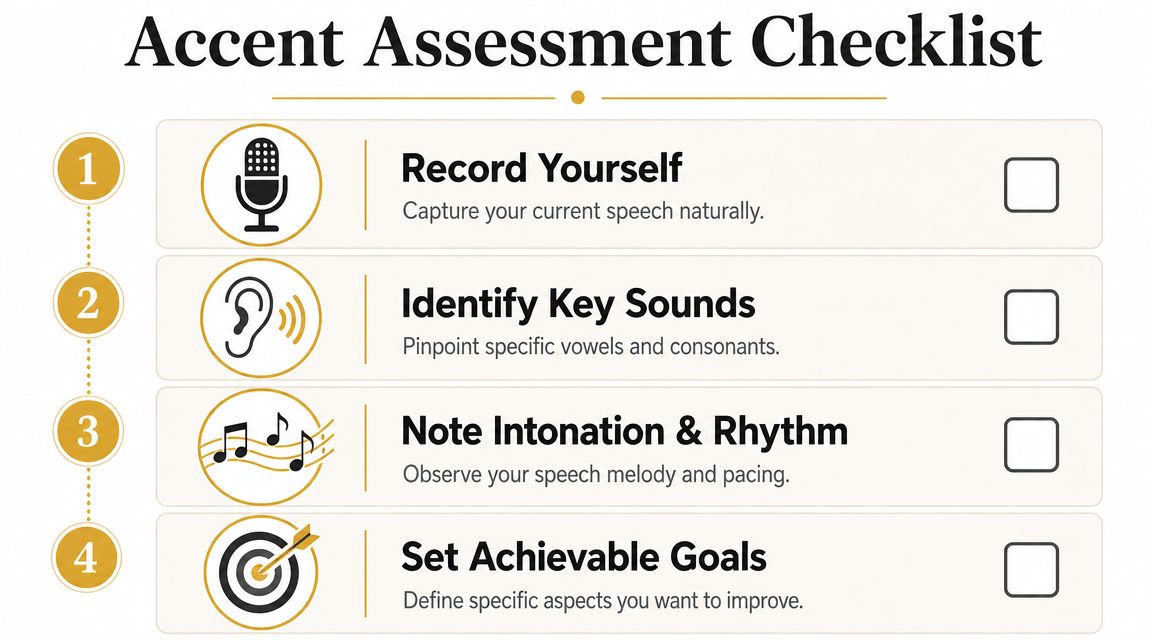
ASHA's guidance is useful here because it frames accent modification as an elective service aimed at improving intelligibility, not erasing identity. It also emphasizes that assessment should cover both segmentals like individual sounds and suprasegmentals like rhythm and intonation, so success can be defined in practical terms such as clearer speech in meetings rather than vague promises of sounding native (ASHA guidance on accent modification assessment and goals).
Start with two recordings
Use your phone and make two short recordings.
Read a short French text aloud
Pick something neutral. A news paragraph, a textbook excerpt, or a short article works well. Reading gives you a controlled sample.Speak freely for about a minute
Talk about your day, your work, your plans, or a recent trip. Spontaneous speech reveals your default habits.Use the same setup each time
Same room, same device, similar time of day. That makes it easier to hear real changes over time.Save the files clearly
Label them by date and task. You want a small archive of your speech, not a pile of anonymous clips.
Listen for patterns, not flaws
When you listen back, resist the urge to wince and stop. You're not judging yourself. You're collecting usable information.
Pay attention to four things:
Vowel accuracy
Are you collapsing distinct vowels into one familiar English sound?Speech melody
Does your French rise and fall in a way that sounds closer to English than to French?Word linking
Are liaisons missing where they should be present, or forced where they shouldn't be?Rhythm and pacing
Does your speech sound choppy, heavily stressed, or overly segmented?
The fastest progress often comes from hearing one repeated pattern clearly, then drilling that pattern until it stops showing up in spontaneous speech.
Now define success in one sentence. Not “I want a better accent.” That's too vague. Use something concrete: “I want to sound clearer in interviews,” “I want to stop sounding hesitant in meetings,” or “I want my French to flow more naturally in conversation.”
That sentence becomes your filter. If a drill doesn't serve that outcome, it can wait.
Your Phonetic Targets for Maximum Impact
Once you've recorded yourself, the next question is where to spend your effort. Many learners waste months at this stage. They attack every mistake equally, even though not every mistake affects clarity equally.
The smarter path is to prioritize the sounds and speech habits that create the biggest perceptual difference.
A standard clinical workflow for accent modification starts by establishing a native-speaker model, then training perception and production on high-impact contrasts, and only later moving into reading and recorded self-review before spontaneous speech. That structure matters because it keeps learners from getting lost in low-impact details (clinical workflow for high-impact pronunciation training).

The four areas that change clarity fastest
I usually group French accent reduction targets into four practical buckets.
Vowel precision
French vowels carry a lot of identity. If you flatten them into English approximations, your speech becomes harder to process. The high-impact contrasts often include rounded front vowels and nasal vowels. The classic example is the contrast between /u/ and /y/, where words like vous and tu require different lip shaping and tongue placement.
This is one of those cases where hearing the difference comes before producing it well.
Rhythmic flow
English speakers tend to over-stress key words and reduce unstressed syllables. French behaves differently. It needs a more even, connected flow. If your rhythm stays English, even accurate individual sounds can still feel foreign and effortful to listeners.
This is why someone can pronounce the French r decently and still sound unmistakably non-native in a way that affects overall clarity.
Targeted consonants
Yes, the French r matters. But it isn't always the first fix that pays off. Often, cleaner dental consonants, softer releases, and more controlled articulation on ordinary sounds improve naturalness faster than dramatic work on a single famous consonant.
In practice, the “boring” consonants often deliver the more professional sound.
Essential liaisons
Liaison is one of the clearest signals that your French is moving from textbook speech toward real connected speech. You don't need every possible liaison at once, but you do need command of the most important patterns if you want your French to sound fluid rather than word-by-word.
For English speakers, this often feels unnatural at first because the linking pattern has to become automatic.
A real example of what actually moved the needle
One student I worked with was preparing for a diplomatic post in Geneva. He came in assuming the issue was his French r. That's what nearly every motivated adult assumes.
But his main barrier wasn't the r at all. It was rhythm and linking. He was speaking accurate French words with English timing, then pausing where French prefers connection. Once he started drilling phrase flow, predictable liaison patterns, and more even syllable timing, people stopped straining to follow him. He sounded more composed and more authoritative, even before his r was fully consistent.
You don't need to fix everything. You need to fix the patterns listeners notice first.
If you're an English speaker, this kind of prioritization is exactly why French pronunciation for English speakers needs a targeted plan instead of a generic list of “hard French sounds.”
Your Practice Toolkit for Effective Drills
Good pronunciation practice is narrower than commonly expected. You're not trying to “speak more French” in a vague way. You're trying to repeat a small number of corrected patterns often enough that they become your default.
That means drills need to be specific, short, and repeatable.
Drills that build control
Start with these four.
Minimal pair work
Use closely related words to train contrasts your ear still confuses. This is especially useful when two French sounds both map onto one familiar sound in your first language.Shadowing
Choose a short native-speaker clip and repeat with it or immediately after it. Match timing, vowel length, linking, and melody, not just the words.Recorded repetition
Say the same phrase several times, record it, then compare it to your model. Most adults improve faster once they stop relying on live self-perception and start listening back.Mirror or camera practice
French lip rounding and jaw position matter. A mirror or front-facing phone camera can help you catch the physical habits your ear misses.
One pattern I use constantly is short phrase looping. Not isolated words for ten minutes, and not free conversation too early. A phrase like tu peux le faire, j'en ai parlé, or ils ont accepté gives you enough context to practice sound, connection, and rhythm together.
How to make practice transfer into conversation
One of the most useful advanced techniques is reverse accent mimicry. Instead of trying to jump straight into better French, first imitate the target accent in your native language. That lets you feel the rhythm, mouth posture, and melody more directly. Then you switch back into French while keeping that same physical pattern. Hilton's method describes this as moving from mimicry into L2 code-switching, then stabilizing the result through repeated scripted dialogues and scheduled practice (reverse accent mimicry and scripted transfer practice).
That last part matters. Transfer doesn't happen automatically.
Coach's note: If a sound is correct in drills but disappears in conversation, the problem usually isn't knowledge. It's stabilization.
A practical toolkit for one week might look like this:
- Two short minimal-pair sessions for high-impact vowel contrasts
- Two shadowing sessions using the same audio until the rhythm locks in
- One scripted dialogue session where you repeat phrases tied to your real life
- One review session listening to your own recordings and marking recurring slips
If you want structured ideas for this kind of targeted routine, ways to improve fast in French pronunciation can help you choose drills that match your current stage rather than overloading yourself.
Comparing Practice Methods and Building a Schedule
Not all practice formats solve the same problem. That's why adults often feel stuck even when they're “doing a lot.” They may be working hard in a format that doesn't provide enough correction.
One common example is speaking more slowly. Many learners assume slower speech automatically improves comprehension. But a 2021 critical review concluded that reducing speaking rate is not an effective broad strategy for improving listener comprehension of accented speech, with no general increase in listener comprehension found overall. The review pointed instead toward factors like accent familiarity and more targeted pronunciation work (critical review on speaking rate and accented speech comprehension).
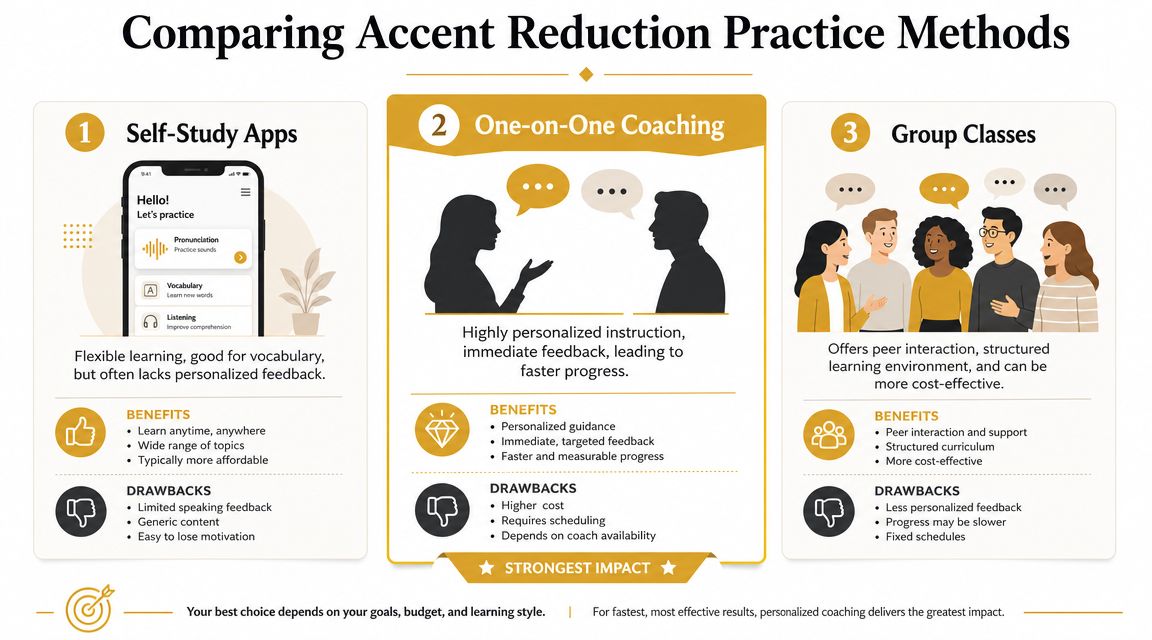
Which learning format fits which goal
Here's the practical comparison I give adults shopping for help with French accent reduction.
| Method | Feedback Quality | Personalization | Cost |
|---|---|---|---|
| Self-study apps | Low to moderate | Low | Low |
| Group classes | Moderate | Moderate to low | Moderate |
| Private tutoring | High | High | Higher |
Self-study apps are convenient. They're often helpful for exposure, repetition, and basic listening. But they usually can't tell you why your vowel is off, whether your liaison sounds natural, or which rhythm habit is causing friction.
Group classes add structure and can be motivating. The trade-off is limited speaking time and broad instruction aimed at the average learner rather than your exact accent profile.
Private coaching is where targeted correction becomes efficient. A tutor can hear the recurring issue, isolate it, and assign drills that directly address it. That doesn't make it the right choice for everyone, but it is usually the fastest route when the goal is measurable change in spoken clarity. For adults comparing options, this guide on how to find the perfect French tutor is a useful decision filter. If you want a customized program with an initial assessment, Elite French Tutoring offers private lessons built around individual goals and speech patterns.
A weekly schedule that adults can sustain
Most adults don't need marathon sessions. They need consistency and clean repetition.
A workable schedule looks more like this:
Three focused practice blocks
Keep them short and targeted. One contrast, one rhythm feature, or one dialogue set per session.One live speaking session
This can be with a tutor, language partner, or structured class. The point is to test transfer under mild pressure.One recording review
Listen back and note the two errors that keep resurfacing. Don't chase ten at once.One recovery day
Accent work is motor learning. Your speech system needs repetition, then space, then repetition again.
What matters most is that your schedule includes both controlled production and real speech. If you only drill, you won't generalize. If you only converse, old habits tend to stay in charge.
Your Timeline for Measurable Progress
Adults always want to know how long this takes. The honest answer is that progress depends on your starting point, your ear, your consistency, and how much feedback you get. But the bigger issue isn't speed. It's whether your practice is producing visible change you can measure.
That's why I tell people to look for milestones in layers.
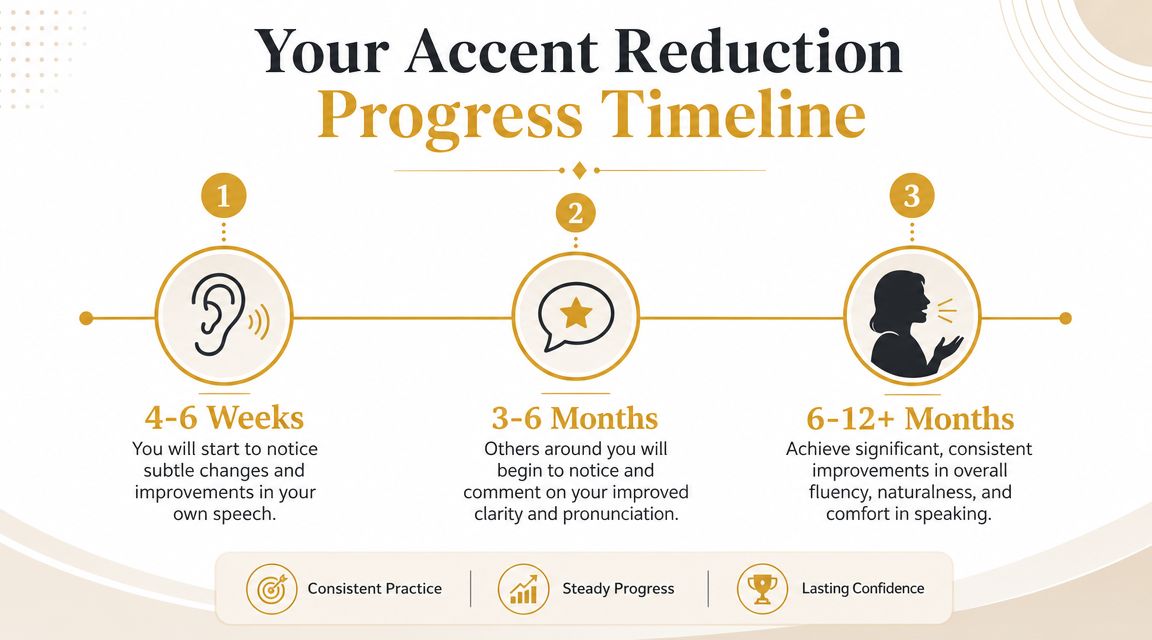
What progress usually feels like
The first sign is usually private. You hear yourself making a sound more accurately, or you notice that a phrase you used to force now comes out more cleanly. Then a second stage arrives, where your speech still isn't fully automatic, but listeners ask for less repetition and conversations feel less effortful.
Later, the new pattern starts surviving under pressure. That's the true test. You can hold onto your rhythm in a fast exchange. Your vowels stay more stable when you're tired. You don't lose every correction the moment you stop reading from a script.
A useful way to track this is with a simple checklist:
Clarity under low pressure
Can you produce the target in reading and short drills?Clarity under moderate pressure
Can you hold it in short spontaneous answers?Clarity under real pressure
Can you keep it in meetings, travel interactions, interviews, or fast conversation?
Better pronunciation isn't proven by your best take. It's proven by what remains when you're thinking about meaning, not mechanics.
Why plateaus happen
Plateaus usually show up when you've improved enough to hear more, but not enough to stabilize the change. At this stage, many self-directed learners get discouraged. They feel stuck, even though what's really happening is that their errors have become smaller and more specific.
At that stage, generic repetition often stops working. You need someone, or some process, that can identify the exact breakdown. Is your mouth shape reverting? Are you losing the pattern at sentence speed? Is the rhythm issue undoing otherwise correct sounds? Those are fixable problems, but they're easier to fix when the diagnosis is precise.
If you're deciding whether to keep piecing it together alone or get expert input, a short consultation with a pronunciation-focused tutor can save a lot of trial and error. The right next step isn't always a full program. Sometimes it's getting a clear diagnosis and a practice plan that matches your actual speaking goals.
If you're comparing lesson options for French accent reduction, it helps to start with an assessment rather than a package. A short consultation can tell you whether you need sound-level work, rhythm training, liaison practice, or a more complete speaking plan. That kind of clarity makes it much easier to choose the right tutoring format and invest where it will actually change your speech.