
You don't usually decide to learn French for work on a calm Saturday afternoon. It starts when a Paris-based client switches to French halfway through a call, when your draft email feels too casual for a formal counterpart, or when you realize your conversational French doesn't help much in a boardroom, procurement review, or investor meeting.
That's the gap I see most often. Professionals don't need "more French" in the abstract. They need French for business that holds up under pressure, reflects the right register, and helps them do their job without sounding hesitant, vague, or unintentionally informal.
Table of Contents
- Why Generic French Isnt Good Enough for Your Career
- Define Your Specific Business French Needs
- Build Your Core Business French Skillset
- How to Choose the Right Business French Program
- Practice and Measuring Your Progress
- Your Action Plan for Business French Success
Why Generic French Isnt Good Enough for Your Career
A client can forgive an accent. They rarely forgive imprecision.
In business settings, French isn't just about being understood. It's about sounding competent, organized, and trustworthy. That matters more when the conversation touches pricing, legal language, project scope, deadlines, or relationship management. A learner who can order dinner comfortably may still freeze when asked to summarize risks, clarify a deliverable, or soften a disagreement in a meeting.

That pressure isn't imaginary. France remains a serious commercial market. Wolters Kluwer describes France as the third-largest economy in Europe and the sixth-largest in the world by GDP, and notes that it hosts 24 Fortune Global 500 companies, ranking fifth globally on that measure in the same source, which helps explain why business-level French matters well beyond tourism or casual networking (Wolters Kluwer on doing business in France).
Where generic French breaks down
Generic courses usually teach broad survival language. That's useful at the beginning, but it doesn't prepare you for:
- Formal email tone when a message needs diplomacy, not literal translation
- Meeting language when you need to interrupt politely, redirect, or summarize next steps
- Negotiation phrasing when directness in English sounds blunt in French
- Industry vocabulary when a finance, legal, or operations term can't be guessed from context
I've seen professionals lose confidence not because their French was weak overall, but because it was mismatched. They learned wide vocabulary with no clear workplace application.
Practical rule: If your job requires precision in English, your French training also needs precision.
What business-ready French actually means
Business-ready French is narrower and more useful. It focuses on the language you need to complete real tasks. That might mean leading a weekly team call, handling a client objection, or writing concise follow-up notes after a meeting.
We often tell clients to stop measuring themselves against "fluency" and start measuring against function. Can you present an update clearly? Can you ask for clarification without sounding abrupt? Can you write a professional message that doesn't need heavy correction before it goes out?
If you're weighing whether this investment makes sense for your role, this short piece on reasons French can improve your business work is a useful starting point.
Define Your Specific Business French Needs
The fastest way to waste time is to study French for a job you don't currently hold.
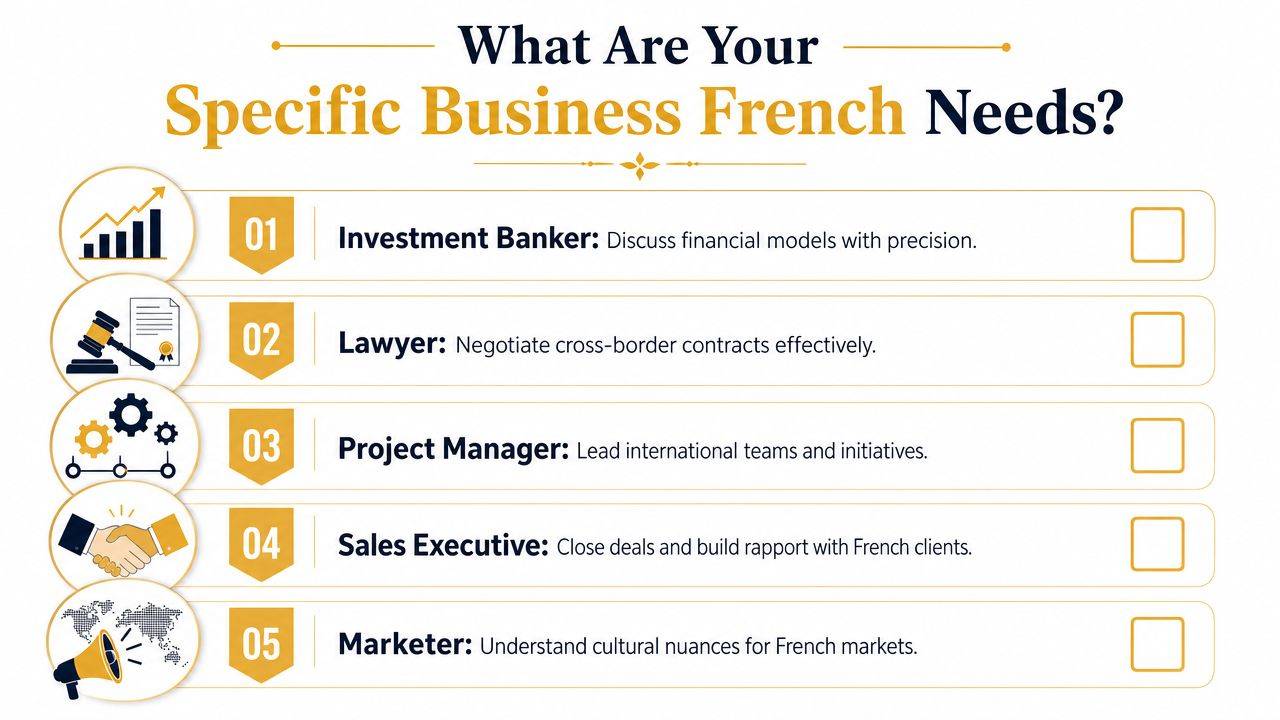
A sales executive, an investment banker, a lawyer, and a project manager may all say they need French for business. In practice, they need different vocabulary, different levels of formality, and different speaking habits. The work starts with diagnosis, not materials.
The stakes are often higher than learners expect. Statista reports that in 2022 the French economy included more than 4.7 million companies, while the same topic summary notes that less than 0.2% of companies generated nearly two-thirds of turnover and related output. For professionals, that usually means important interactions happen inside large, formal organizations where language has to be accurate and controlled (Statista on companies in France).
Start with tasks, not textbook levels
When we build a plan, we don't begin with "upper intermediate" or "advanced." We begin with recurring job tasks.
Ask yourself:
- What do I need to do in French each month?
- Which situations create the most stress or delay?
- Where would better French save time or reduce risk?
Those answers usually fall into a few categories:
- Written communication: internal emails, client follow-ups, status updates, proposals
- Live interaction: meetings, calls, interviews, networking, internal collaboration
- High-stakes speaking: presentations, pitches, investor discussions, negotiations
- Document handling: contracts, briefs, reports, compliance-related language
A simple needs audit
I like using a short audit before any program begins.
- Map your role: Write down your title, team, and the francophone contacts you deal with most.
- List your moments that matter: Identify the conversations or documents where mistakes would be costly or visible.
- Mark your weak points: Maybe you understand meetings but can't jump in quickly. Maybe you speak well but write too casually.
- Prioritize by business impact: Start with the skill that affects client trust, internal visibility, or revenue-related work.
Most professionals don't need all-purpose fluency first. They need reliable performance in a small number of repeated situations.
Role examples that change the curriculum
A lawyer may need careful language for contracts, hedging, and formal correspondence. A project manager usually needs meeting control, action items, and diplomatic follow-up. A marketer may need persuasive language, brand nuance, and cultural sensitivity in messaging. A finance professional often needs precise explanation, structured presentation, and confident Q&A.
That's why one-size-fits-all business French courses often disappoint. They cover broad business vocabulary but skip the actual language of your calendar.
If you're unsure which tasks should drive your plan, a brief diagnostic conversation with a specialist can clarify the order of attack before you spend money on the wrong format.
Build Your Core Business French Skillset
Strong business French is built around performance categories, not random vocabulary lists. The most reliable training follows a competency-driven model. The World Bank's B-READY methodology is useful here because it evaluates both framework and practical delivery through structured specialist input, and that same logic applies well to language training: diagnose the target use case, train the task, then judge results by completion and consistency rather than attendance alone (World Bank B-READY methodology).
In practice, four skill domains matter most for professionals: emails, meetings, negotiations, and presentations.
Email writing that sounds credible
Many learners write French emails by translating English line by line. That's usually where tone slips.
Business French email writing depends on register. You need to know when to sound formal, when to be neutral, and how to soften requests without sounding weak. Good email training includes subject lines, openings, transitions, action requests, and closings that match the relationship.
Useful patterns include:
- Opening formally: Je vous remercie pour votre retour.
- Requesting action politely: Pourriez-vous nous confirmer ce point d'ici demain ?
- Clarifying a misunderstanding: Sauf erreur de notre part, il semble que…
- Closing professionally: Je reste à votre disposition pour toute précision complémentaire.
Email model:
Bonjour Madame Dupont,
Je vous remercie pour votre message concernant le calendrier du projet.
Après examen des éléments transmis, nous proposons de valider la version finale lors de notre réunion de jeudi.
Pourriez-vous également nous confirmer les points en suspens avant demain soir ?
Bien cordialement,
[Nom]
Meeting language you can actually use live
Meetings expose weak French quickly because they require speed, listening control, and polite interruption. Many professionals understand more than they can say in real time.
I train meeting language in small, repeatable chunks:
- To enter the discussion: Si je peux me permettre…
- To agree carefully: Je suis d'accord sur le principe.
- To disagree without friction: Je comprends votre point de vue, mais j'aimerais nuancer ce point.
- To refocus: Si l'on revient à l'objectif principal…
- To summarize: Si je résume, nous avons trois prochaines étapes.
This is where targeted support matters. A generic conversation course won't usually rehearse your actual meeting flow. A more role-specific option such as business-focused French language training can be useful if your goal is workplace performance rather than broad classroom progression.
Negotiations and presentations require structure
Negotiation French isn't only vocabulary. It's control of tone. English-speaking professionals often sound too direct when they translate positions verbatim. In French, nuance, sequencing, and phrasing carry real weight.
For negotiations, train phrases for concession, reservation, and reframing. For presentations, train structure first. Open the point, support it clearly, then close with an action or implication. The language needs to be stable enough that you can think about the business issue, not every verb ending.
A practical curriculum usually works best in this order:
- High-frequency phrases first
- Role-specific vocabulary second
- Scenario practice third
- Correction based on recurring error patterns
That sequence produces usable French faster than trying to "cover the language."
How to Choose the Right Business French Program
Most professionals don't have a motivation problem. They have a format problem.
The wrong program can make a capable learner feel stuck for months. I've seen busy executives spend money on broad group classes that were pleasant but irrelevant, and I've seen motivated self-study learners plateau because nobody corrected their register, speaking habits, or written output.
Current guidance increasingly points toward customized digital delivery for professionals, especially when the learner is balancing travel, remote work, or dispersed teams. The strongest formats usually combine live instruction, self-study, and task-based practice instead of relying on a generic course sequence (CCFS Sorbonne on learning business French).
Business French training options compared
| Feature | Self-Study (Apps/Books) | Group Classes | Private Tutoring (like EFT) |
|---|---|---|---|
| Customization | Low. Content is broad. | Moderate at best. Set syllabus usually drives the class. | High. Lessons can match your role, sector, and task list. |
| Speed to workplace use | Uneven. Good for vocabulary exposure, weaker for live performance. | Moderate. Progress depends on class pace. | Faster when sessions focus on immediate job scenarios. |
| Scheduling flexibility | High | Fixed schedule | Usually flexible, especially online |
| Feedback quality | Limited or automated | Shared across the group | Direct and specific |
| Speaking time | Low unless you self-record | Often limited by group size | High |
| Best use case | Supplement and maintenance | Learners who want structure and peer interaction | Professionals with defined business goals |
What works and what doesn't
Self-study tools work well for repetition, listening exposure, and vocabulary review. They don't reliably prepare you for a tense client call or a formal presentation because they can't adapt to your role in real time.
Group classes can help if your goal is steady general improvement and you enjoy accountability. They work less well when one learner needs legal drafting, another needs travel French, and a third needs boardroom presentation skills. That's a common mismatch.
Private tutoring is usually the most efficient option when the goal is specific: one investor presentation, one relocation timeline, one client-facing role, one exam benchmark, one internal promotion. That's one reason many professionals compare customized providers such as corporate French class options for teams and professionals alongside broader schools and self-paced platforms.
Buy for the task, not for the label. "Business French course" can mean anything from vocabulary worksheets to live negotiation drills.
The decision criteria I use with clients
If you're choosing a program, ask these questions before paying:
- Will the instructor adapt lessons to my role?
- Will I practice my real documents and speaking scenarios?
- How will progress be measured beyond attendance?
- Is there correction on tone, register, and professional phrasing?
- Can the format fit a demanding work schedule?
If the answer to most of those is no, the program may still be enjoyable. It probably won't be efficient.
Practice and Measuring Your Progress
This is where business French becomes real. You don't know whether a learner is ready because they've finished lessons. You know because they can perform a task with less hesitation, fewer corrections, and stronger outcomes at work.
That sounds obvious, but many programs still measure progress by hours studied, chapters completed, or vague confidence gains. The better approach is to track task-specific fluency, vocabulary retention tied to the job, and time-to-productivity, which is the practical measurement gap many business learners care about most (Babbel for Business on measuring language-learning value).
What to measure instead of study time
I encourage professionals to track outcomes they can feel in their workweek.
- Meeting participation: Can you contribute a clear point without scripting it first?
- Email independence: Do your French emails need fewer revisions before sending?
- Vocabulary transfer: Are you using role-specific terms accurately in live conversation?
- Composure under pressure: Can you handle follow-up questions without reverting to English immediately?
These indicators are imperfect, but they're far more useful than counting hours.
A client example from finance
One client came to us from the finance sector with a narrow but demanding goal. She needed to present in French to francophone investors and manage the Q&A without sounding memorized. Her conversational French was decent. Her business French was not yet reliable enough for that room.
We didn't put her through a broad curriculum. We built the training around her actual deck, likely investor questions, and the transitions she needed between data points. We rehearsed short answers first, then longer responses, then interruption handling. We corrected pronunciation only where it affected clarity. We spent more time on structure and delivery than on abstract grammar review.
Her progress became visible in concrete ways:
- First, she stopped reading from notes and started signaling key points clearly.
- Then, she handled predictable questions with stable phrasing.
- Finally, she managed follow-up questions with less drift into English and more control over tone.
The clearest sign of progress is transfer. If a learner can do the job better in French this month than last month, the training is working.
Practice formats that produce transfer
The best exercises usually look boring from the outside because they're so specific.
Try rotating these:
- Role-played calls based on your actual client or internal meeting scenarios
- Timed email drafting with correction on formality and precision
- Presentation rehearsal with interruption and follow-up questions
- Vocabulary recycling drawn from your documents, not generic business lists
If you need a benchmark before starting, a formal French placement test for adults and professionals can help identify whether your real gap is comprehension, output, register, or speed.
Your Action Plan for Business French Success
If you're serious about French for business, the plan should feel narrower than you expect.
Don't start by trying to become fluent in everything. Start by identifying the handful of tasks that matter most in your role. That's where the return shows up first. For one professional, that's client emails. For another, it's leading a project update. For someone else, it's a relocation interview, a presentation, or contract discussion.
A practical roadmap
Use this sequence:
- Define the business moment: Pick the meetings, calls, emails, or presentations where French would create the most value.
- Choose the language functions: Decide whether you need to explain, persuade, summarize, negotiate, or write formally.
- Build around real materials: Use your own agenda, documents, slide deck, or email threads whenever possible.
- Practice under realistic pressure: Rehearse with interruptions, time limits, and follow-up questions.
- Review outcomes, not effort alone: Judge progress by whether work gets easier, smoother, and more independent in French.
This approach is less glamorous than broad fluency goals. It works better.
The trade-off most learners need to accept
A customized plan can feel repetitive because it returns to the same scenarios until they become automatic. That's a strength, not a weakness. Repeating your meeting phrases, your investor answers, or your negotiation language is what creates professional reliability.
What doesn't work is bouncing between apps, random videos, and generic business word lists while hoping confidence will eventually appear. Confidence usually follows competence. Competence follows focused repetition.
If your French has to perform at work, your training has to look like work.
You don't need a perfect long-term plan before starting. You need a correct first step, a clear target, and a learning format that respects how you use language on the job.
If you'd like a low-pressure next step, book a free 20-minute consultation to compare lesson options, clarify your target use cases, and decide whether a customized business French plan fits your schedule and goals.