Skip to content

You've got the offer letter, the start date is getting closer, and now the hard part is making sure the French visa path doesn't become the thing that delays your move. That's where most professionals lose time, not on the job search, but on choosing the wrong route, missing the employer authorization step, or treating arrival in France as the finish line instead of the beginning.
France is not a small, quiet visa market. The Interior Ministry recorded 3,486,275 visa applications in 2024, with 578,441 refusals and 2,857,776 visas issued, up 16.8% year over year, and it also issued 51,335 economic visas for employees, scientists, and entrepreneurs Interior Ministry visa statistics. For job seekers and employers, that tells you something practical, the system is active, crowded, and unforgiving if the file is sloppy.
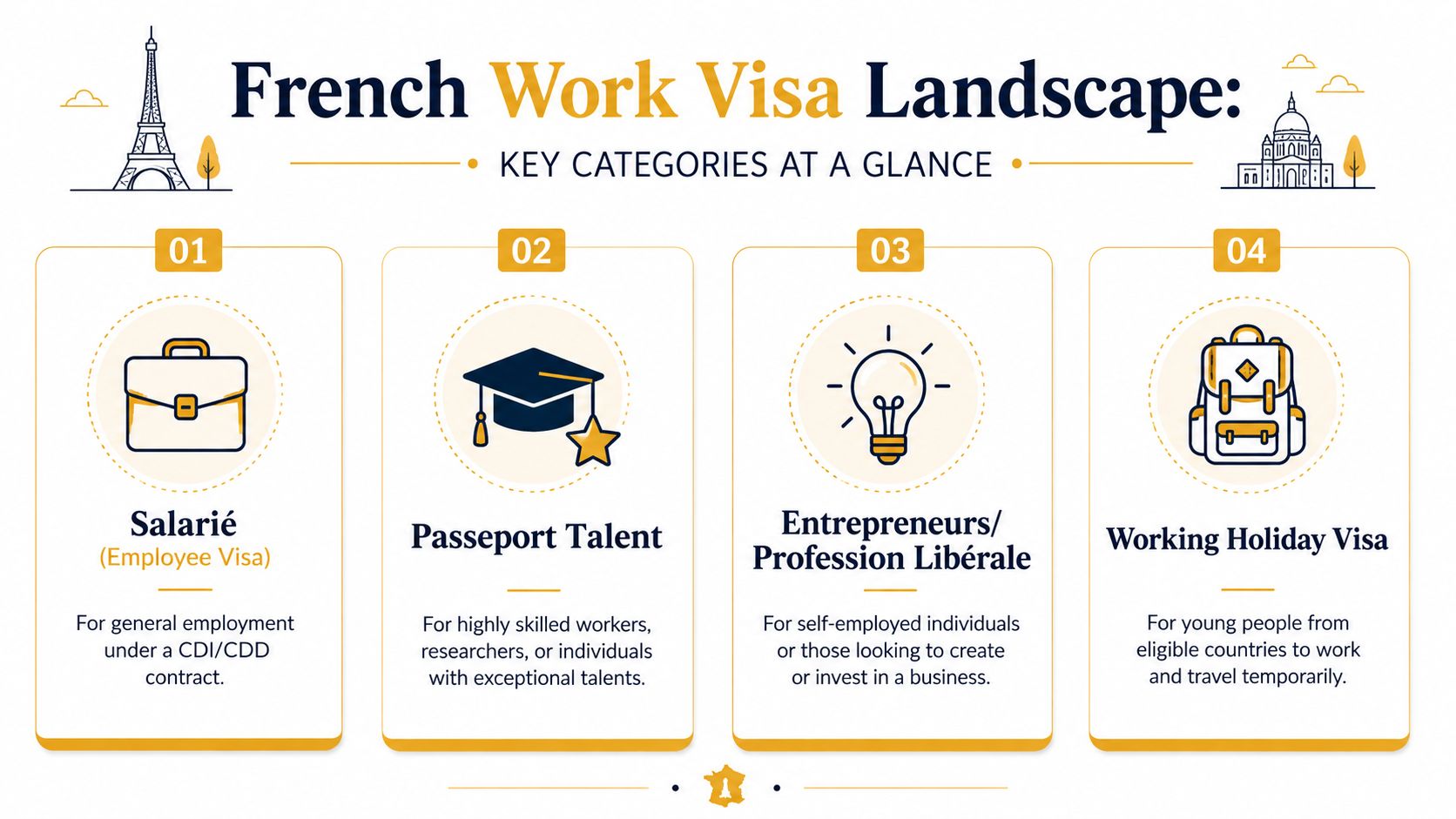
For one client I advised, the first mistake was simple, they assumed “French work visa” was one category. It wasn't. Once we matched the role to the right channel, the process became much clearer, and the move stopped feeling like a maze and started feeling like a sequence.
The most useful commercial decision you can make early is choosing between a talent-track route and a standard salaried route. That distinction shapes your paperwork, your employer's workload, and your timing. If you're comparing relocation options, the difference matters as much as salary or title.
A good starting point is to understand the broader academic and relocation context too, especially if you're moving with family or considering study-first pathways before employment. I often point clients to French relocation and study options when they're still deciding whether work, study, or a blended route makes the most sense.
Table of Contents
- Understanding French Work Visa Options
- Comparing the Main Work Visa Categories
- The Application Sequence and Employer Authorization
- Document Requirements and Common Rejection Reasons
- Post-Arrival Compliance and Renewal Deadlines
- Language Preparation as a Career Investment
- Your Next Steps and Practical Resources
Understanding French Work Visa Options
A lot of people start by searching for “work visas in France” and end up buried in government pages that use different labels for closely related routes. That confusion is normal. The system is organized around the job, the employer, and whether your profile fits a standard employment route or a talent-based route.
Start With the Key Decision
If you're a non-EU, non-EEA, or non-Swiss national, you are usually looking at one of two structures. One is a standard salaried employment path, where the employer authorizes the hire before the visa filing. The other is a talent-track route, used when the role and the employer meet a higher threshold and the file can move with less labor-market style scrutiny.
That distinction changes the order of operations. In the standard route, the job contract has to be approved before the visa stage can really begin EU Immigration Portal, employed worker in France. In talent cases, the company profile and role fit are part of the filter from the start, which is why growing startups and specialized employers often prefer it when the candidate qualifies.
Practical rule: if the employer says “we'll figure out the visa later,” pause. In France, timing and sequence are part of the eligibility itself.
France also processes a large volume of visas, and employment remains a meaningful part of that system Interior Ministry visa statistics. That matters for planning. The process is established, but it is still bureaucratic enough that shortcuts rarely hold up well.
What this means in practice
The post-pandemic rebound in labor-linked mobility is real. Government-linked reporting noted that France issued more than 320,000 first residence permits in 2022, a historic record, and over 52,000 were for economic reasons Le Monde summary of government-linked reporting. A separate summary said 2023 brought 2.4 million visas, compared with 1.7 million in 2022, and economic long-stay visas rose 66.6% year over year.
Those figures do not make approval easy. They show that French employers are actively recruiting across borders and that the administration is handling a lot of labor-related movement. The practical takeaway is straightforward. Choose the category before you collect documents, because reworking a file after submission usually costs more time than getting the classification right at the start.
A second point gets missed often. Work visas are not only about entry. They also set up the first months after arrival, when address registration, contract continuity, and any follow-up residence steps become the true test of whether the move is on track.
If you are still deciding whether work, study, or a blended route makes the most sense, use a practical comparison point such as French relocation and study options. That is often where candidates clarify whether they need an employment route immediately or a longer-term plan that starts elsewhere.
Comparing the Main Work Visa Categories
Choosing the wrong French visa category is one of the fastest ways to create a needless delay. I see this most often when a candidate could fit a talent route, but the employer starts by preparing a standard salaried file, or when a startup hire is treated like a generic work permit case even though the role fits a more targeted channel.
| French Work Visa Categories Comparison | Eligibility | Salary Threshold | Processing Speed | Best For |
|---|---|---|---|---|
| French Tech Visa | Non-EU, non-EEA, or non-Swiss employee hired by a French company recognized for innovation that meets an innovation criterion, with a contract of at least three months | At least 2× the French SMIC, stated as €43,243.20 gross annually from November 1, 2024 Jobbatical French Tech Visa guide | Often faster than a standard labor-authorization path because the employer and role already sit in an innovation framework | Product, engineering, R&D, scaling roles in startups and high-growth firms |
| Standard salaried employment | A job offer from a French employer, plus employer-side authorization before the visa step | No single salary threshold in the verified data, eligibility turns on the employer authorization and permit class | Usually slower, because the employer authorization is the bottleneck France-Visas salaried employment | General employment, CDI or CDD roles that don't meet talent thresholds |
| Talent passport categories | High-skill, research, or specialty profiles that fit a defined talent track | Thresholds vary by subcategory, including salary-linked routes and specialist profiles Jobbatical French visa options | Typically more efficient than a standard route when the profile clearly qualifies | Researchers, highly skilled workers, entrepreneurs, and other specialized hires |
The French Tech Visa is not just a branding exercise. It is an employer-and-role test. The company has to satisfy at least one criterion related to advancement, such as public funding for advancement in the last five years, backing from investors focused on firms pushing boundaries, or support from an incubator-like structure over the last five years Jobbatical French Tech Visa guide. The employee also needs a contract of at least three months and a salary at or above the stated threshold.
The standard salaried route works differently. The employer authorization gates the visa, not the visa form alone. That means HR, not just the applicant, owns part of the risk. If the position does not clearly fit a talent category, expect more compliance work and more time France-Visas salaried employment.
Some hires are faster on paper but slower in reality because the company picked the wrong lane. The best files are the ones that match the role, the company, and the employee profile from the beginning.
For candidates comparing routes, the short version is this. If the employer is growing quickly and the role is technical or scaling-related, the French Tech Visa often makes sense. If the employer is hiring for a mainstream role, the standard employment route is usually the proper channel. If you fall into a high-skill, research, or specialty class, the talent passport family can be the cleanest fit.
The Application Sequence and Employer Authorization
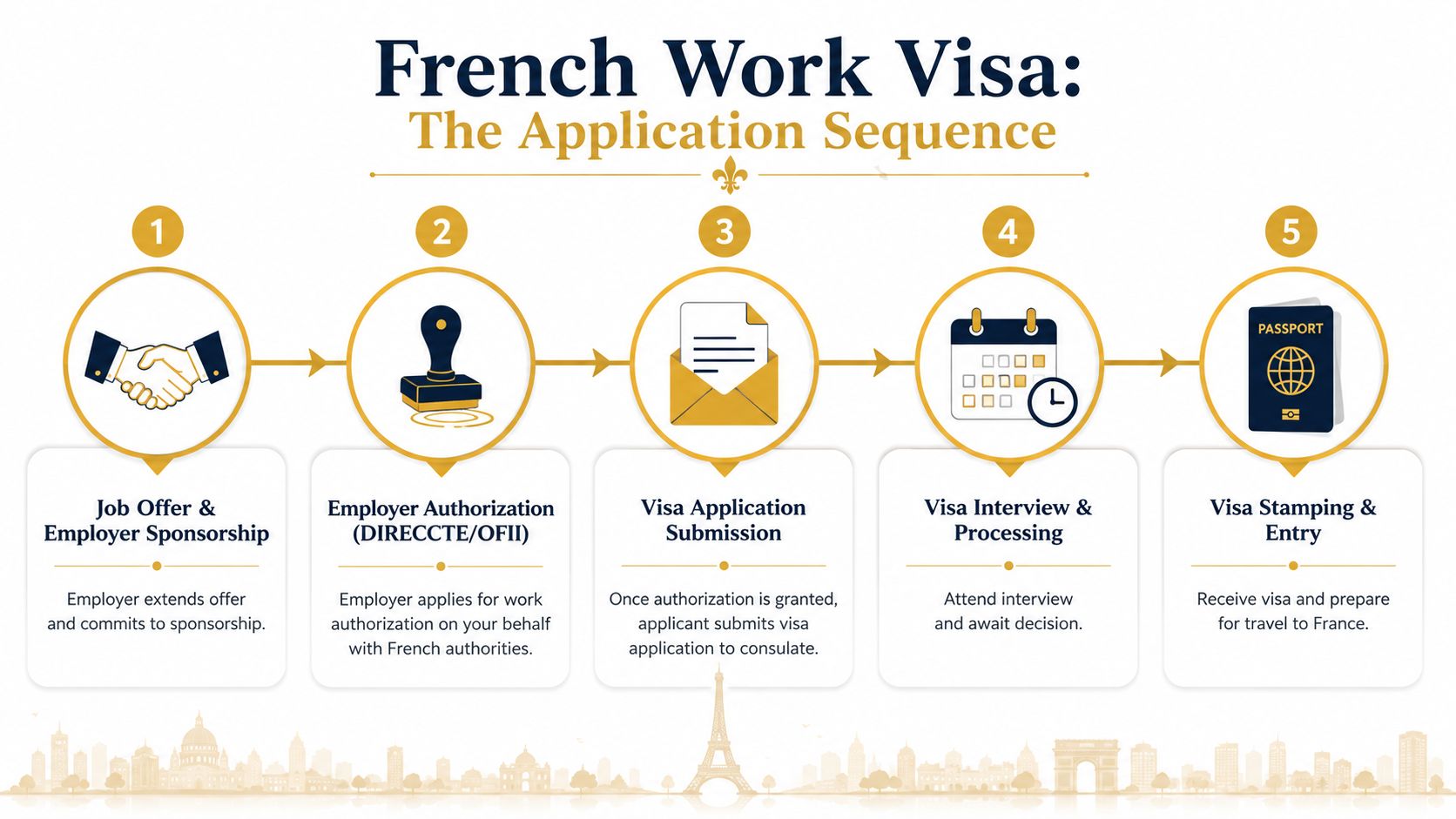
A French work visa file starts before the visa form ever reaches the consulate. For standard employment, the employer secures work authorization first, then the employee files the visa application. If the order is wrong, the case slows down fast, and in some files it fails before the applicant even gets to the interview stage.
The employer is the first gate
Under the standard salaried route, the work contract has to be approved by the competent labor authority before the visa application can move forward. In practice, that means HR, the hiring manager, or an external mobility adviser should be involved from the start, not after the employee has already booked travel or signed a lease. If the company waits too long, the timeline gets squeezed and every later step becomes harder to coordinate.
A separate process summary says employers may need to advertise the job for three weeks first, then the authority has up to two months to decide the permit request, and silence after that period is treated as rejection Admissions.fr work visa guide. That is the part many teams underestimate. The visa clock is often controlled by the employer's internal pace, not by the applicant's readiness.
The Correct Application Sequence
- Job offer and sponsorship commitment. The employer confirms that it will support the hire and, if needed, manage the authorization filing.
- Work authorization filing. For standard routes, the employer submits the labor-authority request.
- Visa application submission. The employee files only after the authorization is in place.
- Consular review and interview. The documents and dates need to match the approved contract.
- Visa issuance and travel. Entry to France happens after the visa is properly issued.
That sequence matters because the paperwork is cumulative. A contract signed too early, a passport that is close to expiry, or a visa file submitted before the employer authorization is ready can slow the case even when the candidate is otherwise a strong fit.
I usually tell clients to coordinate directly with HR and, where needed, bring in a mobility lawyer or specialist for the first filing. That is especially true when the employer is unfamiliar with French process discipline. A useful outside reference on how French workplace expectations shape these conversations is French business culture. It helps explain why many French HR teams prefer precise, document-heavy files and do not improvise around missing details.
If you are working with a recruiter or HR team, ask for a shared timeline in writing. The smoothest cases I have seen are the ones where everyone knows who files what, who approves it, and when each step has to be completed.
Document Requirements and Common Rejection Reasons
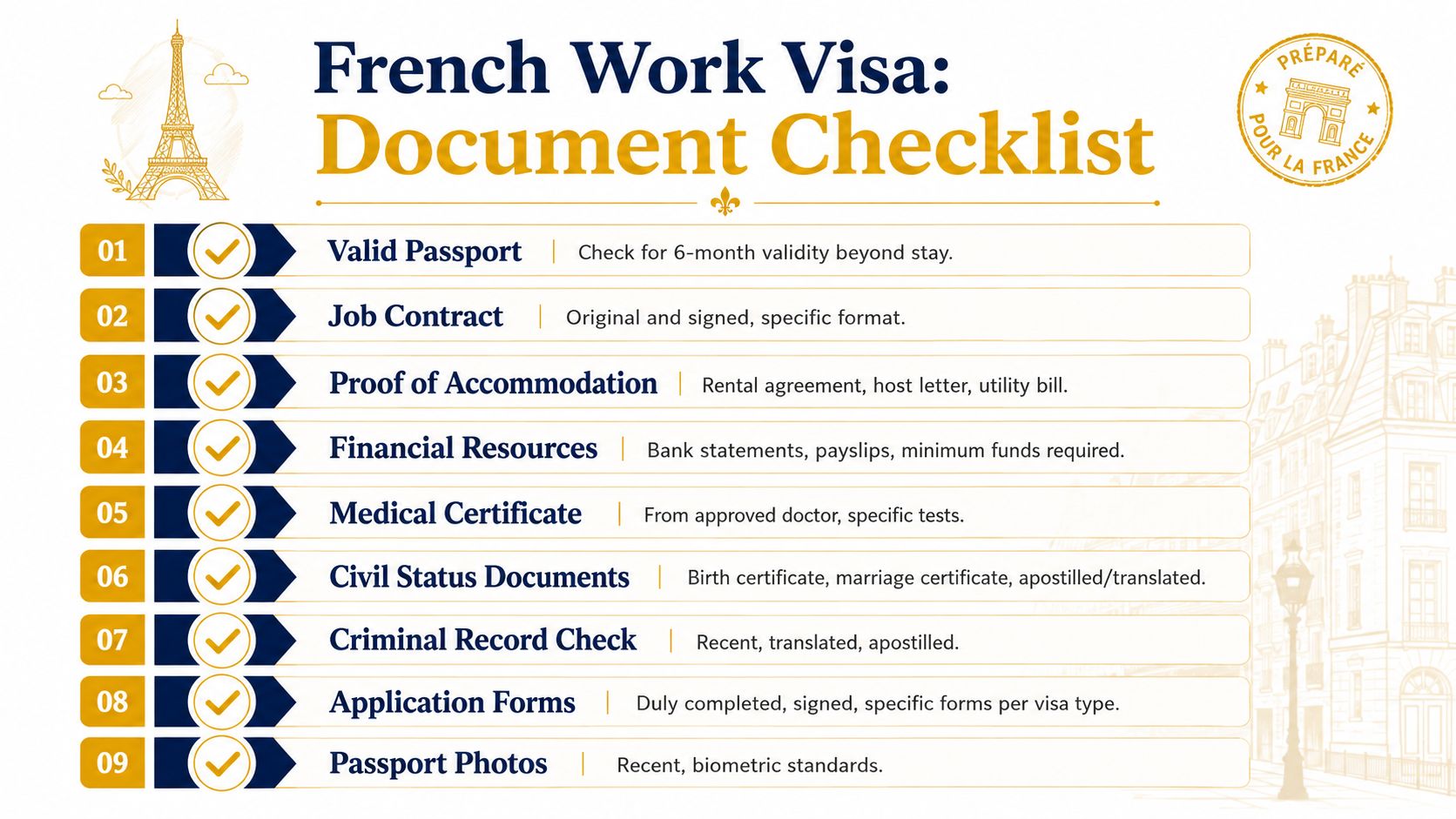
A strong case can still fail on paperwork. In French mobility files, rejection usually comes from a missing document, the wrong format, or a passport that does not meet the technical rules. The standards are strict enough that a good candidate can still lose time because one part of the packet was prepared badly.
The passport and contract do more damage than people expect
The passport check is usually where applicants get caught. AXA Schengen notes that a work-related long-stay visa covers stays of more than three months and up to one year, and the passport must be less than 10 years old and valid for at least three months after leaving the Schengen Area AXA Schengen work visa guide. A passport that looks fine at a glance can still fail this rule, especially if it was renewed late or is close to expiry.
The contract has to fit the visa route. For salaried work, the employer authorization and employment contract need to line up with the visa channel. For talent-track cases, the salary, contract length, and employer category still have to fit the relevant threshold. If those details drift, the file starts to look inconsistent before the consulate even reaches the employment substance.
What usually gets applicants sent back
- Invalid passport timing. Old passports or passports too close to expiry can stop the file before it starts.
- Mismatched contract details. A title, duration, or employer name that does not match the authorization creates avoidable friction.
- Untranslated civil documents. Birth, marriage, and police documents often need proper translation and, in some cases, apostille treatment depending on the file.
- Incomplete forms. French consulates do not reward near-complete submissions.
- Wrong visa category. This is the most expensive mistake because it often means starting over.
Practical rule: if a document feels “probably fine,” assume it needs a second review.
Paperwork errors are rarely about the number of documents. They are about consistency. A visa officer should see the same name, same dates, same employer, and same job description across the entire packet. If one page says one thing and another page says something slightly different, the file looks unreliable.
Applicants who have already studied or worked in France still need the same discipline. A previous status can make the file easier to frame, but it does not reduce the document standard. The packet still needs to be technically clean, and it helps to prepare it as if each page will be checked against the contract and authorization letter line by line.
Post-Arrival Compliance and Renewal Deadlines
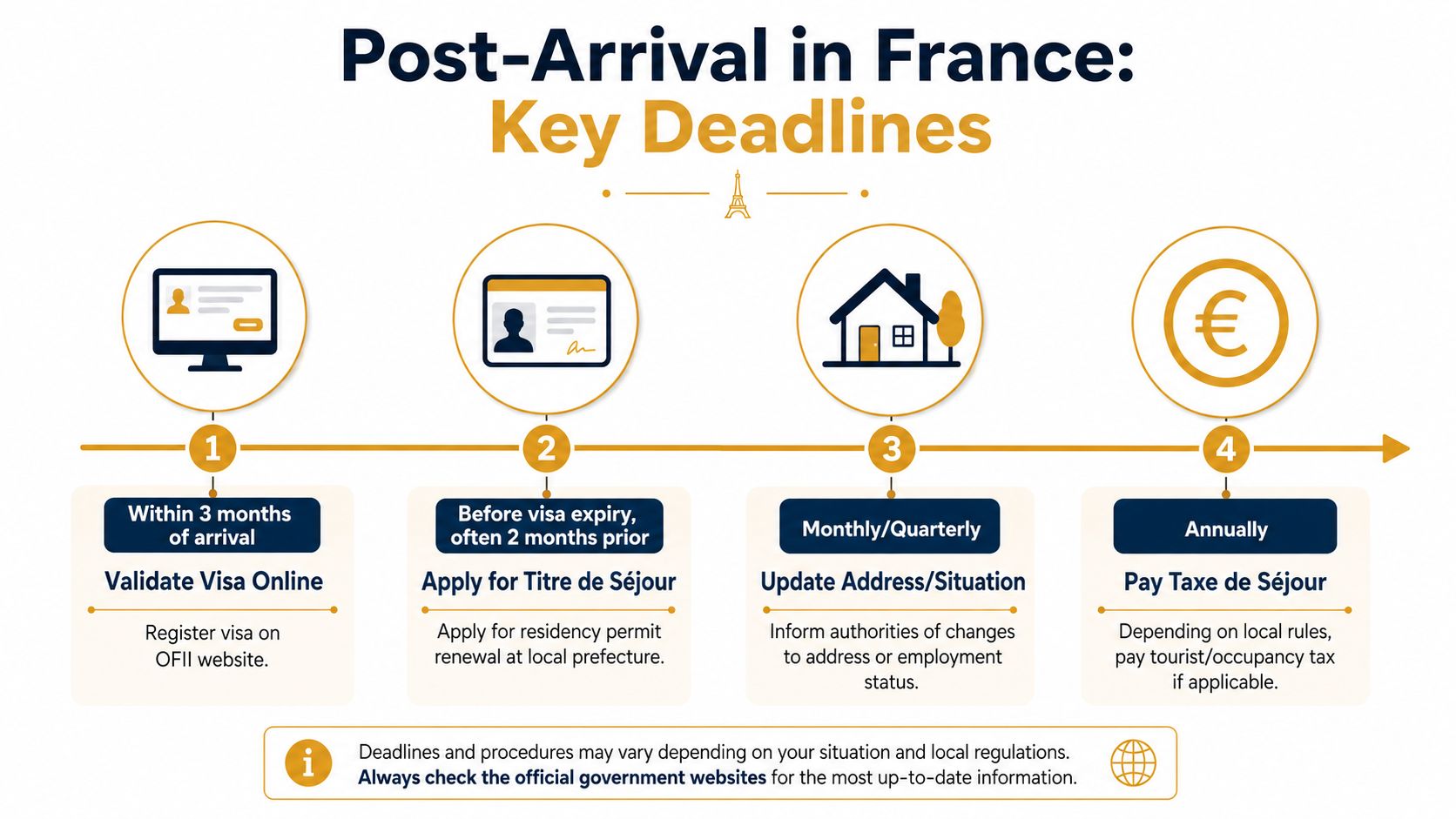
The visa approval is only the start. Once you arrive in France, the legal clock keeps running, and that is where many professionals lose time. A VLS-TS must be validated within three months of arrival, and work authorization renewal must be filed within two months of expiry, as set out in Business France work permit guidance.
The first ninety days matter more than the visa stamp
Validation is a required compliance step, not a formality. If you arrive with a VLS-TS and do not validate it, you leave a basic part of your legal stay unfinished. That can create friction later when you need proof of lawful residence, continuity for a renewal file, or evidence during a status change.
The renewal deadline deserves the same attention. Business France says the work authorization renewal must be filed within two months of expiry Business France work permit guidance. For employees, that means the calendar has to be managed actively, not left to memory. If HR assumes the worker will remember, the file often slips.
Changes after arrival aren't neutral
A change of employer, a different contract type, or a new address can affect the administrative file. The original visa does not automatically cover every later change. French migration paperwork is sensitive to both employment status and residence details, so the relocation plan should include the follow-up steps, not only the first entry package.
A useful reference point for broader residence planning is French residence planning for Americans, because it shows how arrival status and local registration shape what comes next. The pathway may be different, but the operating habit is the same, track deadlines early and record every change cleanly.
The failures are usually predictable. Someone arrives, gets settled into work, then notices the validation window is almost closed. Or a contract changes and nobody updates the paperwork. The fix is straightforward, but it has to happen on time.
If you are organizing a move, set three reminders the day the visa is issued, one for arrival validation, one for renewal, and one for any contract change.
Language Preparation as a Career Investment
You can land in France with a valid work visa and still struggle if your French is too thin for meetings, HR paperwork, or daily coordination. I've seen talented professionals get slowed down not because their role was weak, but because they couldn't handle the operational layer around the role. That's why I treat language preparation as a career investment, not a cultural extra.
Functional French changes the quality of the move
You do not need perfect fluency to start, but you do need enough French to manage everyday situations. That includes onboarding calls, local admin, calendar changes, housing conversations, and the awkward moments that happen when a work authorization question comes up unexpectedly. English may carry you in some multinational teams, but French often decides how fast you settle.
One consultant I worked with, a product manager moving into a Paris startup, started structured French prep before departure. He didn't become fluent overnight, but he could handle introductions, basic office small talk, and key administrative conversations by the time he landed. That confidence changed how quickly his team trusted him, and it made the first months less draining.
Who benefits most from starting early
- Client-facing professionals who need quick rapport with French colleagues or customers.
- Managers and team leads who have to run meetings, not just attend them.
- Parents relocating with children who need school communication and daily life French.
- Candidates pursuing long-term mobility who want more than a one-role move.
If you're comparing learning options, French language certification and preparation is the most practical place to start. It helps you think in terms of workplace usefulness, not textbook completion.
The advantage lies in momentum. When you arrive already equipped to ask direct questions, confirm documents, and understand replies, you stop relying on guesswork. That makes the visa transition smoother; what's more, it makes your first job months feel like a career move instead of a survival exercise.
Your Next Steps and Practical Resources
If you are serious about moving, do not wait for the consulate to tell you what happens next. Start by matching your role to the right visa category, then work backward from your proposed start date. In practice, the employer's authorization timeline usually sets the pace for everything that follows.
A real relocation plan starts before the visa is issued. The fastest files are the ones where HR, the hiring manager, and the candidate already know who is handling each step, which documents must be ready, and when the file has to move.
What to do this week
- Confirm the visa category. Make sure the offer belongs in the standard salaried route, a talent passport class, or the French Tech Visa framework.
- Ask HR who owns the filing. If nobody owns the authorization step, the file will stall.
- Check the passport. The timing rule is technical, and it is one of the easiest things to sort out early.
What to do this month
- Collect the core documents. Contract, civil status papers, translations, and any employer evidence should be prepared together.
- Build a calendar. Track the employer authorization phase, visa appointment, arrival validation, and renewal window.
- Decide whether to use help. A straightforward hire may be manageable in house, but a talent route, an employer transfer, or a family-linked move often benefits from specialist support.
The practical value of this month-by-month approach is simple. It keeps you from treating the visa as a single filing date, when in reality it is a chain of steps that have to be sequenced correctly.
What to do three months before the start date
- Lock the sequencing. The contract, authorization, and visa filing should line up in the correct order.
- Prepare for arrival compliance. Validation and renewal reminders should already be set.
- Start practical French. Even a focused language program can change how quickly you settle into the role.
Once you land, the job is not finished. You still need to validate the visa, keep an eye on renewal timing, and handle early administrative requests without delay. That is where many professionals lose time, not because the visa category was wrong, but because the post-arrival steps were left too late.
If you want the transition to feel less like guesswork and more like a real relocation plan, book a free consultation with Elite French Tutoring and start building the French you will use at work, in HR conversations, and in your first weeks on the ground.