Skip to content


You've got a folder of past papers, a countdown on your phone, and a mock exam result that adds up to 52 out of 100. By the official arithmetic, that's a pass. By the arithmetic that decides your diploma, it isn't, because one of your four papers came in at 4 out of 25.
That single number is where most French exam practice goes wrong. Learners split their study time four ways, chase the total, and walk into the exam hall with a skill sitting close enough to the floor to sink them. I'd rather you spend the next six weeks on the one paper most likely to fail than on a tidy rotation across all four.
So this is a planning article, not a vocabulary list. You'll get the pass rule that governs every practice score you record, a diagnostic that ranks your four skills, a weekly schedule built around the weakest one, and a clear line for when more past papers stop helping and a tutor starts earning their fee.
Table of Contents
- Match Your Practice to the Right DELF or DALF Level
- Know the Pass Rule Before You Score Any Practice Test
- How to Run a Timed Diagnostic Across All Four Skills
- Build a Weekly Schedule Around Your Weakest Skill
- Practice Each Skill With Tasks That Match the Exam
- When a Weak Skill Needs a Tutor Instead of More Papers
- Book a Diagnostic Session Before Your Exam Date
Match Your Practice to the Right DELF or DALF Level
You can hold a conversation in French and still freeze when an oral exam asks you to defend an unfamiliar position. The problem may be the level of the task, not your conversational ability. Choose practice that matches the exam you plan to take.
DELF and DALF follow the six CEFR levels: A1, A2, B1, B2, C1 and C2. DELF covers A1 through B2, while DALF covers C1 and C2. Each diploma is independent, so you can sit the level that fits your proficiency and goal without taking every exam in order, as France Éducation international explains in its DALF overview. All four skills are assessed: listening, reading, writing and speaking. Being comfortable in conversation does not guarantee you can write an argument at the same level.
These diplomas are permanent credentials, valid for life. The FIAF DELF and DALF exam information describes them as six independent certificates aligned to the CEFR. That makes level choice matter: a certificate does not expire, but the exam still needs to match your current ability and purpose.
Match your timed practice to the exam's format. The Alliance Française Bruxelles exam listing gives these typical timings:
| Diploma | CEFR level | Group tests | Preparation before speaking | Speaking test |
|---|---|---|---|---|
| DELF A1 and A2 | A1, A2 | Under 1 hour 55 minutes | 10 minutes or less | Under 15 minutes |
| DELF B1 | B1 | 1 hour 55 minutes | 10 minutes | 15 minutes |
| DELF B2 | B2 | 2 hours 30 minutes | 30 minutes | 20 minutes |
| DALF C1 | C1 | 4 hours written | 1 hour | 30 minutes |
The step from B1 to B2 changes how you need to practise. The group tests take longer, speaking preparation increases from 10 to 30 minutes, and the oral task requires you to defend a position. If you are preparing for B2 with only short, rehearsed speaking answers, your practice is not matching the exam.
A1 and A2 have shorter blocks than B1. C2 follows its own format, so consult the official C2 format sheet before planning those sessions.
The planning rule: Start with the level you intend to take, then practise each skill in that level's time limits and task format. A 20-minute oral rehearsal does not match B2's 30-minute preparation period. The French language certification guide outlines the levels and the credentials they represent.
Know the Pass Rule Before You Score Any Practice Test
Eighteen, seventeen, twelve, three. The candidate adds it up in the corridor and feels fine, because 50 out of 100 is a pass. It isn't. The paper that scored 3 sits below the eliminatory floor, and the diploma doesn't happen.
That scenario is the most expensive misunderstanding in French exam practice, and it's worth fixing before you sit another mock.
Each of the four papers is marked out of 25, you need 50 out of 100 overall, and a score below 5 out of 25 in any single paper fails you regardless of the total. The Alliance Française de Vancouver DALF page states that combination plainly, and every practice result you record should be read through it.
| Skill | Max points | Eliminatory floor | Safety target | Urgent flag below |
|---|---|---|---|---|
| Listening | 25 | 5 | 10 | 8 |
| Reading | 25 | 5 | 10 | 8 |
| Writing | 25 | 5 | 10 | 8 |
| Speaking | 25 | 5 | 10 | 8 |
| Total | 100 | 50 to pass | 40 across four papers | 32 |
Two numbers in that table come from me rather than from a rulebook: the 10/25 safety target and the 8/25 urgent flag. They're working margins. A 10 leaves room for a bad morning in the exam hall. An 8 means the skill is one stumble from the floor and needs attention this week.
Treat the flag as a control chart. After every timed paper, log the four scores in one place and mark anything under 8. The lowest flagged skill becomes the first block of your next session, every time, until it clears 10 in two consecutive simulations.
A candidate with 19, 18, 14 and 4 has more French than a candidate with 13, 12, 12, 11. Only one of them passes.
Pass rates swing more than candidates expect, which is another argument for margins. One published centre comparison showed B2 pass rates ranging from 59% to 88% across two 2024 sessions, while DALF C1 moved from 73% to 63%, as recorded in this DELF exam structure breakdown. A comfortable total on a Tuesday mock isn't a guarantee for a Saturday exam.
Production papers are marked against France Éducation international rubrics by two certified examiners, as the same Alliance Française materials describe. That's reassuring rather than frightening: two trained readers following a published grid are more predictable than one examiner's mood, provided you write and speak to the grid. One technical trap in the reading paper, though. Choosing the correct true or false option without copying the sentence that justifies it can lose the item's points. An unsupported tick isn't an answer.
These thresholds are stated for DELF A1 to B2 and DALF C1, so confirm the rule for your exact level before you build a plan on it. The benchmark that matters isn't one passing total. It's several full simulations in a row with no component near the floor.
How to Run a Timed Diagnostic Across All Four Skills
Run this before you buy a book, book a lesson or download another past paper. One session, four papers, real clocks. What comes out is a ranking of your skills, and every scheduling decision after this uses that ranking.
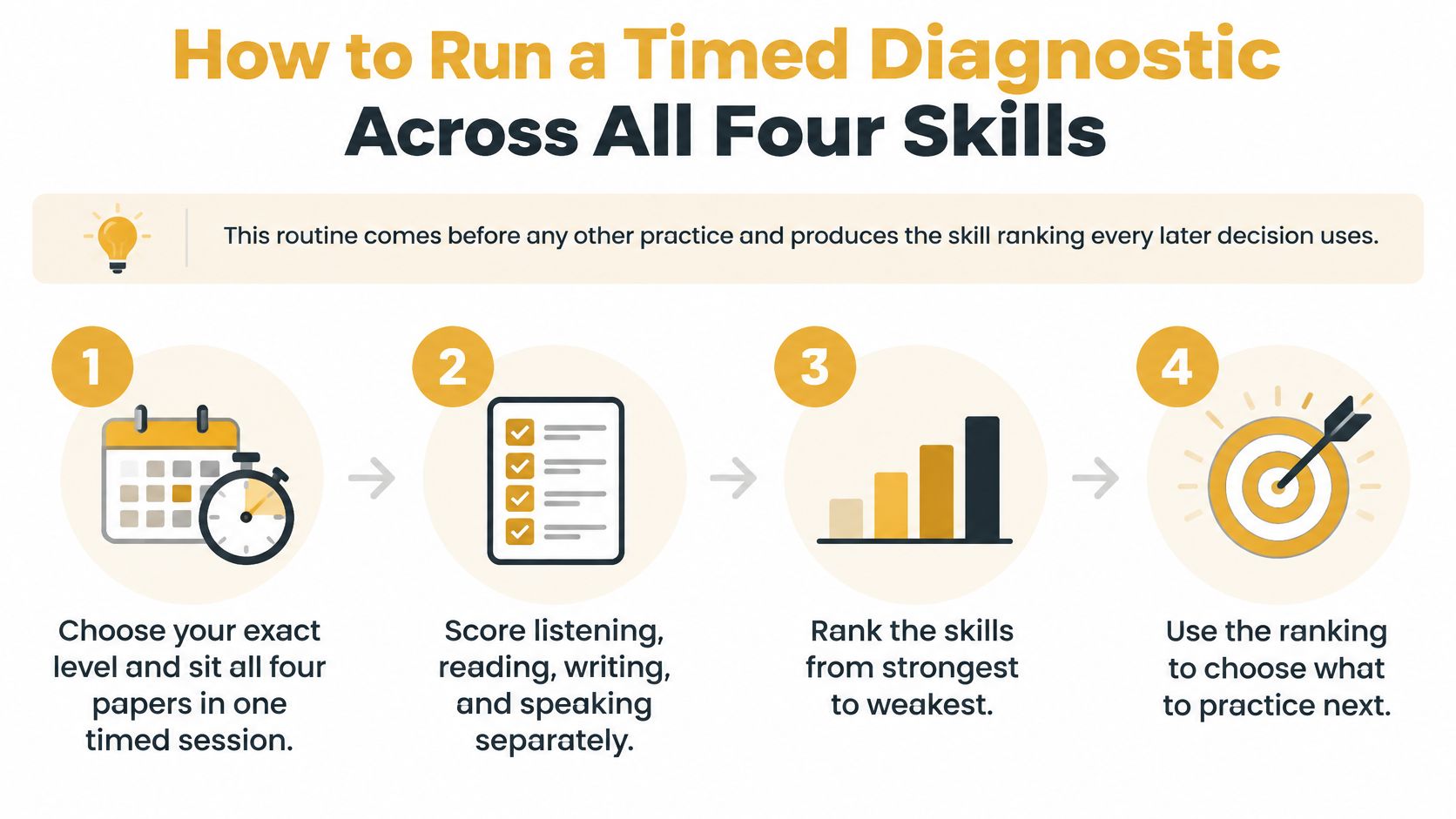
- Pick one level and sit all four papers in a single block. Use the group-test and speaking timings from the level table. Splitting the papers across a week hides the fatigue that arrives in the third hour, and fatigue is one of the things the exam measures.
- Close the dictionary, the notes and the phone. Especially for writing and speaking, because a rehearsed paragraph tells you nothing about what appears under pressure. If you can't resist checking a word mid-task, you've found a vocabulary gap worth logging.
- Score each paper out of 25 against the rubric categories. Task fulfillment, coherence, range and accuracy for the productions. Pronunciation and interaction for the oral. A general impression of "fine" isn't a score, and it won't survive contact with an examiner.
- Put the four numbers beside the 10-point target and the 8-point flag. You're looking for the lowest column, not the total. An average of 62 with a 7 in listening is a listening problem wearing a good disguise.
- Classify every error by type. Missed detail, inference, vocabulary, grammar, organization or interaction. Simon Fraser University's DELF-DALF guidance frames assessment as observable can-do performance that should guide the next round of learning, which is precisely the loop you're starting here.
- Record the speaking section on your phone and listen back. Note the minute where hesitation starts and what you were trying to say at that moment. That timestamp is worth more than a general sense of nerves.
The diagnostic also reveals which errors repeat, and repeated errors are the only ones worth building a drill around.
For a sense of the pace in a real French exam room, watch this before you start the clock.
Two adjustments make the result trustworthy. Have a second evaluator mark your writing and speaking, because self-marking inflates production scores almost every time. And repeat the whole routine after four weeks of targeted work, not after every session, or you'll spend your life diagnosing instead of practising.
By the end you should be able to name one skill as the nearest to failing. That skill gets week one.
Build a Weekly Schedule Around Your Weakest Skill
The diagnostic gives you four numbers. The schedule gives them consequences. The rule I'd start with is uncomfortable for anyone who likes a tidy rotation: the weakest skill gets roughly 60% of your practice time, and the other three get maintenance blocks only. Even practice across four papers is what produces those 18, 17, 12, 3 results in the first place.
| Diagnostic result | Daily focus | Minutes per day | Full mock frequency |
|---|---|---|---|
| Any skill under 8/25 | Weakest skill, timed drills | 60 | Every 10 days |
| Skills between 8 and 10 | Balanced split, weakest first | 45 | Every 14 days |
| All skills at 10/25 or above | Maintenance with timed tasks | 30 | Every 7 days |
| Final two weeks before exam | Full simulations and speaking rehearsal | 60 | Every 3 days |
Count backwards from your exam date rather than forwards from today. Ten weeks out, weeks one to six belong to the flagged skill, weeks seven and eight tilt toward a balanced split, and the last fortnight is simulations only. Working forwards tends to fill the early weeks with comfortable tasks, which is how six months disappear into worksheets.
Don't park listening in one long weekly block either. Twenty minutes on four days beats eighty minutes on a Sunday, because the skill that fails under time pressure is the one you've only ever met when you were fresh.
Log it in four columns: date, skill, task type, score out of 25. A spreadsheet is enough, and the chart is what stops you talking yourself into progress you can't see.
Stopping rule: move a skill to maintenance only after two consecutive full simulations keep it above 10. One good mock is noise.
If you want the daily habits that sit around this schedule, our guide to how to study for a French test covers the routine between the timed blocks.
Practice Each Skill With Tasks That Match the Exam
Memorized answers are the most popular form of French exam practice and one of the least reliable. Assessment guidance for senior French warns that scripted preparation can stop candidates from showing depth, reflection, interpretation and elaboration, which is the exact list of qualities an examiner scores at B2 and above, as set out in this French continuers assessment advice+Subject+Assessment+Advice.docx/6190943c-5f3c-457f-9ef3-e3cca0065e49?version=1.0). The same guidance notes a frequent gap between written and oral expression, with oral weaknesses clustering around limited vocabulary, inaccurate structures and answers that stop before they've developed.
That gap is what each drill should target.
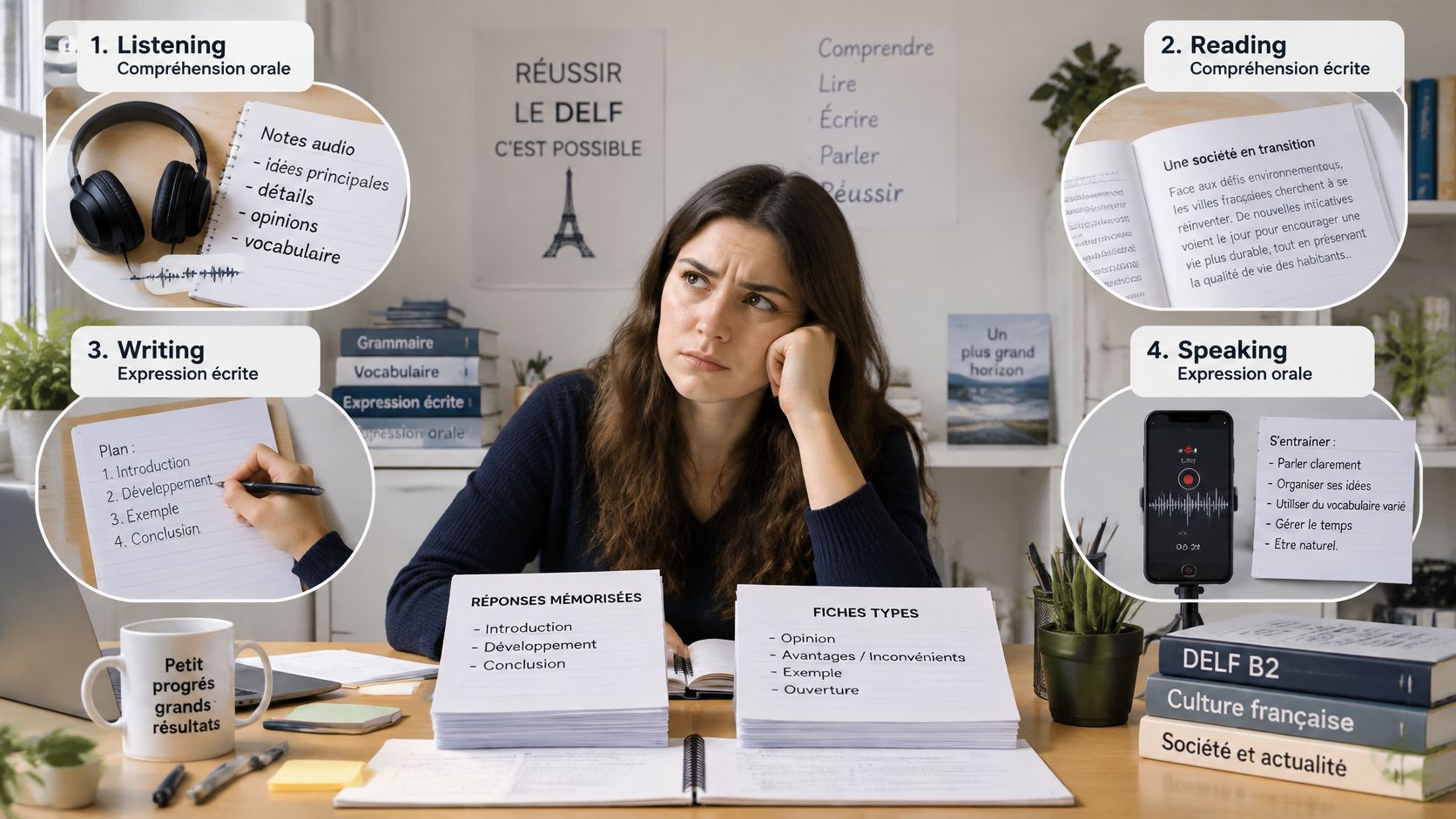
- Listening. Play a clip once for the main idea, then again for supporting detail, and write a timestamp beside every answer. You're training the second pass that finds the number you missed, not just the gist. For the mechanics, see our notes on how to prepare for a French listening exam.
- Reading. Read the question before the text, then hunt for the sentence that answers it. Mark the distractors as you eliminate them, because the wrong options in these papers are built to sound quoted.
- Writing. Time each task, draft once, then use a second read to check task fulfillment, coherence, range and accuracy in that order. Accuracy fixes are cheap at the end and expensive at the start.
- Speaking. Get unpredictable follow-up questions, let a partner cut you off mid-sentence, and rehearse repair phrases for the moment a word escapes you. Then record it and listen for where the argument loses its shape.
Preparation time shifts with level: 10 minutes at lower levels, 30 minutes at B2 and 60 minutes at DALF C1. Practise inside those limits, because an untimed monologue teaches you nothing about what you can produce in half an hour.
Ask for interruptions. A rehearsal where nothing goes wrong is a rehearsal that teaches nothing.
When a Weak Skill Needs a Tutor Instead of More Papers
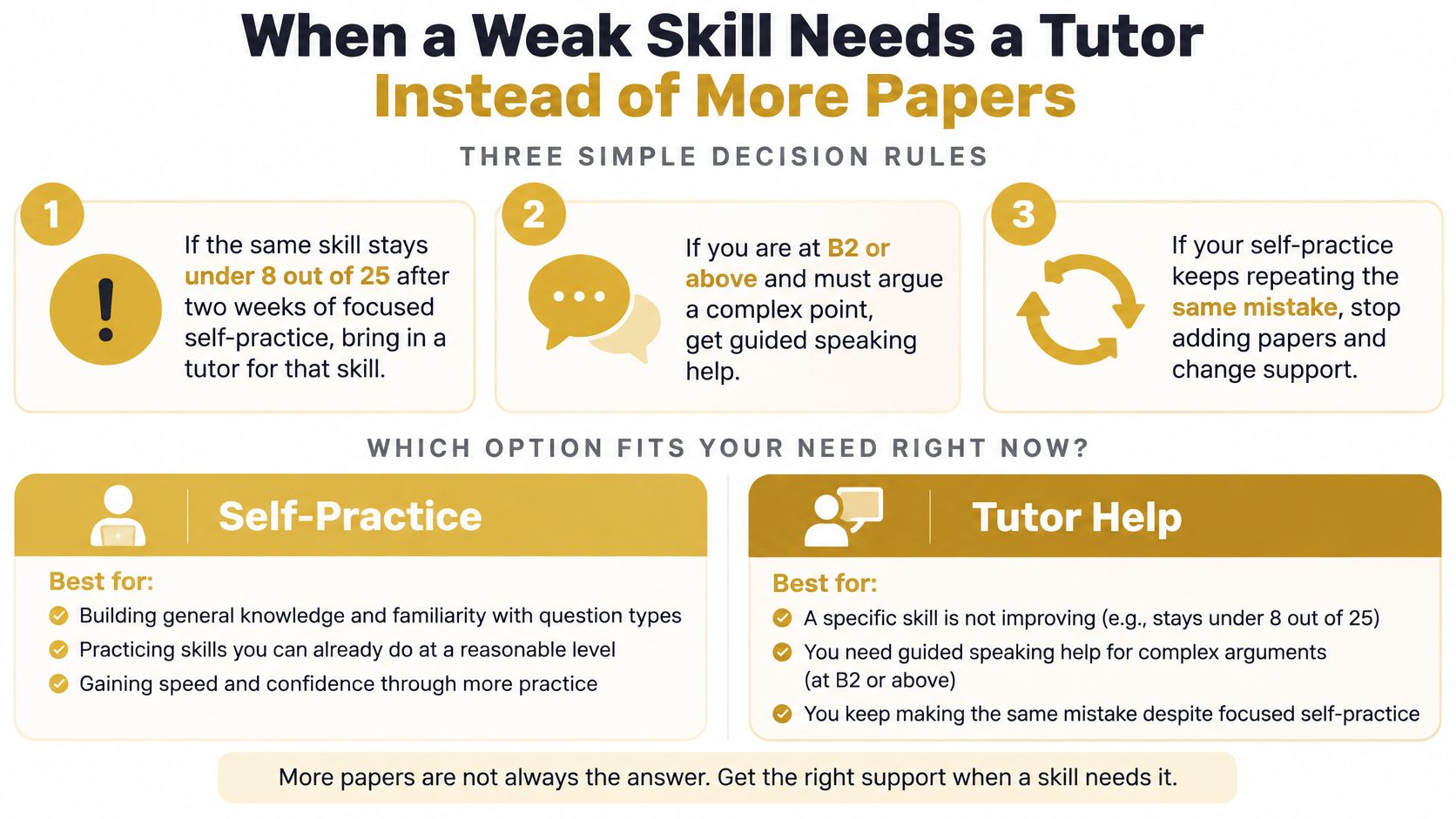
Three decision rules, and I'd apply them without sentiment. If the same skill sits under 8 out of 25 after two weeks of focused self-practice, the problem isn't volume and a tutor for that specific skill is the cheaper path. If you're at B2 or above and have to argue a position and sustain the discussion, book a mock oral with a trained examiner rather than another past paper. If your writing or speaking is scored only by you, get a second evaluator before you trust the number.
| Situation | Self-study | Tutor or mock oral |
|---|---|---|
| Skill stays under 8/25 after two weeks | Keep drilling alone | Book a tutor for that skill |
| Stable skill on a fixed schedule | Works well | Optional check |
| Writing or speaking scored only by yourself | Unverified score | Second evaluator scores it |
| B2 or above, must argue a position | Limited to rehearsed answers | Mock oral with a trained examiner |
| Speaking interaction and register | Hard to test alone | Examiner-style interruption and feedback |
Self-study earns its keep on skills already above the safety target, where timed drills and a fixed weekly slot are enough. It fails on the paper closest to the floor, because the thing you can't do is also the thing you can't hear yourself failing to do. A trained ear hears the missing subordinate clause, the flat register, the answer that ends two sentences too early.
Sarah, a Boston College sophomore, came to us struggling with the DELF exam. The change wasn't more past papers. It was targeted correction on the paper that was holding her back, scored against the same criteria an examiner uses, until the weakest score stopped being the story. She passed.
Anaïs, one of our certified DALF examiners, spends much of her time explaining how real scoring works, so students learn the criteria instead of guessing at them. That's the difference between practising and practising the right thing. If you're weighing the cost against another round of solo drilling, our piece on whether a French tutor is worth the investment runs the comparison fairly.
Book a Diagnostic Session Before Your Exam Date
One action this week: run the timed diagnostic, all four papers under the clocks, and write down the four scores and the skill nearest to failing. That single sheet is worth more than another month of unstructured practice.
Then bring it to a complimentary 10-20 minute call with our team, where we assess your level and talk through your exam date, your target DELF or DALF level and the paper you're most worried about. The program that follows is built around those results and your learning style, with DELF and DALF preparation as one option you can choose rather than a requirement. Lessons run in French, with slight exceptions made for complete beginners, so the mock oral feels authentic from the first session.
Book the consultation at elitefrenchtutoring.com and bring the diagnostic sheet. Between sessions the schedule keeps working, which is the point.